Image source: wikiart.org
Introduction
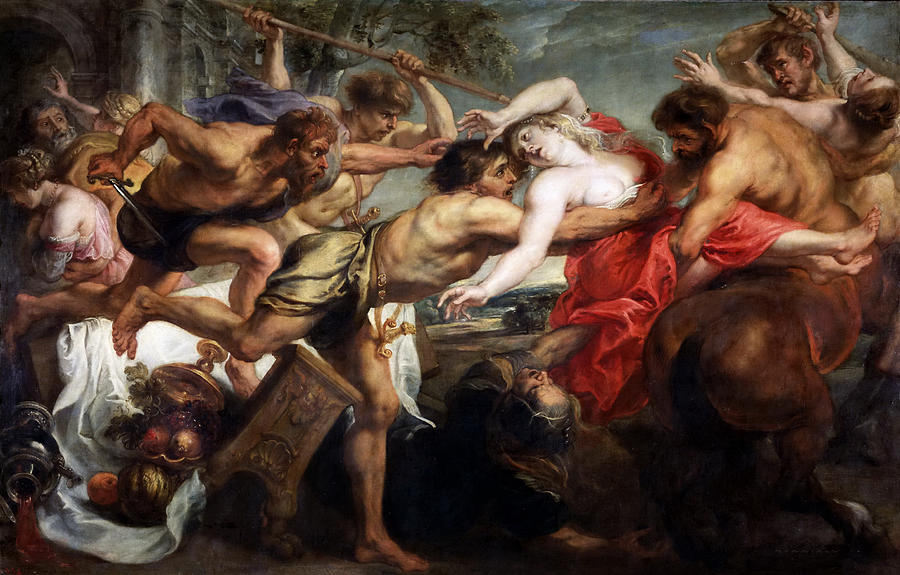
“The Rape of Hippodamia” by Peter Paul Rubens is one of the artist’s most tumultuous mythological scenes, a violent explosion of bodies, draperies, and weapons locked in struggle. Drawn from Greek legend, the painting shows the moment when the centaur Eurytion attempts to abduct Hippodamia during her wedding feast, an act that sparks a brutal battle between Lapiths and centaurs. Rubens’ interpretation plunges the viewer into the chaos of the assault. The canvas seethes with muscular limbs, twisted torsos, and charging centaur bodies, while the central figure of Hippodamia, draped in vivid red, spirals helplessly at the heart of the storm.
In this work Rubens explores not only myth but also the themes of violence, violated hospitality, and the fragility of order in the face of overwhelming passion and aggression. The painting is uncompromising in its depiction of danger and fear; it is a clear portrayal of an assault, not a celebration of it. The artist harnesses the full force of Baroque dynamism—diagonals, foreshortening, and strong contrasts of light and shadow—to evoke the terror of the moment and the desperate energy of those who try to intervene.
Mythological Background
The story behind the painting comes from Greek mythology. Hippodamia is the bride of Pirithous, king of the Lapiths. At their wedding, Pirithous invites the neighboring centaurs—half-human, half-horse beings—to the feast. Fueled by wine and desire, the centaur Eurytion attempts to seize Hippodamia, triggering a violent conflict between centaurs and Lapiths that becomes a symbol of the clash between civilized order and unruly, bestial instinct.
Rubens chooses to focus on the initial, shocking moment of abduction rather than the extended battle that follows. By doing so, he intensifies the drama of violation and response. The painting captures the instant when social celebration collapses into brutality. In emphasizing this turning point, Rubens underscores the precarious nature of harmony and the speed with which it can be shattered by uncontrolled impulses.
The Central Drama and Diagonal Composition
The composition of “The Rape of Hippodamia” is built around a powerful diagonal thrust that runs from the lower left corner to the upper right. Hippodamia, clad in a vivid red dress, is pulled across this diagonal by the centaur on the right, while a Lapith warrior lunges in from the center to drag her back. Their bodies create a tense, zigzagging line, almost like a lightning bolt tearing the painting in two.
Around this central struggle, other figures join the fray. On the left, another centaur charges forward, doubling the sense of menace. At the far right, additional Lapiths and centaurs clash, their raised arms and weapons echoing the jagged movement of the main diagonal. The entire scene feels as if it could burst beyond the frame, a whirlpool of violence and resistance.
Rubens’ mastery lies in the way he keeps this turmoil legible. Despite the overlapping figures, the viewer can clearly trace the chain of actions: the centaur trying to escape with Hippodamia, the human hero club in hand, and the surrounding combatants rushing to join the fight. The diagonal composition becomes a visual metaphor for moral and physical struggle, a clash that slices through the festive setting.
Hippodamia as the Vulnerable Focal Point
At the heart of the painting is Hippodamia herself. Rubens bathes her pale skin in a bright, almost cold light, contrasting sharply with the darker, earthier tones of the surrounding male bodies. Her red dress, slipping off one shoulder, winds around her figure in a swirl that emphasizes her helpless movement. Her head tilts backward, mouth slightly open, eyes closed or averted, conveying shock and terror rather than any hint of consent.
Her position is precarious. One arm flails outward, another is trapped by grasping hands. She does not control the motion; she is being pulled, dragged, and pushed between opposing forces. Rubens’ portrayal recognizes the brutality of what is happening. Hippodamia’s vulnerability, as rendered through soft modeling and exposed posture, invites empathy from the viewer and makes the violence of the centaur’s act all the more disturbing.
Through this central figure, the painting confronts the viewer with the reality of sexual violence in myth. It does not present the scene as a romantic abduction but as a traumatic rupture of safety and dignity.
Centaurs and the Embodiment of Unrestrained Violence
The centaurs in Rubens’ painting represent unleashed aggression and loss of control. Their hybrid forms—human torsos grafted onto powerful horse bodies—embody the fusion of reason and instinct, with the animal side clearly dominating. Muscles bulge under tanned skin; veins stand out on straining necks and arms. Faces contort into snarls and grimaces, eyes fixed on their targets with feral intensity.
The centaur dragging Hippodamia twists his upper body backward, deploying all his strength to wrench her away from her rescuers. Another charges forward from the left, his human torso leaning aggressively over equine flanks. These figures are not noble, idealized creatures; they are embodiments of disruptive desire and physical force.
By filling the canvas with such figures, Rubens visualizes the myth’s central theme: what happens when base instincts overwhelm the restraints of social order and hospitality. The centaurs’ very bodies become symbols of imbalance, of the human self overtaken by the animal within.
Human Defenders and the Struggle for Order
Opposing the centaurs are the Lapith warriors, muscular but more upright and controlled. The central rescuer, with his back to the viewer, is a key figure. His body is tensed in a powerful lunge, one leg braced, torso twisting as he grabs Hippodamia and tries to pull her from the centaur’s grasp. The strain in his shoulders and the taut line of his calf communicate the effort required to counteract the centaur’s strength.
Behind him, another man raises a club or staff high above his head, ready to strike. To the right, more human figures engage other centaurs in combat. Their gestures are sharp and decisive, representing the determination to restore order and protect the victim.
Rubens carefully differentiates these defenders from their adversaries. Their expressions, though fierce, retain a degree of rational focus. Their musculature, while powerful, is less exaggerated than that of the centaurs. In this visual language, humanity is associated with controlled strength, courage, and responsibility, while the centaurs embody reckless violence.
The Overturned Banquet and Symbolic Disorder
In the lower left corner lies a tangle of luxurious objects: spilled fruit, overturned vessels, drapery, and a fallen chair or piece of furniture. This still-life detail is more than decorative bravura; it carries symbolic weight. These objects belong to the wedding feast, now thrown into chaos by the centaurs’ assault. The upended tableware and rolling fruit signal the destruction of hospitality, abundance, and celebration.
The rich textures of metal, glass, and ripe fruit showcase Rubens’ skill in rendering material surfaces, but they also reinforce the narrative of sudden catastrophe. What was once a scene of joy and plenty has been shattered. The ground is slick with spilt wine, echoing the mythic detail that drunkenness triggers the centaurs’ transgression.
By foregrounding this still life, Rubens anchors the mythological violence in a tangible world of objects. The viewer feels the shock of disruption not only in human bodies but in the material environment that has been upended.
Color, Light, and Emotional Intensity
Color and light play crucial roles in shaping the emotional tone of the painting. Rubens uses a warm, earthy palette for the male figures—bronze skin, dark hair, and brown or muted garments—while reserving the brightest and most saturated hues for Hippodamia’s clothing and exposed skin. Her crimson dress acts as a visual alarm, signaling danger and drawing the eye to the epicenter of the crisis.
The light falls strongly across the central group, highlighting the interlocked forms and flashing across muscles and swirling fabric. Shadows deepen in the corners and behind the figures, creating a sense of enclosure and urgency. This contrast of illumination and obscurity heightens the drama, as if a spotlight were cast on the moment of crime, leaving little room for escape.
The overall effect is turbulent and hot. Colors seem to churn along with bodies, as though the very atmosphere has been stirred into agitation. Rubens thus uses his palette not merely descriptively but expressively, to convey fear, adrenaline, and upheaval.
Movement, Anatomy, and Baroque Dynamism
“The Rape of Hippodamia” is an extraordinary showcase of Baroque dynamism. No figure stands still; every body is caught in mid-action. Rubens choreographs a complex dance of pushes, pulls, and rotations. Limbs overlap, torsos torque, and heads whip around in reaction.
The artist’s deep knowledge of anatomy allows him to stretch and twist figures without losing conviction. Strained muscles, flexed hands, and bent knees all correspond to believable physical exertion. The centaurs’ horse bodies rear and plunge with convincing weight and momentum, integrating seamlessly with their human halves.
This intense movement has a psychological dimension. The viewer feels almost physically displaced by the energy of the scene, as though drawn into the vortex of conflict. The painting offers no resting point, except perhaps the pale oval of Hippodamia’s face, which appears almost frozen in shock amid the frenzy. Rubens thus uses motion itself as a tool for expressing trauma and resistance.
Architectural and Landscape Setting
In the upper left background, Rubens includes architectural elements: columns, a staircase, and part of an archway. These hints of a grand structure suggest the setting of the wedding feast, perhaps the palace or hall where the celebration began. Now it stands as a backdrop to chaos, its ordered lines contrasting with the wild tangle of bodies in the foreground.
Beyond the central group, a glimpse of landscape appears—a strip of sky and distant hills behind the figures. This opening offers a sense of depth and also underscores the fact that the attack occurs in a public, open space rather than a hidden corner. The violence unfolds in what should have been a secure, ceremonial environment, making the violation more shocking.
The architecture and landscape, though subordinate to the foreground action, frame the narrative within a broader world. They remind us that the assault has social and communal implications, not just private ones.
Workshop Collaboration and Rubens’ Style
Like several large mythological canvases associated with Rubens, “The Rape of Hippodamia” likely involved contributions from his workshop. Assistants may have helped with secondary figures or background elements, while Rubens himself concentrated on the central group and overall design. The energetic brushwork, robust anatomy, and twisting compositions are recognizably his.
The painting reflects Rubens’ fascination with myth stories that allowed him to explore extreme physical and emotional states. In such works he could demonstrate his command of complex figure arrangements and his ability to convey movement on a grand scale. Yet even amid the bravura display of skill, the emotional and ethical core remains: the viewer is confronted with a brutal act and with the courageous efforts to stop it.
Modern Perspectives and the Ethics of Viewing
For contemporary viewers, “The Rape of Hippodamia” raises important questions about how to look at images of violence, especially sexual violence. The painting emerges from a long tradition of mythological “rapes” in art, where abduction and assault are frequent subjects. Yet Rubens’ handling of the scene invites a critical, empathetic reading rather than a voyeuristic one.
Hippodamia’s distress is clear, and the composition aligns the viewer with the defenders rather than the aggressor. The scene is chaotic and frightening, not romanticized. By recognizing this, modern audiences can engage with the work as a historical document of how earlier cultures used myth to grapple with concepts of aggression, order, and gender, while simultaneously acknowledging the suffering at its center.
The painting can thus serve as a prompt for reflection on consent, power, and the responsibility of those who witness violence to intervene. Rubens’ depiction of vigorous resistance by the Lapiths, even if mythological, underscores the moral imperative to oppose such acts.
Conclusion
“The Rape of Hippodamia” is one of Peter Paul Rubens’ most intense and unsettling mythological compositions. Through a swirling choreography of human and centaur bodies, a shocking central abduction, and a riot of color and light, the artist thrusts the viewer into the heart of a violent crisis. Hippodamia’s vulnerable figure, caught between opposing forces, becomes a poignant symbol of the human cost of unchecked desire and aggression.
Rubens’ virtuosity in anatomy, composition, and texture invites admiration, but the painting also demands ethical engagement. It does not shy away from the brutality of the event; instead it exposes the horror of the assault and the desperate efforts to stop it. In this way, “The Rape of Hippodamia” remains a powerful, challenging work that speaks across centuries about the dangers of losing control, the fragility of social harmony, and the necessity of standing against violence.