Image source: wikiart.org
Introduction
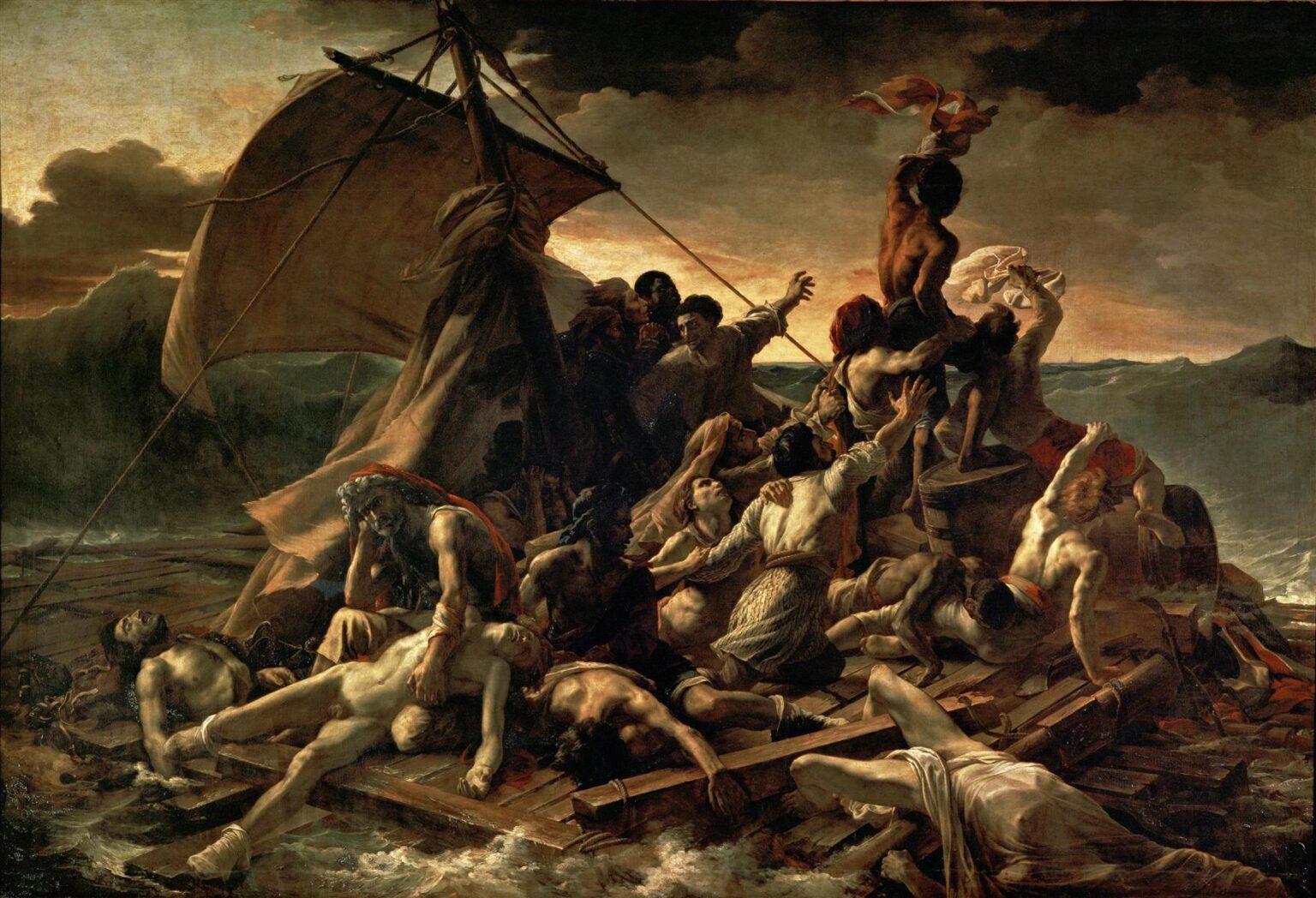
The Raft of the Medusa by Théodore Géricault, completed in 1819, is one of the most powerful paintings of the nineteenth century. Few works in European art confront disaster, desperation, and human endurance with such force. At first glance, the painting overwhelms the viewer with its scale, its dramatic movement, and its emotional intensity. A mass of bodies is thrown together on a fragile raft in a dark and violent sea. Some figures are dead, some are collapsing into despair, and some are straining toward a distant possibility of rescue. The scene feels immediate and monumental at the same time, as if a moment of real catastrophe had been transformed into a modern epic.
What makes this painting so remarkable is not only its technical brilliance, but also its subject. Rather than depicting a heroic event from classical mythology, scripture, or ancient history, Géricault chose a recent political scandal. He painted ordinary people abandoned by incompetence and authority, and he did so on a scale traditionally reserved for grand history painting. In that decision alone, The Raft of the Medusa changed the expectations of what serious art could be. It insisted that contemporary suffering, social failure, and human vulnerability were worthy of monumental treatment.
The painting remains unforgettable because it does not offer simple consolation. It does not idealize tragedy into neat heroism. Instead, it presents a world in which hope and death exist side by side. Some bodies lie limp in the foreground, already beyond rescue. Others rise upward in a desperate surge toward a tiny ship on the horizon. This contrast between hopelessness and hope is the emotional core of the work. Géricault captures the moment when survival still seems possible, yet loss already dominates the scene.
Historical Background
The subject of the painting comes from the wreck of the French naval frigate Méduse in 1816. The ship ran aground off the coast of West Africa, near present day Mauritania. The disaster quickly became a scandal in France because the captain had been appointed largely for political reasons rather than competence. When the shipwreck occurred, there were not enough lifeboats for everyone. A large makeshift raft was constructed to carry many of the passengers and crew, while the boats were supposed to tow it to safety. Instead, the raft was effectively abandoned.
What followed was horrifying. Those left on the raft endured hunger, thirst, panic, violence, and madness over many days at sea. Of the approximately 147 people placed on the raft, only a small number survived. News of the event spread rapidly and shocked the French public. It became a symbol of governmental corruption, class privilege, and human neglect. The scandal was not merely about a shipwreck. It exposed the consequences of failed leadership in a restored monarchy trying to present itself as stable and respectable.
Géricault was deeply drawn to the story. He did not approach it casually or from a distance. He researched the event obsessively, interviewed survivors, built models, and studied bodies in order to represent the scene with disturbing conviction. This seriousness of preparation matters because it shows that the painting was not intended as sensational entertainment. Géricault wanted to create a modern history painting grounded in truth, emotion, and moral force.
By choosing this event, he also aligned art with contemporary public life. The painting was not detached from politics or society. It entered ongoing debates about responsibility, class, and state power. That modern relevance gave the work much of its original shock and continues to shape its meaning today.
A Modern Tragedy on a Monumental Scale
Before Géricault, the highest category of painting in academic tradition was history painting. These works usually depicted subjects from antiquity, religion, or established national legend. They were meant to teach moral lessons and display elevated artistic ambition. Géricault borrowed the scale and seriousness of that tradition, but he applied them to a recent disaster involving anonymous victims. This was a bold and radical move.
The result is that The Raft of the Medusa feels both ancient and modern. It has the grandeur of epic art, yet it is anchored in a contemporary event that viewers of the time would have recognized from newspapers and public discussion. The men on the raft are not classical heroes in the usual sense. They are sailors, passengers, and survivors of state failure. Their suffering is not mythic in origin, but political and human. Géricault gives them a tragic dignity without denying the terrible conditions that brought them there.
This blending of contemporary realism with grand artistic ambition is one reason the painting occupies such an important place in art history. It widened the scope of history painting and made room for modern catastrophe. It suggested that the artist could respond not only to the past, but also to the urgent events of the present. In doing so, Géricault helped open the way for later painters who addressed revolution, war, poverty, and social conflict.
The monumentality of the canvas intensifies this effect. The raft appears almost life sized, and the viewer feels drawn into the scene rather than positioned safely outside it. The large scale forces confrontation. One cannot glance at the painting and move on easily. It demands attention, and with that attention comes a moral burden. To look at the painting is to witness suffering that society would rather hide.
Composition and the Architecture of Despair and Hope
One of the most extraordinary features of the painting is its composition. At first, the scene may appear chaotic, but it is built with remarkable control. Géricault organizes the mass of bodies into a complex structure that guides the eye through the emotional logic of the work.
The composition is shaped by two major diagonal movements. One diagonal slopes downward toward the dead and dying figures in the foreground. These bodies lie close to the viewer, their weight and stillness emphasizing loss, exhaustion, and the reality of death. The other diagonal rises upward from the lower left toward the upper right, culminating in the group of men who wave cloth desperately toward a tiny ship in the distance. This ascending line creates momentum, urgency, and the possibility of rescue.
These two diagonals produce a visual tension between collapse and aspiration. The raft itself seems unstable, tossed by the sea, while the human bodies upon it form a precarious pyramid. At the base are the dead or nearly dead. Higher up are figures who still struggle, react, and hope. At the peak stands the man signaling to the distant vessel. This structure gives the painting clarity despite its emotional complexity. It turns physical arrangement into meaning.
Géricault also uses space masterfully. The foreground is crowded with bodies, wood, cloth, and limbs, making the scene feel heavy and immediate. The middle ground is packed with agitated figures whose gestures convey alarm and desire. Beyond them, the horizon opens into distance, where the tiny ship appears almost impossibly far away. This contrast between crowded suffering and distant rescue deepens the sense of uncertainty. Hope exists, but it is fragile and remote.
The viewer’s eye moves through the painting almost like a narrative. It begins among the dead, travels through grief and strain, and rises toward the signal of hope. Yet that hope is never secure. The smallness of the ship on the horizon leaves the outcome unresolved. This ambiguity is essential. Géricault captures not triumph, but a moment of suspended possibility.

The Human Body as Emotional Language
The painting is filled with bodies, and Géricault uses them not merely as anatomical studies, but as vehicles of feeling, meaning, and drama. Every figure contributes to the emotional atmosphere. Some slump with complete inertia, suggesting death or total surrender. Others twist, reach, brace themselves, or lean forward with urgent intensity. Together they create a visual language of suffering and endurance.
Géricault was known for his intense study of the human form, and that knowledge is evident here. The bodies are muscular, weighty, and carefully modeled. Yet they are not idealized in a cold academic sense. Their beauty is inseparable from vulnerability. Their flesh catches light, bends under strain, and collapses under exhaustion. This gives the painting a deeply physical reality. The viewer can almost feel the heaviness of limbs, the salt air, the fatigue, and the instability of the raft beneath them.
One of the most striking aspects of the painting is the range of emotional states expressed through posture. In the lower left, a father figure sits with his son’s body draped across him, embodying grief and helplessness. Nearby, bodies lie sprawled in ways that communicate complete defeat. In the center, figures begin to stir with alarm and recognition. Higher up, bodies stretch outward in concentrated effort, their arms and torsos forming a chain of collective desperation. The movement from passivity to action is mirrored through the body itself.
This emphasis on the body also reinforces the painting’s realism. Disaster is not abstract here. It is registered in muscle, skin, weight, and gesture. The human body becomes the site where political neglect and natural violence meet. Géricault makes suffering visible in a way that is both physical and emotional, which is part of why the painting remains so affecting.
Light, Color, and the Atmosphere of Catastrophe
The dramatic power of The Raft of the Medusa depends heavily on Géricault’s handling of light and color. The painting is dominated by dark, earthy tones, deep shadows, storm filled skies, and troubled greenish waters. These colors create an atmosphere of danger, decay, and exhaustion. Nothing feels clean, bright, or stable. The world of the painting is one in which nature itself seems hostile.
At the same time, Géricault uses light with extraordinary precision. Light falls across selected bodies, highlighting flesh against darkness and drawing attention to key emotional points in the composition. The illuminated figures do not feel serene. Instead, the light has a harsh, theatrical quality, as if revealing the raw truth of the scene. It exposes suffering rather than beautifying it.
The sky plays a central role in the painting’s emotional tone. Heavy clouds press down over the scene, and the shifting light at the horizon creates an unstable atmosphere. This combination of darkness and distant brightness reflects the emotional condition of the survivors. The sky is not merely background. It participates in the drama, amplifying both terror and possibility.
Géricault’s color choices also prevent the painting from slipping into decorative beauty. Even when flesh is warmly modeled, it exists within a palette marked by mud, sea, wood, and storm. Reds and whites in the cloth help direct the eye and intensify the drama, especially near the figures signaling for help, but these accents never dissolve the scene’s grim reality. Instead, they function like urgent flashes within an otherwise oppressive world.
The sea itself is rendered with powerful restraint. It does not dominate the painting through spectacular waves alone, but through its constant threat. The water around the raft suggests instability and exposure. The survivors are not only lost in space, but at the mercy of a force larger than themselves. Géricault balances the human drama with this vast natural setting, making the disaster feel both personal and cosmic.
Romanticism and the Break from Neoclassical Order
The Raft of the Medusa is often understood as a landmark of Romanticism, and for good reason. Romantic art placed greater emphasis on emotion, individual experience, dramatic intensity, and the sublime forces of nature. Géricault’s painting embodies all of these concerns. It rejects the calm balance, moral clarity, and polished restraint associated with Neoclassicism. Instead, it embraces instability, passion, and psychological depth.
Neoclassical painting often presented heroic action with composure and formal order. Géricault’s raft is entirely different. Its heroism, if it exists at all, emerges from desperation rather than noble certainty. The figures are disordered, the setting is violent, and the emotional atmosphere is unresolved. There is no clean moral lesson delivered through ideal form. Instead, the viewer encounters a world in crisis, where dignity survives only through struggle.
Romanticism was deeply interested in extremes, including shipwrecks, storms, madness, and the limits of human control. Géricault channels that fascination here, but he does so with more than theatrical excess. He grounds the painting in lived suffering and historical scandal. This gives the work a seriousness that goes beyond mood. The emotional intensity is not invented for effect alone. It is tied to real human abandonment and the fragility of civilization.
The painting also reflects the Romantic interest in the sublime, that mixture of awe and terror produced by overwhelming experience. The sea, the sky, and the human mass on the raft generate precisely that feeling. The viewer is pulled between admiration for the painting’s grandeur and horror at its subject. This uneasy combination is central to its power.
At the same time, Géricault never abandons structure entirely. His composition remains highly calculated, his figures carefully arranged, and his use of light rigorously controlled. This balance between formal discipline and emotional intensity is one of the painting’s greatest strengths. It marks a turning point in art, where classical training and Romantic feeling collide to produce something new.
Political Meaning and Social Criticism
Although The Raft of the Medusa can be admired for its formal and emotional qualities alone, its political dimension is impossible to ignore. The shipwreck was not seen simply as an accident. It was widely understood as a consequence of incompetence, privilege, and official failure. By painting the survivors of this scandal on such a grand scale, Géricault transformed a contemporary controversy into an indictment of power.
The painting challenges the prestige of authority in subtle but forceful ways. There are no commanding leaders here, no reassuring symbols of state order, and no dignified representatives of official power. What remains are the abandoned bodies of ordinary people struggling to survive after the structures meant to protect them have failed. The raft becomes a symbol of social collapse, a floating image of what happens when governance is corrupted.
This political meaning would have been especially sharp for viewers in post Napoleonic France, where questions of legitimacy, restoration, and public trust were deeply charged. Géricault did not turn the event into patriotic propaganda or heroic myth. He preserved its discomforting implications. The work asks what kind of society allows such abandonment, and what kind of political order produces such suffering.
The painting is also notable for the way it represents human solidarity under extreme conditions. The figures form a collective body, bound together by shared disaster. Differences of rank seem irrelevant on the raft. The emphasis is on common vulnerability. In that sense, the painting is both critical and humanistic. It exposes systemic failure, but it also honors the desperate persistence of those left behind.
Why the Painting Still Feels Modern
More than two centuries after it was painted, The Raft of the Medusa still feels startlingly modern. Part of this comes from its subject. Disasters caused or worsened by negligence, class inequality, and political failure remain painfully familiar. The image of vulnerable people abandoned by those in power continues to resonate across time. Géricault’s painting does not belong only to early nineteenth century France. It speaks to recurring conditions of human history.
The work also feels modern because it refuses simple resolution. Many earlier history paintings present events with clear moral or heroic closure. Géricault leaves the viewer in uncertainty. The ship on the horizon is visible, but far away. Rescue may come, or may not. Hope exists, but it is precarious. This refusal of certainty gives the painting psychological complexity that feels strikingly contemporary.
Its emotional honesty is another reason for its lasting power. Géricault does not hide the ugliness of suffering, yet he also avoids reducing the figures to mere victims. They remain physically present, emotionally varied, and morally significant. The painting allows grief, despair, exhaustion, hope, and collective effort to coexist. That complexity makes it endlessly engaging.
The scale of the work also continues to matter. In person, the canvas is overwhelming. It creates an encounter that is bodily as much as visual. The viewer does not simply observe the raft. One feels almost placed before it, implicated in the act of looking. That immersive quality helps explain why the painting remains one of the defining masterpieces of French art.
Conclusion
The Raft of the Medusa is a masterpiece because it brings together so many levels of meaning without weakening any of them. It is historically grounded, politically charged, emotionally intense, and formally brilliant. Géricault took a recent scandal and elevated it into one of the greatest monuments of modern painting. He used the language of history painting to represent not victory, but abandonment. He placed ordinary suffering at the center of high art and, in doing so, changed the possibilities of painting itself.
The work remains unforgettable because it stages a profound human contradiction. It shows death and hope on the same unstable surface. Bodies collapse in the foreground while others rise toward the horizon. The sea threatens, the sky darkens, and yet a signal is raised. Nothing is secure, but not everything is lost. That fragile tension is what gives the painting its lasting emotional force.
Géricault’s achievement lies in making this catastrophe feel larger than a single event while never severing it from reality. The raft is both a specific historical scene and a timeless image of human vulnerability. It speaks about politics, nature, suffering, endurance, and the need to be seen. It asks the viewer not only to admire artistic skill, but also to confront what society abandons and what human beings cling to when almost everything has been taken away.