Image source: wikiart.org
Overview of The Prophets David and Daniel
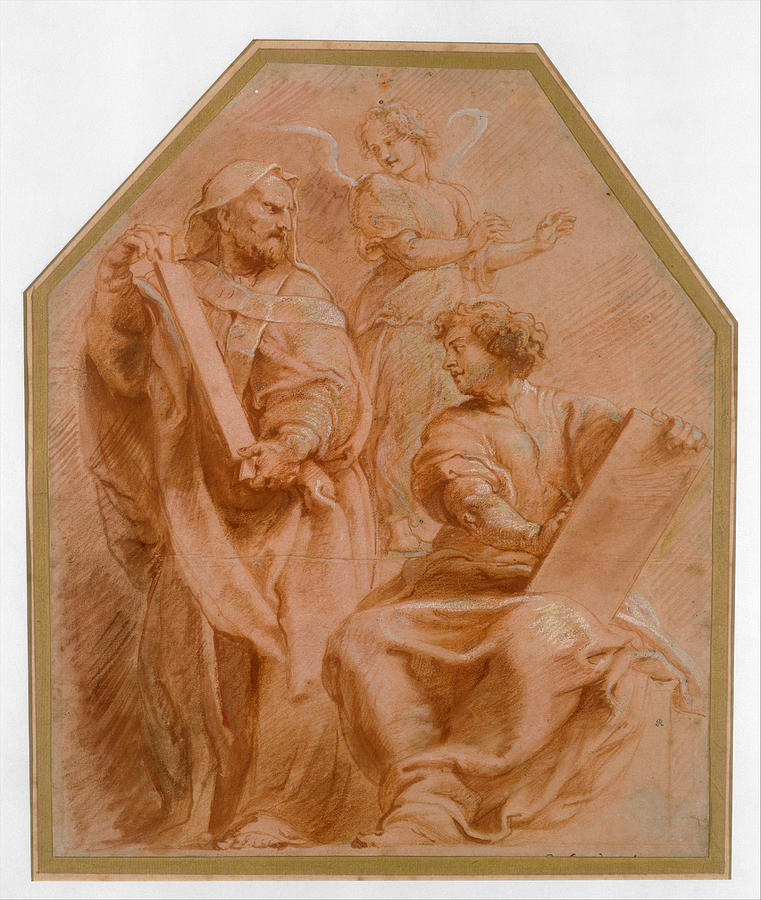
“The Prophets David and Daniel” by Peter Paul Rubens presents a thoughtful, intimate vision of two Old Testament figures caught in a moment of quiet inspiration. Unlike his large, color-saturated canvases, this work is a highly finished drawing executed in warm red chalk with accents of white heightening. The result is a glowing, sculptural image in which bodies and draperies emerge from the tinted paper as if from soft light.
The composition focuses on the encounter between a standing, bearded figure on the left and a younger, seated man on the right. Both hold long scrolls, visual symbols of prophecy and sacred text. Behind them, an angel leans in gently, suggesting the divine source of their insight. Although the drawing is modest in size compared to Rubens’s monumental paintings, it condenses many of his hallmarks: expressive gesture, rhythmic drapery, and a powerful sense of spiritual drama.
Biblical Background and Iconography
David and Daniel are central figures in the Hebrew Bible and in Christian tradition. David, the shepherd who became king of Israel, is celebrated as psalmist, warrior, and ancestor of the Messiah. Daniel, taken into exile in Babylon, is known for interpreting dreams and receiving apocalyptic visions about future kingdoms and God’s ultimate triumph.
By pairing David and Daniel, Rubens brings together the poetic voice of praise and the visionary voice of future hope. David’s psalms prefigure the spiritual struggles and consolations of later believers, while Daniel’s visions frame history within a divine plan. Their scrolls symbolize the written word that carries their prophecies across time. The angel’s presence underscores that these messages are not products of mere human imagination but revelations granted by God.
This combination would have appealed strongly to Baroque patrons, for whom the Old Testament prophets were seen as essential witnesses to Christ and to the life of the Church. Rubens’s drawing visualizes the unity of Scripture: the royal psalmist and the apocalyptic seer share the same divine source and participate in the same unfolding story.
Composition and Spatial Relationships
Rubens organizes the figures in a harmonious triangle. David stands at the left, his tall, cloaked form forming one side of the triangle. Daniel, seated on a low block or step at the right, forms the second side with his voluminous drapery and bent knee. The angel at the back completes the triangle, slightly elevated and leaning forward between them.
This triangular arrangement creates stability while allowing for dynamic interaction. David’s body angles slightly toward Daniel, his head turning as if to address him or share the words on his scroll. Daniel, in turn, twists his torso to look upward toward David, his own scroll tilted as if he is about to record what he hears. The angel watches over them both, her gaze soft, her hands raised in a gesture that suggests encouragement or explanation.
The composition encourages the viewer’s eye to circulate among the three figures. From David’s stern profile and strong hands, we follow the line of the scroll down to his feet, across the base where Daniel’s flowing garment pools, and then up again along Daniel’s seated figure to the angel’s head and wings. The result is a continuous visual dialogue, mirroring the flow of inspiration from God to prophet, from prophet to text, and from text to the faithful.
Medium and Drawing Technique
One of the most striking aspects of “The Prophets David and Daniel” is its medium. Rubens uses red chalk on a toned ground, with touches of white chalk or gouache to heighten highlights. The warm reddish paper becomes an active participant in the image, supplying mid-tones so that the artist can concentrate on deep shadows and bright lights.
Rubens’s chalk strokes vary from broad, soft shading to fine, incisive lines. In the drapery, he layers sweeping hatches to suggest folds and weight, then touches the brightest ridges with white to give them a luminous sheen. In the faces and hands, he uses more delicate, controlled strokes to define features and muscles. The result is a drawing that has almost the solidity of sculpture; forms feel round, tangible, and full of air.
This technique reveals the drawing’s likely function as a preparatory study for a larger painting or decorative scheme. Rubens worked out the arrangement of figures, the fall of light, and the rhythm of drapery here before committing to paint. Yet the drawing is so refined and expressive that it also stands on its own as a finished work of art, showing the spontaneity of Rubens’s hand and the clarity of his thinking.
The Figure of David: Authority and Reflection
David, on the left, is portrayed as a mature, bearded man wearing a hooded mantle. His garments fall in heavy folds that emphasize his solidity and authority. Rubens slightly turns his body, so that one foot projects toward the viewer while the other remains back, creating a subtle sense of movement as if David has just stepped forward to speak.
He holds a long scroll in his left hand, the top rolling toward him, while his right hand gestures as if emphasizing a particular line of text. His head is inclined, eyes cast toward Daniel, but his expression is inward and reflective, suggesting that he is both remembering and proclaiming inspired words.
By emphasizing David’s physical mass and controlled gesture, Rubens conveys the weight of tradition and the enduring authority of the psalms. David stands like a pillar of memory, someone whose songs have become part of the very structure of worship. His hood and cloak hint at a contemplative dimension, linking the royal figure to the world of meditation and prayer.
The Figure of Daniel: Youthful Visionary
In contrast to David’s solid stance, Daniel is shown seated, his body curved in a more fluid, youthful pose. His hair is curly and unhooded, and his features are smoother, emphasizing his relative youth. He sits on draped fabric that spills around his legs, forming a cascade of folds that soften the lower right corner of the composition.
Daniel’s scroll is larger and angled toward us, as if inviting the viewer to become part of the prophetic dialogue. His left hand supports the scroll while his right is partially raised, suggesting that he is either about to write or reacting to what he hears. His gaze turns upward toward David and the angel, indicating both respect for earlier prophecy and openness to new revelation.
Rubens’s depiction of Daniel captures the tension between receptivity and activity. He is not merely a passive listener; his poised gesture and attentive expression show him as a writer ready to transform vision into text. The drawing thus honors the intellectual and imaginative effort involved in prophecy: it is an act of interpretation as well as of reception.
The Angelic Presence and Divine Inspiration
Behind the two prophets, an angel stands in gentle contrapposto, wings curling upward in soft arcs. The angel’s robes flow in delicate folds, more ethereal than the heavier garments of the men. Her head inclines slightly forward, and she appears to be either speaking softly or listening with sympathy. Hands raised near her chest, she seems to encourage, bless, or clarify the messages being communicated.
This angel functions as a visual sign of divine inspiration. Instead of depicting God directly, Rubens uses the angel to represent the invisible source of prophecy. Positioned between David and Daniel, the figure underscores that both prophets are guided by the same heavenly voice. The angel’s placement higher in the composition also suggests the vertical dimension of revelation—from the realm of spirit down to human understanding.
The lightest touches of white heightening are reserved for the angel’s face and garments, making her appear slightly more luminous than the surrounding figures. This delicate glow sets her apart, hinting at her otherworldly nature while keeping her integrated into the intimate scene.
Drapery, Gesture, and the Language of the Body
One of Rubens’s great talents lies in his ability to use drapery and gesture as extensions of character. In “The Prophets David and Daniel,” the folds of cloth and the movements of hands and arms communicate as much as the facial expressions.
David’s cloak wraps around him in thick, almost architectural volumes, echoing his role as a foundational figure. The lines of his garment lead downward, anchoring him to the ground. His hand that holds the scroll is firm and direct; the other hand, partly extended, suggests measured speech, the controlled delivery of words long pondered.
Daniel’s drapery, by contrast, swirls more freely. The fabric around his knees billows outward, creating a sense of movement and emotional responsiveness. His torso twists, and his arm that supports the scroll is tense but not rigid, as though ready to shift in response to new insight.
The angel’s garments are the lightest and most flowing, their folds soft and continuous. Her gestures are open and receptive rather than authoritative. In this way, Rubens uses the language of the body to express the different roles: David as established authority, Daniel as active listener and writer, and the angel as gentle mediator of divine truth.
Light, Volume, and Spiritual Atmosphere
Although the drawing relies only on chalk and white heightening, Rubens creates a remarkably rich play of light and shadow. Light seems to enter from the upper left, catching the edges of drapery, the planes of faces, and the curves of hands and arms. Where the white chalk is applied most strongly—on David’s forehead, Daniel’s knee, the angel’s shoulders—the figures appear to emerge from the tinted paper like illuminated sculptures.
This subtle modeling does more than confer realism; it contributes to the spiritual atmosphere. The light that defines the figures feels symbolic, as though emanating from the divine presence implied by the angel. Areas of softer shadow around the edges of the drawing frame the central group, focusing attention on their interaction.
The overall effect is one of gentle radiance rather than harsh contrast. Rubens uses light to evoke contemplation, as if the prophets are bathed in an inner illumination that corresponds to their inspired understanding.
Purpose and Function within Rubens’s Work
“The Prophets David and Daniel” was likely conceived as a study for a larger decorative scheme, perhaps a church ceiling, an altarpiece predella, or a series of prophet images framing a sacred scene. Rubens often produced elaborate red-chalk designs to refine his ideas about poses, groupings, and emotional tone before painting.
This drawing shows how seriously he treated preparatory work. Far from being a rough sketch, it is carefully composed and fully modeled, allowing a patron or workshop assistant to grasp the final effect. It reflects Rubens’s commitment to integrating biblical figures into sophisticated allegorical programs that combined theology, history, and visual magnificence.
At the same time, the intimacy of the drawing offers a different experience from his grand oil paintings. Here we meet the prophets in a quieter register, seeing them not amid dramatic miracles or public scenes but in the contemplative act of receiving and recording revelation. This quieter aspect enriches our understanding of Rubens as an artist capable of both thunderous spectacle and subtle spiritual introspection.
Emotional Impact and Contemporary Relevance
For modern viewers, “The Prophets David and Daniel” carries a timeless appeal. The image does not require specialized knowledge to communicate its central ideas: two serious figures, absorbed in texts, guided by a gentle angel. The scene speaks to the enduring human search for wisdom, the desire to connect earthly understanding with something higher.
The drawing also highlights the value of dialogue across generations. David and Daniel, separated by centuries in the biblical narrative, stand here side by side. Their scrolls and exchanged glances suggest that later voices listen to earlier ones, reinterpret them, and carry them forward. This visual conversation between past and present resonates with contemporary concerns about tradition, interpretation, and the ongoing relevance of sacred and literary texts.
Finally, the drawing invites a reflective, almost meditative response. The softness of the chalk, the warmth of the paper, and the serene expressions of the figures create a calm space in which viewers can contemplate their own relationship to wisdom, inspiration, and the written word. Rubens’s mastery ensures that this small sheet of paper becomes a window into a larger world of faith, study, and interior dialogue.