Image source: wikiart.org
Introduction
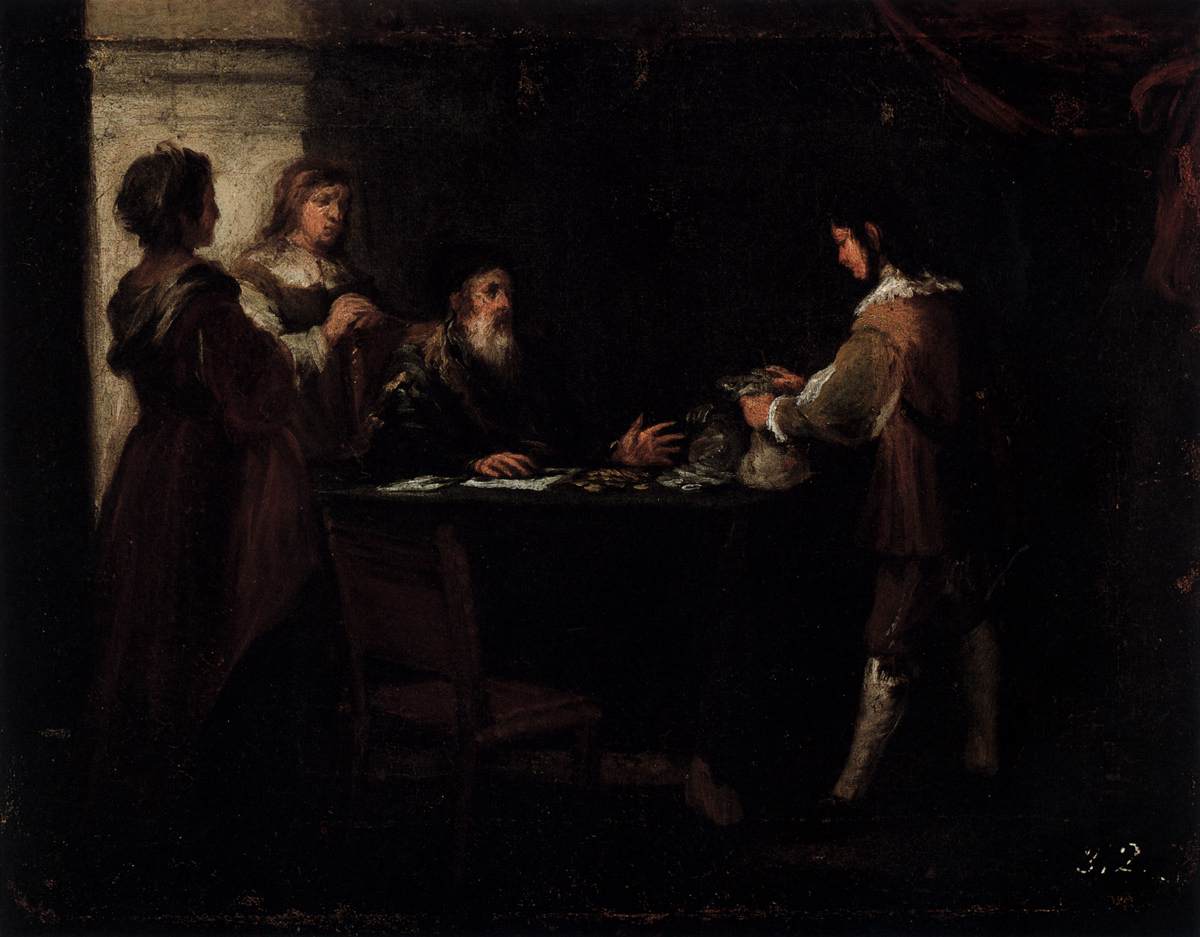
“The Prodigal Son Receives His Rightful Inheritance” by Bartolomé Esteban Murillo captures the quiet but decisive moment when a young man prepares to walk away from the safety of his family home. In this dark interior scene an elderly father sits at a table strewn with coins and documents, while the prodigal son stands to the right, gathering money into a bag with restless eagerness. Two women hover at the left, watching with a mixture of concern and resignation.
Rather than dramatizing the wild living or the dramatic return that normally dominate depictions of the parable, Murillo focuses on the hinge of the story: the moment of departure. It is here that the son chooses separation, and here that the father, though wounded, consents. The painting is intimate, tense and psychologically rich. The subdued light, earthy palette and tightly grouped figures create a mood of moral seriousness that invites the viewer to reflect on the choices that precede visible disaster.
The Parable Of The Prodigal Son
The subject comes from one of Christ’s most beloved parables in the Gospel of Luke. A younger son asks his father to divide the estate and give him his share early. Leaving home, he wastes his fortune in reckless living, eventually ending up destitute and feeding pigs. In this misery he “comes to himself,” returns home and is welcomed with unexpected joy and forgiveness. The parable culminates with the elder brother’s jealousy and the father’s insistence that mercy and celebration are fitting for a lost child who has been found.
Murillo was deeply drawn to this story and painted a complete narrative cycle of the Prodigal Son, following the young man from inheritance to debauchery, ruin, repentance and reconciliation. In this particular canvas he turns to the first chapter of the drama. There are no pigs, no distant city, no running father; everything is still contained within the family house. Yet the tension of what is about to unfold hums underneath the quiet surface of the scene.
A Moment Of Decision
The painting shows the instant when the inheritance is being counted out and handed over. The prodigal son has not yet left; his boots still stand on familiar floorboards. But his body already faces away from the family group, angled toward the edge of the canvas and toward the unknown. His head is slightly bowed as he counts or secures the money, absorbed in the newly acquired wealth rather than in the people around him.
The father, seated behind the table, reaches toward the coins with one hand and gestures with the other, perhaps clarifying the amount or uttering final words of warning. His long beard and dark cap mark him as a figure of authority and experience. Across from him, the son’s youthful posture and fashionable clothes speak of energy and restless ambition.
The two women at the left occupy a more ambiguous role. They might be the mother and an older sister, or perhaps a maid and a relative. One stands closer to the father, resting her hand on the back of his chair as if supporting or pleading with him. The other, more shadowed, turns her head toward the transaction, her body fixed in a posture of anxious observation. Their presence reminds viewers that the son’s choice wounds more than one heart; the entire household will feel his absence.
Composition And Interior Space
Murillo structures the composition around the horizontal line of the table, which anchors the figures and divides the picture into an illuminated zone of human interaction and a deep background of shadow. The old man sits at the center, slightly set back, so that the son at the right and the women at the left lean in toward him. This arrangement creates a subtle triangular form, with the father at the apex and the three younger figures forming the base.
The background is deliberately dark and indistinct. Only a section of pale wall behind the women emerges from the gloom. On the right, behind the prodigal son, darkness is nearly complete. It feels as though the unknown life he is rushing toward is already a kind of shadow into which he will soon vanish. The left side, near the father and the women, retains more light, suggesting the solidity and safety of the household he is about to abandon.
The table itself becomes a stage on which the drama of choice unfolds. It holds scattered coins, small stacks of money, and a few sheets of paper. These objects lead the eye back and forth between the father’s hand and the son’s bag, reinforcing the idea of transfer. The single empty chair in the foreground is particularly poignant. It invites the viewer into the scene but also hints at absence. Once the son has claimed his fortune, that chair may remain empty at family meals until his eventual return.
Light, Shadow And Emotional Atmosphere
Murillo’s handling of light is key to the painting’s emotional impact. The scene is enveloped in a dark, almost smoky atmosphere, broken only by a soft beam that falls from the upper left. This light illuminates the faces and hands of the figures, the edge of the table and a few glittering coins. Everything else recedes into near obscurity.
This chiaroscuro effect does more than create visual drama. It reflects the moral ambiguity of the moment. The son’s request is technically legal—he is receiving his “rightful inheritance” as the title emphasizes—but spiritually it is fraught. The light falls on the money and on the faces, emphasizing the weight of the decision, while the surrounding darkness suggests the consequences that remain hidden from everyone except perhaps the viewer, who knows the rest of the parable.
The muted color palette reinforces this mood. Murillo uses deep browns, soft blacks and warm, earthy reds for clothing and interior surfaces. Highlights appear in the white cuffs and collars, in the papers on the table and in the gleam of metal coins. There are no bright blues or radiant golds that one might find in his religious altarpieces. Here the tone is sober, grounded, almost claustrophobic—the perfect environment for a quietly tragic decision.
The Prodigal Son: Youth, Freedom And Blindness
Murillo’s prodigal son is dressed in stylish, somewhat extravagant clothes. He wears a short brown doublet with padded sleeves, white shirt and lace collar, and tall boots. His hair falls to his shoulders; his posture is energetic and slightly restless. These details convey youth and a desire to present himself confidently to the world.
Yet Murillo avoids caricaturing him as purely selfish or villainous. The young man’s head tilts down; his face is partly in shadow, creating a sense of inwardness or uncertainty. He appears absorbed in the money, counting it carefully or securing it in the bag he holds. This concentration suggests both eagerness and anxiety. He knows that this wealth will enable his departure, but he may also feel the weight of stepping into independence.
The fact that he does not look at his father or at the women is significant. His attention has turned from relationships to resource. The people who love him become peripheral as the coins glitter in his hands. Murillo thereby visualizes one of the core messages of the parable: when desire for freedom is driven primarily by material gain or self indulgence, it easily blinds us to the bonds of love that sustain us.
The Father: Authority, Sorrow And Generosity
The father is one of the most compelling figures in the composition. Seated in shadow, he appears calm yet deeply aware of the gravity of what he is doing. His beard and simple dark garments give him patriarchal dignity. One hand rests on the table near the documents, grounding him in the legal and practical aspects of the transaction. The other hand extends slightly toward the coins, fingers spread in a gesture that could signify explanation, warning, or reluctant acquiescence.
Murillo resists the temptation to portray the father as angry or melodramatically grieving. Instead, he looks thoughtful and subdued. His task is painful but accepted: he must honor his son’s free will even though he foresees the dangers. This portrayal aligns with the theological interpretation of the parable in which the father represents God, who allows human beings the freedom to turn away even while remaining ready to welcome them back.
The father’s central position and relative composure also anchor the composition emotionally. While other characters appear tense or watchful, he is steady, a fixed point in the drama. His quiet dignity makes the son’s impulsive departure seem all the more reckless, but it also foreshadows the steady mercy that will receive him upon his return.
The Women: Witnesses And Emotional Echo
The two women on the left deepen the painting’s emotional resonance. The one closest to the father stands almost in profile, her face partially hidden in shadow. She appears to speak or lean toward the older man, perhaps urging him to reconsider or expressing worry. Her body language suggests an attempt to mediate.
The second woman, standing slightly behind but bathed in more light, looks intently toward the prodigal son and the money. Her clasped hands and tense posture indicate quiet distress. She cannot halt the transaction, but she bears witness to it with the full weight of her emotions.
These female figures bring a domestic and familial dimension to the scene. They represent the wider network of relationships that the parable only hints at. Murillo subtly reminds the viewer that the prodigal is not just walking away from a father, but from a household that has supported and loved him. Their presence also creates visual balance, filling the left side with warm, draped forms that echo the son’s figure on the right.
Symbolism Of Money, Documents And Interior Setting
The table’s contents function almost like characters in their own right. Gold and silver coins scattered across the dark surface catch the light, emphasizing their seduction. Papers—perhaps legal documents, account records or a symbolic will—lie beneath or beside the coins. Together they represent both the legitimate rights and the dangerous temptations wrapped up in inheritance.
The bag that the son holds is especially important. It is the container for his future illusions. At this moment it is full, heavy with possibility. In later scenes of the cycle, similar bags will be empty, lost or replaced with the husks of the pigs he feeds. Murillo encourages the viewer to see continuity between this quietly full sack and the later emptiness of the prodigal’s life.
The interior setting contributes to this symbolism. The room is dark, enclosed and sparsely furnished. There are no windows visible, no glimpses of distant landscape. It feels like a private study or counting room, a place dedicated to financial transactions rather than to convivial family life. By staging the scene here, Murillo underscores the fact that the son’s decision is essentially economic before it becomes moral and spiritual. He is choosing to convert his place in the household into liquid assets, to swap belonging for coin.
Murillo’s Narrative Strategy Within The Prodigal Son Cycle
When this painting is considered alongside the rest of Murillo’s Prodigal Son series, its narrative role becomes clear. Other canvases show the prodigal feasting with courtesans, tending pigs in misery, resolving to return, and finally being embraced by his forgiving father. Those scenes contain more obvious pathos and spectacle.
By contrast, “The Prodigal Son Receives His Rightful Inheritance” is quiet and interior. Murillo uses this calm to build suspense. Viewers who know the story realize that everything that follows—riotous living, hunger, repentance and reconciliation—flows from the decision made in this room. The painting asks us to pause and contemplate our own beginnings, the seemingly small choices that set our lives on particular trajectories.
Murillo’s choice to treat this moment with subtlety rather than overt judgment also invites empathy. We may recognize in the young man echoes of our own desires for independence, our own impatience with the constraints of home and duty. The painting becomes not merely an illustration of a biblical parable but a mirror held up to the human heart.
Place Within Murillo’s Oeuvre And The Spanish Baroque
This canvas reveals many hallmarks of Murillo’s mature style: the warm, enveloping chiaroscuro; the soft modeling of flesh and fabric; the focus on psychological interaction rather than flamboyant gesture. While his religious altarpieces and Immaculate Conception images aim at heavenly radiance, this work belongs to his more earthbound, narrative side.
Spanish Baroque painting often emphasized moral themes, dramatic contrasts of light and shadow, and a deep interest in the lives of ordinary people. Murillo participates fully in this tradition but tempers it with a distinctive tenderness. His figures, even when flawed, are treated with compassion. The prodigal son is not demonized; the father is not idealized beyond recognition. Instead, each character feels like a real person caught in a difficult moment.
In this sense, the painting contributes to the broader Baroque project of making sacred stories immediate and emotionally accessible. Viewers in seventeenth century Seville could look at this interior, this family, this table of coins, and feel that the Gospel parable was unfolding not in some distant land but in a house very much like their own.
Conclusion
“The Prodigal Son Receives His Rightful Inheritance” by Bartolomé Esteban Murillo is a powerful meditation on choice, freedom and the hidden beginnings of repentance. By focusing on the quiet moment when the inheritance changes hands, Murillo invites viewers to consider the inner motives and emotional currents that lie beneath outward actions.
In the dimly lit room, the youth bent over his money, the patient yet sorrowful father, and the anxious women create a rich tableau of conflicting desires: independence versus security, material gain versus relational loyalty, control versus trust. The coins gleam with deceptive promise, while the empty chair and encroaching shadows hint at loss and loneliness to come.
Murillo’s subtle handling of light, composition and gesture transforms a simple financial transaction into a deeply human drama. For viewers today, the painting still speaks with relevance, reminding us that the decisive turns in our own stories often occur not in moments of visible catastrophe, but in quiet rooms where we choose what to value most.