Image source: wikiart.org
Introduction to Murillo’s “The Prodigal Son Abandoned”
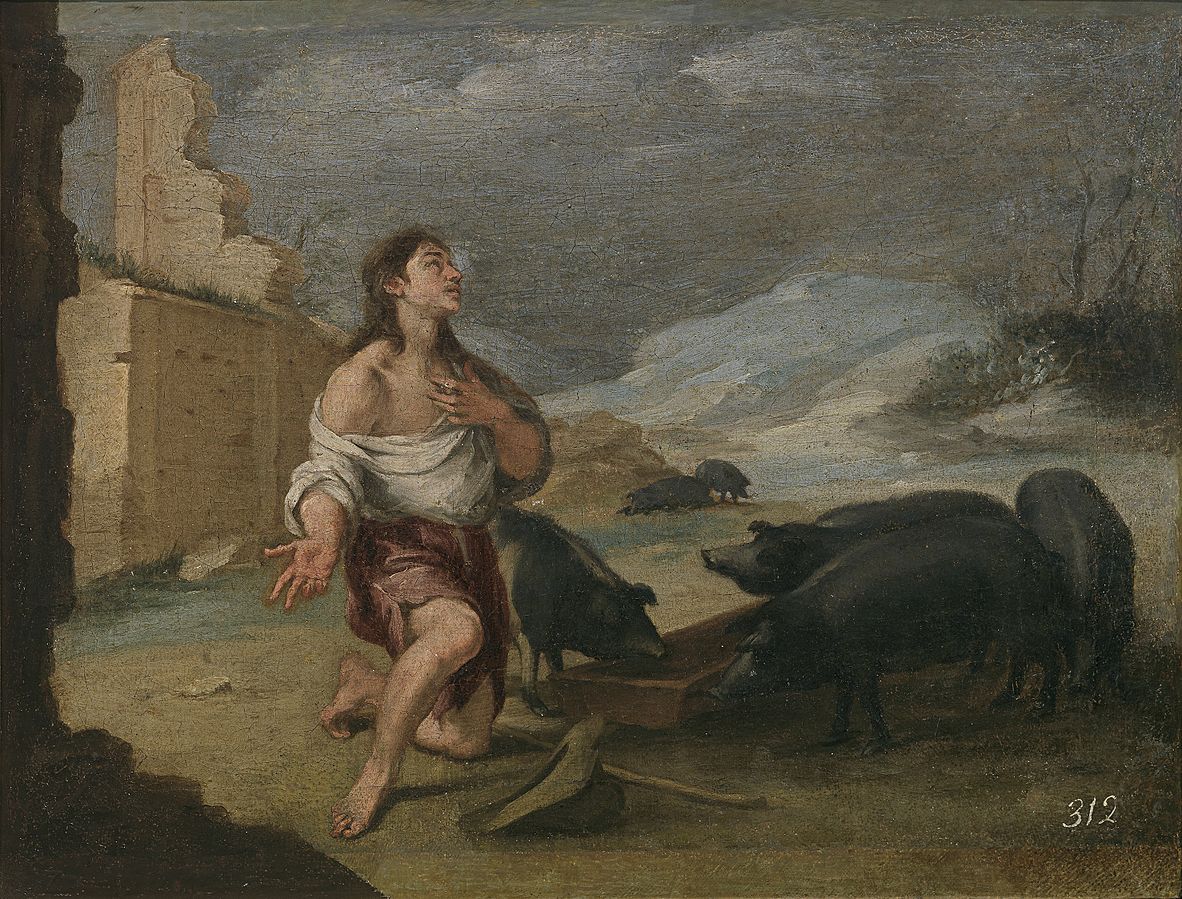
“The Prodigal Son Abandoned” by Bartolomé Esteban Murillo presents one of the most poignant moments in the famous Gospel parable. The painting captures the instant when the young man, having squandered his inheritance, finds himself alone, destitute, and forced to care for pigs. Murillo chooses not to depict the joyful return to the father but the moment of deepest humiliation and spiritual awakening, when the son finally realizes how far he has fallen.
This small horizontal canvas is intimate in scale yet powerful in emotion. On the left, the prodigal son kneels barefoot on the ground, his clothes tattered, his chest partially exposed. With one hand pressed to his heart and the other extended outward, he looks up toward the sky, as if beginning the prayer that will lead him back home. On the right, a group of dark pigs crowd around a trough, indifferent to his inner turmoil. Behind him stretches a barren landscape under a heavy gray sky, with ruins and sparse vegetation emphasizing his desolation.
Murillo’s image distills the moral of the parable into a single, unforgettable vision: true conversion begins in the heart, often at the lowest point of one’s life.
The Biblical Parable and Murillo’s Interpretation
The story of the prodigal son, told in the Gospel of Luke, was a favorite subject in Christian art and preaching. A young man demands his inheritance, travels to a far country, and wastes his wealth in reckless living. When famine strikes, he is left with nothing and is forced to hire himself out as a swineherd. Hungry enough to envy the pigs’ food, he finally “comes to himself,” recognizes his sin, and resolves to return to his father, who will welcome him with forgiveness and celebration.
Artists often choose either the initial departure, the revelry, the misery among the swine, or the joyful reunion. Murillo focuses on the most introspective episode: the moment when the son recognizes his abandonment and begins to turn back. The painting is not a simple genre scene of a poor youth feeding animals. It is a psychological and spiritual portrait of remorse and grace beginning to work in a broken heart.
Murillo does not show the father in the distance or angels guiding the son. Instead, the divine presence is suggested indirectly through the son’s upward gaze and the heavy sky that seems to weigh on his conscience. This subtle approach reflects Murillo’s gift for combining religious teaching with believable human emotion.
Composition and Spatial Arrangement
The composition of “The Prodigal Son Abandoned” is straightforward yet carefully constructed. The young man occupies the left foreground, set against a high wall and dark interior corner. His kneeling posture places him low in the picture plane, emphasizing his humiliation, but his torso and face rise in a diagonal line toward the sky. This upward movement hints at the beginning of hope even in his misery.
On the right side, the pigs cluster around a feeding trough. Their bodies form a heavy, dark mass that anchors the composition. They are almost level with the son’s head, creating an uncomfortable comparison: he has sunk to the level of the animals he tends. A couple of pigs graze further back in the middle distance, leading the eye deeper into the landscape and reminding us that his degradation is not a brief moment but an ongoing, extended state.
The background features low hills and a desolate countryside under a cloudy sky. A ruined wall rises behind the young man, its broken edge silhouetted against the sky. This ruin, placed prominently, may symbolize the collapse of his former life and the moral decay that followed his reckless choices.
The empty space between the son and the pigs is important. It creates a visual gap that mirrors the spiritual distance between his human dignity and the animal realm in which he now lives. At the same time, the diagonal from the dark corner on the left to the open landscape on the right traces the path from confinement to possible freedom, foreshadowing his eventual journey home.
The Prodigal Son as Emotional Focus
Murillo’s handling of the prodigal son is the key to the painting’s emotional power. The young man’s clothing tells much of his story. His white shirt has slipped from one shoulder, exposing his chest, yet it is torn and dirty. The reddish-brown garment around his waist is ragged, hinting at the wasted wealth he once flaunted. He is barefoot, grounding his humiliation in physical discomfort.
His pose conveys both exhaustion and awakening. One knee presses into the earth, the other leg forward as if he has just collapsed or is about to rise. His left hand extends outward, palm open, a gesture that can be read as plea, confession, or expression of helplessness. His right hand touches his chest, subtly indicating that the crisis is internal as well as external.
The expression on his face is finely judged. His head is tilted back, eyes raised toward the sky with a mixture of pain, longing, and dawning realization. Murillo avoids melodramatic contortions. Instead, there is a quiet intensity, a sense that the young man is finally seeing his life clearly. This psychological nuance transforms the image from a moralizing illustration into a true spiritual drama.
The Pigs and the Depth of Degradation
The pigs in the painting are more than background animals. In the context of Jewish culture, pigs were considered unclean, and tending them was one of the most degrading jobs a person could have. Murillo’s dark, heavy swine emphasize the depth of the prodigal’s fall.
They are painted in deep blacks and browns, with little variation in tone, in stark contrast to the lighter flesh of the young man. Their hunched bodies and snouts buried in the trough convey single-minded appetite. They are creatures of pure instinct, consumed by material hunger. Their indifference to the son’s inner crisis highlights the loneliness of his plight.
Murillo uses these animals symbolically. They represent the life of sin and dissipation that has consumed the son’s inheritance and dignity. The fact that he must feed them but is not allowed to share their food underlines his spiritual starvation. Even the pigs are better off than he is, because they are at least satisfied in their limited way, while he is empty within.
Landscape, Ruins, and Atmosphere
The landscape setting reinforces the mood of abandonment. Unlike some of Murillo’s warm, luminous skies, this one is gray and heavy, with clouds threatening rain or storm. The light is diffused and cool, lacking the golden glow seen in many of his religious works. This muted palette mirrors the son’s emotional state: hope has not yet fully dawned, and he remains under a cloud of misery and guilt.
The ruined wall rising behind the son is particularly important. Its crumbling bricks and jagged edges speak of destruction and neglect. It might once have been part of a prosperous estate or solid city wall, but now it lies broken and forgotten, just as the son has ruined the comfortable life he once enjoyed.
In the distance, low hills and sparse vegetation stretch under the overcast sky. There are no thriving trees or fertile fields. The land appears dry and unwelcoming, reflecting the famine mentioned in the parable and the spiritual barrenness that comes from turning away from the source of life.
Murillo’s landscape is not detailed or topographically precise. Rather, it is a psychological space, shaped to express desolation and the loneliness of repentance.
Light, Color, and Murillo’s Painterly Touch
Even in a somber work like “The Prodigal Son Abandoned,” Murillo’s characteristic sensitivity to light and color is evident. The overall palette leans toward earthy browns, muted greens, and cool grays, but the young man’s skin retains a subtle warmth that sets him apart from the environment. This slight glow suggests that he is not lost forever; a spark of life and grace still burns within him.
The white of his shirt, though soiled, is the brightest element in the painting. It draws the eye immediately to his torso and face, emphasizing his role as the focal point. White here can also symbolize the purity that may be restored through repentance and forgiveness.
Murillo’s brushwork in this small canvas is relatively loose, especially in the background and the pigs. Forms are suggested rather than minutely described, allowing the viewer’s eye to blend the strokes into a cohesive scene. The more detailed treatment of the son’s hands, face, and bare feet directs attention to his humanity and emotional state.
The subtle modulation of light across his body and the surrounding ground creates a gentle modeling that makes the figure appear solid and real, even though the overall surface retains a somewhat sketch-like freshness. This may suggest that the work belonged to a cycle or series, where speed and unity of tone were important.
The Theme of Conversion and Inner Awakening
At its heart, “The Prodigal Son Abandoned” is about the moment of conversion. The son is still physically in the foreign land, still surrounded by pigs and ruins, still barefoot and hungry. Yet something has changed within him. The hand to his chest and the upward gaze tell us that he has begun to turn his heart back to his father.
Murillo captures this interior shift with remarkable simplicity. There are no angels or visions to signal divine intervention. The transformation is quiet, almost invisible, but the viewer senses it in the tension of the pose and the look on his face. The painting thus reminds us that conversion often begins not with dramatic miracles but with a painful recognition of one’s own poverty and a desire for home.
This theme would have resonated strongly in seventeenth century Spain, where sermons and spiritual literature frequently emphasized repentance, confession, and the mercy of God. Murillo’s image could encourage viewers to identify with the prodigal, acknowledging their own failures and trusting in a loving Father who waits to welcome them back.
The Painting within Murillo’s Prodigal Son Cycle
Murillo is known to have painted a series of scenes from the parable of the prodigal son, depicting stages such as the departure, the revelry, the expulsion from the tavern, the feeding of the pigs, and the return. “The Prodigal Son Abandoned” fits into this narrative cycle as the interior turning point between fall and restoration.
By isolating this single moment, the painting gains contemplative depth. While other works in the series may show crowded scenes of dancers, servants, or feasting companions, here the focus is almost entirely on the solitary figure and his silent dialogue with God. This helps explain the restrained scale and intimate feel of the canvas.
Even for viewers who do not see the other paintings, this work stands on its own as a complete spiritual statement. It distills the entire story into a single gesture of repentance.
Legacy and Contemporary Relevance
Today, “The Prodigal Son Abandoned” continues to speak to viewers across cultural and religious boundaries. Its themes of failure, regret, and the possibility of renewal are universal. Many people can recognize themselves in the figure of the young man who has made poor choices and now finds himself isolated, longing for a better life.
Art historians value the painting as an example of Murillo’s narrative skill and his ability to combine genre-like realism with moral and spiritual meaning. Its modest size and direct approach contrast with his larger, more radiant altarpieces, revealing another facet of his artistic personality.
For contemporary audiences, the image offers a powerful reminder that moments of crisis can become turning points. The desolate landscape and the indifference of the pigs underline the emptiness of a life turned inward on itself, but the son’s upward gaze suggests that change is possible. The story does not end here; the next step is the journey back to the father’s house, where mercy and celebration await.
Murillo’s painting stops at the threshold of this journey, allowing viewers to complete the narrative in their own minds and hearts. It invites them to imagine the walk home, the embrace, and the restored dignity, and to consider what such a journey might mean in their own lives.