Image source: wikiart.org
Introduction
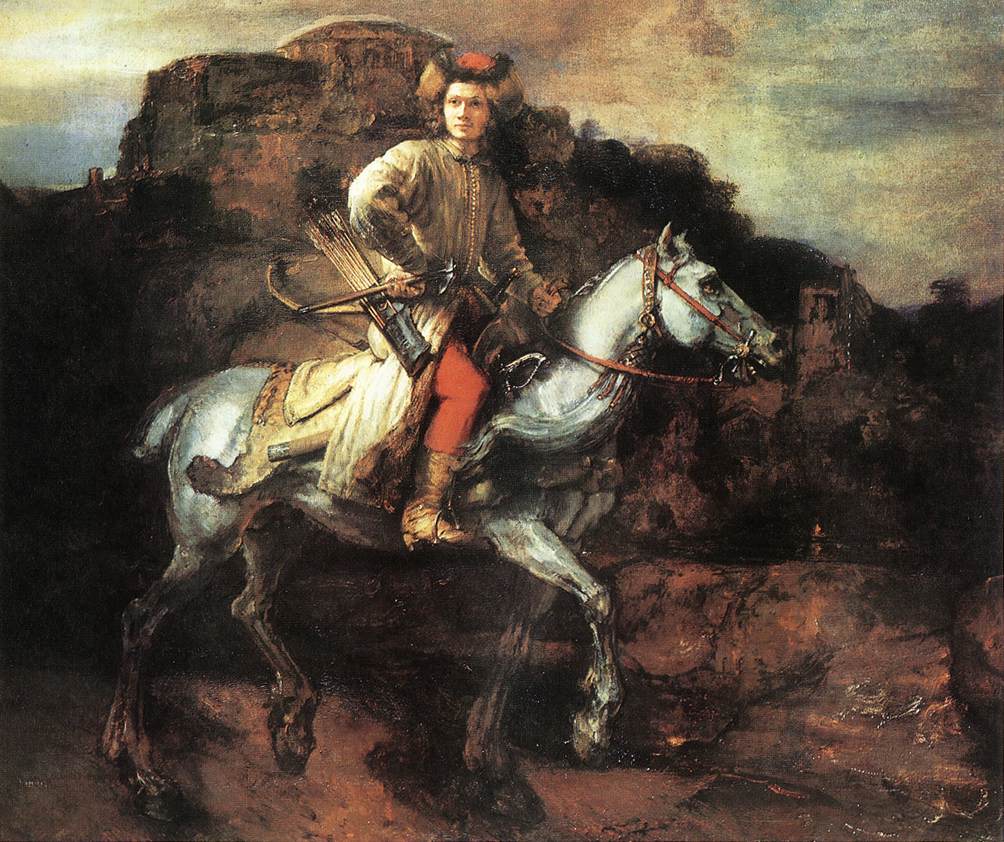
Rembrandt’s “The Polish Rider” (1655) is one of the most enigmatic full-length equestrian portraits of the seventeenth century. A solitary young horseman, armed but unarmored, advances through rugged country on a pale mount. The air is unsettled, the path uncertain, and the rider looks past us as if listening for a signal beyond the frame. The painting is at once portrait, history picture, and landscape, yet it refuses to be pinned down as any one of them. In Rembrandt’s late style—thick paint, earthy tones, and searching light—the picture becomes a meditation on journey, vigilance, and identity under pressure.
What We See At First Glance
At life size, the young rider dominates the foreground, his body turned three-quarters toward the viewer while his head tilts left, eyes alert. He wears a fur cap with a red cockade, a long pale caftan trimmed with braid, crimson trousers that flare like embers within the earth palette, and soft riding boots. A quiver of arrows, a bow, and a curved saber hang at his side; a small pistol peeks from a sash. The horse—luminous gray with dapples that pick up the sky—steps carefully over broken ground, its neck arched and ears pricked. Behind them stretches a rough, rocky landscape interrupted by a ruined tower and a dark watercourse that catches a little light like a path of thought. Clouds thicken toward evening; the picture holds the hour when travel is still possible but night is already in the air.
The Puzzle Of Identity
Few Rembrandt works have prompted more debate about who, exactly, is represented. The title “The Polish Rider” is traditional but not definitive. The young man’s costume resembles that of Eastern European cavalry, particularly the Polish-Lithuanian Commonwealth’s light-horse or Cossack dress, with its fur cap, long coat, and composite weaponry. Some scholars have proposed a specific sitter—a Polish noble, a mercenary officer, even Prince Jonasz Radziwiłł—while others read the figure as a poetic type: a Christian knight, a pilgrim-warrior, or the biblical figure of the “Rider” from Job or Revelation translated into seventeenth-century terms. Rembrandt cultivates that ambiguity. The face is individualized yet free of heraldry or insignia; the landscape offers symbols but no caption. The painting invites viewers to hold portrait likeness and allegory in suspension.
An Equestrian Portrait Against The Grain
In the Baroque age, equestrian portraits usually proclaim pomp: rearing stallions, fluttering banners, armor that mirrors the sun, and a conqueror who controls both beast and realm. Rembrandt overturns the formula. His rider is young, almost vulnerable, and the horse is cooperative rather than explosive. There is no entourage, no triumphal architecture, only a path hacked through stone. The result is not a public boast but a private encounter. We feel the intimacy of the rider’s breath, the soft thud of the hoof, the vigilance of the horse’s eye—the kind of seeing that comes from being on the road, not on a parade ground.
Composition As A Moving Triangle
The painter organizes the scene around a diagonal that runs from the rider’s cap through his torso to the horse’s forelegs and onward into the broken terrain. This diagonal is balanced by a counter-sweep: the curve of the horse’s neck and the arc of the quiver and bow. Together they create a dynamic triangle that stabilizes the composition while projecting forward momentum. The rider sits slightly high in the saddle; his torso leans just enough to suggest he has noticed something off to his left. The horse’s raised near fore and the flex at the hock give a sense of careful advance rather than speed, perfectly matching the rider’s watchfulness.
The Horse As Character
Rembrandt is not a specialist in horses, but here he renders one of the most convincing equine personalities in Dutch art. The gray coat is built from cool whites and silvery browns over a warm underpainting, giving the animal the glint of living skin. The nostril is flared, the jaw tight, and the bit lightly taken—signs of a sensitive mount. The musculature at shoulder and gaskin is abbreviated with large, confident strokes rather than anatomical cataloguing; truth of movement matters more than detail. The horse’s alert ear angles toward the rider’s glance, creating a visual duet: both creature and human are keyed to the same unseen stimulus.
Costume And Weaponry As Narrative Tools
The fur cap, braided coat, and crimson trousers carry cultural signals understood by Rembrandt’s Amsterdam audience, who traded with and read about the eastward frontier where Christian states confronted Ottoman and Tatar forces. The quiver and bow are particularly telling. In Western Europe of the 1650s, firearms were standard, yet steppe cavalry still prized bowmanship. By including both a pistol and a bow, Rembrandt blends contemporary and archaic weapons, multiplying resonances: the rider as a modern soldier and as a timeless guardian. The curved saber resting against the thigh reads less as threat than as readiness. Nothing in the picture glorifies violence; the arms simply record vocation.
Light, Color, And The Weather Of Thought
The palette is classic late Rembrandt: umbers, siennas, and bitumen-like browns set off by brief, strategic flashes—the gray-white of the horse, the red of the trousers and cockade, tiny notes of sky. Light is neither theatrical spotlight nor steady daylight; it is broken, like light sifting through weather. The rider’s face receives enough illumination to read expression while the landscape drowns in complex darkness, as if earth and sky were roiling around the pair. Color carries mood: the reds heat the center; the cool grays oxygenate the scene; the surrounding browns thicken like questions. This is the color of vigilance.
Brushwork And Surface
Built up in robust, tactile layers, the paint varies from thin, scrubbed passages in the sky to thick impasto on the horse’s chest and the rider’s coat trim. Rembrandt scumbles and drags the brush to simulate worn leather and travel-worn cloth; he lays down broader, creamier strokes to catch the horse’s sheen. These physical differences correspond to the painting’s psychological tones. The roughness of the ground is literally rough; the smoothness of the horse’s flanks conveys vitality; the soft edges around the rider’s face allow thought to seem in motion. The surface itself becomes narrative.
The Landscape As Moral Stage
Rembrandt’s landscape is not decorative backdrop. Rocky shelves, a dark stream, and a ruined tower orchestrate a theme of passage through precariousness. The small blaze of light at the far right edge—often read as a campfire—suggests human presence beyond the frame and intensifies the sense that the rider moves between zones of shadow and watchlight. The ruined structure tucked into the middle distance broadens the story from a single ride to history’s long cycles—empires rise and fall; travelers continue. The path feels newly made, as if the rider is not merely using a road but testing it.
Psychological Reading Of The Rider
The face is remarkable for its combination of youth and self-command. The mouth is set without stubbornness; the brow is engaged without strain; the eyes are focused beyond us, listening more than looking. Unlike triumphal equestrian sitters, who confront the viewer, this rider is not concerned with being seen. He is oriented toward a task. If the image is a portrait, it is of a character as much as a person: the sentinel, the courier, the pilgrim with arms. The ambiguity of expression—alert yet composed—draws the viewer into the same vigil. We begin to scan the landscape with him.
Allegory, History, Or Portrait?
One of the painting’s productive tensions is the way it hovers between categories. As allegory, the figure can stand for Christian Fortitude or the Miles Christianus—the soldier of faith who rides against darkness. As history picture, it evokes the ongoing wars at Europe’s eastern marches, news of which circulated widely in Amsterdam. As portrait, it might commemorate a young nobleman’s service. Rembrandt sets conditions for all three readings and then leaves the decision to the viewer, trusting that mystery is not confusion but a chance for richer engagement.
The Late Style And The Courage Of Austerity
By the mid-1650s Rembrandt had turned away from the crystalline finish prized by many contemporaries. Instead he fused drawing, painting, and sculpting in paint into a single, expressive method. “The Polish Rider” exemplifies this late style’s courage: shortened detail, heightened essentials, and an acceptance of roughness where roughness is true. The effect is not carelessness but concentration. The artist bets that conviction of form and emotion will hold the image together—and he wins.
Dialogue With Other Rembrandt Works
Placed alongside the stormy drama of “The Night Watch” or the spiritual hush of “The Return of the Prodigal Son,” this picture occupies a middle register—more solitary than his civic guard scenes, more worldly than his biblical narratives. It rhymes with his etchings of riders, scouts, and soldiers and with his many landscapes that prefer weather and earth over postcard clarity. It also speaks to his portraits of young men in exotic dress, though here costume serves a story rather than mere display. The result is a uniquely hybrid Rembrandt: a life-size, moving figure in an active landscape, painted with the gravity of history and the intimacy of a likeness.
Provenance, Attribution, And Debate
The painting’s authorship has periodically been questioned, not because the central invention feels un-Rembrandtian, but because parts of the surface—especially in the background—show workshop handling and later retouchings. Yet the psychological acuity of the rider, the orchestration of light, and the equine presence consistently pull scholars back to Rembrandt’s hand, at least in the figure and horse. Such debates, far from diminishing the work, testify to its uniqueness in his oeuvre and to the power of the central image to command belief.
The Ethics Of Motion
Many equestrian portraits celebrate mastery over a rearing animal. Rembrandt offers a different ethics: partnership and care. The rider advances not by dominating the horse but by attending to the world together with it. The joint alertness—the man’s glance, the horse’s ear—creates a model of leadership as listening. Even the weapons, though present, hang at rest. The painting registers readiness without aggression, authority without display.
Resonance For Modern Viewers
Contemporary audiences, accustomed to narratives of travel and identity, often experience “The Polish Rider” as a story about finding one’s way under uncertain skies. The young figure’s alertness, the absence of escort, and the broken land feel uncannily current. We read the picture as an emblem of transitional life: between youth and responsibility, between war and peace, between home and a destination not yet visible. That relevance endures because Rembrandt shifts the focus from what a hero achieves to what a person perceives—the moral adventure of attention.
A Close Look At Hands, Reins, And Seat
Small details reveal Rembrandt’s observational fidelity. The rider’s near hand holds the rein with loose competence; the far hand rests near the bow, close enough to move but not tense. His seat is deep, weight settled over the horse’s center of gravity, the pelvis aligned with the forward step. The saddle’s blanket is painted with thick, tactile strokes that suggest nap and use. These cues tell us the rider is no masquerader but a practiced horseman—information that intensifies the plausibility of the narrative.
Space, Scale, And The Viewer’s Position
Rembrandt places us at ground level, close to the horse’s stride, so the painting reads at body scale. We feel the animal’s height and the depth of the drop just beyond the hoof. Because the rider looks away, we become witnesses rather than participants, free to follow his gaze into the darker right-hand distance where a tower looms and fire flickers. The composition thereby turns the viewer into a second scout, echoing the painting’s theme of watchfulness.
A Landscape Of Thresholds
Repeated motifs—the broken ledge, the bridge-like shelf, the tower doorway, the uncertain ford—mark the picture as a landscape of thresholds. The rider does not just move through space; he repeatedly crosses from one state to another: light to shadow, safety to exposure, known to unknown. Rembrandt’s late browns and grays are perfect for this geography. They hold their own chiaroscuro, as if the earth itself were lit from within by memory and risk.
Why The Work Matters
“The Polish Rider” matters because it marries the specificity of portraiture to the universality of journey. It refuses the easy rhetoric of power and instead dramatizes the labor of perception. The painting is beautiful—glowing horse, breathing sky—but its real power lies in that steady, listening face framed by humble fur and wind-darkened clouds. Rembrandt gives us a hero of attention at the moment when attention is needed most.
Conclusion
Across the rough country of Rembrandt’s late palette, a young horseman advances with poise and purpose. His weapons speak of danger, his eyes of judgment, his horse of partnership. The ruins and fire in the distance refuse to resolve into a single storyline, leaving room for multiple readings: a Polish noble on patrol, a Christian knight on an allegorical road, a messenger riding between histories. What binds those readings is the felt truth of movement under uncertain skies. “The Polish Rider” endures because it makes vigilance beautiful and dignity quiet, rendering a human being in the act of going forward when no trumpet sounds—only hoof, weather, and the mind awake.