Image source: wikiart.org
Introduction
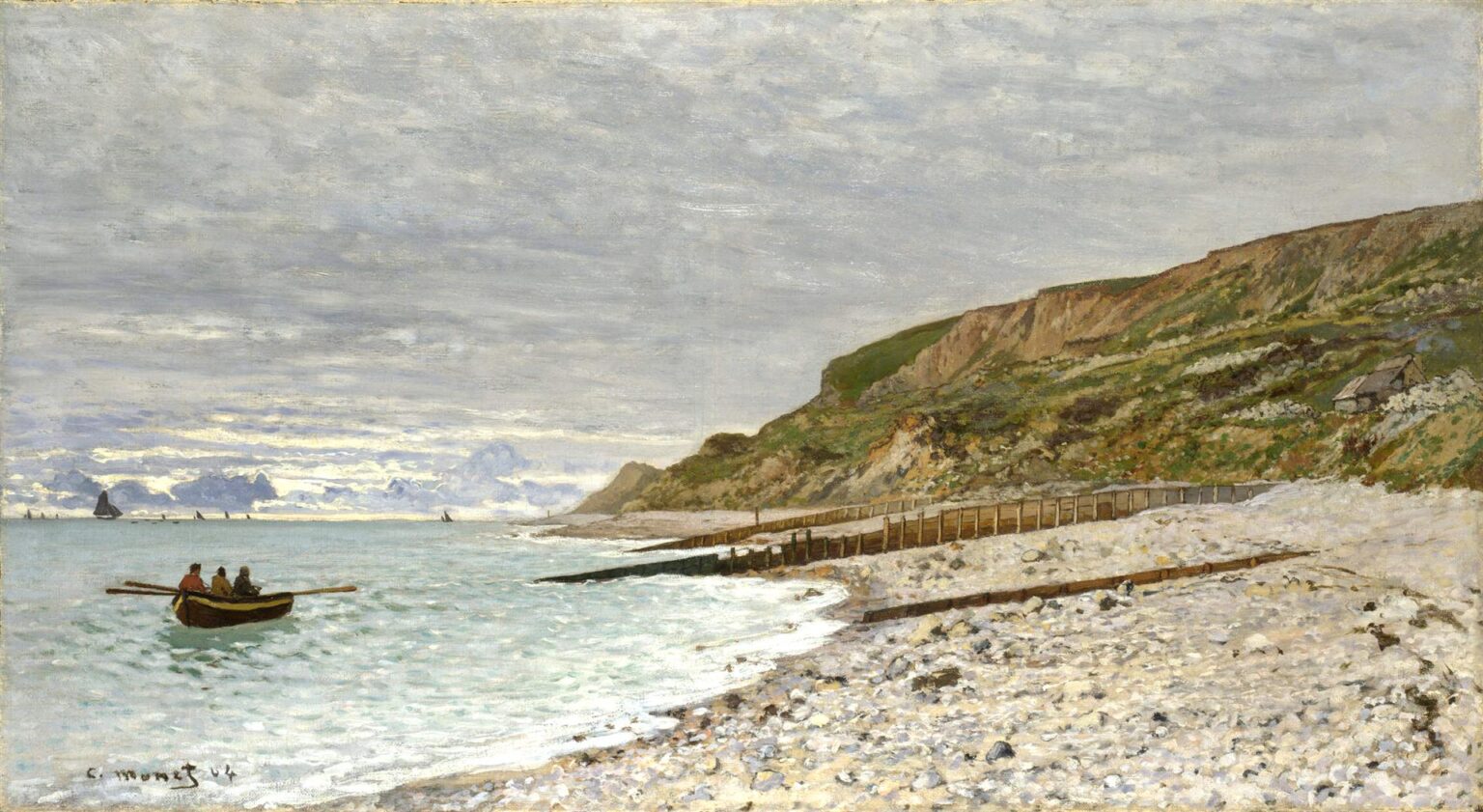
Claude Monet’s The Pointe of Heve from 1864 is a remarkable early coastal painting that reveals how quickly the young artist was developing the visual language that would later transform modern art. At first glance, the scene appears quiet and restrained. A small rowing boat sits on pale water near the shoreline, chalky cliffs stretch across the right side of the composition, and a broad sky hangs over the Channel with a veil of soft gray clouds. Nothing dramatic seems to happen. Yet the longer one looks, the more the painting opens up. Monet is not simply recording a coastal view. He is studying atmosphere, distance, light, texture, and the shifting relationship between land, sea, and sky.
This work belongs to a crucial moment in Monet’s formation. Painted before the first Impressionist exhibition and before the full flowering of his mature style, it shows him already departing from academic finish and moving toward a more immediate way of seeing. Rather than treating nature as a backdrop for narrative, he makes the landscape itself the subject. The sea does not serve as a stage for heroism or anecdote. The cliffs are not symbols inserted into a literary scene. The painting is about perception itself, about what it feels like to stand before the coast and register its light, air, and changing tones.
The location was important for Monet. The Normandy coast, especially around Le Havre and Sainte-Adresse, played a decisive role in his development. The sea, beaches, cliffs, weather, and open horizon offered him a natural laboratory in which to experiment with direct observation. In The Pointe of Heve, he turns a familiar stretch of shoreline into a study of subtle movement and visual harmony. The result is not flashy, but it is deeply modern. It shows a young painter learning how to trust the eye over convention.
Claude Monet in 1864
To understand this painting fully, it helps to place it in Monet’s career. In 1864 he was still a young artist finding his direction, but many of the core elements of his later achievement were already emerging. He had been shaped by the coastal environment of Normandy and by artists who encouraged open-air observation, especially Eugène Boudin and Johan Barthold Jongkind. These painters helped push him toward the direct study of changing weather and light. Their influence did not lead him to imitation. Instead, Monet absorbed their example and pushed further toward a freer, more responsive handling of paint.
At this stage, Monet had not yet become the artist most people now associate with shimmering gardens, cathedrals, haystacks, or water lilies. He was still experimenting with seascapes, river views, village scenes, and portraits. But in these early works one can already see the foundations of his later greatness. He was learning to treat transient effects as worthy subjects in themselves. He was becoming increasingly sensitive to tonal shifts, reflected light, and the instability of surfaces under changing conditions.
The Pointe of Heve captures that moment of transition beautifully. It still retains some structural discipline associated with mid nineteenth century landscape painting. The composition is carefully organized, and the landmass has solidity. Yet the brushwork is loosening, the emphasis on fleeting light is becoming stronger, and the boundaries between objects are softened by atmosphere. Monet is not merely describing what the coast looks like. He is describing how it appears in a particular instant, under specific weather, from a particular vantage point.
The Coastal Setting and Its Importance
The setting of The Pointe of Heve is central to its power. The Pointe de la Hève, near Le Havre, offered Monet a rich mix of visual contrasts. There were open expanses of water, imposing cliffs, narrow beaches, and endlessly variable skies. It was a place where weather could transform the entire appearance of the landscape within minutes. Such a site naturally appealed to an artist interested in perception and change.
In this painting, the coastline curves gently into the distance, guiding the eye along the shore. The cliffs rise in bands of earthy color and green vegetation, their form softened by the moist atmosphere. The beach is pale and stony, filled with broken texture rather than polished detail. Wooden structures, likely groynes or protective barriers, extend into the water and mark the human effort to shape or stabilize the coastline. These man made elements do not dominate the scene, but they matter. They provide rhythm, perspective, and a subtle reminder that this is a lived landscape rather than an untouched wilderness.
The sea itself is calm but not flat. Monet paints it as a shifting reflective plane, touched by light near the horizon and milky in the foreground. The small boat near the left adds a human scale to the composition and balances the massive openness of the sky and shoreline. Distant sails and dark silhouettes on the horizon suggest maritime life, but only faintly. They remain secondary to the larger atmospheric unity of the scene.
What makes the setting especially compelling is its lack of spectacle. Monet does not choose a storm, a shipwreck, or a dramatic sunset. Instead, he chooses a muted day with diffused light. This decision is revealing. He is drawn not to theatrical effect but to subtle relationships of tone and texture. The quietness of the weather allows him to focus on delicate transitions, on the way the cliff merges with the sky at a distance, on the way water brightens near the shore, and on the way chalk, cloud, and sea share a common range of pale hues.
Composition and Spatial Design
One of the most striking features of The Pointe of Heve is its compositional intelligence. Monet organizes the painting so that the viewer experiences both breadth and depth. The shoreline begins near the foreground on the right and recedes toward the center distance, pulling the eye inward. The cliffs then continue that movement, stretching toward the horizon and creating a long diagonal that anchors the composition. This recession of land is balanced by the broad horizontal sweep of the sea and the even broader spread of sky above it.
The painting is therefore built on a tension between diagonal movement and horizontal stability. The diagonals of the beach, barriers, and cliffs create motion and direction. The sea and sky create calm and spaciousness. Together they produce a composition that feels natural but carefully judged. Nothing is crowded, yet nothing is empty. The eye moves easily across the picture, lingering first on the luminous foreground, then on the tiny boat, then along the cliffs, and finally toward the distant horizon.
The placement of the boat is particularly effective. It sits left of center, low in the composition, and prevents the sea from becoming too abstract or detached. It also creates a human point of entry into the scene. The figures in the boat are small, almost incidental, but their presence matters. They make the surrounding world feel larger and more atmospheric. Monet does not turn them into portraits or narrative actors. They are part of the coastal life of the place, absorbed into the wider rhythm of land and sea.
Another compositional strength lies in the distribution of visual weight. The right side contains the cliffs and shore, which are denser and more textured. The left side opens outward into water and sky, which are lighter and less materially dense. This balance prevents the painting from tipping either into heaviness or emptiness. The scene feels stable, but it also breathes.
Light, Weather, and Atmosphere
If the composition provides the structure of The Pointe of Heve, atmosphere provides its soul. Monet is deeply attentive to the weather conditions of the scene. The sky is overcast, but not dark. Instead of dramatic storm clouds or bright blue openness, he gives us a delicate blanket of layered gray and silver tones. The clouds seem to filter the light, spreading it softly across the landscape.
This diffused illumination is essential to the painting’s mood. It eliminates hard shadows and sharp contrasts, allowing forms to emerge gradually rather than abruptly. The cliffs do not stand out in stark outline. The beach does not blaze with direct sunlight. The sea does not glitter with intense highlights. Everything is unified by the same damp, cool, coastal light. The effect is contemplative and deeply convincing.
Monet’s handling of atmosphere also affects spatial depth. The distant portions of the coast become lighter and less defined, partly because of perspective and partly because of air. He understands that distance is not only measured by scale but also by clarity. The farther the land recedes, the more it is absorbed into the surrounding moisture and light. This is one of the ways the painting anticipates Impressionism. Monet is not drawing space with rigid lines. He is painting it through optical relationships.
The light near the horizon is especially beautiful. There, the cloud cover breaks slightly, and the sky glows with a pale brightness that reflects onto the water below. This region of luminosity becomes a quiet focal point. It gives the scene depth, but it also suggests the perpetual variability of coastal weather. The day is not static. The light seems to be shifting even as we look.
Color and Tonal Harmony
The color palette of The Pointe of Heve is restrained, but it is far from dull. Monet builds the painting through subtle variations of gray, cream, pale blue, green, ochre, and brown. These colors do not clash. They merge into one another with great sensitivity, creating a tonal harmony that feels perfectly suited to the maritime setting.
The sky is composed of cool grays touched with blue and silver. The sea echoes these tones, though it becomes greener and milkier toward the foreground. The shore introduces chalky whites and pale earth colors, while the cliffs combine ochre, tan, gray, and muted green. Because the light is so diffused, no single color dominates aggressively. Instead, Monet lets small shifts in temperature and value do the work.
This sensitivity to tone is one of the painting’s greatest achievements. The surface may appear simple from afar, but up close the eye notices how carefully Monet calibrates differences between warm and cool passages. A pale warm band on the cliff can make the nearby green feel fresher. A cool gray in the sky can make the cream colored beach appear brighter. A faint blue reflection in the sea can deepen the sense of moisture and air.
The result is a painting that feels unified without becoming monotonous. Monet does not rely on high contrast or brilliant color to create interest. He finds richness in nuance. This approach would become central to his mature art, where entire paintings could be built around delicate shifts within a limited chromatic range. In The Pointe of Heve, that instinct is already clearly present.
Brushwork and Surface
Monet’s brushwork in this early work deserves close attention because it reveals how he was moving away from polished academic finish toward a more direct and responsive technique. The surface is lively without being reckless. He does not smooth everything into uniformity. Instead, he allows visible strokes to register the texture of sea, beach, cliff, and cloud.
In the sky, the brushwork is light and layered, creating a soft, broken surface that mimics the spread of cloud. In the water, the paint is handled with a gentle flicker, suggesting movement and reflection rather than precise wave description. The beach is rendered with small, varied touches that capture the uneven scatter of stones and chalk. The cliffs combine broader masses with broken strokes that imply vegetation and erosion.
What matters here is not simply that the brushwork is visible, but that it is responsive to different kinds of forms. Monet does not use one uniform method everywhere. He adjusts his touch according to what he sees. The sky requires a veiling softness, the sea a reflective fluidity, and the shore a more granular texture. This flexibility gives the painting both coherence and vitality.
The paint handling also contributes to immediacy. One senses that Monet wants to preserve the freshness of direct observation. He is not laboring to hide the process. The strokes remain present as traces of seeing and making. This quality links the painting to the larger shift that would culminate in Impressionism, where the act of painting becomes inseparable from the experience of perception.
Human Presence and Coastal Life
Although The Pointe of Heve is fundamentally a landscape, human presence is woven into it with quiet precision. The boat with three figures, the distant sails, the shoreline structures, and the small building on the right all remind us that this coast is inhabited and used. Yet Monet refuses to turn these elements into a narrative. They do not tell a story in the literary sense. Instead, they deepen the reality of place.
The rowboat is especially important because it introduces a fragile human scale into a vast natural setting. The figures are tiny, and we cannot identify them individually, but that is not the point. They are part of the scene’s balance. Their presence makes the sea feel broader, the sky higher, and the coastline longer. They also add a note of everyday life, suggesting labor, travel, or simple coastal routine.
The wooden barriers along the shore are another subtle but meaningful detail. They divide space rhythmically and help establish recession into depth. At the same time, they imply ongoing human engagement with the coast, perhaps against erosion or shifting tides. Monet does not moralize about this relationship between humanity and nature. He simply includes it as part of the visible world.
This integration of human activity into the landscape is characteristic of much nineteenth century French landscape painting, but Monet handles it in a distinct way. He does not dramatize the figures or sentimentalize rural labor. He subordinates human anecdote to visual truth. The people are there, but the painting’s main subject remains the atmosphere of the coast itself.
The Painting as an Early Step Toward Impressionism
The Pointe of Heve is not yet full Impressionism in the later, more familiar sense, but it clearly points in that direction. The most important sign of this is Monet’s commitment to transient visual effects. He is less interested in composing an idealized landscape than in capturing a specific moment of light and weather. This emphasis on the fleeting appearance of nature would become one of the defining principles of Impressionist painting.
The work also anticipates Impressionism in its treatment of color and brushwork. Rather than relying on dark outlines and fixed local tones, Monet lets forms emerge through tonal relationships and broken paint. The surface remains active, and the light seems to dissolve hard edges. Even the cliffs, which could have been treated as firm geological masses, are softened by atmosphere and shifting color.
At the same time, the painting retains some elements of earlier landscape conventions. Its composition is carefully stabilized, and the spatial structure is clear. This blend of discipline and freedom makes the work especially interesting. It shows Monet not as a fully formed revolutionary but as a painter in the process of discovering how far direct observation could lead him.
That process matters. Great artistic change rarely appears all at once. It develops through experiments, partial departures, and rethinking established habits. In The Pointe of Heve, one can witness Monet testing a new way of seeing. He is learning that a gray sky can be as visually rich as a sunset, that a quiet coast can be as compelling as a dramatic one, and that the truth of a place lies not in formula but in attention.
Why The Pointe of Heve Still Feels Fresh Today
Part of the lasting appeal of The Pointe of Heve is that it resists easy spectacle. Many viewers expect Monet to offer bright gardens, vivid poppies, or sparkling water. Here, instead, he offers muted weather, a pale beach, and a subdued coastal view. Yet the painting feels alive because it is grounded in genuine looking. Monet trusts nuance, and that trust gives the scene its freshness.
Modern viewers often respond strongly to this kind of work because it feels honest. The coast is not exaggerated. The mood is not forced. The beauty of the painting lies in its sensitivity to ordinary conditions. Most days in nature are not theatrical. They are subtle, shifting, and atmospheric. Monet recognizes that such moments are not lesser. They are full of visual meaning.
The painting also remains fresh because of its balance between immediacy and structure. It feels observed in the moment, yet it is composed with lasting intelligence. It is both spontaneous and considered. That combination is difficult to achieve, and it helps explain why Monet became such a central figure in modern art. He could transform direct perception into enduring form without losing its vitality.
In this early seascape, one can already sense the future master. The mature series paintings, with their obsession with changing light and repeated motifs, are still years away, but the essential impulse is already present. Monet is teaching himself how to paint not just what a place is, but how it appears in time, weather, and memory.
Conclusion
Claude Monet’s The Pointe of Heve is a beautiful and revealing early landscape that captures a turning point in the artist’s development. Through a restrained palette, sensitive atmosphere, intelligent composition, and increasingly free brushwork, Monet transforms a quiet coastal view into a profound meditation on light and perception. The painting may seem modest at first, but its achievement is considerable. It shows a young artist already thinking beyond academic convention and moving toward a new understanding of landscape.
The beach, cliffs, sea, and sky are not treated as separate elements but as parts of a single visual field shaped by weather and light. Human presence remains small and integrated, reinforcing the scale and reality of the setting without distracting from the landscape’s broader unity. Every part of the painting contributes to a feeling of calm attentiveness, as though the scene has been caught in a moment of cool stillness before it changes again.
What makes The Pointe of Heve especially compelling is its combination of discipline and openness. Monet has not yet fully arrived at the style for which he is most famous, but the seeds are unmistakable. His fascination with fleeting atmospheric effects, his sensitivity to tonal nuance, and his willingness to let paint remain alive on the surface all point forward to the innovations that would define Impressionism.
Seen today, the painting remains deeply rewarding. It invites slow looking. It rewards patience. And it reminds us that artistic revolution can begin not with grand declarations, but with careful attention to a cloudy sky, a pale shoreline, and the changing light on the sea.
