Image source: wikiart.org
Introduction
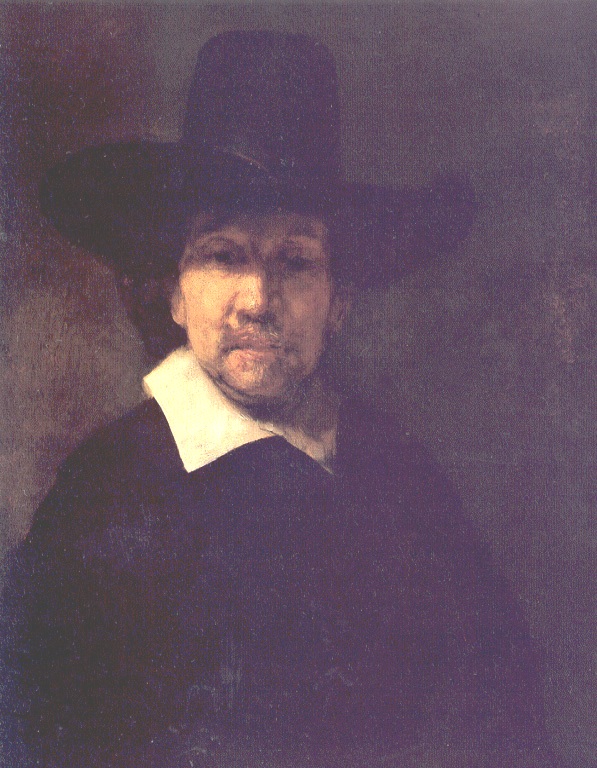
Rembrandt’s “The Poet Jeremia de Decker” (1666) is a late portrait that compresses a lifetime of observation into a restrained, quietly magnetic image. The sitter appears half-length against a neutral ground, his broad-brimmed hat casting a shade across his upper face, his white collar opening a triangle of light at the throat, and his dark coat dissolving into the surrounding dusk. The paint is economical yet richly alive: strokes thicken where flesh catches illumination, thin where fabric sinks into shadow, and soften where edges must breathe. Nothing is superfluous. The picture reads like a conversation held in a low voice, meant for a listener who is willing to draw close and look long.
The Sitter And His Circle
Jeremia de Decker belonged to Amsterdam’s literary world, a poet known for devotional verse and translations that circulated among the cultured circles Rembrandt frequented. The painter’s interest in writers was consistent across his career. He gravitated to scholars and poets whose authority derived not from office but from intellect, and he depicted them with an intimacy that honored their craft. In de Decker’s features we sense a man of letters at midlife: the gaze steady and introspective, the mouth lightly pursed as if weighing a phrase, the skin marked by time but not hardened by it. Rather than staging the poet with symbols—books, quills, or draped tables—Rembrandt relies on expression, posture, and light to suggest vocation. The restraint dignifies both sitter and art.
Composition And The Architecture Of Calm
The composition is built from a handful of large shapes. The hat creates a dark, horizontal arc that stabilizes the upper half of the canvas. Beneath it, the pale wedge of collar forms a luminous countershape, guiding the eye down toward the throat and up again to the face. The torso is a single, quiet mass that anchors the figure. This economy of forms gives the image poise. The body turns slightly in three-quarter view, bringing the head forward and allowing the light to model cheek, nose, and lip. No props interrupt the triangular dialogue among hat, collar, and visage. The architecture of the portrait is therefore a geometry of attention, a scaffold designed to serve the presence of a thinking person.
Light, Shade, And The Drama Of Restraint
Rembrandt’s light in 1666 is full of tact. It descends from the left, grazing the forehead and cheek, and glances across the mustache and the soft fold at the corner of the mouth. The hat’s brim blocks the upper glare, so the eyes emerge from a half-shadow that makes the gaze delicate rather than demonstrative. The white collar collects the strongest illumination, sending a cool reflection upward to soften the jaw. Everything below the chest dissolves into the warm obscurity of the coat. The distribution is purposeful: by letting the brightest values concentrate in the collar and cheek, Rembrandt frames speech and thought while leaving the rest to implication. Darkness becomes an ally, a shelter that permits light to speak in measured phrases.
Palette And Temperature
The palette is sparse yet nuanced: umbers and bone blacks modulated by ocher, a few touches of lead white, and a faint rosy undertone in the flesh. The cool gray of the background quietly shifts near the hat and shoulder, preventing the silhouette from turning into a cutout. The collar’s whites are not a single value but a tissue of warm and cool strokes, so the fold reads as fabric, not chalk. In the face, warm half-tones and cooler gray shadows knit into a natural complexion that looks observed rather than idealized. The restrained color keeps attention on value and temperature, where tiny variations—an ember at the tip of the nose, a chill along the lower eyelid—carry expressive weight.
Brushwork And The Material Intelligence Of Paint
Late Rembrandt treats paint as a speaking substance. In this portrait the handling changes according to need. The hat reads as broad, slightly textured planes made by dragging a loaded brush along a resistant underlayer, leaving a faint rib that mimics worn felt. The collar’s light is built from flexible, semi-opaque strokes placed rapidly and then softened at the edges, an effect that suggests linen smoothed by the sitter’s movement. The flesh is a network of short, adjusted touches: denser over the cheekbone, gentler at the philtrum, a tiny ridge of impasto catching real light at the lower lip. Even the background bears tracks of the bristle, creating a faint atmospheric vibration that keeps the figure from feeling pasted on. The difference in touch across zones provides not only verisimilitude but rhythm.
Hat, Collar, And The Poetics Of Dress
Rembrandt uses clothing as visual character rather than costume. The hat is large, authoritative, and practical; it grants the head a stage while protecting the eyes from glare. The open collar is more than fashion; it is a prism that refracts light toward the face. The coat, unornamented and dark, belongs to a world of letters rather than a court of display. Together these elements suggest a person whose dignity is inward. The simplicity of attire also prevents the portrait from announcing any narrow social type. The sitter could be a poet, a theologian, or a thoughtful citizen—precisely the ambiguity Rembrandt favors when character matters more than category.
Expression And Psychological Depth
The face is quietly animated. The eyes, set back under the brim, do not challenge but attend. The mouth tightens slightly, as if caught between speech and reflection. There is nothing melodramatic in the features—no arched brows, no set jaw—but there is a living tension. Rembrandt’s psychology rests on asymmetry: one eye marginally brighter than the other, one corner of the lip a fraction lower, the head tilted just off center. These minute departures from balance encourage the mind to read motion and thought into the stillness. We feel we are looking at a person who has turned toward us mid-conversation, a phrase lingering in the mind before it becomes sound.
Space, Distance, And The Viewer’s Position
The shallow space behind the sitter draws him toward us. There is no receding vista, no architectural frame, no desk or window to place the figure at a polite remove. Instead we are within conversational distance. The frontal breadth of the hat and collar amplifies this nearness, creating a sense that the portrait occupies our space rather than a theatrical set. The effect is intimacy without informality. We meet the poet not in a salon but in a zone of shared air, where quiet talk would be possible and where every shift of light across his skin would register.
Historical Context And Late Style
Painted in Rembrandt’s final year, the portrait belongs to a period of extraordinary inwardness. The artist had weathered bankruptcy, loss, and the fickleness of fashion; he had honed a style that prized presence over polish and truth over display. In these years he pared down pictorial rhetoric—fewer accessories, fewer theatrical settings, more attention to the expressive capacities of light, value, and touch. “The Poet Jeremia de Decker” exemplifies that approach. It is not a showpiece for patrons; it is a meditation on how little is needed to make a face live in paint. The mastery lies in the restraint.
Comparisons Within The Oeuvre
Compared with Rembrandt’s flamboyant portraits of the 1630s, where crisp costumes and elaborate interiors often dazzle, this painting is austere. The change is not merely stylistic; it reflects a shift in values. In the 1660s Rembrandt finds drama in the subtleties of perception rather than in accessory. Set beside the contemporaneous portraits of scholars or the late self-portraits, the de Decker canvas shares the same softly staged light, the same preference for broad tonal masses, and the same readiness to let darkness carry meaning. It also shares a specific intimacy with portraits of writers and preachers, where the faces are never fully lit, as if to protect inner life from public glare.
The Role Of Shadow And The Ethics Of Looking
One of the portrait’s most moving features is the modesty of its shadows. The brim’s shade does not conceal character; it allows the viewer to look without intruding. We sense a respect for the privacy of thought. The shadow is a veil that the light does not rudely tear aside, and it has an ethical function: to honor the human person as more than the sum of visible details. This approach suits a poet, whose vocation depends on what occurs behind the eyes. Rembrandt’s darkness becomes a partner in truth, not an excuse for vagueness.
Paint Layers, Revisions, And The Time In The Surface
Technical scrutiny of comparable late portraits shows a consistent sequence of operations that is audible here as well. A warm ground sets the overall cast. Large zones of middle value block in hat and coat. The collar and flesh arrive next, often wet-in-wet, so that soft transitions can be developed at speed. Glazes darken the background and unify forms; discrete impastos activate the highlights along cheek and lip. Small revisions—what painters call pentimenti—seem to live in the contour of the hat and the soft edge of the jaw, where a corrected arc or a softened boundary indicates thinking in paint. The surface preserves this history like rings in wood; the image is not a frozen instant but a sediment of decisions.
Language, Poetry, And Portrait
How does a painter make a portrait of a poet without resorting to prop or inscription? Rembrandt answers by translating poetic qualities into pictorial ones. The portrait has cadence: the alternation of dark hat, light collar, and half-lit face creates a rhythm akin to meter. It has tone: a range of values that moves from hush to brightness like modulated voice. It has diction: specific, exacting touches where meaning must be precise—the glint at the tear duct, the wet edge of the lower lip—and broader, suggestive strokes where meaning benefits from ambiguity—the coat’s body, the background’s drift. In this way the painting itself behaves like a poem, concentrating feeling into a spare and resonant form.
Viewing Experience And The Dance Of Distance
The painting rewards shifts in distance. From across a room, the figure resolves with quiet authority, the hat as a dark canopy, the face as a small island of light. At a step’s remove the brushwork emerges, disclosing how the illusion is built: thin veils, thick accents, soft transitions that seem to exhale. Closer still, the skin becomes a terrain of faint ridges and valleys where paint catches light like living flesh. Step back again, and the portrait regathers, the eyes returning to their gentle steadiness. This oscillation between matter and likeness is one of late Rembrandt’s greatest pleasures. The painting remains alive because it never stops being paint.
Legacy And Continuing Relevance
“The Poet Jeremia de Decker” has remained compelling not because it shouts but because it listens. It teaches how portraiture can honor a life of the mind without resorting to cliché. It demonstrates that gravity requires neither pomp nor overstatement. For modern viewers it offers an antidote to spectacle, proposing instead a model of attention: look simply, look long, and you will find character in half-tones and silences. For painters it remains a lesson in the expressive power of limited means—a few values, a few planes, and a living surface are enough to carry a world.
Conclusion
Rembrandt’s portrayal of Jeremia de Decker is a triumph of understatement. The hat’s shadow, the pale collar, the softly lit cheek, and the dark field that receives the coat—all these elements collaborate to produce an image that feels both intimate and monumental. The brushwork lays bare the painter’s hand without sacrificing the sitter’s presence; the palette whispers and yet speaks volumes. In its quiet way the portrait makes a strong claim: that the truest likeness arises not from display but from attention, not from showy detail but from the careful ordering of light and the ethical respect of shadow. It is a painting that meets the viewer with the same qualities one hopes to find in a poet—clarity, humility, and a voice that lingers long after the words have ended.
