Image source: wikiart.org
Introduction
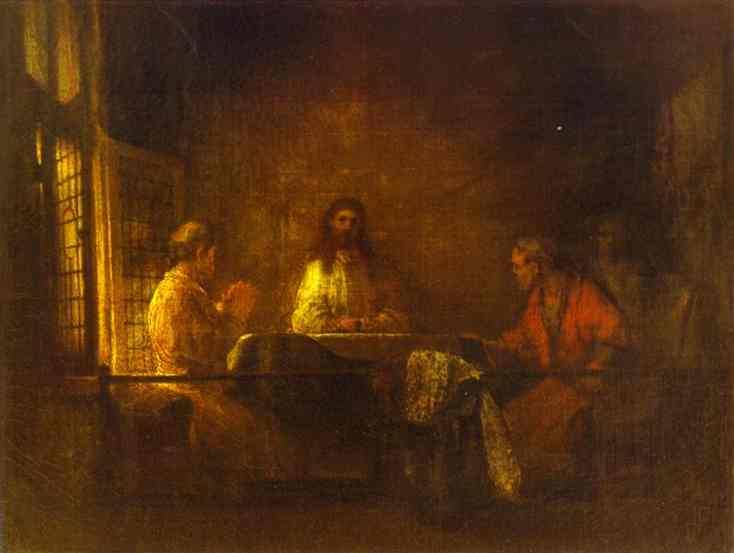
Rembrandt’s “The Pilgrims at Emmaus” transforms a quiet supper into a revelation staged with light, shadow, and the unspectacular gestures of recognition. The scene derives from the Gospel narrative in which two followers meet the risen Christ on the road to Emmaus, fail to recognize him, and only know him “in the breaking of the bread.” Rembrandt compresses the story to the moment of dawning understanding. In a simple room washed by evening light, three figures gather around a table. Christ sits at the center, his presence clarified by a subtle halo of illumination, while the two pilgrims react at different speeds—one in prayerful astonishment, the other leaning forward, mind racing to catch up with the heart. The painting is a meditation on how truth arrives: incrementally, tenderly, and with the power to reconfigure ordinary space into sacred ground.
Composition As A Stage For Recognition
The composition is organized as a low, stable triangle. The table forms the base, and Christ’s softly vertical figure rises to the apex. The pilgrims occupy the left and right corners, creating a conversational symmetry that reads less as tableau and more as a dynamic circuit of attention. Rembrandt places a large plane of wall behind the group, a hushed backdrop whose breadth slows the eye and intensifies the small human motions in front of it. The left edge opens to a bank of windows; their gridded panes constitute a counter-rhythm of rectangles that ground the room in Dutch domesticity. This mix of geometric calm and human asymmetry keeps the narrative focused and believable, while the triangular structure establishes Christ as quiet center rather than theatrical star.
Light As Revelation Rather Than Spectacle
Light in this painting does theological work. It enters from the left, slips across the windows, and sifts into the chamber with the tired warmth of late day. That secular light becomes sacred when it reaches Christ’s figure, where it brightens into a gentle aureole that defines his shoulders and face without resorting to a drawn halo. The face is not aggressively lit; it glows as if the source were near but not visible. The pilgrims are modeled by the same light but receive it differently. The one at left turns his hands upward in a gesture of blessing or shock; the light catches those hands and underscores the intimacy of his response. The figure at right, in a warm garment, leans toward the table; light slips along his sleeve and cheek, showing the mind’s acceleration toward recognition. Darkness gathers under the table and behind the figures, not as menace but as soft enclosure. The chiaroscuro is moral and psychological: truth is emerging from within the ordinary dusk of human perception.
The Table As Threshold
The table is the painting’s hinge between daily life and sacrament. Its surface is modest, almost rough, covered with a plain cloth that spills toward the viewer in a single, tactile fold. Upon it lies bread, barely indicated, along with a few domestic objects that Rembrandt refuses to catalogue. The unadorned quality of the setting emphasizes the theology at stake: the risen Christ reveals himself in common things. The table’s slight recession in space draws viewers into participation. We are not positioned grandly above the scene; we take a seat at its edge, close enough to feel the heat of the room and the surprise that ripples through it.
Palette And Tonal Harmony
The palette is a restrained harmony of earths and embered golds. Warm browns, honeyed ochers, umbers, and softened reds establish an atmosphere of dusk. The highlights carry no icy whites; even the brightest notes are warmed by glazes, creating the sensation of light traveling through air rather than striking hard surfaces. This tonal unity supports the theme of recognition. No color shouts. Instead, the painting persuades with calm, allowing fine modulations—light along a window mullion, a tremor of brightness on a cheek—to speak decisively. The right pilgrim’s garment, likely a red-brown, serves as the picture’s physiological pulse; it attracts the eye and then yields it back to the center.
Gesture, Expression, And The Drama Of Real Time
Rembrandt is unmatched at painting states of mind as they unfold. Here, the pilgrims’ bodies tell the story before their faces fully catch up. The left pilgrim, hands raised, is already inside the revelation; his palms open like pages, and he seems to bless as he is being blessed. The right pilgrim is the narrative’s hinge; his body leans, his head tilts, his mouth begins to part. He is the thought turning into certainty. Christ’s gesture is the picture’s gentlest: both hands near the bread, not dramatically tearing but poised in blessing and offering. The restrained muscle of these gestures makes the moment feel true, as if we have walked into a room where something rare is happening and everyone has the grace not to perform it.
Space, Silence, And The Room Of The Heart
The room itself is a character. Its walls are thick with the brown hush of evening; its windows are complicated enough to convince without demanding attention; its dimensions are domestic, not monumental. Rembrandt’s refusal to decorate has a moral logic: the sacred shows itself in the ordinary when eyes are ready. The painting’s silence is palpable. You can almost hear the small scrape of the bench, the soft clink of tableware settling, the inhaled breath before a name is spoken. That silence is not emptiness; it is the atmosphere in which recognition breathes.
The Windows And The Ethics Of Looking
The bank of windows on the left is a subtle mirror of the narrative. They are gridded, translucent, and mostly unreadable, exactly like the pilgrims’ understanding at the story’s onset. As light moves across their panes and enters the room, the windows become a metaphor for perception itself—structured, limited, yet capable of carrying illumination. Rembrandt resists showing a clear world outside; we see the threshold and the filtered air instead. Our attention returns to the table, where a clearer seeing is happening.
The Bread As Image And Event
Every Emmaus picture must handle bread, the modest object carrying immense meaning. Rembrandt keeps it small, centrally placed, and touchable. It is neither gilded nor heaped. Christ’s hands hover near it with a gravity that is as much memory as miracle—memory of meals before the Passion and of the breaking that will now mean something new. The bread’s ordinariness is not aesthetic stinginess; it is doctrine made visual. What transforms the bread is the presence revealed and the eyes that are opened. The painting makes that transformation legible without sensationalism.
Brushwork, Glaze, And The Intelligence Of Paint
Rembrandt’s late manner finds a perfect subject here. The foreground and faces are painted with relatively small, supple strokes that preserve soft transitions. The wall and deeper recesses are built from broader, scumbled passages through which underlayers breathe. Glazes warm the light and sink the shadow, creating a unified atmosphere where highlights feel earned, not applied. The window mullions and cloth edges show more decisive touches, anchoring the scene’s geometry. Paint is never merely descriptive; it carries emotion. The way light clings to Christ’s shoulder, for example, is as expressive as any facial detail.
Psychological Time And The Viewer’s Journey
The painting lets us feel time passing. We travel from left to right, following the light from windows to table, where recognition first ignites in one pilgrim, then crosses the table to kindle the other. We then return to the center, where Christ’s calm encompasses both speeds of response. The eye repeats this circuit, and with each loop the room seems to deepen and the moment to widen. The painting’s pacing is tender; revelation here is not a thunderclap but a tide.
Theology Without Insistence
The canvas is rich with faith but free of coercion. There is no halo traced with a ruling pen, no angelic chorus at the margins. Rembrandt refuses devices that would extract assent by spectacle. Instead, he offers the dignity of still life turned sacramental, of conversation warmed into communion. Believers will find confirmation of the story’s heart; those who are not will still recognize a profound image of recognition and companionship. The common ground is attention itself, which the painting treats as a sacred act.
Domesticity And The Sacred Ordinary
The power of this work rests in how gently it marries the sacred and the domestic. The benches are plain; the tablecloth is serviceable; the light is recognizably Northern. The room feels like hundreds of rooms in Dutch houses, and precisely for that reason it can become the site of a miracle. Rembrandt thereby makes a cultural proposition: holiness visits ordinary homes, and revelation occurs within the habits of supper, conversation, and hospitality. This democratization is not a modern imposition; it is baked into the Gospel episode. The painting’s fidelity to it is both historical and visionary.
Comparisons Within Rembrandt’s Oeuvre
Rembrandt returned often to Emmaus, and this version distills lessons learned across decades of grappling with biblical presence. It shares the tender chiaroscuro of “Supper at Emmaus” and the subdued grandeur of late portraits where character is modeled by light. It converses with domestic interiors in which windows create lattices of illumination across ordinary lives. The painting also sits beside the late self-portraits as a document of belief that is more interior than ecclesiastical: not a spectacle of piety, but a record of inward seeing made outward.
The Spectator’s Ethics
This picture teaches us how to be present at another’s moment of truth. We are positioned neither as judges nor as voyeurs. The low vantage, the modest table edge, the absence of obstacles between viewer and scene—they invite close, respectful attendance. The painting asks for the same virtues it depicts: patience, watchfulness, and readiness to be changed by what we see. Standing before it, we practice a kind of Emmaus ourselves—moving from unknowing to recognition through the simple act of staying with a scene until its light clarifies us.
Material Presence And Spiritual Meaning
Rembrandt’s art often converts the physical into the spiritual without dissolving one into the other. In this painting, the thickness of paint where light is richest, the grainy scumbles of wall, the slackness of the tablecloth’s fold, the heaviness of a sleeve—each is both matter and meaning. The materials insist on their reality while participating in a second reality of symbol and story. That doubleness is not a trick; it is the mystery the painting celebrates: the divine recognized in bread, in a gesture, in a familiar room.
How To Look, Slowly
To receive the painting fully, let your eyes adjust to the darkness first. Begin at the window, where muted squares mark the threshold between outer and inner light. Drift toward the table and settle on Christ’s face, whose glow is modest but inexhaustible. Move to the left pilgrim’s lifted hands and feel the hush of prayer; then travel to the right pilgrim’s leaning body and sense the brain’s click toward belief. Lastly, rest on the fallen edge of the cloth as it comes toward you; that ordinary fold is the bridge between your space and theirs. Repeat this journey and the room will seem to breathe.
Enduring Relevance
“The Pilgrims at Emmaus” endures because it honors the ways truth still arrives in a distracted world: around tables, in conversation, amid the chores of an evening. It does not ask us to step outside of life but to look within it more carefully. The painting’s light is not the light of spectacle but of recognition—the sort we know when a meaning finally clarifies or a person we thought lost stands before us changed and yet the same. That is why the canvas continues to feel modern. It trusts that the sacred remains available wherever attention gathers.
Conclusion
Rembrandt’s vision of Emmaus is less a miracle witnessed than a meal transfigured. Composition centers the table; light clarifies without dazzling; color sustains a low, warm chord; brushwork varies from tender to rough with the intelligence of lived experience. Most of all, the painting offers a profound study of recognition as it enters human faces at different speeds. Standing before it, we are reminded that revelation often looks like supper, that holiness arrives as companionship, and that the most powerful light in a room is the one that teaches people to truly see.