Image source: wikiart.org
A Still Life That Breathes
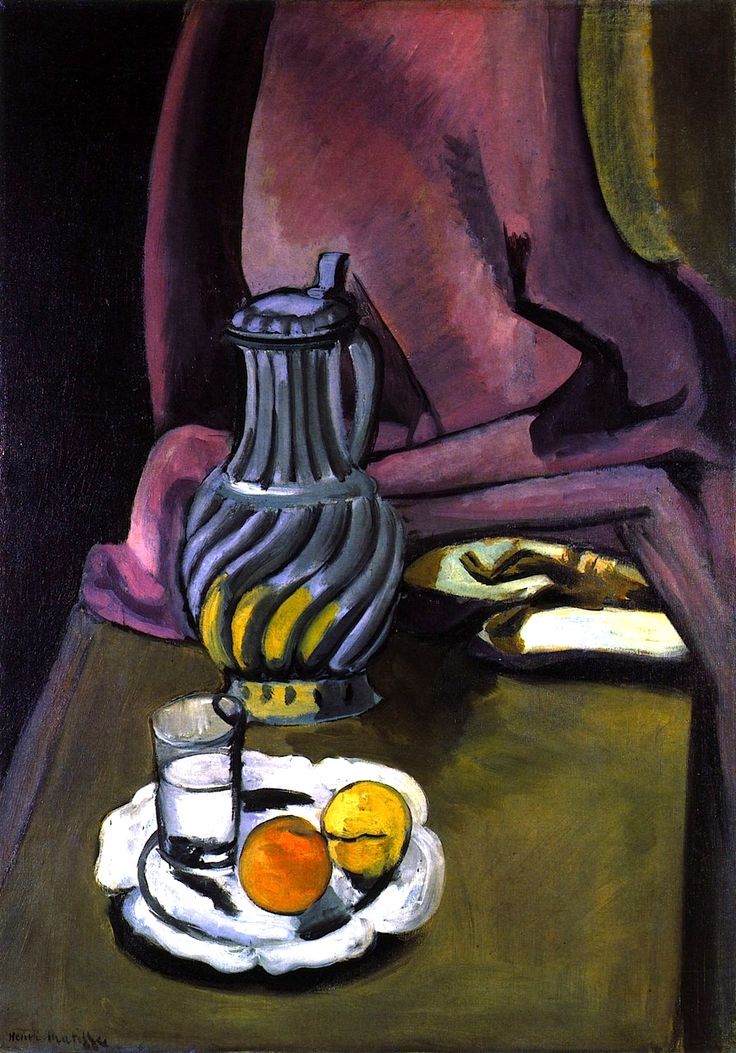
Henri Matisse’s “The Pewter Jug” (1917) transforms a small tabletop scene into a theater of structure, color, and touch. At its center stands a ribbed, lidded vessel modeled in pewter tones that fold and twist like a column of soft metal. A scalloped white plate anchors the foreground; a glass of water, an orange, and a lemon provide measured flashes of light and warmth. Behind them, a pink-violet drapery slumps across a dark void and a mustard-yellow napkin catches on the table’s edge. The arrangement is modest, but the painting is anything but modest in intention. It is a lesson in how a few objects can carry the full weight of pictorial thought when line, plane, and color are set in precise relation.
First Impressions and the Logic of the Setup
The composition places the jug slightly left of center, its height and mass balanced by the expanse of drapery and the horizontal run of table. The scalloped plate sits at the lower left corner like a medallion stamped onto the surface, while the glass of water rises within it as a vertical counter to the jug. At the right, a folded cloth and a creased stretch of drape fill the middle distance, tying foreground and background into a single, continuous field. Matisse crops tight at the top and sides, generating an immediacy that feels like reaching distance. The tabletop’s plane tilts toward the viewer in the French tradition of still life, compressing space so that forms press against the picture plane without losing their volume.
The Jug as Architecture
The pewter jug is the painting’s protagonist and its architecture. Its ribbed belly spirals gently, catching light along alternating ridges of cool gray and subdued yellow. The lid caps the figure with a small domed roof; the handle arcs out and back as a measured bracket. The jug’s contours are drawn with the supple black that is Matisse’s hallmark—thick where he wants weight, thinned where he wants breath. Those black edges do not sit on the form; they build it, acting like the lead came in stained glass that holds color fields in place. Where the ribs curve inward, the contour compresses; where the body swells, the contour opens. The result is an object that feels both metal-solid and pictorially elastic, a form that stands, turns, and commands the space.
Color as Structure and Atmosphere
Matisse restricts himself to a short, eloquent palette: pewter grays for the jug, a spectrum of violets and plum-roses for the drapery, olive and ocher yellows for cloth and reflected light, deep blacks to carve space, and two assertive notes of warm color in the orange and lemon. The whites of the plate and water are not paper-white; they are creamy, with shadows that take on the colors of the neighbors—violet on the rim, gray along the glass. Because the palette is limited, each color has a job. The grays give weight and coolness to the metal; the violets provide a luminous, airlike backdrop; the yellows bridge metal and fabric; the citrus warms the entire orchestration without overwhelming it. Nothing is superfluous. Color does not decorate; it organizes.
Black Contour and the Discipline of Drawing
Throughout the painting, black is used not merely to outline but to organize space. The handle’s inner edge, the rim of the glass, the scallops of the plate, and the creases of the drape are all stated with decisive black strokes. These marks declare intervals, separate planes, and establish the rhythm by which the eye travels. The effect is clarity without dryness. The lines thicken, break, and recover; their pressure records the painter’s wrist and arm. In a work from 1917—a year when Matisse’s palette is quieter than in his Fauve period—black regains its status as a load-bearing color, a structural tone that frames and intensifies the surrounding hues.
Light That Clarifies Rather Than Theatricalizes
The light in “The Pewter Jug” is broad and calm. There is no spotlight splitting the composition into hero and entourage. Instead, a generalized daylight washes the objects, catching on metal ribs, drifting across the folded cloth, and pooling in the glass. Highlights are simply paler passages, never whipped into glare. Shadows are planes of cooler color that rest rather than slash. This refusal of theatrical chiaroscuro keeps the painting open and breathable. Each object offers itself to sight as a series of legible planes; volume emerges from value steps, not from tricks of shine.
The Role of the Drapery
The pink-violet drapery is more than backdrop. It is a second protagonist, a counter-form to the jug. Where the jug is structured by spiral order, the drapery is governed by gravity and fold. Its arcs and triangular pleats echo the jug’s curves while softening them. Tonal shifts across the drape move from mauve to wine, interrupted by deeper bands where folds overlap. The drapery’s edge, trimmed in black, cuts diagonals that animate the empty right side of the table, leading the viewer toward the folded yellow cloth and back to the jug. This orchestration shows Matisse’s mastery of negative space: the drapery’s voids—those dark pockets between folds—are as alive as the colored planes.
The Scalloped Plate and the Quiet Drama of White
The white plate’s scallops deliver a regular rhythm, a low hum that stabilizes the lower left. Its surface carries reflections of the glass and fruit: faint oval shadows, a cool gray cast, a touch of yellow bounce from the lemon. Matisse paints white as a color among colors, not as absence. Its thickness varies, sometimes opaque, sometimes thin enough to reveal the underpainting. Those variations produce the porcelain’s sense of weight. The plate catches real light in the gallery and metaphorical light in the composition, functioning as a visual pause between the intense presence of jug and drape.
The Glass of Water as a Modernist Device
The glass of water is a study in compression and clarity. Its cylinder is drawn with two dark ellipses and a single vertical seam; the water line sits just over halfway, and inside the glass a slender black utensil or stem introduces a vertical accent. The transparency is handled with almost no illusionism: a few reflections, a pale wash of the tabletop color lifted into the glass, and the suggestion of the plate beneath. The glass works as a modernist device—an object that both belongs to the still life and comments on it. It is a small cylinder of pure painting, a place where real-world transparency becomes the idea of transparency conducted in paint.
The Citrus as Color Engine
The orange and lemon are the painting’s two brightest notes. They are not fussed as botanical specimens; their dimpled skins are suggested by broad, tactile strokes, their lights and shadows by large value transitions. The orange’s richer, redder hue and the lemon’s cooler, acid yellow play off the violets behind them, and both glow all the more because their complements pervade the scene. Without these two fruits the painting would be an admirable arrangement of grays and violets; with them it becomes a world with a pulse. They are the warm heartbeat, small in size but decisive in effect.
Spatial Design and the Tilted Plane
The tabletop tilts toward the viewer, a deliberate choice that compresses deep space into a shallow stage where color and line can perform. The edges of the table approach the picture’s edges at oblique angles; the top left corner disappears into darkness, while the right edge meets the drapery. The tilt aligns with the jug’s vertical thrust, making the table feel like a solid block rather than a receding plane. In this shallow space Matisse can keep forms close to the picture plane, creating a modern sense of presence where objects are not distant illusions but near, declarative facts.
Material Presence and the Pleasure of Paint
One of the painting’s quiet joys is its surface. Brushstrokes in the drapery record their direction and pressure; the jug’s rib highlights are set with confident swipes; the tabletop’s ocher has been dragged and glazed so that warmer and cooler notes interweave. At the plate’s rim a ridge of white impasto catches real light, while a passage of black along the jug’s handle shows where the brush bristled. Matisse leaves these traces visible. The painting is not polished to disguise its making; it welcomes the viewer into the record of decisions that produced its balance.
A 1917 Temperament
Dated 1917, the canvas exemplifies the discipline Matisse adopted during and just after the First World War. The wild chroma of his Fauve years is tempered; black and gray return as governing tones; composition more than color carries drama. Yet the work is not austere. The violet drapery, the slip of yellow cloth, and the saturated citrus prove that restraint does not mean deprivation. The painting’s mood—lucid, concentrated, unhurried—reflects a desire for order and calm without sacrificing sensuous pleasure.
Dialogues with Tradition: Chardin, Cézanne, and the Moderns
“The Pewter Jug” converses with still-life forebears while declaring its own modern grammar. Chardin’s calm domestic objects echo in the jug’s solidity and in the plain dignity of the plate and glass. Cézanne’s lesson—organize by planes and let color build form—appears in the tilted table and the scaffolding of drawn edges. But where Cézanne facets, Matisse outlines; where Chardin dissolves edges into atmosphere, Matisse hardens them into design. The painting shares with his contemporaries a belief that clarity and economy can deliver depth of feeling.
The Eye’s Path Through the Painting
The viewer’s itinerary is beautifully choreographed. Many enter at the bright plate and fruit, then rise to the glass and its dark interior line. From there the jug’s spiral ribs pull the gaze upward and around to the lid, which releases the eye into the drapery’s sloped plane. Following a diagonal crease, the eye glides to the folded yellow cloth and the table’s far right corner, then returns along the table edge to the plate. This loop repeats, each time catching new details: a cool reflection on the jug, a deeper violet in a fold, a tiny flick of white on the lemon’s pith. The composition’s pleasure is not a single epiphany but a steady rhythm of rediscovery.
Ornament and Order Kept in Balance
Matisse often walked the fine line between decorative richness and structural rigor. Here the scalloped plate, ribbed jug, creased drape, and dotted cloth edges provide ornament, while the black contours and broad color fields impose order. The decorative elements are not all-over patterns; they are concentrated along edges and in a few key zones so that they reinforce rather than dissolve structure. The painting satisfies both appetites at once: the desire for sensuous surfaces and the desire for an intelligible architecture.
Touching on Symbol Without Program
Still lifes naturally invite symbolic readings—metal for endurance, water for clarity, citrus for life, drapery for luxury. Matisse neither insists upon nor excludes these associations. He lets them hover in the periphery while he keeps his attention on pictorial coherence. If the jug feels like a guardian figure and the fruits like small suns, it is because the design has made those feelings plausible, not because a narrative has been imposed. The painting’s iconography is the language of painting itself.
Why This Still Life Endures
“The Pewter Jug” endures because it demonstrates a difficult truth: restraint, not extravagance, can make a painting feel abundant. With a handful of forms and a narrow palette Matisse constructs a space we can inhabit, a rhythm we can follow, and a climate we can sense. The canvas is generous at both distances. From across a room it declares a clear arrangement: a tall jug, a drape, a plate with glass and fruit. Up close it offers the intimacy of brushwork and edge. The two experiences—graphic legibility and tactile nearness—support each other, ensuring that the picture rewards returning eyes.
A Closing Reflection
To spend time with this canvas is to feel how painting can turn ordinary objects into a conversation about order and delight. The jug’s spiral ribs become a classical column, the plate’s scallops become a ground beat, the drapery becomes weather. The glass of water is a small piece of logic that clarifies everything around it. Nothing clamors; everything participates. Matisse has created a still life that seems to breathe, as if with each glance the jug takes in light and lets it out again across the drape and the plate. In a year marked by uncertainty, this measured harmony is its own kind of statement about how to see.