Image source: wikiart.org
A Studio Turned Inside Out
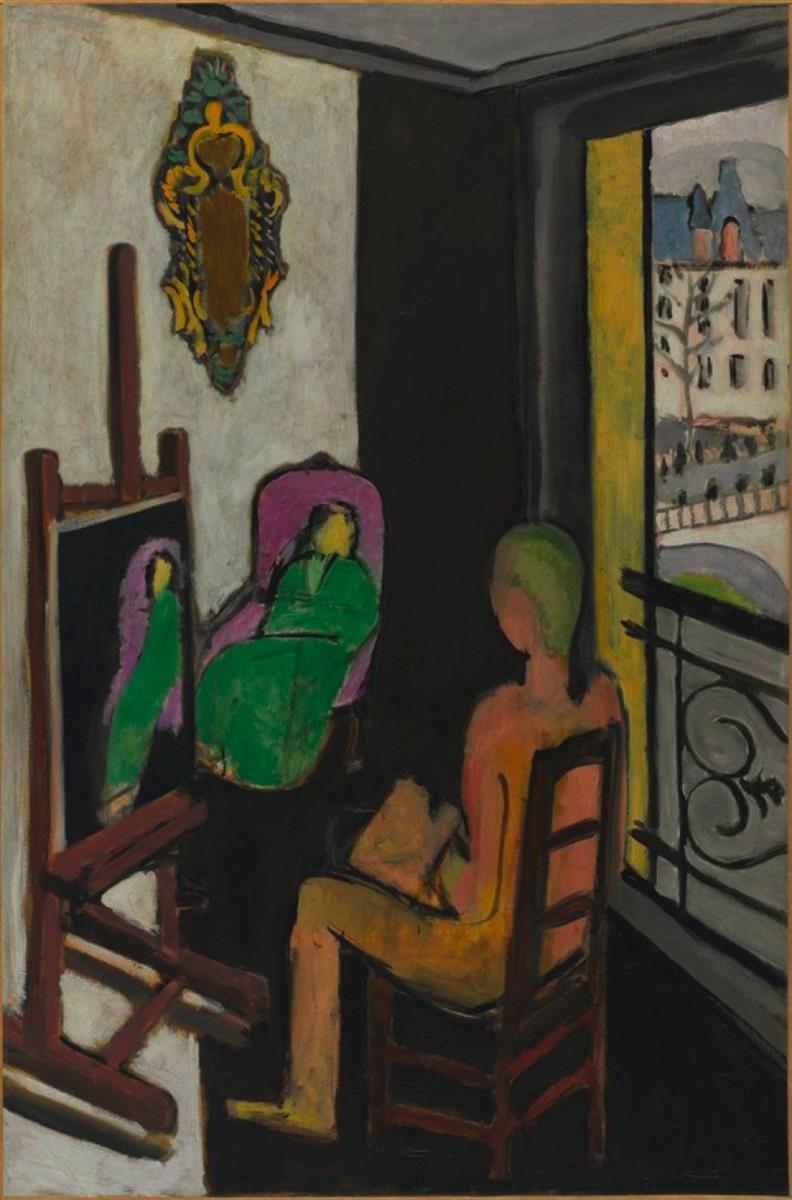
Henri Matisse’s “The Painter and His Model” (1916) is an interior that feels both deeply private and surprisingly public. At first glance we see a studio: an easel at left, a model draped in green on a violet chair, the painter himself seated with sketchbook in hand, and to the right a balcony door that opens onto the city. But the more we look, the more the room behaves like a thinking machine. Broad zones of black carve the space into mental compartments, while high-key passages of green, pink, and yellow flare like ideas. The painting is not a neutral record of work in progress. It is a proposition about what painting is, how looking happens, and how inside and outside life braid together.
The Scene and Its Stage
Matisse builds the studio like a stage set assembled from a few decisive planes. A pale wall occupies the left third of the canvas. A curtain of deep, velvety black claims the center and spills toward the floor, creating a pocket where the model and easel reside. On the right, a tall vertical slit—an open door or window—introduces a panel of yellow and a strip of exterior cityscape. The composition is simple and powerful: pale, dark, bright. The viewer’s eye moves from the cool restraint of the white wall to the saturated black of the studio’s heart and then out to the sunlit view. This triptych of light zones organizes everything else.
The furnishings are plain and functional. The easel stands with its legs splayed in the lower left. The model’s upholstered chair forms a soft mound of violet, an oasis amid the black. The painter sits on a wooden chair, his back to us, his body rendered in warm, earthy notes that read like a living counterweight to the cool walls around him. The balcony railing, drawn in confident curlicues, is both ornament and boundary. Beyond it, the urban façade appears as brisk patches of gray, rose, and blue. Nothing is overdescribed. Matisse chooses the few marks that make each thing necessary.
A Painting Inside a Painting
On the easel we see a canvas that already contains the model. The small internal image mirrors the larger composition: a figure in green, a halo of violet, a black surround. With this self-reference Matisse invites us to shuttle between three realities—the model in the room, the model in the unfinished painting, and the model in the painting we ourselves are viewing. The nested structure turns the studio into a hall of mirrors where each act of representation generates another. Instead of confusing the eye, this doubling clarifies Matisse’s belief that painting is not a window onto the world but a construction that openly displays its own rules.
Importantly, the smaller image is not a careful copy. It is a sign—few shapes, strong contour, emphatic color. The difference in scale between model and image suggests the compression that occurs when experience becomes art. We watch the painter look, decide, abbreviate, and transform. The process is laid bare for us, not in academic diagrams, but in the live tension between figure and picture.
The Model as Presence and Color
The model, reclining or perhaps sitting deep in the chair, is a concentrated chord of green, violet, and yellow. Her face is not detailed; it is a golden oval encircled by darker hair. The robe or garment is a deep, wet green that holds the middle of the painting like a jewel pinned to velvet. Matisse’s decision to treat the model as a color-shape rather than an anatomically descriptive body pushes us to feel rather than inventory. She is an area of radiance held within a black alcove, a calm heart inside a studio that otherwise hums with structural decisions.
Her pose is closed yet not withdrawn. The angle of the chair tilts slightly toward the easel, forming an inward loop with the painter’s seated body. Between them, invisible lines of attention run back and forth. We read the model not only as a person but as a generator of color. That is not depersonalizing; it is faithful to Matisse’s understanding that human presence in painting is as much a matter of chromatic relations as of portrait likeness.
The Painter as a Block of Warmth
At right, the painter sits with his back to us, legs bent, sketchbook resting on a thigh. He is an earthy orange and ocher form, edged in dark brown. The head is a simple rounded shape with a greenish cast that rhymes subtly with the model’s robe. In denying us the painter’s face, Matisse avoids anecdote and directs attention to posture. This is a body in the act of looking and translating. The bare skin—which may suggest nudity or simply the economy of color—turns the painter into a living counter-form to the black studio and the exterior yellow. He is the warm middle between dark and light, interior and exterior.
The chair’s lattice back and angled legs form a quiet geometry that locks the body in space. Everything about the figure’s construction is economical. The rounded shoulder and bent arm are drawn as if cut from a single piece of paper. The sketchbook is little more than a lozenge of tan. Yet we feel the weight of concentration. The painter is not idolized; he is a workman in his element.
Black as Architecture and Thought
The most dramatic feature of the picture is the great vertical band of black that divides room from balcony and that swallows the floor beneath model and painter. This is not shadow in the naturalistic sense; it is a structural color, an active force. Black defines the studio as a realm where light is absorbed and transformed. It dramatizes the silhouettes of chair, easel, and figures, making them read like cutouts. At the same time, the black sets off the bright zones—green robe, pink upholstery, yellow doorway—so that color seems to glow from within.
Matisse uses black not as an outline alone but as a plane. The surface drinks light, giving the surrounding colors a milky luminosity. That strategy goes back to his Fauvist belief in color’s independence from local description but now weds it to a calmer architecture. Black becomes the studio’s gravity—necessary, weighty, and serene.
The Open Window and the City Beyond
At the right edge, an open door or window introduces a competing reality. A vertical stripe of yellow frames the view and pours a ribbon of daylight into the black interior. The balcony’s wrought iron spins decorative arabesques that echo motifs elsewhere in Matisse’s work. Beyond the railing, façades line a street or square, their windows arranged in terse rows, their roofs a blue-gray rhythm against the sky. The city is constructed with astonishing economy—daubs for windows, a brushed tree trunk, a swatch of green for a park or garden. Its presence does not overwhelm the studio; it seasons it. The painter works within culture, within a living city, and the painting acknowledges that social context with a single glance outward.
The yellow sliver is more than sunlight. It is painting’s connection to the world, a narrow but vital conduit. It keeps the studio from feeling sealed and reminds us that art’s ordered space remains in conversation with the unpredictability beyond.
Ornaments and Echoes
Above the model hangs a wall ornament shaped like a shield or mirror, with curling green and yellow flourishes around a brown center. Its baroque curves repeat the balcony’s ironwork and the painter’s curved shoulder. This ornamental punctuation serves two jobs. It animates the pale wall so the left third of the picture does not go quiet, and it reasserts the idea that decoration—pattern, arabesque, stylization—is not frivolous but structural in Matisse. The object’s warm colors bridge model and painter; its green repeats the robe, its yellow predicts the doorway. Small as it is, the ornament is a node in the color network.
Color as Climate
Matisse narrows the palette to intensify climate. The painting has three dominant temperatures: the cool chalky wall, the deep neutral black, and the sun-warmed yellow of the opening. The chromatic accents—the model’s green, the violet chair, the painter’s ocher skin—sit like gemstones set into those metals. Because the surrounding fields are restrained, each accent speaks with clarity. The green is not just a hue; it is a state. The violet is not just upholstery; it is a cushion of calm. The painter’s ocher is not just flesh tone; it is the color of work.
In several places Matisse lets color exceed strict description. The painter’s head carries a green cast, as if reflecting the model’s robe. The floor near the balcony darkens into black that cannot be explained by light source alone. Such liberties teach the viewer to read color relationally: what matters is how one patch modifies another, not how faithfully it mimics an object.
Drawing With the Brush
The painting is built from edges that feel cut and placed. Thick black contours around the easel, chair, and railing are not timid traces; they are assertive strokes that establish boundaries. Inside those boundaries, color is laid in with broad, opaque passages. The lines of the balcony are drawn with a loaded brush that records pressure changes and small tremors of the wrist, giving the railing a human vibrato. On the wall, the fascia between white and black is softened by a smoky transition, proof of the painter’s sensitivity to plane meeting plane.
Throughout, Matisse’s drawing trusts economy. Where another painter might model a cheek or shade a robe, he lets a single shift in value or temperature do the job. The result is clarity without brittleness.
Space as Negotiation Rather Than Illusion
Perspective is present but simplified. The balcony railing recedes in a gentle diagonal; the easel’s legs splay in believable foreshortening; the chair seats overlap convincingly. Yet the planar logic of the painting prevents deep tunneling into space. The black middle acts like a wall as much as an interior; the pale wall at left reads as a flat screen; the open doorway is a vertical slab. Matisse purposely keeps the picture shallow so that the viewer oscillates between reading it as a room and as an arrangement of colored planes. That oscillation—between fact and design—is where the painting’s vitality resides.
The Year 1916 and the Work’s Mood
Painted in the midst of the First World War, the canvas refuses gloom without denying gravity. The studio is a refuge, but not an escape. The city beyond continues to exist; the painter continues to work. The picture’s mood is poised, concentrated, undramatic, resolved. It enacts a discipline that feels ethical as well as aesthetic: focus on essentials, build with clarity, maintain connections to life. Compared with the blaze of early Fauvism, this is a mature quietude, a harmonization of pleasure and order.
Dialogues With Matisse’s Other Interiors
Matisse repeatedly painted studios and rooms with windows, treating interiors as engines of composition. Here we can see the seeds of the later Nice period, where open windows, iron balconies, and pale walls become theaters for patterned fabrics and reclining figures. Yet the 1916 canvas is more severe. The large black field has few parallels in the later, lighter works. The austerity lends the painting a classic strength, a monumental stillness that makes the bright accents more telling.
The nested painting on the easel also anticipates Matisse’s late cut-outs, where form is reduced to flat silhouettes with strong edges. The model’s green shape on the easel could almost be a paper cut-out already, proof that the artist was moving toward seeing figures as harmonized blocks rather than elaborated volumes.
How the Eye Moves
Matisse guides the viewer with a choreography that feels natural. Many eyes begin at the easel’s dark frame and the green figure within. From there we slide to the actual model in her violet seat, then across the black to the ocher back of the painter. The yellow slit of the balcony pulls us outward to the small city, and the iron scroll brings us back in a looping curve toward the painter again. The trip completes a circuit from image to subject to maker to world and back to maker. It is a perfect diagram of how art circulates among realities.
Time, Process, and the Visible Hand
The surface retains signs of decisions—the soft erasure of a contour here, a thicker rim of paint at an edge there, a pentimento where black meets white. These traces are not cleaned away. Matisse believes that the process of finding the picture is part of the picture’s truth. We sense pauses, revisions, and re-entries. The viewer is not watching a sealed product but a living record of thinking-through-paint.
Psychology Without Melodrama
Because faces are not the carriers of emotion here, psychology arises from posture, interval, and color. The painter’s inward tilt toward the model, the snugness of their shared black field, the outward tug of the balcony, the guardrail’s ornamental barrier—these elements create a mood of concentrated intimacy open to the world. The painting feels like silence filled with attention, the atmosphere of a studio hour when the room, the model, the painter, and the city breathe together.
Why the Painting Endures
“The Painter and His Model” endures because it gives a lucid answer to an old question: how do you show painting thinking about itself without becoming academic or cold? Matisse’s response is to stage the problem in a real room with real bodies and to solve it with color and plane. The painting is candid about its construction, generous in its feeling, and exact in its design. It lets the viewer experience the loop between perception and creation, between the seen and the made. That loop is not theoretical here; it is as tangible as the violet chair, the black floor, the yellow light, and the city beyond.
A Closing Reflection
What makes this 1916 canvas so persuasive is its equilibrium. Everything has room to be itself: the painter to be a working body, the model to be a color-presence, the studio to be a contemplative chamber, the city to be a glimpse of social life, and the painting-within-the-painting to be the distilled artifact at the center of the enterprise. Matisse respects each component while binding them into a calm, indivisible whole. He does it with flat planes and saturated accents, with confident drawing and disciplined restraint. The result is a studio we can enter again and again, each time finding the space freshly organized by looking, each time stepping back into our own world with the sense that clarity is possible.