Image source: wikiart.org
Introduction to “The Origin of the Milky Way”
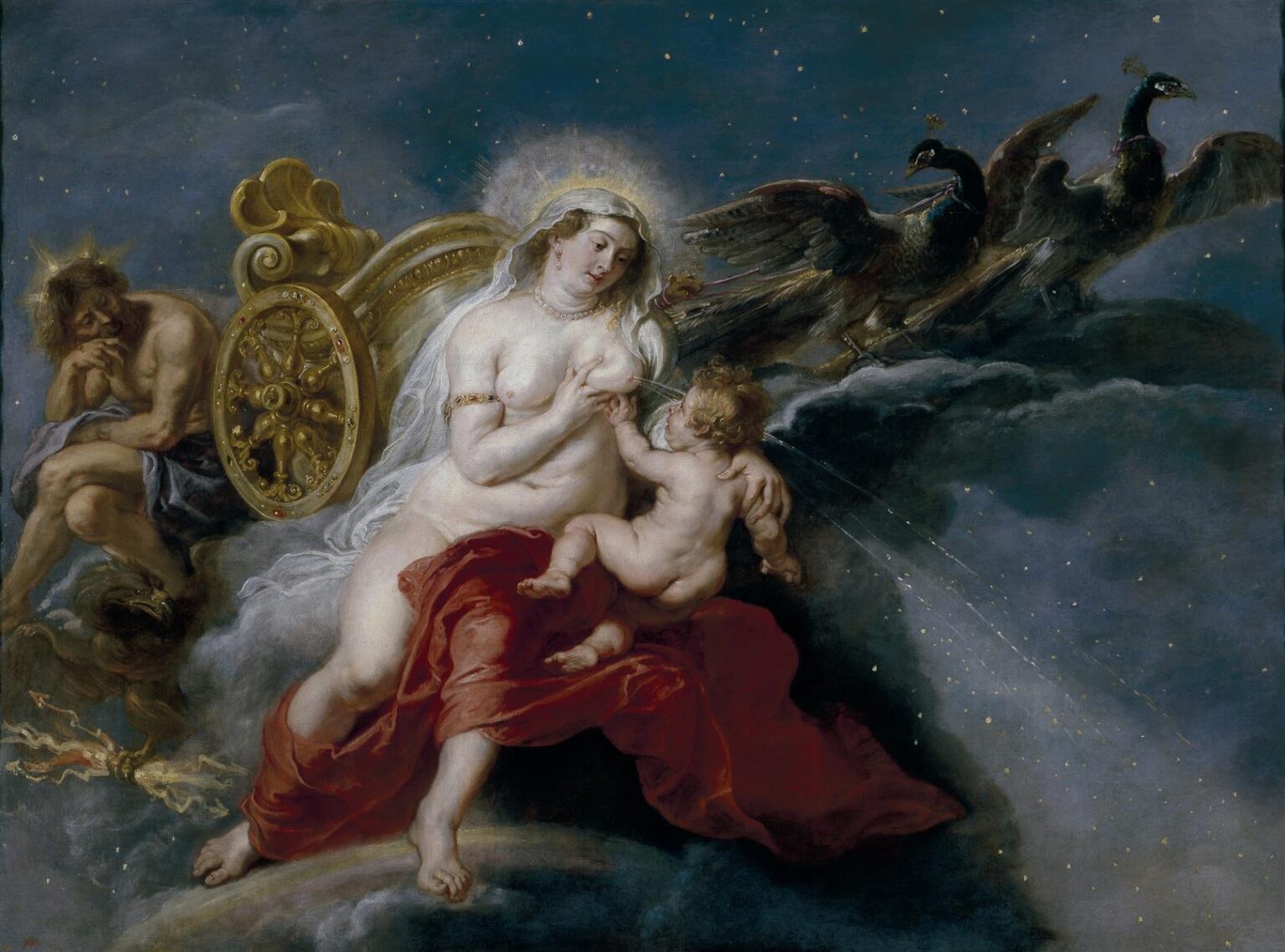
Peter Paul Rubens’ “The Origin of the Milky Way,” painted around 1637, is one of the most dazzling mythological visions of the Baroque period. In a single swirling composition he combines celestial spectacle, sensuality, humor, and learned classical reference. At the center of the scene sits the queen of the gods, Juno (Hera in Greek myth), her luminous body framed against the night sky as she nurses an infant. The child, Hercules, squirms and pulls away. Spurted milk arcs across the heavens and transforms into a glittering river of stars. Behind the goddess, her golden chariot and proud peacocks proclaim her status. To the left, the weary figure of Jupiter (Zeus) watches events unfold.
This painting does much more than illustrate a mythic origin story. Rubens uses the episode to explore themes of divine power, jealousy, cosmic order, and the transformation of bodily experience into universal significance. Painted near the end of Rubens’ career, it showcases his mature mastery of color, movement, and expressive anatomy.
The Mythological Story Behind the Painting
Rubens draws on a classical myth that explains how the Milky Way was formed. According to the story, Jupiter had fathered Hercules with the mortal woman Alcmene. Wanting his son to attain immortality and full divine status, Jupiter devised a plan: he brought the infant to his wife Juno while she slept and placed the baby at her breast so he could drink the milk of a goddess. When Juno awoke and realized she was suckling another woman’s child, she pushed him away in anger. Her milk sprayed across the sky and formed the luminous band of the Milky Way. The drops that fell to earth became lilies or other white flowers.
This myth allowed ancient authors and artists to link the intimate act of breastfeeding with the formation of the cosmos. Rubens seizes on the theatrical potential of the moment of rejection, when bodily fluid bursts out and becomes an astronomical phenomenon. It is at once comic, violent, and awe-inspiring, bridging domestic experience and galactic scale.
Juno at the Center: Majesty, Vulnerability, and Rage
Juno dominates the composition. Rubens presents her as a voluptuous, mature woman seated on a bank of clouds. Her pale flesh gleams against the deep blue of the night sky, ringed by a halo of golden light that emphasizes her divinity. She wears a thin veil over her hair and a few pieces of jewelry—a bracelet, a necklace, pearl earrings—but her body is largely uncovered, wrapped only in a red drapery that swirls around her legs.
Her pose is both maternal and imperious. One arm cradles the twisting Hercules; the other reaches up in a gesture that signals the instant of pushing him away. Her head turns slightly to the side, expression caught between surprise, pain, and indignation. Rubens captures an almost comic discomfort: the baby pulls at her breast, her body recoils, and the milk jets out with physical force.
At the same time, Juno’s halo and the majestic framework of the chariot behind her remind viewers that she is the queen of the gods. This mixture of vulnerability and authority conveys the complexity of her character in mythology, where she is both a powerful deity and a jealous, often wronged wife. Rubens emphasizes that even a goddess cannot escape bodily sensation or emotional reaction.
The Infant Hercules: Strength and Disruption
The nude child in Juno’s arms is Hercules, the hero famous for his strength and later labors. Rubens depicts him as a sturdy, curly-haired toddler, already full of energy. His small frame wriggles vigorously; one foot jams into the folds of red drapery while his hands clutch at Juno’s breast. He is not a serene Christ child but a robust, demanding infant.
The force of his movements is essential to the narrative. It is Hercules’ strong suck and struggling that prompt the spray of milk. His disruptive presence embodies the idea that extraordinary destiny often begins with disorder. In the mythic logic of the painting, the future hero’s appetite becomes the catalyst for a cosmic event. Rubens enjoys this paradox: the Milky Way arises not from calm divine decree but from a messy maternal accident provoked by a squirming baby.
The way Rubens paints Hercules’ flesh—rosy, dimpled, full of life—also reflects his interest in the physicality of children. The child’s body contrasts with the more expansive curves of Juno, underscoring the generational relationship while maintaining his status as an independent character with his own agency.
Jupiter in the Shadows: Architect of the Scene
On the left side of the painting, partially hidden by clouds and shadow, sits Jupiter, identified by his crown of light and the presence of an eagle at his feet. Unlike the radiant Juno, he appears subdued and contemplative. His body is muscular but slumped; his head bows as if in a mixture of guilt, calculation, and weary resignation.
Jupiter’s placement suggests that he is the orchestrator of the event, yet not the active agent at this moment. He has engineered the plan to have Hercules drink Juno’s milk, but the consequences escape his control. His diminished visibility in the composition mirrors his ambiguous moral status. Rubens does not present him triumphantly but rather as someone watching the unpredictable effects of his manipulation.
The eagle beside Jupiter, traditionally his attribute, adds an ominous note. The bird’s sharp beak and focused gaze contrast with the more chaotic, emotional actions at the center. Together they hint at the distance between divine strategy and human—or divine—emotion.
The Chariot and the Peacocks: Emblems of Juno
Behind Juno rises a golden chariot with large, elaborately carved wheels studded with jewels. Its curved forms echo the curves of the goddess’s body. The chariot is pulled by peacocks that stride along the clouds to the right, their plumage iridescent even in the night sky. Both chariot and peacocks are traditional attributes of Juno, symbolizing her regal status and association with the heavens.
The peacocks contribute significantly to the painting’s sense of movement. Their wings spread, heads bob, and feathers ripple as if disturbed by the sudden commotion. Their elongated bodies create a diagonal that sweeps from the chariot toward the upper right, balancing the diagonal formed by Juno and Hercules. Their brilliant eyespots echo the stars scattered across the sky, creating a visual rhyme between earthly birds and celestial lights.
Rubens delights in the textures here: the metallic gleam of the chariot, the glossy sheen of peacock feathers, the soft billow of clouds. These details enrich the mythological narrative with sensory pleasure and display his technical virtuosity.
The Milky Way: From Body to Cosmos
The central marvel of the painting is the transformation of breast milk into the Milky Way. Rubens visualizes this by painting thin, bright streams shooting from Juno’s breast into the dark sky, where they break into clusters of tiny stars. The arcs of milk connect the bodily foreground with the celestial background, literally drawing a path from flesh to galaxy.
The Milky Way itself is suggested as a luminous band of mist and stars sweeping diagonally across the upper part of the canvas. The droplets that fall downward seem to dissolve into stardust or perhaps fall toward the unseen earth. This dual direction reflects the myth’s idea that the milk fertilizes both heavens and world.
By choosing to emphasize the jets of milk, Rubens underscores the physical basis of even the most ethereal cosmic phenomena. The painting becomes a meditation on how the divine and natural worlds intermingle. The same substance that nourishes a baby becomes the substance of the stars. This idea would have held particular fascination in an age when scientific inquiry into astronomy and the nature of the cosmos was rapidly expanding.
Light, Color, and Nighttime Atmosphere
Color and light play crucial roles in the painting’s impact. Rubens sets the scene against a rich, deep blue sky peppered with small golden stars. The darkness of the night makes Juno’s pale body glow almost supernaturally. She is encircled by a halo of light that blends into the clouds, creating the impression that she is both illuminated from within and lit by the surrounding cosmic radiance.
The red drapery around Juno and Hercules adds warmth and dynamism. Its folds swirl, echoing the curves of their limbs and the movement of the peacocks. Red, the color of passion and life, connects the maternal act with heroic destiny and divine drama.
In the left portion where Jupiter sits, Rubens shifts to cooler tones—grays, muted blues, and browns. This subdued palette reinforces the contemplative mood and separates Jupiter’s pensive stillness from the vivid central action.
Highlights flicker on metallic surfaces—the chariot wheel, Juno’s jewelry, the peacocks’ feathers—mimicking the sparkle of stars. The entire image glows as if lit by celestial fire rather than earthly sunlight, immersing the viewer in an otherworldly night.
Movement and the Baroque Sense of Drama
“The Origin of the Milky Way” is a quintessential Baroque composition, full of swirling movement and dramatic diagonals. Juno’s body twists; the child wriggles; peacocks stride and flap; clouds surge; milk arcs; stars scatter. There is hardly a straight, static line in the scene.
Rubens arranges these movements to guide the viewer’s eye. Starting at the left with Jupiter, the gaze moves along the curve of the chariot wheel to Juno and Hercules, then follows the spray of milk into the starry sky and along the bodies of the peacocks. From there, the eye returns down the long diagonal of the red drapery to Juno’s feet, completing a visual circuit. This flow mimics the cyclical motion of celestial bodies and reinforces the theme of cosmic origin.
The dynamism also expresses emotional intensity. The moment depicted is not calm contemplation but sudden disruption: Juno has just woken, Hercules is being pushed away, and milk bursts forth. Rubens translates this explosive event into visual energy, using the full resources of Baroque style to capture the instant when creation is bound up with chaos.
Bodies, Sensuality, and the Blending of Sacred and Profane
Rubens is renowned for his robust, sensual nudes, and Juno in this painting exemplifies his aesthetic. Her flesh is soft and ample, with convincing weight and warmth. Yet this sensuality is not merely erotic; it is bound to her role as mother and goddess. The act of breastfeeding, usually associated with domestic intimacy, is elevated into a divine event.
The painting thus blends sacred and profane associations. On one level it is a playful myth about a jealous goddess and a mischievous infant. On another level it points to broader themes of nourishment, origin, and the maternal principle in the cosmos. The bare breast, while sensual, also symbolizes generosity and life-giving power. The milk becomes a metaphor for the sustaining energy of the universe.
Rubens walks a delicate line here. He offers viewers the pleasure of looking at a beautiful nude figure while framing that figure within a learned mythological and cosmic context. This combination would have appealed to his sophisticated patrons, who enjoyed both sensual delight and intellectual complexity.
Rubens’ Late Style and Intellectual Context
Painted in the mid-1630s, “The Origin of the Milky Way” belongs to Rubens’ late period, when he was highly respected, wealthy, and still extraordinarily productive. During these years he received commissions for cycles of mythological paintings celebrating royal patrons, including works for the Spanish royal hunting lodge at the Torre de la Parada. This painting likely formed part of such a decorative scheme, designed to embellish a princely residence with scenes from classical mythology.
Rubens was well-educated and deeply engaged with humanist culture. He read ancient literature in the original languages and corresponded with scholars. The choice of this particular myth reflects that intellectual milieu. It allowed him to show off his knowledge of Ovid and other classical sources while creating an image that paralleled contemporary interest in astronomy and cosmology.
At the same time, his late style tended toward freer, more painterly brushwork and a greater emphasis on atmospheric effects. In this painting, the softness of the clouds, the misty edges of the stars, and the luminous skin tones demonstrate this looser, more expressive handling. The result is a work that feels both sumptuous and airy, substantial and dreamlike.
Cosmic Imagination and Human Experience
“The Origin of the Milky Way” stands at the intersection of cosmic imagination and human experience. On one side, it offers a grand explanation for a phenomenon observable in the night sky. On the other, it centers on experiences familiar to any viewer: a woman waking abruptly, a baby pulling at the breast, a husband scheming in the background. Rubens bridges these scales by showing how personal emotions and bodily actions can have universe-shaping consequences in mythic thinking.
This bridging reflects a broader Baroque tendency to connect heaven and earth, the infinite and the intimate. The painting suggests that the heavens are not remote and cold but intimately linked to the passions of gods and humans. The Milky Way is not just a band of stars; it is the trace of a divine quarrel, a frozen jet of milk, a permanent reminder of a fleeting maternal reaction.
For modern viewers, the painting may also evoke questions about how cultures explain natural phenomena and project human stories onto the cosmos. Rubens’ work reminds us that scientific and mythic ways of understanding the universe can coexist, each revealing something about the values and imaginations of their time.
Conclusion: A Baroque Vision of Creation
“The Origin of the Milky Way” is one of Rubens’ most imaginative mythological paintings. By dramatizing the moment when Juno rejects Hercules and her milk spills across the sky, he fuses domestic intimacy with cosmic grandeur. The swirling composition, rich color, and expressive figures embody the energy and theatricality of the Baroque while conveying deeper reflections on power, jealousy, and the mysterious origins of the universe.
Juno’s glowing body, Hercules’ restless vigor, Jupiter’s shadowed watchfulness, the striding peacocks, and the dazzling streams of milk all work together to create an unforgettable image. The painting invites viewers to look up at the night sky and imagine that behind the distant stars lies a story of gods, love, and a single impatient child whose hunger reshaped the heavens.