Image source: wikiart.org
Introduction to Rembrandt’s “The Omval” (1645)
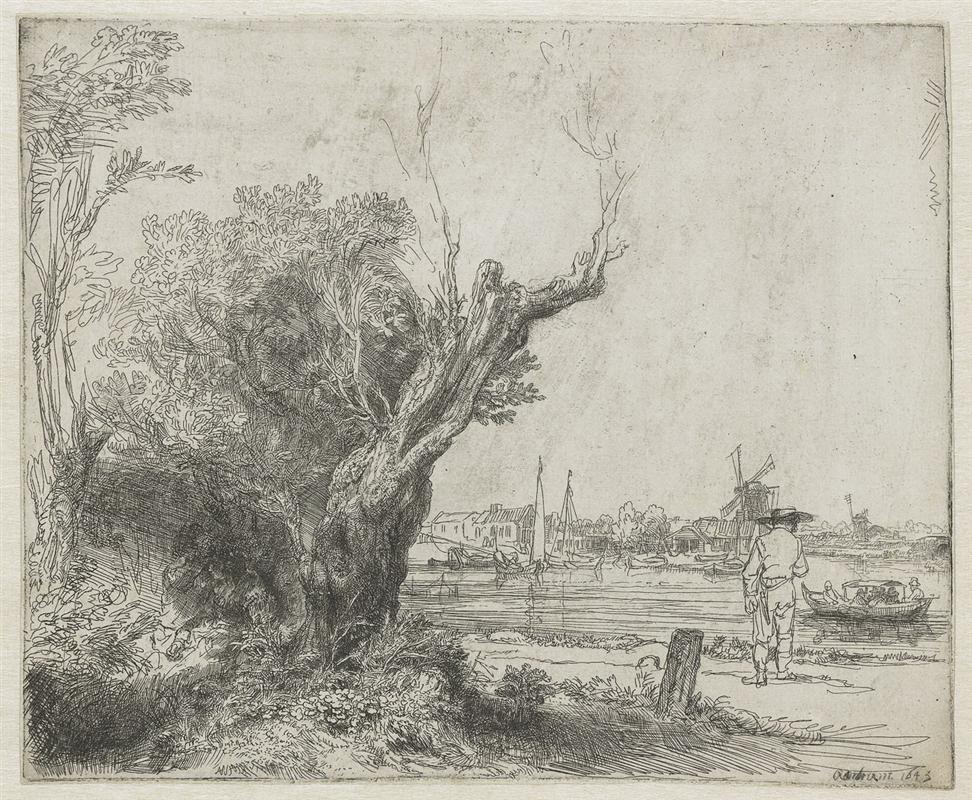
Rembrandt’s “The Omval” is a compact masterclass in how etched line can hold a living landscape. Dated 1645, the plate records a bend of the Amstel River just south of Amsterdam that was known as the Omval, a low, sandy tongue of land bordered by water and ringed with windmills, barns, and moored boats. Rather than staging a postcard vista, Rembrandt builds the scene around a gnarled tree in the left foreground, then lets the eye walk outward across a ribbon of water toward the bustle of river life and a distant windmill. The result is both local and universal: a specific Dutch place observed with the accuracy of an eyewitness and a timeless essay on how foreground, middle distance, and horizon converse.
A Landscape Named for a Place
The title anchors the print in topography. “Omval” identifies a real bend in the Amstel that Rembrandt knew well from his sketching walks, and its inclusion signals an intention to translate a known prospect rather than invent a caprice. Yet fidelity to place never constrains invention. The artist edits mercilessly—thickening the tree, clearing a swath of sky, arranging boats and figures to keep the composition breathing. He honors the truth of the site while shaping a scene that reads like a memory distilled by long looking.
Composition as a Walk Through Space
The plate’s left half is dominated by a massive, twisted tree whose trunk leans toward the center, its bark modeled by dense, wiry hatchings and knotted burrs of crossline. From this anchor, the view opens like a fan: a bank slips into the river; the river widens; roofs, masts, and a windmill rise in alternating intervals; and a low horizon secures the sky. The diagonal thrust of the tree’s main branch points toward the waterborne traffic, binding foreground to far shore. A single standing figure on the right edge—hat brim wide, hands behind his back—becomes the viewer’s surrogate, observing the river with us and pacing our attention across the sheet.
The Tree as Protagonist and Measure
The storm-scarred tree is more than staffage; it is the protagonist that measures everything else. Its rugged bark sets the scale for soft leaf clusters; its sweeping bough drives the eye toward the river; its shadowed roots knit the ground plane so the scene doesn’t float. Rembrandt’s line treats the trunk as sculptural mass, then loosens into feathery flicks for leaves curled by breeze. The contrast between wounded wood and lively foliage gives the print its emotional temperature: endurance paired with renewal, a fitting emblem for a river landscape animated by constant use.
The River as Social Stage
Across the center, the Amstel becomes a stage where daily life performs in small gestures: a ferry or skiff crosses with seated passengers, another boat hugs the far bank, a mast cuts the skyline, and ripples record the unhurried traffic of a workday. Rembrandt draws water with low, lateral strokes and small reserves of white paper that catch light like scales. No theatrical breeze disturbs the surface; instead, the flow is steady, sufficing to carry work and leisure alike. The river is not scenery—it is infrastructure, the artery that explains why windmills turn and why houses face the bank.
A Standing Figure as Our Double
At right, a man stands in three-quarter view toward the river. He is small but not negligible—an index of human scale and an ethical cue. We look as he looks, not as a tourist but as a neighbor pausing on a familiar path. His relaxed stance, with one foot slightly advanced and hands likely clasped, stabilizes the right edge and invites a contemplative pace. He’s a compositional fulcrum too, balancing the weight of the tree while addressing the open space of sky and water.
The Windmill and the Economics of Wind
On the far bank the windmill rises like a modest monument, its angled sails and scaffolding etched with decisive strokes. Dutch viewers would have read the mill as a sign of economic health—grain ground, timber sawn, or water managed for polder life. Rembrandt positions it not as a heroic centerpiece but as a factual presence among roofs and trees. The mill’s geometry adds a crisp counterpoint to the organic swell of the tree, linking human engineering with natural power and reminding us that this landscape is a collaboration between land, water, and craft.
Line, Hatching, and Plate Tone
The print’s language is line, and Rembrandt speaks it with dialects. The tree’s bark receives close-knit hatchings that bite deeper, darkening the mass; the grasses at its base are notated with quick zigzags; far-shore buildings are defined with sparing contours and a few shadow wedges; the sky is largely left to the whiteness of the paper, with only faint drypoint scratches at the right margin to keep the field from feeling vacant. If printed with a breath of plate tone, the sky would glow with a grey veil, amplifying atmosphere; wiped clean, it offers a bright day. Either way, the hierarchy of strokes creates depth without theatrical chiaroscuro.
Negative Space and the Ethics of Air
One of the print’s audacities is the generous, nearly empty sky. That blankness is not laziness; it is structural air that allows the congested tree and busy riverscape to breathe. By leaving the upper right quadrant open, Rembrandt lets the eye rest, then return renewed to the details that matter. The white also throws the etched marks into relief, sharpening the tree’s silhouette and the windmill’s limbs. In a small plate, air is a moral resource; used well, it grants dignity to each mark.
Depth Without Vanishing Points
Perspective is present but modest. Rembrandt prefers to stack depth through overlap and tonal recession: dark, detailed tree up front; lighter, smaller boats midstream; lightest, thinnest lines on the far bank and windmill; the horizon a low, unbroken seam. This accumulative method feels natural because it matches how our eyes survey the world—by noticing nearer textures first and letting the far distance simplify into planes and edges.
The Ground at Our Feet
The lower left foreground is a botanical vignette: tufts of grass, wildflowers, and a broken post, all tossed off with breezy shorthand yet convincing as habitat. This clump of earth anchors the spectator on firm ground and gives the tree a believable footing. It also frames a narrative of maintenance. Posts and rough turf speak of property boundaries, ferries landing, and footpaths worn by commerce. Such care for humble signs is a hallmark of Rembrandt’s landscapes; they bind poetry to use.
The Omval as Threshold Between City and Country
Geographically, the Omval sat at a hinge where Amsterdam’s urban energy met the rural Amstelland. Rembrandt’s view honors that dual identity. The river traffic and windmill whisper the city’s needs; the loud presence of the tree and the open sky preserve the country’s freedom. The print thus embodies a Dutch ideal: prosperity without loss of pastoral sanity, enterprise tempered by attention to the ordinary forms of land and weather.
Motion, Time, and the Human Pace
Nothing in the print is static. The tree bends as if remembering wind; the ferry cuts its slow wake; the standing man’s posture suggests he’ll resume his walk soon. This low-grade motion gives the plate time—minutes rather than seconds, workday rather than event. Rembrandt’s etched lines register that duration with a touch that is quick but not hurried, a tempo consistent with craft done properly.
Comparisons Within Rembrandt’s Landscapes
Compared to the dramatic “Three Trees” or the moody “Goldweigher’s Field,” “The Omval” feels conversational and sociable. The storm rhetoric is absent; the sublime gives way to human scale. Yet the same intelligence of edges and air governs all three: a large, speaking foreground; a middle distance where daily life gathers; and a horizon that breathes. What changes is the mood—here, a calm civic piety toward land and labor.
Printing Variants and Collectors’ Pleasures
Rembrandt delighted in printing variety. Impressions of “The Omval” could carry a soft plate tone veiling the sky, or be wiped to a sparkling clarity suited to a bright afternoon. Slight differences in inking bring out or subdue the dark mass of the tree, changing the emotional emphasis. Such variations are not accidents; they are part of the artwork’s living possibilities. They make each impression a conversation with weather and light rather than a fixed stamp.
The Viewer’s Role as Fellow Walker
The image invites the viewer to adopt the pace of the figure on the right: pause, look, move on. There is no privileged lookout; the riverside path is public. That democratic invitation is central to the print’s charm. You don’t need allegorical keys to read it; you need only the patience to let the foreground tree introduce you to a place and the leisure to watch boats pass.
Light, Weather, and Season
Although monochrome, the etching conjures a bright, temperate day—likely late spring or summer—through the fullness of foliage, the clean air of the sky, and the untroubled water. Light comes from high right, grazing the near bank and clarifying the roofs across the river. The season feels generous, a good time for moving goods and for standing a moment to watch them go. This clarity of weather keeps the mood anchored in gratitude rather than drama.
The Omval as Quiet Self-Portrait of a Way of Seeing
While no person in the print is Rembrandt, the scene functions as a self-portrait of his looking. He chooses a large, scarred tree to begin, because truth loves irregularity. He opens a massive sky, because attention requires rest. He draws boats and mills plainly, because usefulness is beautiful. And he gives the viewer a companion on the path, because looking is a social act—not voyeurism but shared notice of the world.
Legacy and Contemporary Resonance
Modern viewers, alert to environmental and urban edges, will find the Omval’s threshold quality familiar: a place where city and river negotiate daily life. The print models a posture of care toward such in-between spaces. It argues for the value of noticing how infrastructure, landscape, and habit shape one another—and for the pleasure of letting a single tree tutor the eye in complexity.
Conclusion: A Bend in the River, a Bend in the Line
“The Omval” turns a bend of the Amstel into a lesson in pictorial thinking. From the gnarled tree to the windmill pricking the horizon, from the ferry’s wake to the white breathing of the sky, Rembrandt composes with trust in ordinary forms and the intelligence of line. The plate’s modest size belies its expansiveness. It charts a full geography—natural, civic, and moral—within the space of a small sheet, and it leaves the viewer with a durable calm: the feeling of having stood still long enough beside a river to let a place tell you who it is.