Image source: wikiart.org
Introduction to “The Mystic Marriage of Saint Catherine of Alexandria”
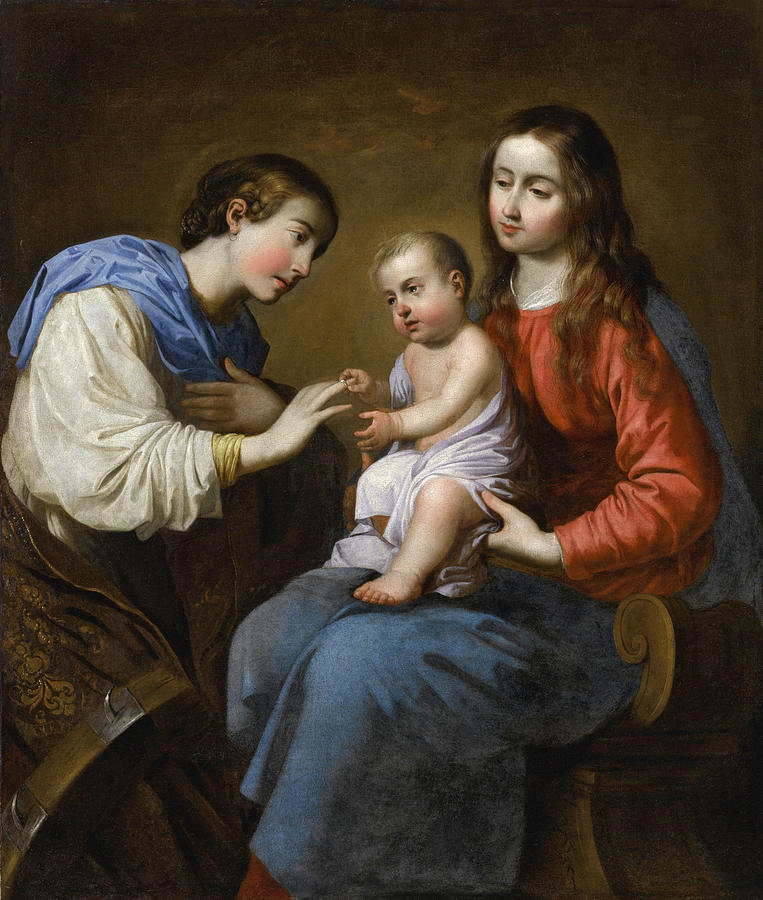
Francisco de Zurbaran’s painting “The Mystic Marriage of Saint Catherine of Alexandria” offers a remarkably gentle interpretation of one of the most beloved legends of Christian devotion. In place of a grand courtly setting or a crowded scene, Zurbaran creates an intimate domestic moment between three figures. The Christ Child sits on the lap of the Virgin Mary, while Saint Catherine leans in from the left, her hands extended toward the infant.
The entire composition feels like a quiet family encounter. Yet within this apparent simplicity lies a dense web of symbolism. The painting visualizes a mystical event in which Catherine, a learned princess and martyr, becomes spiritually espoused to Christ. The tender exchange between the saint and the Child reveals this invisible covenant, while Mary presides as loving mother and heavenly queen.
Zurbaran’s soft modeling, luminous color, and restrained drama present the mystery of spiritual union in a way that is accessible, affectionate, and deeply contemplative.
The Legend Behind the Mystic Marriage
According to tradition, Saint Catherine of Alexandria was a princess renowned for her beauty, intelligence, and devotion to Christ. Refusing earthly marriage, she declared that she was already promised to a heavenly bridegroom more noble than any human prince. Later legends describe a vision in which the Virgin Mary presented her to the Christ Child, who placed a ring on her finger as a sign of mystical marriage.
Artists across Europe painted this subject from the late Middle Ages onward. Italian painters often set the event in a richly decorated throne room or a celestial garden, surrounding the central figures with angels and symbols of martyrdom. Zurbaran, working in seventeenth century Spain, adopts a more concentrated approach. He removes every distraction and brings the figures very close to the viewer, transforming the mystical episode into a tender, almost domestic scene that could unfold in a quiet corner of a home.
The result is a painting that honors Catherine’s lofty spiritual destiny while emphasizing her human warmth and humility. She draws near to Christ not as a distant queen but as a young woman filled with reverence and love.
Composition and the Intimate Triad
The composition is built around a triangular arrangement of figures. Mary sits at the right on a carved wooden seat, her body turned slightly toward the center. The Christ Child rests comfortably on her lap, supported by her arm. Catherine kneels or leans from the left, inclined toward the child.
This triangular structure creates stability and harmony. The apex of the triangle lies near the faces of the Virgin and Catherine, which are at nearly the same height. The Child occupies the center of the base, bridging the space between them. This geometry quietly expresses the theological meaning of the scene. Christ is the connecting point between the saint and his mother, and through him the spiritual marriage takes place.
Zurbaran brings the figures close to the picture plane. Their faces and hands are large in relation to the canvas, allowing the viewer to read every expression and gesture. Background architecture and landscape are eliminated in favor of a warm, neutral backdrop that recedes gently into brownish tones. This further emphasizes intimacy and keeps attention fixed on the emotional exchange.
The Virgin Mary as Mother and Mediator
Mary appears seated, serene and composed, wearing a red bodice and blue mantle. These colors traditionally symbolize love and divinity on the one hand, and faithfulness and heaven on the other. Her long hair cascades over her shoulders, introducing soft vertical lines that echo the fall of the drapery across her lap.
Her expression is contemplative rather than ecstatic. She looks slightly downward and to the left, toward Catherine and the Child, with a quiet, almost introspective gaze. This calm presence suggests her dual role. She is both the loving mother who gently supports her son and the spiritual mother who introduces the saint to her divine bridegroom.
Mary’s hands reinforce this role. One hand encircles the Christ Child, steadying him on her lap. The other rests near his lower body, subtly guiding him toward Catherine. She does not dominate the scene with commanding gestures. Instead, she presides with a discreet, nurturing authority, allowing the focus to rest on the encounter between her child and the saint.
The Christ Child at the Center of the Mystery
The Christ Child appears slightly older than a newborn, perhaps at toddler age, which makes the interaction more engaging. He sits on Mary’s lap with legs extended toward Catherine, his small body wrapped in a pale, almost iridescent drapery that reveals much of his torso and limbs.
His face is thoughtful and somewhat solemn. Rather than smiling playfully, he looks intently at Catherine as if conscious of the significance of their meeting. One hand reaches toward hers in a delicate gesture of touch. In some versions of the theme, the Child places a ring on the saint’s finger. Here Zurbaran chooses a more understated approach. The fingertips meet, suggesting the giving of a ring without requiring a literal depiction.
The child’s body is modeled with Zurbaran’s usual care. Rounded limbs and gentle shadows give him weight and presence. Yet his skin also carries a soft glow that evokes the divine life dwelling within this fragile human form. Positioned at the very center of the painting, he unites the movements and gazes of both women, embodying the spiritual bond that joins them.
Saint Catherine of Alexandria and Her Iconography
Catherine, on the left, is shown as a young woman with delicate features and elegantly arranged hair. She wears a richly patterned brown skirt and a white blouse, over which lies a bluish mantle. The combination of luxurious textile and fresh, luminous color hints at her noble origin.
Traditional attributes of Saint Catherine include the spiked wheel of her torture, a martyr’s palm, and often a crown to signify her royal status. In this painting, Zurbaran does not emphasize these dramatic symbols. The bottom left hints at a curved metallic form that may suggest the wheel, but it remains largely suppressed under the saint’s garments. This restraint keeps the focus on her spiritual relationship with Christ rather than her martyrdom.
Catherine’s pose is dynamic, yet gentle. She leans forward, one hand extended to receive the Child’s touch, the other resting near her chest. The gesture of the right hand, slightly open and offered, communicates trust and readiness to accept the covenant. Her gaze is directed tenderly toward the child, and her lips are parted as if she were softly speaking words of devotion.
By minimizing martial and regal emblems, Zurbaran underscores Catherine’s identity as a contemplative bride of Christ. Her nobility is revealed more in her attitude than in her ornaments.
Color, Light and the Warm Harmony of the Scene
Color plays a crucial role in creating the gentle atmosphere of this work. The overall palette is warm and harmonious. The background is brownish ocher, against which the brighter colors of the clothing stand out without harsh contrast.
Mary’s red and blue garments form a rich anchor on the right. Catherine’s brown and white clothing, combined with the cooler blue mantle over her shoulder, balance this weight on the left. Together, the two sets of colors create a subtle cross rhythm of warm and cool tones.
The Christ Child’s pale flesh and light drapery introduce a luminous center. Light falls evenly across the figures, softening edges and modeling forms with smooth transitions rather than abrupt changes. This soft illumination reinforces the mood of quiet intimacy and spiritual peace.
Zurbaran avoids the stark tenebrism associated with some earlier Baroque masters. Instead of plunging large areas into darkness, he allows the warm background to remain visible, creating a gentle glow around the figures. The effect is almost like candlelight in a peaceful interior, inviting the viewer to linger contemplatively on the scene.
Gestures, Glances and Emotional Narrative
What gives this painting its particular emotional force is the finely orchestrated play of gestures and glances. Each figure’s pose interacts with the others, creating a visual conversation.
The Christ Child’s arm extends toward Catherine. Her hand reaches toward his in a corresponding movement. Their fingers nearly touch, forming a small but intense focal point in the center. This point of contact becomes the visual symbol of the mystical marriage.
Catherine’s head inclines gently toward Christ, her lips slightly open in what may be a quiet vow. Mary’s gaze, more detached yet affectionate, hovers above them, as if witnessing and inwardly affirming the union. The viewer’s eye follows this triangular network of gazes and gestures, circling repeatedly through the faces and hands.
The absence of dramatic background events or strong diagonals ensures that this subtle choreography of gestures remains the primary narrative. The scene does not aim to overwhelm with spectacle. Instead, it invites viewers to reflect on the nature of spiritual commitment, portrayed here as an interplay of tender affection, reverence, and interior consent.
Texture, Drapery and Zurbaran’s Technique
Zurbaran’s technical mastery is evident in the treatment of textures and fabrics. The drapery over Mary’s lap folds into generous, soft curves, catching the light in broad highlights that emphasize the volume of her legs and the solidity of the wooden seat. Catherine’s garments reveal more intricate detail, especially in the patterned brown skirt and the delicate folds of the white sleeve.
The blue mantles that both women wear echo each other and are painted with smooth, confident brushstrokes. Their surfaces shift from bright blue to deeper tones as they move into shadow. This handling of cloth not only delights the eye but also supports the thematic unity of the figures.
Skin tones are modeled with subtle transitions. The cheeks of the women show soft blushes, while the Christ Child’s flesh has a luminous, almost pearly quality. Highlights on foreheads, noses and fingers are small yet carefully placed, giving each face a sense of life and presence.
The background, by contrast, is handled in broad, undifferentiated brushwork. This contrast between detailed figures and generalized backdrop directs attention where it belongs, on the sacred family drama unfolding in the foreground.
Spiritual Themes and Symbolism
Beyond its visual beauty, the painting carries rich spiritual meaning. The mystical marriage of Saint Catherine symbolizes the union between Christ and the soul, and by extension the union of Christ with the Church. In Catholic spirituality, saints like Catherine serve as models for all believers who seek intimate friendship with God.
The tender way in which the Child and the saint exchange gestures of affection emphasizes that this spiritual union is not cold or purely formal. It involves love, trust and mutual self giving. Catherine’s slightly bowed posture suggests humility and surrender, while the Child’s forward leaning movement expresses divine initiative.
Mary’s presence indicates that such union takes place within the maternal care of the Church and under her guidance. She is both witness and teacher, representing contemplative faith that nurtures and presents souls to Christ.
Even the absence of explicit martyrdom symbols carries significance. It suggests that the heart of sainthood lies not only in heroic death but in prior surrender of the heart. Catherine’s crown and wheel may be hidden, but her spiritual bridal encounter with Christ is front and center.
Zurbaran’s Devotional Art and the Spanish Baroque Context
Zurbaran is often associated with austere monastic scenes and powerful single figure saints. “The Mystic Marriage of Saint Catherine of Alexandria” reveals another side of his talent: the ability to paint tender, almost Murillesque devotion while still retaining his characteristic clarity and seriousness.
In seventeenth century Spain, images of the Virgin and famous saints were central to domestic and conventual spirituality. Paintings like this one would be used for personal meditation, feast day celebrations and the fostering of particular devotions. Zurbaran provides a composition that is both accessible and profound. Its human warmth makes it easy to approach, while its symbolic depth offers endless material for reflection.
The painting also reflects broader Baroque interests in portraying spiritual realities through emotional encounters. Unlike earlier more hieratic images, Baroque religious art often shows saints interacting, embracing or exchanging meaningful glances. Here, the mystical marriage is understood not only as a theological idea but as a deeply personal relationship between Christ and a devoted follower.
Lasting Appeal for Contemporary Viewers
For modern viewers, this painting continues to speak in several ways. On a purely human level, the tender interactions between the three figures recall family intimacy, a mother cradling her child while a close relative leans in with affection. This familiarity makes it easy for people of all backgrounds to connect emotionally with the scene.
On a spiritual level, the work proposes a vision of divine love that is gentle and personal. The Christ Child meets Catherine at her level, touching her hand with a gesture that anyone can recognize as affectionate and trusting. The painting suggests that spiritual commitment is grounded in such personal love rather than in fear or obligation alone.
The serene mood and balanced composition also offer a visual refuge from the speed and noise of contemporary life. Spending time with this image can become a form of quiet meditation, inviting viewers to consider their own relationship with what they hold sacred.
Conclusion
“The Mystic Marriage of Saint Catherine of Alexandria” by Francisco de Zurbaran is a jewel of Baroque devotional art. Through a simple yet sophisticated composition, soft light, harmonious color and finely observed gestures, the painter transforms a legendary mystical event into an intimate, humanly touching scene.
Mary, seated in tranquil dignity, supports the Christ Child whose small hand reaches toward the open palm of Saint Catherine. Between their fingertips lies the invisible ring of spiritual union, symbolizing the love that binds Christ to every soul that seeks him. Catherine’s humble yet eager posture, Mary’s contemplative gaze and the child’s attentive expression together create a powerful meditation on devotion, humility and divine initiative.
More than a narrative illustration, the painting offers a living image of interior encounter. It invites viewers into the quiet space between the figures, encouraging them to experience the mystery of spiritual love that transcends time and place. Through this tender vision, Zurbaran affirms that holiness is found not only in heroic martyrdom but also in the gentle yet profound exchange of hearts between God and the human person.