Image source: wikiart.org
Introduction
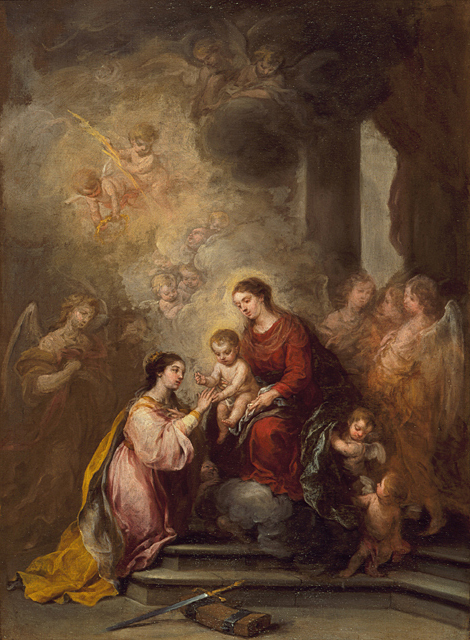
“The Mystic Marriage of Saint Catherine” by Bartolomé Esteban Murillo, painted in 1682, is a glowing vision of intimacy between heaven and earth. In this richly atmospheric scene, the Virgin Mary sits with the Christ Child on her lap while Saint Catherine of Alexandria kneels before them. Surrounded by angels, clouds, and a soft golden light, the saint receives a ring from the infant Jesus that seals their mystical union.
Murillo transforms a complex theological idea into a tender family moment that unfolds on a small set of steps. The painting is filled with movement, yet its mood is one of quiet reverence. Delicate colors, shimmering brushwork, and gentle gestures invite the viewer to kneel spiritually beside Catherine and share in her experience of divine love.
Historical And Devotional Context
Seventeenth century Spain placed great importance on saints as models of Christian virtue and as powerful heavenly intercessors. Stories of visionary unions between saints and Christ communicated the idea that the soul could enter into a deep, personal relationship with the divine. Among these narratives, the mystic marriage of Saint Catherine became especially popular.
Saint Catherine of Alexandria was revered as a learned princess who converted to Christianity, debated pagan philosophers, and ultimately suffered martyrdom rather than renounce her faith. According to legend, Christ appeared to her in a vision and placed a ring on her finger, symbolizing a spiritual marriage that bound her soul to him forever. This story allowed artists to explore mystical love using the familiar imagery of engagement and marriage, while maintaining a focus on spiritual rather than earthly intimacy.
Murillo, a leading painter in Seville, often responded to the devotional needs of religious orders and confraternities. His tender style, marked by soft contours and luminous color, was ideal for subjects that combined theological depth with emotional sweetness. “The Mystic Marriage of Saint Catherine” exemplifies this approach, presenting the saint’s union with Christ as both sublime and warmly human.
The Subject Of The Mystic Marriage
At the heart of the painting lies the symbolic act of Christ placing a ring on Saint Catherine’s finger. This event does not depict a literal marriage in an earthly sense. Instead, it represents the total dedication of the saint to Christ, her acceptance of his love, and her commitment to live entirely for him.
Murillo presents this mystical exchange as a family scene. The Virgin Mary acts as mediator, holding the Christ Child on her lap and offering his small hand to Catherine. The saint, dressed in elegant garments, kneels with poised humility, her gaze fixed on the child. Angels crowd the background, leaning forward with interest and joy. The atmosphere is that of a wedding attended by a heavenly court.
Through this visual language, viewers are invited to imagine their own souls as potential brides of Christ, called to intimacy and fidelity. The painting makes this spiritual calling appealing and tender rather than abstract or remote.
Composition And Spatial Structure
Murillo organizes the composition around a series of curving diagonals that lead the eye from the lower left corner, where Saint Catherine kneels, up toward the Virgin and Child, then further upward into the swirling mass of angels and glowing clouds. The figures are grouped on a small circular stair, which introduces a gentle upward movement and places the holy family slightly above the viewer’s level without creating a harsh separation.
The Virgin and Child occupy the central position, seated on a cloudlike cushion at the midpoint of the stairs. Catherine kneels on the lowest step to the left, forming a triangle with the Virgin and the Christ Child. To the right, other angels stand or sit on the steps, their bodies turned inward, creating a semicircle around the central act. Above, more angels emerge from the clouds, culminating in a radiant vision that spans the upper part of the canvas.
This layered arrangement creates depth while maintaining intimacy. The viewer feels close to the figures in the foreground yet aware of the vast heavenly realm that opens above them. The steps act as both literal architecture and symbolic ladder, suggesting the soul’s ascent toward God through love and devotion.
The Figures Of The Virgin And Child
Murillo’s Virgin Mary is both queenly and maternal. She wears a deep red dress, symbolizing love and sacrifice, with a blue mantle that drapes across her lap and cascades down the steps. Her body leans slightly toward Saint Catherine, creating a subtle gesture of welcome. Mary’s head tilts gently as she watches the exchange of the ring, her expression calm and reflective.
On her lap sits the Christ Child, chubby and lively yet imbued with quiet seriousness. Murillo portrays him as a toddler, old enough to sit upright and extend his hand with purpose. With one small hand he reaches for Catherine’s fingers, while the other rests on his mother’s arm for support. His eyes focus on the saint, acknowledging her as the object of his gift.
This mother and child form the emotional and theological center of the painting. Mary’s presence emphasizes her role as mediatrix, the one through whose motherhood Christ enters the world and through whom believers are introduced to him. The child’s gesture of giving the ring embodies his offer of a loving covenant, not only to Catherine but to all faithful souls.
Saint Catherine And Her Symbolic Presence
Saint Catherine kneels at the foot of the steps, her body turned toward the Virgin and Child. Murillo dresses her in rich garments that blend royal dignity with spiritual humility. She wears a flowing gown of pale tones with delicate pinks and yellows, covered partially by a warm golden cloak that spreads behind her on the steps. The softness of her clothing reflects her nobility, yet her posture is one of reverence.
Her hands are the focus of the central action. One hand is extended toward Christ, fingers slightly curved as she receives the ring. The other rests near her chest, ready to press against her heart. Her head tilts upward, and her features show a combination of wonder, gratitude, and deep inner concentration. Murillo avoids theatrical emotion. Instead, Catherine appears absorbed and serene, experiencing a love that is both ardent and peaceful.
At the lower center of the composition, near Catherine’s draped cloak, lie a sword and a broken wheel, the instruments associated with her martyrdom. According to legend, a torture wheel prepared for her execution miraculously shattered, after which she was beheaded by the sword. By placing these objects at the saint’s feet, Murillo reminds viewers that mystical union with Christ leads to courageous witness, even to the point of suffering and death.
Angels, Heavenly Vision, And Atmosphere
The painting is filled with angels of various sizes and positions. To the right of the Virgin, a cluster of angels sits or stands, their wings catching the light. They watch the scene with reverent attention, their faces mirroring the joy of heaven at the union of Christ and Catherine. One small angel at the bottom right plays with a cloth or steps forward as if to approach the viewer, adding a playful anecdote that humanizes the celestial court.
Above, angels appear in a swirling mass of cloud and light. Some carry musical instruments, others extend their arms or bend toward the central group. Their forms are partially dissolved in the luminous mist, giving the impression that they emerge from and return to pure light.
This upper register creates a sense of spiritual overflow. The mystical marriage on the steps is echoed by a heavenly celebration in the sky. The softness of Murillo’s brushwork here is particularly striking. Edges blur, colors melt into one another, and the angels seem to hover between visibility and invisibility. The viewer senses that the air itself is charged with divine presence.
Light, Color, And Painterly Technique
Murillo relies on a warm, golden light that suffuses the entire canvas. The brightest area lies around the Virgin and Child and the upper cluster of angels, where light appears to emanate from the spiritual event itself. This illumination gradually fades as it moves toward the darker architectural background on the right and the lower foreground steps.
The color palette is harmonious, centered on soft golds, warm browns, muted greens, and gentle reds. The Virgin’s red dress and blue mantle provide strong chromatic anchors. Catherine’s garments offer pastel notes that harmonize with the surrounding clouds. The angels are painted with delicate flesh tones and light draperies that catch the light, contributing to the overall feeling of radiance.
Murillo’s brushwork is loose and fluid, especially in the clouds and background. Details of the architecture are only lightly suggested, allowing the focus to remain on the figures and the glowing atmosphere. In contrast, the faces and hands receive more careful modeling, with smooth transitions between light and shadow that create a sense of living flesh.
This combination of soft, atmospheric handling and precise focal details is characteristic of Murillo’s mature style. It allows him to create a scene that is both visually sumptuous and spiritually subtle.
Symbolic Objects And Theological Meaning
Several objects in the painting carry important symbolic meanings. The ring that Christ offers to Catherine is the key symbol. It represents the covenant of love between the soul and Christ, a bond that is both personal and irrevocable. By receiving the ring, Catherine accepts a life fully dedicated to him.
The sword and broken wheel near the bottom of the stairs recall her martyrdom. Their placement on the ground indicates that Catherine has triumphed over these instruments of death through her faith. They also connect her mystical union with the concrete reality of witness in the world. True union with Christ does not remove the saint from suffering, but gives strength to face it.
The clouds that cushion the Virgin’s seat suggest that she and the Child occupy a higher, heavenly realm, even though they sit on the same steps as Catherine. The steps themselves can be read as symbols of spiritual ascent. Catherine moves upward from the earth toward Christ, while Christ descends through Mary to meet her.
Together, these elements express the pattern of Christian life as understood in Murillo’s time. The soul is invited into intimate union with Christ, strengthened through the intercession of Mary and the companionship of the angels, and then called to live out that love through courageous witness, sometimes unto death.
Emotional Tone And Viewer Experience
Despite the theological complexity behind its symbols, the emotional tone of the painting is gentle and inviting. Murillo does not emphasize the harshness of martyrdom or the dangers of spiritual pride. Instead, he focuses on the sweetness of divine love. The gestures of the figures are graceful, the faces serene, and the light warmly embracing.
The viewer is drawn into the scene at ground level near Catherine’s kneeling figure. The steps create a natural place for the viewer’s eye to rest, almost as if there were room to kneel alongside the saint. From there, the gaze rises to the Virgin and Child and then to the angels above. The painting thus guides the viewer through a visual and spiritual ascent.
Because Murillo humanizes his figures so effectively, viewers can easily empathize with them. Catherine’s reverent amazement, Mary’s quiet encouragement, the Child’s innocent yet purposeful gesture, and the angels’ joyful attention together create a multilayered emotional chorus that speaks across centuries.
Place Within Murillo’s Late Work
Painted in 1682, toward the end of Murillo’s life, “The Mystic Marriage of Saint Catherine” shows the artist at a mature stage of his career. His earlier works already displayed a love of soft light and tender expression, but by this time his technique had become even more atmospheric and unified. The edges of forms blend more gently into the surrounding space, and the overall color harmony is more restrained and subtle.
Thematically, the painting reflects Murillo’s continued interest in mystical visions and intimate religious experiences. Alongside his many images of the Immaculate Conception, the Holy Family, and child saints, this work emphasizes the possibility of personal union with the divine. It reveals an artist deeply attuned to the spiritual aspirations of his age and capable of expressing them with great delicacy.
As part of his late oeuvre, the painting can be seen as a summation of Murillo’s strengths: warm humanity, luminous atmosphere, elegant composition, and a capacity to present high theological concepts through tender, accessible imagery.
Conclusion
“The Mystic Marriage of Saint Catherine” by Bartolomé Esteban Murillo is a masterful fusion of mysticism, symbolism, and human feeling. Through a carefully structured composition, glowing color, and soft yet expressive brushwork, Murillo transforms the legend of Saint Catherine’s spiritual union with Christ into a scene that feels both heavenly and familiar.
The Virgin Mary, serene and maternal, presents the Christ Child who offers a ring to the kneeling saint. Angels gather around them in a cloud of light, celebrating the covenant between the soul and its divine spouse. At Catherine’s feet, the sword and broken wheel remind viewers that true union with Christ leads to courageous witness, even to the point of martyrdom.
For contemporary viewers, the painting remains a powerful invitation to contemplate the nature of spiritual love, the role of Mary as mediator, and the beauty of a life wholly given to God. Murillo’s luminous vision continues to shine, revealing why he is remembered as one of the great masters of Spanish Baroque art.