Image source: wikiart.org
Introduction
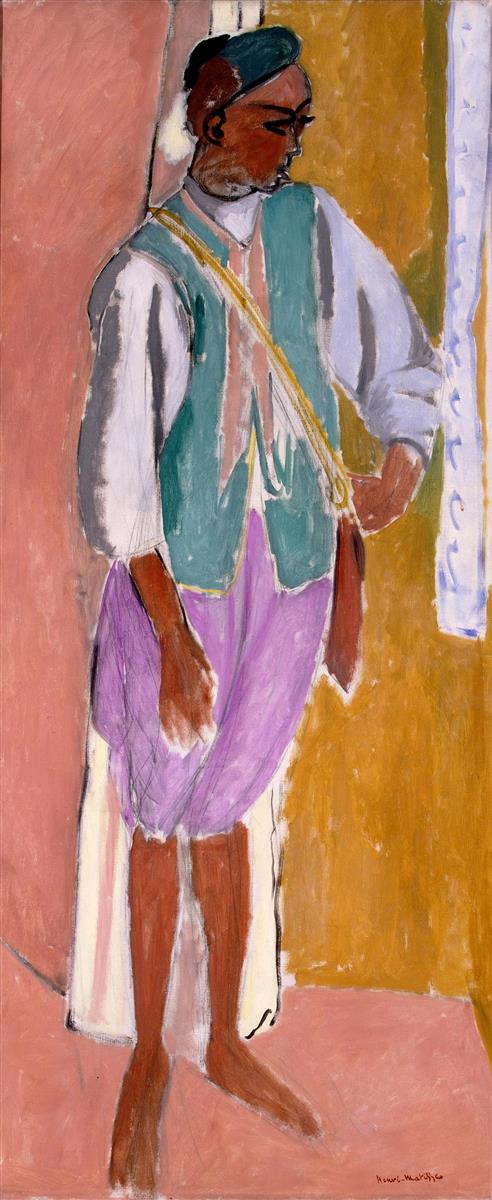
Henri Matisse’s “The Moroccan Amido” (1912) is a masterclass in how a portrait can be built from color, contour, and proportion rather than descriptive detail. Painted during his first Moroccan sojourn, the work distills the sensation of Tangier into a tall, breath-like format where a single standing figure occupies almost the entire height of the canvas. Barefoot and poised, the sitter wears a mint-green vest over a pale shirt, a lilac sarouel, a green cap, and a diagonal gold sash. The background is reduced to blocks of ochre, rose, and a vertical band of cool blue-white that reads as a window or curtain. There is no anecdote and no ornament for its own sake. Instead, Matisse composes a climate of color in which the sitter’s presence can resonate with quiet authority.
First Impressions and the Force of Format
The painting’s proportions immediately set its tone. The narrow, elongated rectangle is almost architectural, like a door or a slender niche. Within this column the figure becomes a living pilaster. The head sits high near the top edge, the feet are planted close to the bottom, and the diagonal of the gold sash runs like a structural brace across the torso. Matisse has long understood that format is not a container but an active participant in meaning. Here the vertical thrust evokes minarets and tall Moroccan doorways while lending the sitter a dignity that is calm rather than grandiose. The format also enforces a choreography of verticals and diagonals that guides the eye from head to sash to hand to ankle and back upward to the inward-turned face.
Color as Architecture
Color constructs everything in “The Moroccan Amido.” Matisse forgoes modeled shadow in favor of temperature relationships and value steps. The overall climate is warm, anchored by fields of salmon pink and ochre. Against that warmth he stages a suite of greens—the cap, the vest, and thin interior accents—and a countering lilac in the trousers. The conversation between warm ground and cool clothing replaces theatrical light. The greens appear truer and the lilac richer because they are set amid the pinks and ochres that surround them. A slim, icy band at the right edge cools the composition further, perhaps an open shutter or a tiled reveal, which keeps the painting from closing in on itself. Color is the scaffolding that holds the portrait upright.
Contour and the Written Line
Matisse draws with the loaded brush, letting line and color arrive simultaneously. The figure’s outline is a continuous series of varied strokes: thicker at the shoulders and thighs, thinner along the cheek and nose, decisive at the hand resting on the hip. These lines are not fencing; they are statements about weight and direction. Inside the silhouette, the vest is divided into large flat shapes, their edges slightly frayed where the brush dragged across the dry underlayer. The lilac trousers are cut by a few economy lines to suggest fold and volume without fuss. Even the features of the face—brow, nose bridge, lips—are delivered with a handful of sure marks. This painted calligraphy grants the sitter poise while preserving the painting’s tempo.
Light by Adjacency
Instead of a single source, light in this picture is the result of adjacency. The brown skin warms when it touches the lilac of the trousers and cools near the mint vest. The pale shirt brightens because it sits between the darker vest and the ochre wall. The gold sash glows not from metallic sheen but because Matisse pitches it against complementary neighbors, a strategy that keeps the surface unified. The result is a portrait that feels luminous without sacrificing flatness; every area participates in the same atmospheric logic.
The Ethics of Simplification
A portrait painted by a European artist in North Africa in 1912 inevitably raises the question of exoticism. Matisse’s approach is noteworthy for what it refuses. There is no display of props to signify the picturesque. There is no peeping into a private interior. There is just Amido himself, his clothing, and a plainly constructed space. By stripping away anecdote and focusing on attitude, posture, and color, Matisse sidesteps the clichés of the colonial gaze. The sitter is not a “type”; he is a presence. Simplification is a form of respect because it clears space for attention rather than spectacle.
Pose, Balance, and Psychological Temperature
The pose is informal but composed. One hand hangs relaxed at the side; the other braces the hip, stirring a shallow counter-curve through the torso. The head turns to the left, the eyes directed downward, registering a self-contained alertness rather than a theatrical expression. The bare feet root the figure to the pink floor, softening any hint of military stiffness the sash might suggest. Matisse uses this stance to balance diagonals and verticals like a quiet music—sash against arm, hip against thigh, ankle against floor—so that the body seems to breathe within the tall format. The psychological temperature is calm, observant, slightly withheld, perfectly in tune with the painting’s controlled palette.
Background as Silent Partner
The setting is three planes: an ochre wall, a rose floor, and that cool vertical strip along the right edge. Each has been brought to life with visible brushwork—thin scrapes, scumbles, and small areas where undercolor peeks through—so the ground never becomes dead theater. The right-hand band does crucial work. It presses gently against the figure, counterbalancing the ochre plane and refreshing the eye with its cooler temperature. Some viewers read it as a curtain or a sunlit jam; others as a tiled reveal; it is enough that it is a note of blue-white clarity within a warm chord. In this way the background is not a place but a set of intervals into which the figure is tuned.
The Diagonal Sash and the Logic of Design
The gold sash that slips from shoulder to hip is more than an accessory. It is the painting’s primary diagonal, a gleam that runs almost the full torso and organizes the neighboring shapes. It also knits together the two chief temperature families: it warms the cool greens and lilac, and it catches the light of the ochre plane. Such a line would risk cutting the figure in half if it were fully detailed. Matisse keeps it spare, a few strokes bright enough to carry, thin enough to keep everything breathing.
Material Surface and the Trace of Making
Look closely and the painting’s order of decisions becomes visible. A thin, dry ground was first scrubbed across the canvas to establish the pink and ochre fields. Over these fields the figure was staked out with dark contour and broad shapes of vest and trousers. Edges were corrected with return strokes of background color, creating narrow halos that push the body forward. Small pentimenti remain at the hand and hem, testifying to adjustments made during the sitting. The shirt’s whites are not a single pigment but a stack of cool and warm grays that catch the hairline ridges of earlier layers. The surface has the tactility of thought.
Cultural Specificity without Costume Drama
Amido’s dress signals a particular culture, but Matisse treats it with the same structural intelligence he gives to any garment. The vest becomes a set of large green planes that mediate between flesh and background. The sarouel is an airy lilac wedge that opens the lower half of the canvas and offers a counter to the vertical torso. The cap is a small echo of those greens higher on the body, a reprise that completes the chromatic arc. The result is descriptive enough to be true and abstract enough to be universal. Cultural specificity enriches the painting without becoming its subject.
Relations to the Moroccan Cycle
“The Moroccan Amido” belongs to the group of 1912 works in which Matisse painted sitters he encountered in Tangier: “Fatma,” “Zorah,” and other portraits now central to his Moroccan period. Compared with the cross-legged seated portraits, Amido’s standing posture and the extreme vertical format give this work a particular architectural gravity. Compared with the arabesque density of “The Blue Window” or the botanical abundance of “Acanthus,” the present canvas is almost ascetic, a figure against three planes. Yet they share methods: saturations of violet and green, lines that act like calligraphy, and light built by adjacency. The painting’s reserve makes it one of the cycle’s most distilled statements.
Depth as Rhythm, Not Perspective
Depth in this portrait is felt as overlapping planes rather than mapped by converging lines. The ochre wall passes behind the figure’s head and arm; the rose floor tilts up as if still part of that wall; the bluish strip advances slightly because of its coolness but is pinned to the right edge like a column. The figure occupies the shallow space between these planes without being squeezed. Rhythms of verticals and diagonals create a sense of place in the absence of perspective cues. The result is a modern space, legible and honest to the flatness of the canvas.
The Face as Sign and Presence
Matisse achieves likeness with economy. The brow is a single curved note; the nose is set with one long, sure stroke and a short perpendicular; the lips are compact and dark; the cheek’s modeling is little more than a temperature shift over the ochre ground. Yet the face feels specific and alert. The artist’s long engagement with African and Islamic objects taught him that the mask-like can be profoundly human when pared to essentials. Here, the sitter’s introspective turn and the slight dip of his lids speak volumes without one fussy detail.
Lessons for Painters and Viewers
This portrait teaches that a limited palette can carry complex emotion when intervals are tuned precisely. It demonstrates how a format can dictate the language of a painting and how a single diagonal can organize a figure without becoming a gimmick. It shows that contour painted with conviction can replace laborious modeling and that light can be constructed by adjacency rather than by illustrative highlights. It also models an approach to cross-cultural subjects founded on attentiveness rather than display. Viewers feel the calm concentration with which the painting was made; they are invited to return it in kind.
Influence and Afterlife
The long, simplified figure set against unbroken fields anticipates Matisse’s later work in several ways. The pure color planes foreshadow the late cut-outs where figures and interiors are carved from paper into equally decisive silhouettes. The reliance on vertical format and structural diagonals anticipates the staging of his studio scenes from 1911 and 1912 and the organizational clarity of works such as “The Red Studio” and “The Pink Studio.” Designers and photographers have taken similar lessons from this portrait: that a subject can command a composition through posture and negative space alone, and that the strongest environment is often the one reduced to its essential planes.
Why the Painting Still Feels New
Viewed today, “The Moroccan Amido” retains the shock of clarity. The colors remain fresh because they were never slavishly descriptive; they were chosen for relationship and effect. The drawing feels contemporary because it is frank, economical, and confident. The respect with which Amido is presented—self-contained, untheatrical, dignified—has only grown more relevant. In a world crowded with images that demand immediate drama, Matisse’s portrait reminds us that attention is itself a subject.
Conclusion
“The Moroccan Amido” crystallizes Matisse’s Moroccan discoveries into a singular portrait that is both deeply human and rigorously designed. A tall format becomes a piece of architecture for a living column of color. Greens and lilacs breathe against ochres and pinks; a golden sash calibrates the diagonals; contour lines write the figure into being. The background refuses spectacle and instead offers the lucid planes in which a person can stand. Modern in method and timeless in its calm, the painting is an object lesson in how much presence can be summoned with how few means when every decision is alive to structure, rhythm, and respect.