Image source: wikiart.org
Introduction
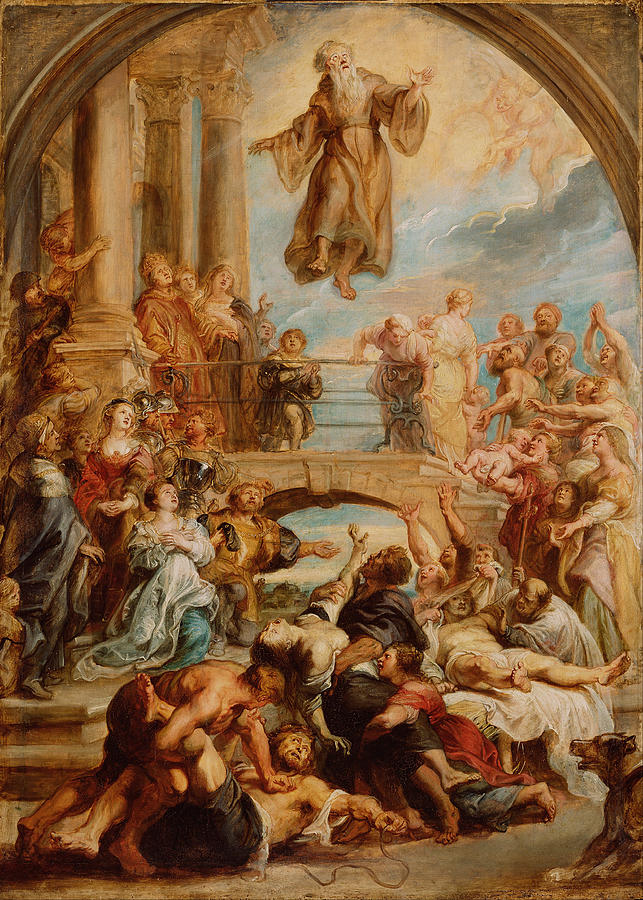
“The Miracles of Saint Francis of Paola” by Peter Paul Rubens is a whirlwind of bodies, architecture, and divine intervention. The painting depicts the humble hermit and wonder-worker Francis of Paola suspended in mid-air as he works miracles among crowds of the sick, desperate, and astonished. Rubens transforms the saint’s legend into a vast theatrical spectacle, filled with twisting figures, dramatic light, and emotional extremes.
The work encapsulates the Baroque ideal of religious art: it is didactic, emotionally charged, and visually dazzling. Rather than presenting quiet piety, Rubens emphasizes the explosive impact of holiness in the world. The saint’s levitating figure dominates the sky while, below, chaos and suffering slowly resolve into faith and hope.
Saint Francis of Paola and His Miracles
Francis of Paola (1416–1507) was an Italian hermit and founder of the Order of Minims. Known for extreme humility and asceticism, he was nonetheless credited with spectacular miracles: healing the sick, raising the dead, and even crossing the sea on his cloak. Rubens’ painting is not a literal illustration of one specific event but a composite, celebrating his reputation as a universal healer and intercessor.
In the early seventeenth century, saints like Francis were promoted as models and protectors for Catholic believers, particularly in the wake of the Counter-Reformation. Rubens, steeped in this spiritual climate, portrays Francis as a conduit of divine power whose presence transforms an entire city square into a stage for God’s mercy.
Composition: An Upward Surge
Rubens organizes the painting as a dramatic ascent from chaos to the miraculous. The bottom third is crowded with writhing bodies: the sick, the possessed, and the injured. Moving upward, the middle zone shows people rising, pointing, and turning their faces toward the saint. At the top, Francis floats in a radiant cloud, framed by an architectural arch and luminous sky.
This vertical progression is reinforced by compositional lines. Arms, gazes, and architectural elements all converge on the hovering figure of Francis. The arch above him functions almost like a halo on an architectural scale, emphasizing that everything in the painting—spatially and spiritually—centers on the saint’s holy presence.
The effect is like watching a great wave rise: anguish and disorder at the base surge upward into awe and worship near the apex. Rubens thereby visualizes the movement from human misery to divine grace.
The Levitation of Saint Francis
Francis is depicted mid-air, robe billowing, arms gently extended. His bare feet dangle just above the balustrade of the loggia, making it clear that he is not standing but miraculously suspended. Rubens deliberately avoids rigid, statue-like levitation; instead, Francis’ body has organic motion, as if lifted by a warm updraft of divine energy.
His face is serene yet intense. The eyes look slightly upward toward a light source in the clouds where faint angelic forms appear. This gaze establishes a direct link between heaven and earth: Francis is rooted in the crowd’s needs but oriented toward God, the ultimate source of his power.
The brown habit of the Minim friar is simple and unadorned, emphasizing Francis’ humility. Rubens contrasts this modest clothing with the sumptuous garments worn by many onlookers, underlining the paradox that great spiritual power can dwell in outward poverty.
Crowds in Crisis: The Lower Register
The bottom zone is a tumult of bodies—one of Rubens’ specialties. Here we see people collapsed on the steps, writhing on the ground, clutching each other in fear or desperation. Some appear possessed or insane, others mortally ill. One figure lies on his back as another struggles to restrain him; nearby, a man supports a fainting woman.
Rubens packs this area with muscular torsos and expressive faces, creating a sense of pressing urgency. These are not generalized sufferers; each person has a distinct posture and story. The viewer is drawn into their plight and can almost feel the heat and smell of this dense crowd.
This chaos at the base serves as a visual “before” to the miracle’s “after.” It shows the depth of human suffering that calls forth divine intervention. Without this darkness, the saint’s light would feel less potent.
Witnesses and Beneficiaries of the Miracle
Above the struggling masses, a second tier of figures reacts to Francis’ levitation. Some fall to their knees with arms raised in praise; others point upward, guiding the viewer’s eye. Mothers hold up infants, pleading for healing. Soldiers lean on their weapons in stunned amazement. A richly dressed woman with a feathered headdress looks upward with entranced devotion, a reminder that saints attracted all classes—from nobles to beggars.
Rubens uses these intermediate figures to show the emotional transformation wrought by the miracle. Faces register fear, joy, hope, and overwhelming awe. This spectrum of responses allows viewers to locate themselves in the scene: do they feel skeptical, shocked, moved to prayer? The painting’s power lies partly in this invitation to personal identification.
Architecture and the Setting of the Miracle
The event unfolds in a grand architectural setting typical of Rubens’ admiration for Italian and classical forms. Massive columns, balustrades, and an enormous arch frame the action. The building suggests a public, civic space—a city square or palace forecourt—rather than a secluded monastery.
This choice reminds viewers that sanctity is not confined to cloisters but erupts into everyday life. The stone architecture underscores the permanence and stability of the Church, even as the swirling figures demonstrate the volatility of human experience.
The arch is particularly important. It functions as a compositional device that encircles Francis’ levitating figure, echoing the shape of a halo or mandorla. The open sky beyond the arch further emphasizes the connection between this earthly environment and the heavenly realm into which the saint seems partly absorbed.
Color, Light, and Atmosphere
Rubens’ color palette is warm and opulent, typical of his mature work. Earthy browns and golds dominate the architecture and lower figures, while brighter reds, blues, and whites highlight key characters. Saint Francis’ habit is painted in subdued tones, allowing the more vivid garments of the crowd to swirl around him like a storm of color.
Light pours in from the upper right, bathing Francis and the surrounding clouds in pale gold. This light then cascades downward, touching some faces while leaving others in semi-shadow. The distribution of illumination is not purely naturalistic; it is symbolic. Those nearer to faith and openness receive more light; those still trapped in confusion remain partially obscured.
The subtle haze in the upper sky, with suggestions of angelic forms, creates an atmosphere of the supernatural without breaking the painting’s overall realism. The miracle feels wondrous yet plausible within Rubens’ world.
Baroque Drama and Movement
Everything about the painting screams Baroque dynamism. Bodies twist in exaggerated poses, fabrics whirl, expressions are heightened almost to the point of theatrical performance. Rubens uses diagonals everywhere: the tilt of heads, the angles of arms, the curves of staircases all create a rhythmic motion that sweeps the eye across the canvas.
This sense of movement is not chaotic for its own sake. It visualizes the sudden shock of the miraculous. A man levitating in a public square would provoke exactly this kind of frenzy—people rushing, jostling, collapsing, reaching out. Rubens harnesses that imagined physical reaction to express inner spiritual agitation: the disruption of disbelief, the stirring of wonder, the birth of faith.
At the same time, the composition is carefully controlled. Francis remains calm and stable at the top, a fixed point amid the swirling masses. This contrast between heavenly stillness and earthly movement is a hallmark of Rubens’ religious works.
Iconography of Miracles and Charity
Scattered throughout the painting are visual clues to specific types of miracles associated with Francis. We see the sick being presented, the lame carried, infants held up for blessing. Figures who appear newly strengthened or freed from torment react with ecstatic gratitude.
These details stress that Francis’ miracles are not abstract displays of power but acts of charity. He intercedes for the most vulnerable: the ill, the poor, the children. In this way, the painting operates as a visual theology of saintly mediation. The saint’s levitation is impressive, but its real significance lies in what it accomplishes for others.
The painting also aligns Francis with Old Testament prophets and New Testament apostles whose miracles validated their mission. Rubens thus inserts him into the larger story of salvation history, reinforcing his status as a legitimate and powerful intercessor.
Devotional and Political Functions
Works like “The Miracles of Saint Francis of Paola” served multiple purposes. Devotionally, they encouraged viewers to venerate the saint, seek his intercession, and imitate his faith. Politically, they reinforced the Catholic Church’s message that sanctity and miraculous power continue in the post-biblical era, countering Protestant doubts about such phenomena.
Rubens’ painting makes a persuasive case for the continued presence of the divine in history. The miracle occurs in a setting that feels contemporary to Rubens’ viewers—Baroque architecture, fashionable clothing, and recognizable social types. The implicit message: just as Francis transformed his world, saints and grace can still transform ours.
Rubens’ Synthesis of History, Legend, and Theatricality
The painting demonstrates Rubens’ ability to blend historical and legendary material into a unified, emotionally gripping whole. Although no eyewitness account could capture an event exactly like this, Rubens’ depiction feels plausible because he grounds it in physical reality: weighty bodies, believable gestures, recognizable spaces.
At the same time, he borrows from theater and classical art to heighten the impact. The composition resembles a staged drama with a proscenium arch, upper balcony, and densely populated stage. The crowd functions like a chorus reacting to the miracle. Francis is the central actor, but every onlooker plays a role in conveying the narrative.
This synthesis speaks to Rubens’ broader artistic project: to use all available visual languages—classical, theatrical, naturalistic—to communicate sacred truths dynamically and convincingly.
Conclusion
“The Miracles of Saint Francis of Paola” is an exuberant affirmation of Baroque faith in the power of saints and the reality of divine intervention. Through a towering vertical composition, dense crowds, luminous color, and the serene levitation of the saint, Peter Paul Rubens turns a hagiographic episode into a sweeping vision of grace at work in the world.
From the agonized bodies struggling on the steps to the uplifted arms and astonished faces, the painting charts a journey from despair to hope. At its apex, Saint Francis floats between earth and heaven, linking the two realms. The viewer, caught in the middle register, is invited to move inwardly from confusion to belief, from passive observation to active devotion.
As both a masterpiece of Baroque art and a powerful piece of Counter-Reformation propaganda, this painting demonstrates Rubens’ extraordinary capacity to make theology visible, turning the stories of saints into living, breathing experiences that still captivate and challenge modern viewers.