Image source: wikiart.org
Introduction
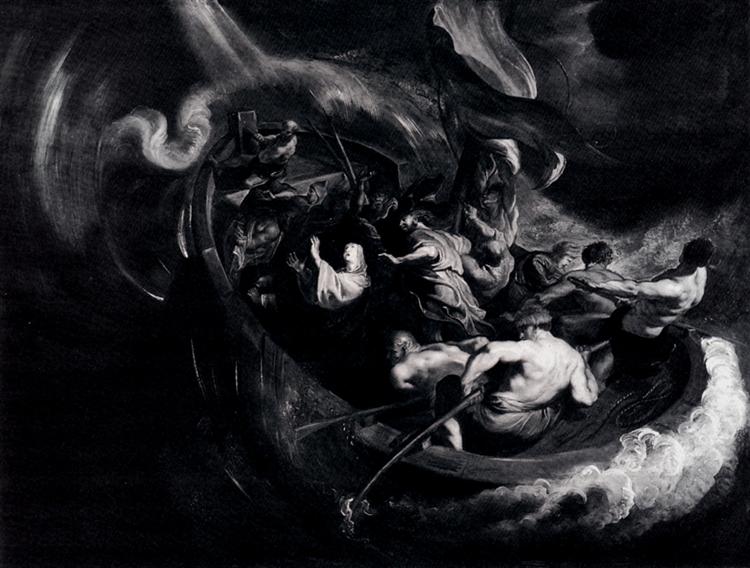
Peter Paul Rubens’s “The Miracle of St. Walburga” (1610) is a vortex of wind, spray, and human effort in which the salvation of a ship depends on the intervention of a saint. The scene is a Baroque storm at full cry: a narrow boat heels under a wall of black weather, oars bend, bodies lunge, and a sudden, concentrated brightness isolates the holy figure at the heart of the tumult. Rubens turns water and air into narrative forces, binding theology to motion. Made just after his return to Antwerp from Italy, the picture compresses everything he learned from the antique and from Venetian drama into a single, whirling composition that argues for the power of intercession the Counter-Reformation prized. It is a painting you almost hear—the slap of the sea against planks, the snap of canvas, the shout to pull together—and by the time you realize your own breath has quickened, the miracle has already begun.
St. Walburga and the Meaning of the Storm
Walburga was an eighth-century Anglo-Saxon missionary whose cult spread widely across the Low Countries and Germany. Among her many recorded favors were rescues at sea. Sailors invoked her name when weather turned murderous, and churches near waterways adopted her as patron. For a mercantile port like Antwerp at the beginning of the Twelve Years’ Truce (1609), an image of Walburga calming the waters was not an abstraction but a civic reassurance. Rubens chooses a moment when chaos borders resolve. The saint, robed in light and set at the luminous center of the boat, is not a static icon; she is a presence in the crisis. Around her, the crew enact a spectrum of human responses—terror, labor, supplication—so that the painting visualizes a theology of community: grace descends, but salvation also requires a common pull on the oars.
A Spiral Composition that Swallows and Saves
Rubens anchors the design with a great spiral that turns from the lower right, where the bow cuts a white seam of foam, up along the curve of the hull, over the striped sail that whips like a banner, and back down through a whirl of cloud toward the saint. The boat itself is drawn as a crescent, a cradle fighting to stay upright, and every figure is drafted into the swirl. This spiral is not decorative; it is the story. It expresses the physical torque of the gale and becomes the visual path by which the eye discovers the miracle at the center. Baroque diagonals abound—oars thrust forward, bodies hurl their weight crosswise, and a mast lunges like a spear—but the spiral binds them into rhythm. In a single glance you experience suction and release, peril and reprieve.
Light and Shadow as Instruments of Grace
The illumination is violently selective. The world is mostly night—storm-dark sky, wet timber, backs of rowers caught in a black polish—until a wedge of light crashes down and spreads across the saint’s robe and the faces turned toward her. Rubens’s chiaroscuro here is not the trapping light of Caravaggio’s interiors; it is seaborne, directional, salted with foam. Light signifies two things at once: the break in the weather and the arrival of help. The darker the gale rages at the perimeter, the more sacramental the lit core becomes. Foam at the prow and the rip of the sail are painted as pale echoes of that grace, so that even the elements begin to brighten in sympathy.
The Cast of the Boat: A Choir of Human Responses
Rubens arranges the crew as a moving chorus. At the stern men strain at the oars, torsos twisted, muscles articulated with an energy the painter learned from antique river gods. Closer to the saint figures lean in with hands raised in appeal; others claw at ropes or brace against the gunwale, their faces split by fear and concentration. One sailor has turned completely inward, shielding his eyes from spray and revelation alike. The variety of gesture makes the miracle legible as experience rather than legend. This is not a placid devotional scene. It is a document of how people behave when the world is trying to throw them overboard.
The Saint in the Eye of the Storm
Walburga stands or kneels amidships, her drapery clamped by the same wind that mangles the sail yet falling with a steadiness foreign to the rest of the boat. This contrast isn’t an accident. Rubens shows the saint subject to weather—she is in the storm with the sailors—while also anchoring the composition with her calmer rhythms. Her hands, lifted in blessing or prayer, form a small architectural shape at the center of turbulence, like a chapel built of gesture. That poise is the miracle’s visible form; it imparts order to the vortex, and the surrounding bodies begin to align with it.
Water, Wind, and the Physics of Baroque Motion
You can almost diagram the weather from Rubens’s marks. The sail bellies and kinks in several directions at once, the brine at the prow frets into beaded lace and then crushes into a white slab under the keel, and the sky itself seems to rotate in greasy arcs, as if the air were a giant screw turned by a furious hand. Oars scoop black water; one blade catches, biting the sea with an S-shaped wake. These observations are not generic. Rubens paints forces, not symbols of forces. That is why the scene convinces before it instructs; our bodies recognize the physics first and the theology second, and then both fuse as one truth.
Antwerp, the Truce, and the Rhetoric of Salvation
The painting’s rhetoric would have been immediately legible in 1610. Antwerp’s prosperity turned on the Scheldt and the wider sea, and decades of war had made storms—literal and political—part of civic memory. With peace newly declared, a church picture that celebrated communal deliverance through a saint’s intercession affirmed a fragile hope. The boat is a polity, the oars are common labor, the saint is the patron who binds the parts into a safe passage. Rubens’s grand storms always carry this double register: they are bodily spectacles and political allegories at once.
Dialogue with Sacred Precedents
The subject inevitably recalls the Gospel story of Christ calming the Sea of Galilee, a theme Rubens and many others treated. He borrows the textual energy of that miracle—the terror of professionals outmatched by weather—and translates it to the life of a later saint. The move is strategic. Counter-Reformation art defended the network of saints and their efficacy by staging in them the same divine generosity seen in the life of Christ. Rubens distinguishes Walburga’s miracle by making her not the commander of nature with a single word but the intercessor whose prayer steadies hands and hearts. The sea quiets, but not before people begin to pull together.
Materials, Touch, and the Speed of the Brush
The painting’s surface shows Rubens working with urgency. Waves are built with fast, loaded strokes dragged into crescents; the sail’s highlights are scumbled so that canvas grain seems to appear; flesh is modeled with warm underpainting pulled up into cool notes at the shoulder and spine. The spareness of detail—few descriptive accessories, little architecture—throws all the painter’s labor into bodies and weather. Even in monochrome reproductions, the surface feels wet. That tactility is a key to the picture’s persuasiveness; it isn’t only a story of a storm, it is storm made of paint.
The Boat as Stage and Instrument
The hull is not a passive container. Its curved rim and high sides choreograph the action, turning the boat into a theater in the round. The saint occupies the stage’s center; the oars are props; the mast is a vertical axis that rotates the ensemble. Rubens has built a machine for emotion: wood channels force, oars translate muscle into progress, and canvas imperfectly obeys command. You feel how close technology brings the crew to defeat and how small the increment is by which they regain control.
The Soundscape Painted in Gestures
Few paintings are as audible. You can map sound to gesture: a man pulling hard on an oar opens his mouth in a shout; another claps a hand to his ear to steady himself against the wind’s howl; the saint’s lips part in prayer that must be shouted to be heard. Foam at the prow is brush-written sibilance; the sail’s whipping tail is a drumroll. Rubens turns the whole image into a score whose dynamics crescendo at the center and decrescendo toward the upper left where the sky begins to clear.
Theology in Muscle and Foam
The theology here is not tacked on with inscriptions; it is embodied. Grace appears as usable calm at the critical center, but it also moves outward in practical effects: men find their footing; oars catch water cleanly; the sail stops fighting itself; the prow points where it should. This is the Counter-Reformation imagination at its most persuasive—no denial of the elements, no contempt for effort, only the claim that human striving flowers when faith steadies the hand.
A Picture for Sailors and City Fathers
Images like this were not only for cloistered contemplation. They argued publicly for the protection and patronage of saints whose names were attached to parishes, guilds, and confraternities. Merchants could read their fortunes in the crease of that sail; sailors could see their own back muscles on the men at the oars; magistrates could find a parable of municipal concord in the boat that requires every hand. Rubens knew how to make grand art talk fluently to everyday life.
The Body Language of Fear and Trust
Study the crew and you discover a moral spectrum carried in posture alone. At the edge of the boat a man leans entirely into the sea, as if daring the wave to take him; another curls inward in a fetal brace; a third stretches backward in sudden trust, leaving the oar to the saint’s favor for a heartbeat. These positions are not anecdotal. They are the anatomy of fear and trust—Rubens’s favorite human drama—made legible so that viewers can find themselves among the cast and choose a position.
Near Catastrophe as Rubens’s Chosen Instant
Rubens rarely paints miracles at the moment of placid completion. He prefers the brink, the last breath before reversal, because there human freedom is visible. In this picture the wave at the bow is still a claw, the wind still tries to wrench the sail, and yet the compositional center has already turned toward order. That balance between still-threat and arriving-calm generates the painting’s electricity and explains why it continues to feel modern: it is a portrait of rescue underway, not of salvation finished.
The Eye’s Path and the Viewer’s Place
Rubens locates the viewer just above and slightly off the starboard side, looking down into the boat on the same diagonal as the wave. The vantage throws you into the weather; your eye slides with the foam, rides the curve of the gunwale, and bumps into the saint’s light before being flung back toward the rowers. It’s a visual reenactment of a near-capsize and an invitation to be part of the crew. You are not a distant spectator; you’re on the water, drenched and blinking into light.
Afterlife and Relevance
The painting’s afterlife is written in every subsequent storm scene that treats weather as a character and miracles as kinetic events. Its argument remains crisp: in public crises, communities find their way when labor and petition converge. That claim travels beyond the harbor. It is civic advice disguised as sacred drama and an image that still feels true when winds rise in any century.
Conclusion
“The Miracle of St. Walburga” is Rubens at full sail—anatomy blazing, drapery whipping, light breaking like a benediction. It takes a patron saint beloved by sailors and turns her legend into an immersive experience of air and water. The spiral composition swallows the viewer and then, with the saint at the eye, steadies the world. Muscles, oars, mast, and wave become sacraments of effort made effective by grace. In the uncertain calm of 1610 Antwerp, no picture could have said more with greater force: the boat holds, the crew pulls, the storm relents, and faith proves seaworthy.