Image source: wikiart.org
Introduction
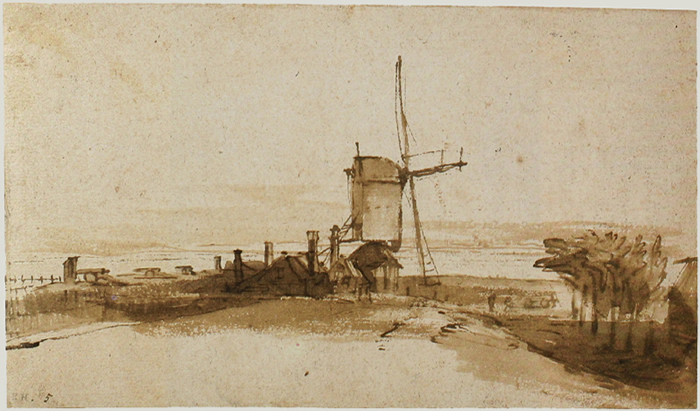
Rembrandt’s landscapes often feel like lived memories more than topographical records, and “The Mill on the Het Blauwhoofd” belongs to that intimate current in his work. The image shows a windmill perched along the water’s edge with a shallow skyline stretching into a pale distance. Sparse buildings nestle at the base of the mill, while a roughened foreground embankment curves inward as if inviting the viewer to step onto the scene. The entire sheet is executed with a restrained palette of ink and wash, the kind of simple means that Rembrandt used to astonishing effect. In a few tonal bands and decisive strokes he shapes a place where engineering, weather, and work cohere into a single, breathable atmosphere.
Historical Setting And The Meaning Of Het Blauwhoofd
Het Blauwhoofd was part of Amsterdam’s watery perimeter, a protruding point along the IJ where defenses, quays, and industrial structures met the harbor. In seventeenth-century Holland, windmills were not pastoral ornaments; they were machines that pumped water, sawed timber, ground grain, and stabilized the delicate equilibrium between land and sea. The choice to draw a mill at the Blauwhoofd therefore situates the image at the juncture of civic infrastructure and daily labor. Rembrandt does not deliver a grand view of the city’s pride; instead he offers a quiet portrait of one of the civic organs that kept Amsterdam alive. It is engineering seen with affection, not as spectacle but as the familiar neighbor that hums, creaks, and turns with the wind.
Subject And First Impressions
At the center rises the cylindrical mill tower with its high cap and skeletal sails. Attached to its base, a cluster of low roofs and small outbuildings form a wedge of darker tone, their chimneys signaling activity inside. A fence line tapers off to the left, while on the right a hedge or row of pollarded trees thickens into a blunt, columnar mass. The far distance is expressed with delicate horizontal washes that read as the wide waterway and the faint shoreline beyond. The composition is unusually open, its true subject arguably the spread of air and light. The mill acts as a pivot in this openness, the single vertical that fixes an otherwise horizontal world.
Composition And The Physics Of Balance
Rembrandt constructs the scene like a system of levers. The mill and its sails are the visual fulcrum. To the left of that fulcrum run low, lengthened forms—fences, roofs, the slow band of water—creating a counterweight of horizontals. To the right he places a denser, darker block of trees and embankment that balances the mill’s height and binds the foreground to the middle distance. The result feels stable yet not static. The gentle incline of the foreground path draws the eye inward on a diagonal, meeting the vertical of the mill and the horizontals of water and horizon in a three-way negotiation. The entire sheet breathes with this balance: vertical labor, horizontal expanse, diagonal approach.
The Language Of Ink And Wash
The beauty of the drawing lies in its economy. Thin pen lines establish the armature of forms—the struts of the sails, the edges of roofs, the palings of the fence—while diluted washes create soft planes of tone. In the foreground Rembrandt drags a brush charged with a slightly darker mixture to articulate the battered edge of the bank and the rut of the path, allowing the paper to show through as dry light. The mill’s body is built from a few vertical strokes and a gentle wrap of wash that suggests curvature without fuss. The distant water is almost empty of detail, a whisper of tone that yields to the sky. The restraint is deliberate: by refusing to overstate, Rembrandt grants the eye room to complete the world.
Light, Weather, And The Breath Of The Scene
The drawing’s light is cool and even, more akin to overcast brightness than theatrical sunbeams. Because the sky is left largely untouched, it functions as the sheet’s great reservoir of air. The mill’s silhouette reads clearly against that pale field, and the thin shadows pooled at the buildings’ bases feel like dampness rather than deep shade. Weather in Holland is a story of subtle shifts—breezes that strengthen, clouds that thin—and Rembrandt catches that mutability with strokes that waver just enough to imply movement. The long sail dropping to the right looks slack and wind-seeking, as if the mill is poised between work and rest. The viewer registers not a frozen instant but an interval, a minute in which weather is deciding what to do.
Space And The Art Of Suggestion
Depth is achieved less through linear perspective than through the stacking of tonal bands. Foreground bank, middle cluster of buildings, far water, and more distant land peel away in mild gradations. Overlaps do the rest: chimneys occlude roofs, the mill occludes the horizon, the right-hand trees occlude the path. The eye reads these overlaps as cues for distance, even though drawing information remains sparse. This spareness is crucial to Rembrandt’s method. He is not mapping a survey; he is recreating the sensation of standing on a windy margin and letting one’s attention move between near textures and far brightness.
The Mill As Machine And Emblem
A Dutch windmill is both mechanism and symbol. It embodies ingenuity, communal maintenance, and the conversion of invisible forces into useful work. Rembrandt acknowledges its emblematic status but keeps it human-scaled. The tower is not idealized; it is slightly squat, with a cap that feels patched, practical, and weather-proof. The sails are drawn as structural lines rather than decorative crosses. You sense gears, ladders, and worn wood behind the ink. By anchoring the machine to the modest buildings at its base, he reminds us that mills are lived environments: they include workers’ rooms, storage spaces, and thresholds crossed many times a day.
Infrastructure And Domesticity
One of the drawing’s quiet arguments is that infrastructure and domestic life interpenetrate. The little roofs could belong to a miller’s family or to the auxiliary huts where tools and materials are stored. Chimneys imply warmth and cooking; a tiny, almost incidental figure appears near the buildings, a dark fleck of movement that confirms the site is inhabited. On the left, a fence keeps animals or people from straying onto the working ground. The mill does not stand apart from the life of the city; it is a neighbor. By showing such adjacency without commentary, Rembrandt naturalizes the integration of large civic systems into everyday routines.
The Foreground As Stage And Threshold
The foreground bank, broad and nearly empty, is not an afterthought. It is a field of entry that sets the scale of the world beyond. Its gently curving edge and the faint trace of a road guide us toward the mill, yet the space never collapses into a single vanishing point. Instead it retains the feeling of a common, accessible place where bodies can stand, where carts can roll, where dogs and children can wander. This threshold matters because it renders the image hospitable. The viewer is not trapped outside looking at an unreachable icon; the viewer is invited in.
Rhythm, Repetition, And The Pulse Of Work
The image is alive with small repetitions: a picket, a chimney, a tree trunk, a roof ridge. These repetitions create rhythm, like a slow percussion that undergirds the scene. Mills epitomize rhythmic labor—circles turned into ground grain or pumped water—and the drawing echoes that tempo visually. Even the distant shoreline is a repeated beat of pale wash. Nothing clamors. Instead the picture sets a pace at which one could sustain attention for a long time, the very pace that working life demands.
The Poetics Of Omission
Rembrandt’s greatest landscapes are built on what they withhold. Here he withholds clouds as forms, people as faces, ships as elaborate rigs. He restricts himself to essentials and trusts implication to do the rest. The omission is not laziness; it is poetics. A nearly blank sky intensifies the reality of a single vertical, the mill. A formless band of water evokes the entire system of commerce and travel without fragmenting attention. An absent crowd allows the one or two flecks that might be figures to carry human presence with minimal fuss. The sheet thereby achieves a contemplative clarity unusual in more detailed topographical views.
Local Memory And The Artist’s Process
Whether Rembrandt drew the scene on site or from recollection, the drawing reads as the work of someone who knew how the Blauwhoofd felt underfoot. There are the telltale signs of quick looking: a sail fixed with a single long stroke, a roof shaded with one decisive brush pass, a fence that oscillates in height as if traced from a moving gaze. These are not inaccuracies but records of touch and attention. The drawing is a memory made visible—the memory of windward exposure, of the hush that follows when a mill’s sails slack, of eyes adjusting to brightness off water.
Relationship To Rembrandt’s Other Mill Views
Rembrandt returned often to mills in drawings and etchings, partly because their functional beauty suited his taste for honest structures. Compared with more crowded views that set mills amid village bustle, “The Mill on the Het Blauwhoofd” is stripped down and maritime, oriented to the water rather than to fields. It shares with his river scenes a love for low horizons and long light, yet it places a man-made vertical at the center of the composition. That choice underscores the human role in organizing the Dutch landscape. The drawing stands at a crossroads between topography and meditation: recognizable place filtered through inward mood.
Reading The Right-Hand Trees
On the far right, a compact group of trees or pollards forms a dark, ribbed column. Their trunks are abbreviated, their crowns smudged, as if reduced to pure mass. They work compositionally as a counterweight to the mill’s height and, narratively, as the landscape’s organic chorus. Where the mill is geometry and gear, the trees are growth and seasonality. Together they register a partnership: culture and nature side by side, each shaping the other’s silhouette.
The Human Scale And The Ethics Of Use
The drawing does not romanticize technology. Instead it presents a mill sized to the human body, set among structures that suggest rest, meals, and maintenance. This scaling fosters an ethics of use rather than domination. The mill is large but not monstrous, the landscape modified but not erased. The picture articulates a relationship to environment grounded in care and repair, which may be why it feels so contemporary. The scene models a way of living with infrastructure that remains legible and proximate rather than remote and abstract.
Time Of Day And Seasonal Temperature
The cool evenness of light hints at a day of high cloud, perhaps morning or late afternoon when the glare off water softens. The tonal temperature is muted; nothing is yellowed with heat or purpled with dusk. That neutrality lets texture and structure carry expression. Seasonally, the scene reads as neither winter bare nor summer lush; it occupies that large Dutch span when trees hold leaves but the air remains damp. Such temperate ambiguity is useful for a drawing that aims to be archetypal rather than anecdotal.
What The Image Reveals About Amsterdam’s Identity
Amsterdam’s seventeenth-century identity fused trade, water management, and communal investment. A mill at the Blauwhoofd condenses that fusion into a single emblematic site. The drawing shows a city built by modest increments—piles driven, banks raised, machines tended—rather than by spectacular gestures. The grandeur is in the system. By setting one mill in a sweep of light and water, Rembrandt shows how a single, local machine participates in a network that holds a metropolis together.
Why The Drawing Resonates Today
Contemporary viewers live with hidden infrastructures that are difficult to picture. This drawing offers a model for how to look at them: choose one working node, clarify its relationship to the environment, and let air and light explain the rest. The work’s slowness is also restorative. It asks for the duration of a breeze and gives back the reassurance of forms that have purpose, scale, and place. In an age of noise, the sheet’s quiet is an argument.
Close Looking At Key Passages
The cap of the mill is rendered with a slightly darker wash, suggesting weather-stained wood and tarred seams. The long sail at right is a single straight calligraphy that wobbles delicately, implying both length and flex. At the base of the mill, a crooked ladder or beam leans against the structure, a small diagonal that animates the cluster of roofs around it. The foreground contains a fissure or rut that arcs toward the lower edge; its odd, thickened stroke feels like a last-minute insistence that the viewer stand here, on this worn ground, before looking out. These passages prove how much narrative Rembrandt can extract from a handful of marks.
Conclusion
“The Mill on the Het Blauwhoofd” is a compact meditation on usefulness and air. With a few washes and lines, Rembrandt generates a world in which the human-made and the natural not only coexist but define one another. The mill’s vertical certainty stabilizes the open breadth of water and sky; the foreground’s humble earth offers footing for thought. Nothing in the drawing is flamboyant, yet everything is resonant. It is the image of a working city imagined at the scale of a single site, seen with tenderness and structural intelligence. To look at it is to rehearse the experience of standing by a Dutch waterway, feeling the wind slacken, sensing the latent rotation of sails, and recognizing that civic life is composed of such ordinary, necessary places.