Image source: wikiart.org
First Impressions and the Painting’s Quiet Hook
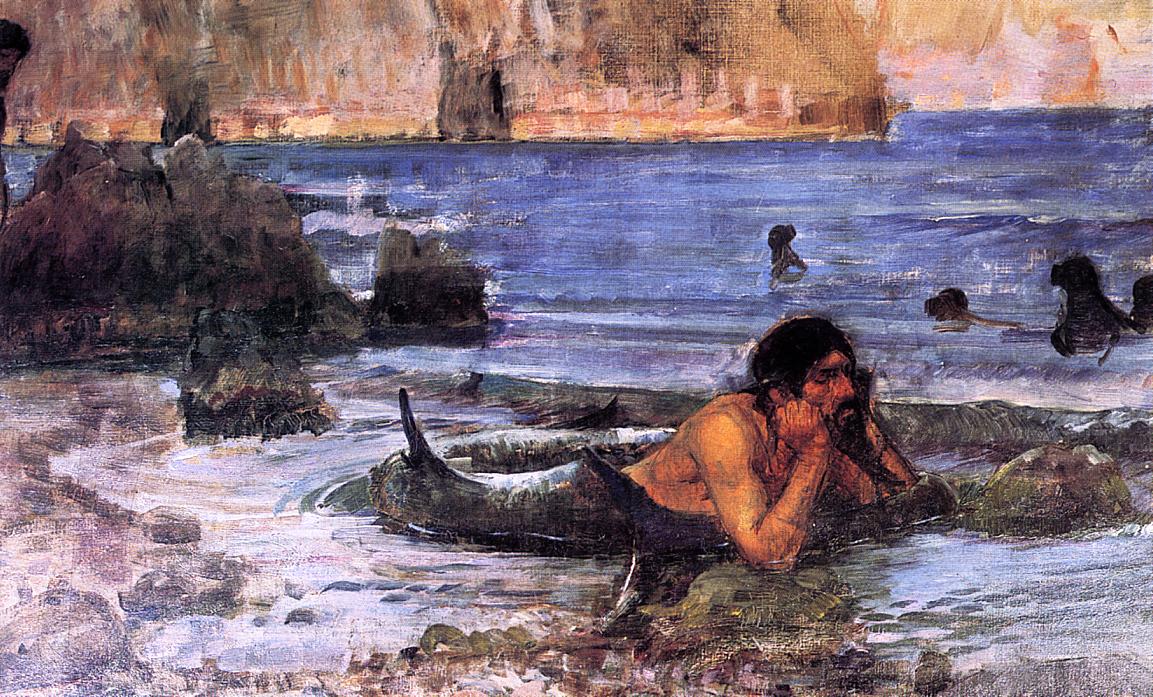
The scene in The Merman feels like something glimpsed rather than staged. A shoreline is caught in a moment of pause, when the sea has not decided whether it will soothe or shove. In the foreground, the merman lies half out of the water, propped on his elbows, his hands pressed to his face as if he is listening to his own thoughts. The pose is striking because it is so human: not heroic, not triumphant, not performing. It reads as weary, contemplative, even a little lonely.
That emotional tone is the painting’s hook. Mythological subjects often arrive with spectacle, with drama, with a narrative that insists on being read. Here, the myth is understated. The tail is undeniable, yet the mood is closer to a private reverie than a legend told aloud. Waterhouse turns fantasy into psychology. The viewer is invited to wonder what this creature wants, what he is waiting for, and whether the sea behind him is a home, a prison, or both.
Even the environment participates in this hushed tension. The water is active with ripples and foam, but the painting does not shout. It murmurs, and the merman, pressed low to the rocks and tide, seems to murmur back.
Composition and the Sense of Watching from the Shore
Waterhouse builds the composition with a strong foreground anchor and a spacious band of sea stretching behind it. The merman occupies the lower right area, close enough that the viewer can register the weight of his torso and the curve of his tail. This closeness creates intimacy, like overhearing a thought. At the same time, the sea opens wide across the middle of the canvas, pushing the viewer’s attention outward into distance and possibility.
Rocks on the left act as a counterweight. Their darker mass stabilizes the frame and adds a blunt, natural geometry against the water’s horizontal pull. The contrast between solid rock and shifting sea becomes a visual metaphor for the merman’s condition: a being shaped by change, temporarily resting on something that refuses to change at all.
In the middle distance, small figures break the surface. They are rendered with minimal detail, silhouettes and gestures rather than portraits. Because they are small and partially submerged, they feel like fleeting presences, almost like memories or temptations moving through the water. They complicate the narrative without making it explicit. Are they companions, distant swimmers, or siren-like beings? The uncertainty keeps the painting active. The composition is calm, but not settled.
The Merman’s Pose as Emotion, Not Display
The most important “event” in the painting is not an action but a posture. The merman’s elbows dig into the rock, his shoulders roll forward, and his head sinks into his hands. This is a pose associated with brooding, with waiting, with being overcome by thought. It is also a pose that turns the body inward. Instead of presenting himself to the viewer, the merman closes off, as if the viewer has arrived at the edge of his solitude.
Waterhouse handles the human part of the figure with a grounded physicality. The torso has warmth and weight, and the arms carry a believable strain, the kind that comes from holding still against pressure. The sea does not feel like a decorative backdrop here. It feels like a force pressing at the merman’s edges, and the pose suggests he is bracing, not only physically but emotionally.
The face is dark and intense, framed by hair and shadow. Even if the features are not sharply defined, the expression reads as troubled, distant, inwardly occupied. That inwardness is what makes the figure modern in feeling. Instead of myth as pageant, we get myth as a portrait of mood, a creature caught in a very human state of mind.
Sea, Rock, and the Liminal Space Between Worlds
Shorelines are natural thresholds, places where categories dissolve. Land becomes slick, water becomes foam, and stability turns provisional. Waterhouse uses this liminal space as the perfect setting for a hybrid being. The merman belongs to the sea, yet he is shown at the point where the sea’s authority weakens, where rock interrupts it and air enters the story.
The tide around him is thick with movement. Pale foam streaks across the foreground, and the water seems to wrap around the rock like fabric tugged by an unseen hand. This makes the merman’s stillness more poignant. Everything around him shifts, yet he holds a pose that suggests endurance, resignation, or stubborn longing.
The rock itself is not romanticized. It is rough, dark, irregular, and it reads as cold against the warm skin of the torso. That contrast heightens the sense that this moment is uncomfortable and therefore meaningful. Resting here is not indulgent. It is necessary. The merman appears to have chosen a hard place to pause, as if softness is not available to him.
Because the shoreline is a boundary, it also becomes a stage for desire. Boundaries invite crossing. The merman’s gaze points outward, and the distant figures in the water hint that something, or someone, exists beyond his reach.
Color and Light: Cool Water, Warm Distance, and a Mood of Dusk
The palette balances cool blues with warm, earthy tones. The sea is painted in layered blue-violets, broken by white foam and streaks of lighter reflection. The background cliffs or distant shore glow in warm oranges and pinkish browns, as if lit by late-day sun. This interplay sets up a subtle emotional push and pull: coolness in the immediate environment, warmth in the far distance.
That warmth feels unreachable, and that matters. The merman is physically close to the viewer, but the warmest light is not on him. It is beyond him, across the water. The effect is quietly narrative. It implies a world elsewhere that carries comfort, memory, or promise, while the present moment remains salted and cold.
The merman’s skin is rendered with warm ochres and browns, making him a bridge between the two color zones. He belongs to the cool sea by nature, but he carries the warmth of humanity in his body. The painting’s color logic reinforces the theme of hybridity, not as a novelty, but as a condition that creates tension.
Light is not crisp or theatrical. It is softened, dispersed, and atmospheric. That softness keeps the painting from turning into melodrama. Instead, it sustains a reflective mood, like the end of a day when thoughts grow louder because the world grows quieter.
Brushwork, Texture, and the Painting’s Suggestive Finish
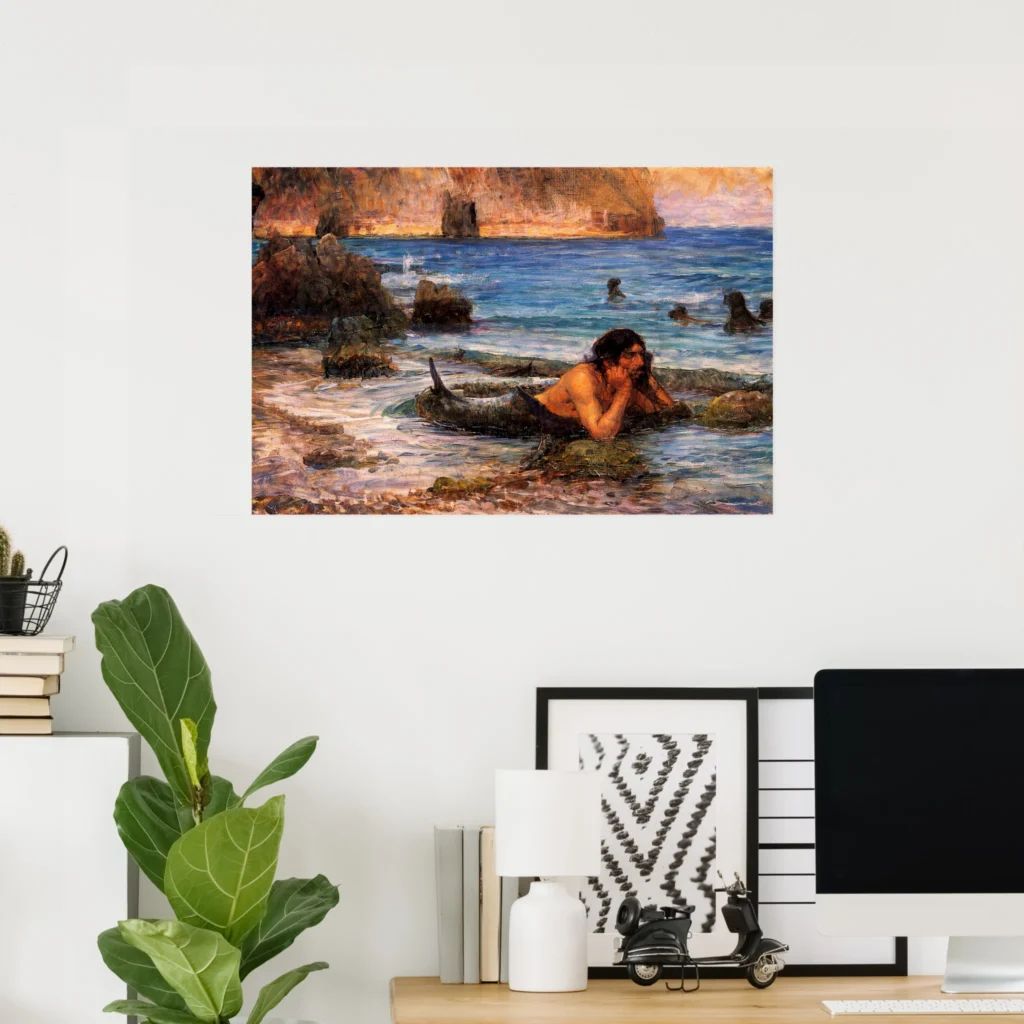
One of the most distinctive aspects of this work is its painterly surface. Waterhouse does not chase a polished illusion across every inch. Instead, he allows brushstrokes to remain visible, especially in the water and sky. The canvas texture shows through in places, and the paint can feel scrubbed or dragged, which adds to the sensation of shifting elements and unstable ground.
This suggestive handling is especially effective for the sea. Water is notoriously hard to fix in a single image because it changes faster than any gaze. By using broken strokes and layered tones, Waterhouse communicates movement without needing to describe each ripple. Foam becomes a rhythm of light marks. Waves become bands of color that slide into one another.
The distant figures are treated with even more economy. They emerge from the water with minimal definition, which makes them feel fleeting and slightly uncanny. That lack of clarity is not a weakness. It is a strategy. The painting is about uncertainty and longing, so the forms that represent “elsewhere” should not be fully possessed by the eye.
Even the merman, though more solidly modeled, is not rendered with hyperreal precision. The figure feels real because the weight and warmth are convincing, not because the details are exhaustive. The overall finish supports the theme: a myth seen through mood, a story carried by sensation.
Mythology Reimagined as Victorian Psychology
A merman is a figure of old stories, yet Waterhouse treats him less like a character from a specific tale and more like an emblem of a state of being. The painting suggests mythology as a language for inner life. The hybrid body becomes a symbol for divided identity: part instinct, part reflection; part belonging, part exile.
This approach fits a late nineteenth-century fascination with the emotional and the subconscious. Rather than illustrating a clear plot, the painting creates a situation charged with implication. The merman’s posture implies thought and perhaps regret. The distant swimmers imply attraction, curiosity, or a world from which he is separated. The sea implies both origin and threat.
There is also a reversal of typical power dynamics. Mythic sea beings are often depicted as alluring predators or supernatural dangers. Here, the creature appears vulnerable. He is not hunting, not enchanting, not attacking. He is waiting, perhaps even wounded in spirit. That vulnerability changes how the viewer reads the fantasy. The supernatural becomes a mirror for human fragility.
The painting’s restraint makes it feel emotionally credible. By refusing spectacle, Waterhouse makes room for empathy. The merman is not simply an exotic subject. He is a mood made visible, a myth used to articulate what ordinary realism sometimes cannot.
Waterhouse in 1892: A Shift Toward Atmosphere and Ambiguity
Placed in 1892, this painting belongs to a period when Waterhouse was developing a more fluid, atmospheric approach. While he is often linked with the orbit of the Pre-Raphaelite Brotherhood, his later work frequently loosens strict linear clarity in favor of tone, texture, and emotional charge. The Merman reflects that interest in atmosphere as a carrier of meaning.
The subject also aligns with Waterhouse’s recurring attention to myth and legend, especially stories that center on enchantment, longing, and the perilous edge between desire and doom. What makes this painting distinctive is the direction of empathy. Instead of focusing on a human victim of enchantment, Waterhouse places the mythic figure at the center and presents him as the one who suffers the weight of feeling.
The setting is not an ornate, symbolic stage filled with objects that “explain” the story. It is pared down to essentials: sea, rock, distance, and a few ambiguous presences. That simplicity makes the painting feel modern in its openness. It does not tell you what to think. It arranges the conditions for thought.
In this sense, Waterhouse treats mythology as an emotional environment rather than a script. The year matters because it sits within a wider artistic turn toward suggestion, toward images that create questions instead of answering them.
The Distant Figures and the Theme of Desire at a Remove
The small heads and partial bodies in the water are easy to overlook at first, but they are crucial. They create a social and erotic tension without explicitness. The merman is not alone in an empty sea. There are others, and they appear to be in motion, oriented in different directions, their presence scattered like possibilities.
Because these figures are not detailed, they function like symbols of “the other side” of experience. They could be humans bathing, sea nymphs, or simply imagined presences, and each reading changes the emotional color of the scene. If they are humans, the merman becomes a watcher separated by nature from what he desires. If they are sea beings, the separation becomes psychological rather than biological, suggesting alienation even among one’s own kind.
What matters most is distance. They are too far to grasp. They are close enough to haunt the merman’s awareness but far enough to remain unattainable. That is a classic structure of longing. The desired object is visible, yet unreachable. The sea, instead of connecting, becomes the very medium of separation.
This is where the painting quietly becomes tragic. Not through violence, but through the ache of being stuck on the threshold. The merman is poised between worlds, and the figures in the water make that in-betweenness feel like a wound.
The Meaning of the Sea: Memory, Fate, and the Weight of Time
Waterhouse’s sea is not just scenery. It behaves like a psychological force. The layered blues suggest depth, and the constant movement of foam suggests time that cannot be held. Water, in symbolism, often stands for memory and emotion, and here it seems to carry both. The merman lies within it, yet he also lies against it, as if resisting being pulled fully back into its flow.
The horizon line is calm compared to the turbulence near the shore. This contrast creates a sense of two tempos: the immediate, restless churn of the present, and the steady distance of something larger, older, perhaps indifferent. The merman is caught in the restless zone, the place where waves break and everything is unsettled. That placement hints that his conflict is active, unresolved.
There is also an implication of fate. Mythic creatures often exist outside ordinary time, yet the scene feels temporal, like a specific hour in a specific tide. That specificity makes the merman seem subject to time rather than master of it. He is not an eternal emblem carved into legend. He is a being having a day, having a moment, having a feeling that might pass or might harden into sorrow.
The painting’s emotional power comes from this blend of vastness and immediacy. The sea is infinite, but the pose is personal. The world is large, but the ache is close.