Image source: wikiart.org
Introduction
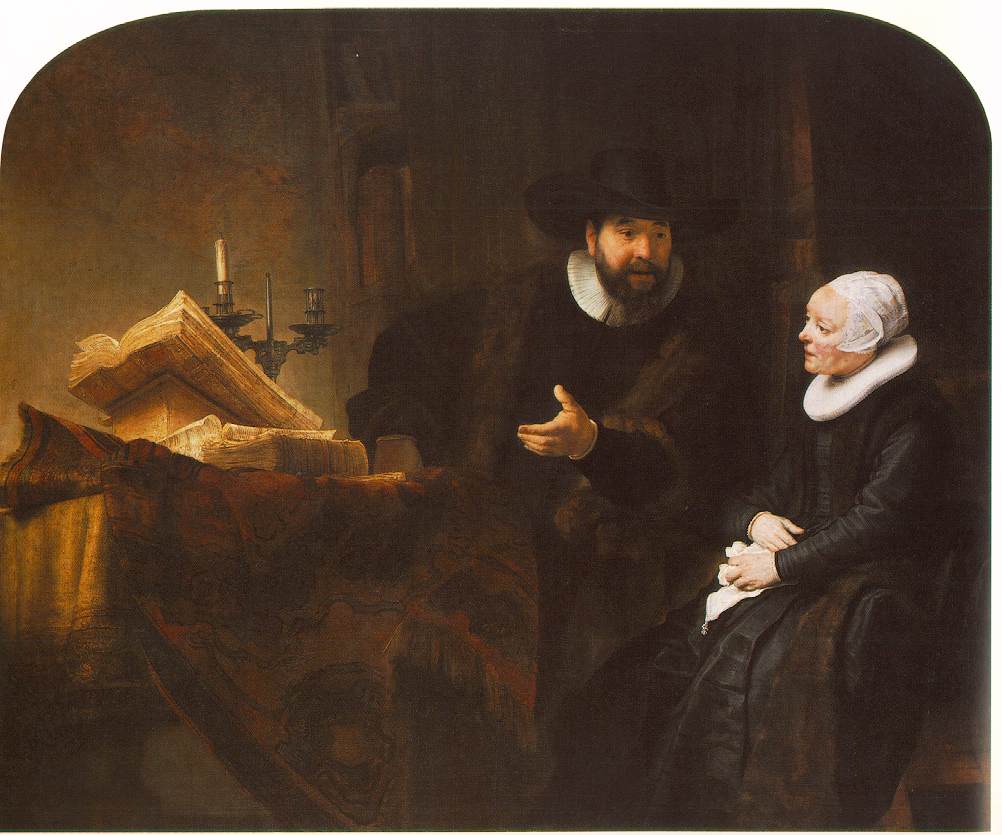
Rembrandt’s “The Mennonite Preacher Anslo and His Wife” (1641) is among the most intimate double portraits of the Dutch Golden Age, a painting that reads like a conversation caught in mid-flow. In a dusky interior, the minister—identified as Cornelis Anslo, a respected Mennonite preacher and poet in Amsterdam—turns toward his wife and opens his hand in a persuasive, tender gesture. She listens with folded hands, attentive and serene. Between them, a mountain of books blanketed by an oriental carpet forms a glowing promontory from which words seem to surge into the dim room. Rembrandt transforms doctrinal discourse into lived human exchange: faith becomes light, scholarship becomes texture, and marriage becomes a sanctuary for speech and listening.
A Portrait of Speech and Listening
Most portraits fix their sitters in a poised stillness. Here Rembrandt paints an action—speaking—and its counterpart—listening. Anslo leans forward, his body angled toward his wife, his right arm extended with palm up. The gesture is generous and unthreatening, a preacher’s hand that offers rather than commands. His wife’s pose answers in kind. She does not recoil or interrupt; she folds her hands over a white kerchief and tilts her face toward him with an expression that mixes affection, curiosity, and quiet appraisal. The entire drama unfolds in the small rift of light between their faces, where Rembrandt concentrates his tonal energy, making attention itself the subject.
Composition: A Theater of Ideas
The painting’s architecture is simple but strategically daring. Rembrandt pushes the couple to the right half of the canvas, leaving a conspicuous expanse of dark air at left that is occupied chiefly by the slanting pile of folios, a candlestick, and the richly patterned table carpet. The books sit like steps up a pulpit; they also form a compositional ramp that leads the eye across the painting toward the couple. The rectangle of the tabletop, trimmed by the scalloped edge of the carpet, becomes a stage on which learning, scripture, and memory are stacked. This oblique stage counters the forward lean of Anslo’s torso, creating an X-shaped dynamic that holds the picture in tension. The upper corners are softly arched, a device that suppresses hard angles and contributes to the hushed interior mood.
Chiaroscuro and the Audible Light
Rembrandt’s light has sound. It falls like a warm voice onto the preacher’s face, collar, and hand, then echoes in softer notes across his wife’s cap, ruff, and cheeks. The cascade of light across the carpet’s orange-red pile suggests the resonance of speech traveling outward. Behind the couple, darkness is profound but not opaque; it is charged with the warm brown atmosphere that makes Rembrandt’s interiors feel inhabitable. The candelabrum stands unlit, its candles intact. The message is unmistakable: the illumination in this room does not require flame. It comes from the encounter of minds and from the Word embedded in those folios.
The Books and the Carpet: Material Culture as Meaning
Rembrandt describes the books with loving specificity—buckram covers, thick spines, pressed corners, pages pushing out like worn pillows. They are not inert props; they testify to a lifetime of use and to the authority of texts within Mennonite devotion, where preaching and biblical literacy were central. Draped over the table, the oriental carpet introduces a current of worldly trade and Amsterdam wealth. Its saturated reds and dull golds thicken the left side of the composition and anchor the intellectual enterprise in tangible prosperity. Far from ostentation, the carpet’s opulence is softened by age and by Rembrandt’s glazing; it becomes a field on which learning and piety comfortably rest.
Mennonite Ethos and Amsterdam’s Civic Fabric
Cornelis Anslo belonged to a Mennonite community known for simplicity, pacifism, and a congregational model of leadership. Rembrandt honors this ethos without stripping the scene of warmth or status. The garments are black but not severe, enriched by fur trims suited to a prosperous household and articulated by modest, starched collars. In seventeenth-century Amsterdam, Mennonites were influential in trade and philanthropy; their homes could be comfortable, their public manner restrained. The painting embodies that balance. The couple’s dignity flows from conduct rather than ornament, from the willingness to speak and to listen responsibly.
The Psychology of Partnership
What makes the painting modern is the psychological equality it grants the figures. Anslo’s wife is not a decorative pendant; she is the measure and audience for her husband’s thought, a participant who bestows meaning through attentiveness. Her eyes, luminous and steady, determine the rhythm of the scene. Rembrandt casts her not as the subject of a sermon but as the person to whom the sermon is first entrusted. This dynamic gently destabilizes the hierarchy implied by books, pulpit, and office, recentering the act of ministry within domestic speech.
Hands That Speak
Rembrandt’s hands are famous for their truthfulness, and here they carry the argument. Anslo’s open palm forms a crescent of light; the fingers are slightly splayed, the wrist relaxed. This is not the rigid index of a polemicist but the invitation of a counselor. His left hand remains in shadow—perhaps resting on a chair or table—suggesting a second, stabilizing point. The wife’s hands, folded atop her kerchief, are small and beautifully modeled. A thread of light runs along her ring finger; trust and companionship are palpable. The conversation is tactile: speech rests on the body’s grammar.
Costumes: Black as a Color, White as a Rhythm
Within the Dutch tradition of sober black dress, Rembrandt finds a full chromatic orchestra. Anslo’s coat reveals deep, resinous browns within the black, and the fur collar catches a quiet nap of light. The preacher’s hat, broad and soft, absorbs illumination; his wife’s cap reflects it in quick silver sparks along the pleats. The alternating pulses of white—the preacher’s modest ruff, the edge of his cuff, her cap, ruff, kerchief, and hands—create a visual rhythm that moves the eye from books to speaker to listener and back again.
Space and the Viewer’s Role
We occupy a seat just beyond the table, as if visiting the couple at home. The large carpeted table thrusts into our space, almost touching the picture plane; it invites us to rest an elbow as we listen. Because the candles are unlit and the background blends into dusk, our attention compresses to the bright triad of books, Anslo’s hand, and his wife’s face. Rembrandt refuses architectural distraction; there are no windows, columns, or vistas. Space is not measured by depth but by attention span. The room becomes as large as the conversation requires.
Paint Handling: From Glaze to Impasto
Rembrandt’s technique in the early 1640s balances polish with palpable substance. Thin glazes build a breathable darkness; thicker passages load light-bearing accents onto collars, fingertips, and the carpet’s nap. The books appear sculpted by soft impasto that catches the smallest glints and suggests individual fibers along the edges of pages. The black garments are a web of semi-transparent layers, each glaze warming the one beneath. Up close, the surface is alive with directional brushwork; from a few paces back, the textures fuse into the hum of a lived interior.
The Candelabrum and the Ethics of Light
The unlit candle to the left is a moral emblem. It acknowledges human devices for making light while insisting that another, more inward illumination governs this scene. Its wrought metal arms curve like parentheses around the sermon that has just been or will be spoken. Rembrandt treats the metal soberly, with minimal highlights, letting the object retreat behind the books it once illuminated. This restraint gives the painting its ethical clarity: truth shines most when it is not ostentatiously staged.
Sound, Silence, and Time
Rembrandt paints sound by orchestrating rests. The dark chamber behind the couple reads as an acoustic cavity; the folds of the carpet absorb vibrations; the broad table is a resonant box. The minister’s mouth is slightly open mid-sentence, but we also sense the pause between words—the suspense that makes listening meaningful. A minute later the hand will fall, the wife will answer, and the room will stir. The painting compresses this elastic interval into a single, endlessly renewable present, which is why viewers feel drawn into the conversation rather than excluded by it.
Dialogues with Other Rembrandt Portraits
This canvas converses with Rembrandt’s companion portraits from the same period, including the depictions of merchants with their wives and the pendant of Nicolas van Bambeeck and Agatha Bas. Yet it departs from the social pair format by placing both figures in one frame and rooting their bond in shared vocation rather than public status. It also belongs to Rembrandt’s broader exploration of scholars and readers—think of his aged philosophers and St. Paul at his desk—where books act as living organisms. Here the scholar is not solitary; his first community is marital.
Theological Nuance Without Iconography
Although the subject is explicitly religious, there are no haloes, inscriptions, or narrative props beyond books and candles. Rembrandt trusts posture and light to do theology. The open hand and the receptive gaze enact a doctrine of grace grounded in mutual regard. The pile of books confirms the authority of Scripture and commentary; the glow across their spines hints that texts live when they are spoken into relationship. In this regard the painting models a pastoral ideal: persuasion that honors the listener’s freedom.
The City Outside the Frame
Amsterdam never appears, but it saturates the work. The carpet speaks of maritime trade; the sturdy table of shipbuilders and joiners; the books of printers and stationers; the collars of laundresses and lace-makers. Mennonite networks supported poor relief, artisan guilds, and international commerce—currents that flow just below the painting’s surface. Rembrandt knits this civic world to domestic affection, claiming the household as the place where public words acquire humane proportion.
Conservation, Surface, and the Glow of Age
The painting’s current warmth likely owes much to Rembrandt’s layered browns and to the slow transparency that oil glazes develop over centuries. Where light strikes hardest—on the book edges, cuffs, and kerchief—the paint stands proud, creating a scintillation that intensifies under museum lights. Soft craquelure in the dark ground functions almost like a silent vibration, enhancing the sense that speech has left a trace in the air.
Why the Picture Still Feels Contemporary
Viewers recognize themselves in the scene not because they are preachers but because they know conversations in which love is the medium of truth. The painting honors the labor of explaining and the equal labor of attending. In an image culture saturated with declamation, Rembrandt makes listening luminous. The room is without spectacle; the only drama is ethical attention. That is why the canvas remains fresh: it models a humane politics of the voice.
Conclusion
“The Mennonite Preacher Anslo and His Wife” is a masterclass in how painting can portray ideas without allegory and intimacy without sentimentality. Rembrandt builds a world from light, books, and human presence. He stages a theology of conversation where learning stands in service to affection and where authority is exercised by an open hand rather than a pointing finger. The couple’s shared gaze completes the circuit of illumination the way a lamp completes a circuit of electricity. In that glow, marriage becomes a quiet pulpit, and the viewer becomes both witness and guest.