Image source: wikiart.org
Introduction to Murillo’s Vision of Martyrdom
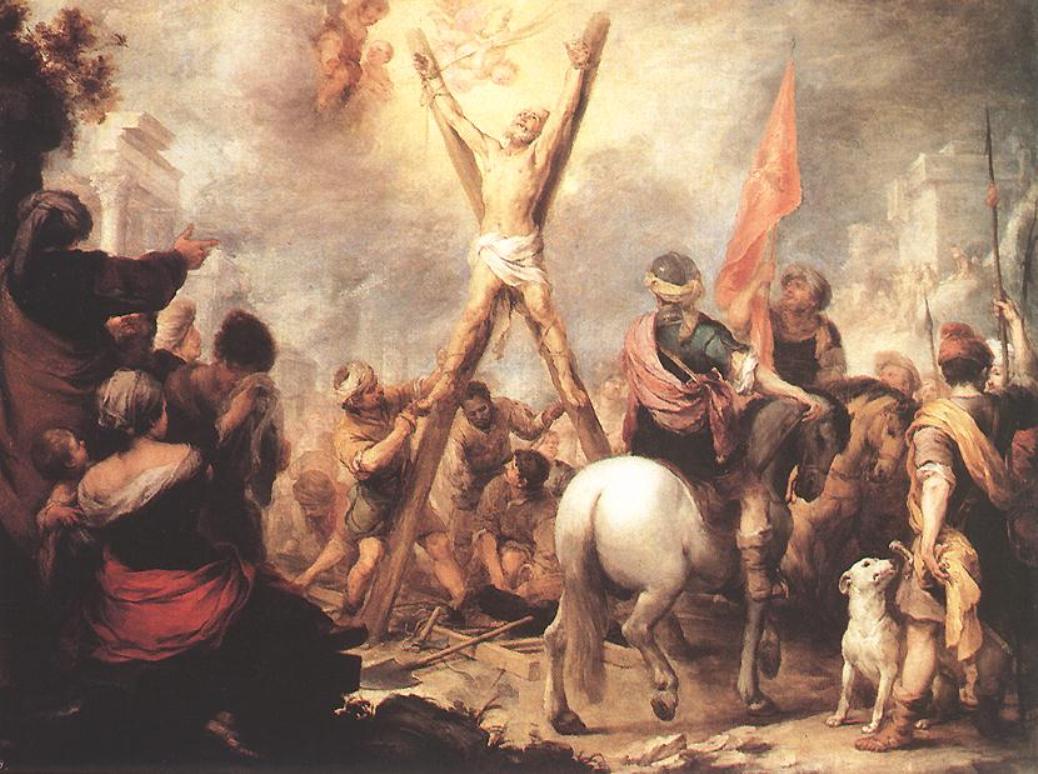
“The Martyrdom of St Andrew,” painted in 1682 by Bartolomé Esteban Murillo, is one of the most dramatic and ambitious canvases of the artist’s late career. Unlike his soft and intimate images of the Virgin and Child, this painting presents a crowded public spectacle where a saint is raised on a cross in the midst of soldiers, workers, onlookers, and swirling clouds of light. At the center stands St Andrew, stretched upon his distinctive X shaped cross, looking upward as his body is lifted toward the sky.
The scene captures the charged moment when the executioners haul the cross upright. Around them, soldiers give orders, a mounted officer supervises, and a cluster of townspeople watch with fear, curiosity, or grief. Above, angels and cherubs break through the clouds, receiving the martyr’s soul and bathing him in a golden radiance. This fusion of earthly brutality and heavenly glory is at the heart of the painting’s power.
Murillo here engages with a long tradition of martyrdom scenes in European art while infusing it with his own warm palette and emotional sensitivity. The painting is both a historical drama and a spiritual meditation on sacrifice, courage, and divine reward.
Historical and Religious Context
Seventeenth century Spain was a deeply Catholic society shaped by the Counter Reformation. Religious images were expected to inspire devotion, instruct the faithful, and uphold the heroic examples of saints. St Andrew, one of the twelve apostles and brother of St Peter, was venerated across Europe as a model of missionary zeal and steadfast faith. According to tradition, he was martyred in the Greek city of Patras, bound to a cross of diagonal beams so that his suffering would be prolonged.
Murillo created this work at a time when large narrative altarpieces remained central to church decoration. While he was widely known for tender depictions of the Immaculate Conception and scenes of sacred childhood, he also undertook more monumental subjects like this one, often for important religious institutions. “The Martyrdom of St Andrew” likely adorned a chapel dedicated to the apostle, reminding worshippers of the cost of discipleship and the promise of heavenly glory.
The painting also reflects the Baroque taste for dynamic movement and emotional intensity. Spanish patrons expected images that moved the heart, stirred compassion, and reinforced the triumph of the Church. Murillo responds to these expectations but tempers the harshness of the scene with his characteristic warmth, especially in the heavenly light that envelops the saint.
Overall Composition and Spatial Drama
At first glance, the painting is a whirl of figures and diagonals, yet it is carefully organized. The cross of St Andrew forms the main diagonal thrust, rising from the lower center toward the high right side of the canvas. Workers strain to lift it upright, their bodies bent and twisted with effort. The saint’s arms are stretched wide, forming an X shape with the beams, and his head tilts upward toward a burst of radiance at the top.
The crowd is distributed on both sides. To the left, a group of ordinary citizens gathers, including women and children who seem to witness the spectacle with a mixture of alarm and fascination. One prominent figure in red and brown points toward the scene, directing the viewer’s attention to the ascending saint. On the right, soldiers on horseback and on foot occupy the foreground. A white horse, turned away from the scene, adds a powerful curve that balances the diagonal of the cross.
Murillo uses the architecture in the background more as a suggestion than a detailed setting. Faint outlines of classical buildings and city walls establish the urban environment and create depth, but they do not compete for attention. The sky, filled with swirling clouds and emerging angels, completes the composition, uniting the earthly turmoil below with the heavenly realm above.
Light, Color, and Atmosphere
Light is a crucial tool in Murillo’s storytelling here. A warm, almost golden illumination radiates from above, centered around the figure of St Andrew. This high light source creates a halo effect that separates the saint from the rest of the composition, marking him as the spiritual focus of the event. The brightness around his body contrasts with the darker tones of the crowd and soldiers, drawing the viewer’s eye inexorably upward.
The color palette is typical of Murillo’s mature style. Warm browns, ochres, and muted reds dominate the clothing of the figures, blending harmoniously with the dusty ground and distant architecture. The white of St Andrew’s loincloth and the horse’s gleaming hindquarters provide strong highlights. These touches of white not only break up the lower mass of darker colors but also echo the heavenly light above, visually linking earth and heaven.
The sky is treated with great energy. Clouds swirl in soft grays and creamy yellows, opening near the top to reveal cherubs bathed in golden light. This atmospheric treatment creates a sense of divine intervention, as if the very air is responding to the saint’s sacrifice. The contrast between the glowing upper zone and the smoky lower zone reinforces the painting’s central tension between suffering and glory.
The Figure of St Andrew
At the emotional center of the painting is the figure of St Andrew himself. Murillo depicts him nearly nude, his body taut yet graceful as it stretches along the beams of the cross. His arms are bound to the upper ends of the diagonal timbers, and his legs are tied near the base. Despite the painful position, his expression is one of spiritual rapture rather than agony. His face is turned upward, eyes raised toward the radiant cloud where angels hover.
This upward gaze is vital to the painting’s message. St Andrew’s attention is not on the soldiers or the crowd but on the divine realm that awaits him. Murillo thus portrays martyrdom not merely as physical torture but as a moment of mystical union with God. The saint appears almost weightless, transformed by the light that envelops him.
The anatomy is rendered with sensitivity. Muscles are defined but not exaggerated, and the skin tones are warm, echoing the golden light. Murillo avoids gruesome details, such as blood or contorted features. Instead, he emphasizes the dignity and serenity of the martyr. The white cloth around his waist provides modesty but also serves as a symbolic sign of purity, reminding viewers of his innocence and faithfulness.
Soldiers, Workers, and the Crowd
The surrounding figures add narrative depth and human complexity. The workers who raise the cross are dressed in simple garments, their bare legs and arms showing the strain of physical labor. Their faces are intent on the task, not on the saint. For them, this is a job rather than a religious event. Their muscular efforts ground the scene in the reality of human action.
The soldiers, by contrast, embody authority and worldly power. Mounted officers oversee the execution, carrying lances and banners. One soldier on horseback, seen from behind, dominates the right side of the canvas with his broad back and the rounded form of his white horse. Another soldier, standing near a white dog, looks toward the cross, perhaps checking that the order is carried out correctly. The dog adds a touch of everyday life to the scene and may suggest loyalty or simple animal confusion amid human cruelty.
On the left, the cluster of spectators introduces a different emotional register. Women clutch children, and men lean forward to see more clearly. One man extends his arm and points toward the elevated saint, as if commenting on the unfolding drama. These figures invite the viewer to consider multiple perspectives: horror, curiosity, sorrow, or admiration. They also act as stand ins for the audience of the painting, mirroring our own act of looking.
Heavenly Witnesses and the Triumph of Glory
The upper part of the painting is populated by small angels and cherubs who gather within the luminous cloud. Their presence transforms what might otherwise be a purely tragic scene into a narrative of victory. The angels appear to be descending toward St Andrew or waiting to receive his soul. Their soft, rounded forms and gentle gestures contrast with the roughness of the soldiers and workers below.
This contrast highlights the central theme of Christian martyrdom: that apparent defeat in the eyes of the world is actually a triumph in the eyes of heaven. The bright light surrounding the saint and the angels functions as a visual manifestation of divine approval. The more the earthly crowd exerts force to lift the cross, the more the saint seems to rise toward that radiant glory, already halfway out of the human realm.
Murillo uses this vertical movement to guide the viewer’s meditation. The eye follows the diagonal of the cross upward, passes along the stretched body of the saint, and finally arrives at the cherubs glowing in the clouds. This journey mimics the spiritual ascent from suffering to eternal life that the martyr himself undergoes.
Symbolism and Narrative Details
Every element in the painting contributes to its symbolic richness. The X shaped cross, unique to St Andrew, immediately identifies him and differentiates this martyrdom from the crucifixion of Christ. Its unusual geometry creates strong diagonals that energize the composition and suggest instability, as if the cross is still in motion.
The tools scattered on the ground and the planks around the base of the cross hint at the construction and brutal practicality of the execution process. They remind viewers that martyrdom involved real physical mechanisms, not just symbolic gestures. At the same time, the inclusion of these objects roots the scene in a tangible world that viewers can imagine entering.
Banners and lances carried by the soldiers signal imperial authority and the might of earthly powers. Yet these vertical lines are ultimately overshadowed by the larger, more radiant vertical formed by the cross and the light above it. In this way, Murillo visually asserts that the power of faith surpasses that of any empire.
Even the white dog can be read symbolically. Dogs often represent loyalty. Its presence at the edge of a scene of betrayal and violence might suggest a quiet reminder of faithfulness, or simply emphasize the contrast between innocent life and human cruelty.
Murillo’s Baroque Technique and Dynamism
“The Martyrdom of St Andrew” demonstrates Murillo’s ability to handle large, complex compositions without losing clarity. His brushwork is lively and varied. Figures in the foreground receive more detailed modeling, while those in the middle and background are suggested with looser strokes, creating a sense of depth and atmospheric perspective.
The drapery of the soldiers and spectators is painted with sweeping strokes that suggest weight and motion. Reds, oranges, and greens are layered over earthy underpaintings, creating fabrics that feel both rich and worn. The textures of skin, cloth, horsehair, and clouds are differentiated through subtle shifts in brush handling.
Murillo’s use of diagonals, overlapping forms, and gestures creates Baroque dynamism. Nothing is static. The cross is being hauled upright, the horse shifts its weight, figures lean, point, or twist. Yet all this movement is choreographed around the calm, central figure of St Andrew, whose stillness offers a spiritual counterpoint to the agitation around him.
The painter’s control of crowd scenes is particularly evident here. Despite the multitude of figures, the viewer never loses sight of the main story line. Murillo achieves this through careful placement, lighting, and the use of gestures that direct the gaze toward the saint.
Emotional Impact and Devotional Purpose
Beyond its technical brilliance, the painting is designed to move the viewer emotionally and spiritually. The sight of a vulnerable human body being raised to a cruel death naturally evokes compassion. Murillo intensifies this by surrounding the saint with vigorous activity and noisy spectators, so that his calm surrender stands out as an act of deliberate courage.
The contrast between earthly violence and heavenly light invites viewers to think about their own response to suffering and faith. The painting asks them to see martyrdom not simply as an old story but as a living challenge to remain faithful in adversity. For seventeenth century worshippers, gazing at this altarpiece during Mass or prayer would have been a powerful reminder of the cost of discipleship and the glory promised to those who persevere.
Modern viewers can still feel the impact of this emotional drama. Even without sharing the original religious context, one can sense the tension between oppression and inner freedom, between external coercion and personal conviction. Murillo’s humanistic approach to faces and gestures allows us to identify with the various figures, from the grieving woman to the hardened soldier, and to reflect on where we ourselves would stand.
Place Within Murillo’s Oeuvre and Legacy
“The Martyrdom of St Andrew” stands somewhat apart from the more intimate devotional images for which Murillo is best known. Yet it reveals the full range of his abilities and his responsiveness to large scale narrative challenges. The painting shows that he could handle complex historical subjects with as much sensitivity as small scenes of children or the Virgin.
Within his body of work, this canvas forms part of a broader interest in the lives of saints and apostles. Murillo often depicted moments of charity, prayer, and mystical vision, emphasizing the gentle side of spirituality. Here he tackles the darker theme of persecution but ultimately returns to his central concern with divine mercy and inner peace. The martyr is not crushed by suffering but transformed into a figure of luminous serenity.
The painting also contributes to the Spanish Baroque tradition of martyrdom imagery, which includes works by artists such as Ribera and Zurbarán. Compared to their often stark and brutal treatments, Murillo’s version is gentler in its depiction of pain and more focused on spiritual exaltation. This difference highlights his distinctive voice within seventeenth century art, a voice that privileges compassion, warm color, and atmospheric light.
Conclusion
“The Martyrdom of St Andrew” is a powerful synthesis of drama, devotion, and artistic mastery. Murillo transforms a brutal execution into a visual meditation on faith and transcendence. Through his skillful use of composition, light, and gesture, he leads the viewer from the confusion of the crowd to the luminous figure of the martyr and finally to the radiant heavens that open above.
The painting remains a compelling example of how Baroque art could engage both the senses and the soul. It invites us to contemplate courage in the face of suffering, the tension between earthly power and spiritual conviction, and the belief that beyond human cruelty there is a realm of mercy and glory. In this way, Murillo’s vision of St Andrew’s final moments continues to speak across the centuries, reminding us that heroic faith can emerge in the very midst of chaos and violence.