Image source: wikiart.org
The Martyrdom of Saint George by Peter Paul Rubens: Overview
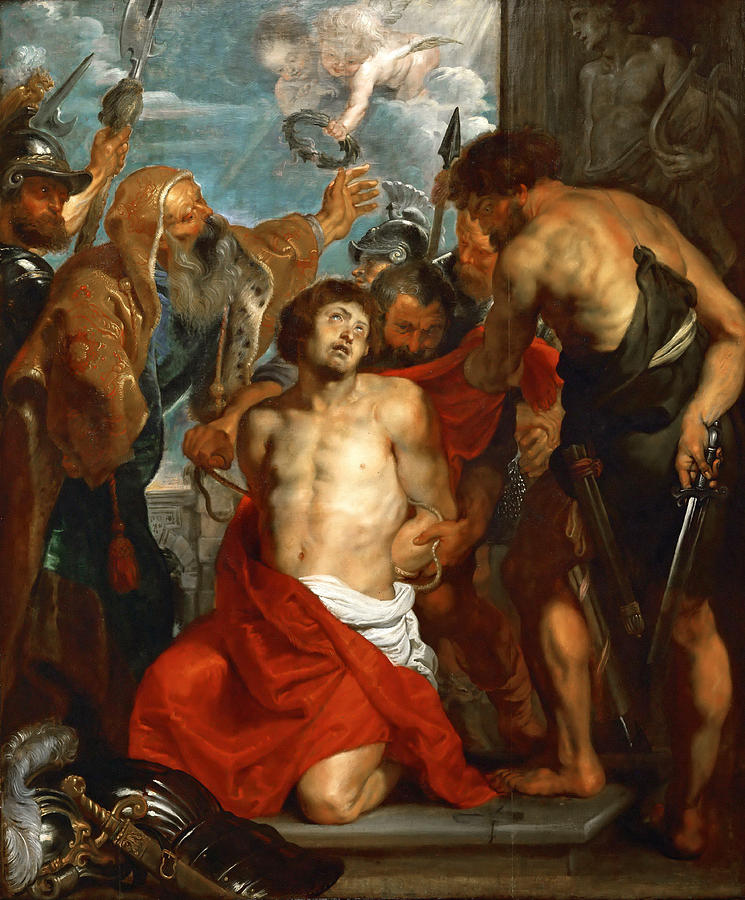
Peter Paul Rubens’s painting “The Martyrdom of Saint George” presents the final moments of the soldier-saint with the full theatrical force of Baroque art. At the center, Saint George kneels on a stone block, his torso stripped of armor and illuminated by a divine light. A brilliant red cloak wraps around his lower body, falling in heavy folds that pool near his bare feet. Around him crowd soldiers and officials who press in from every side, creating a dense ring of bodies and weapons that underscore the violence of the scene.
Above this earthly drama, the sky opens and a group of cherubs descends amid glowing clouds. One angel carries a laurel crown, another the palm of martyrdom, visual promises of heavenly reward. The composition turns a brutal execution into a triumphant passage from earthly defeat to spiritual victory. Rubens uses gesture, color, and light to make the viewer feel both the physical vulnerability of Saint George and the radiant strength of his faith.
The Narrative of Sacrifice and Faith
“The Martyrdom of Saint George” depicts the legendary soldier of Cappadocia at the moment he is condemned for refusing to renounce his Christian faith. Rather than showing the dragon-slaying episode that made him famous in popular devotion, Rubens chooses the quieter but more spiritually charged instant before his execution.
George is already on his knees, hands bound, held firmly by two muscular executioners. Their grasp makes clear that his death is inevitable, yet the saint’s gaze turns away from them. His eyes lift toward the opening sky, searching not for rescue but for confirmation that his sacrifice has meaning. The drama lies less in any physical struggle and more in the clash between earthly power and spiritual conviction.
On the left, an elderly figure in rich robes gestures upward, as if debating or perhaps warning George one last time. Behind him, helmeted soldiers push forward with raised weapons, ready to enforce the sentence. Their presence reminds us that the Roman state, with all its military authority, stands against the lone believer. Yet Rubens subtly inverts the balance of power: while the soldiers are numerous, they are partially in shadow, pushed to the sides of the composition. The light falls instead on the saint’s exposed body and on the heavenly realm above, suggesting that true authority lies beyond the earthly rulers.
Composition and Dramatic Baroque Movement
Rubens composes the scene as a swirling vortex of bodies and fabrics that narrows toward Saint George’s luminous torso. The figures form a tight cluster around the kneeling saint, pressing in from all directions. Arms extend, torsos twist, and heads bend toward him, creating a sense of restless motion even though the moment is static.
The diagonal lines of the painting are particularly important. The stone block on which George kneels angles slightly, leading the eye upward. The red cloak creates a strong diagonal sweep from the bottom left toward the center of the canvas. This movement continues through George’s tilted head and up into the open sky where the angels appear. The entire composition therefore traces a path from the dark foreground armor to the glowing clouds, visually echoing the idea of martyrdom as a journey from earthly struggle to heavenly glory.
Rubens also balances the mass of figures with empty space. The lower half of the painting is crowded and heavy, filled with metal armor, muscular limbs, and deep shadows. In contrast, the upper portion opens into an airy sky of pale blues and whites. This contrast heightens the impact of the celestial vision: after the dense, suffocating crush of the execution scene, the sky feels expansive and liberating. The composition thus mirrors the spiritual release promised to the martyr.
Light, Color, and the Theater of Martyrdom
Light in “The Martyrdom of Saint George” functions almost like a character in its own right. A sharp beam descends from the upper right, cutting across the scene to fall on the saint’s torso and face. This illumination isolates him from the surrounding figures and transforms his pale skin into a focal point. The light originates from the opening in the clouds where the cherubs appear, visually linking heavenly presence with the saint’s suffering body.
Color strengthens this effect. Rubens uses a restrained palette dominated by earthy browns, blacks, and muted armor tones for the soldiers. Against this subdued background, the radiant red of George’s cloak explodes with intensity. Red here operates on several symbolic levels: it evokes blood and sacrifice, signifies royal dignity, and suggests the fire of spiritual fervor. Draped around the saint, it turns his vulnerable body into something almost regal, transforming him from victim into hero.
The metallic glints on helmets, swords, and armor are picked out with quick highlights, reminding the viewer of the harsh reality of violence. Yet these reflections never compete with the soft, heavenly light that bathes George and the angels. Instead, the glittering steel serves as a counterpoint to the luminous clouds, a reminder that physical power, however formidable, remains cold and transient when compared to the warmth of divine grace.
The Figure of Saint George: Heroism in Defeat
At the center of the painting, Rubens presents Saint George with a striking mixture of physical vulnerability and moral strength. His body is robust, muscular, and idealized, reminding us that he is a seasoned soldier. However, his hands are bound and his armor lies discarded at his feet, symbolizing his renunciation of worldly protection.
His head tilts backward, eyes raised, mouth slightly parted. This expression might at first appear almost dazed, but on closer examination it conveys rapt attention and inner absorption. George is no longer engaged with the men around him; his focus has shifted to the heavenly vision above. In this way, Rubens turns the moment before death into a moment of spiritual contemplation.
The saint’s bare chest becomes the primary surface on which the narrative is written. Muscles are defined but not exaggerated, and the subtle modeling of flesh under the cool light suggests both strength and fragility. By undressing the soldier, Rubens reveals the humanity of the martyr. George’s heroism does not lie in invulnerability but in his willingness to be wounded.
The kneeling pose further contributes to this duality. On one hand, it shows submission to the earthly sentence; on the other, it recalls positions of prayer and worship, implying voluntary surrender to God’s will. Rubens captures this tension perfectly, making George appear both captive and free at the same time.
The Executioners and Crowd: Human Responses to Holiness
Surrounding Saint George, Rubens paints a range of characters whose gestures and expressions reveal different reactions to sanctity and suffering. The executioners, especially the muscular figure on the right, are portrayed with dynamic anatomy and sinewy strength. The man who grasps George’s arm leans forward, his back turned toward the viewer, revealing powerful shoulders and arms poised for action. He embodies brute force and the machinery of punishment.
Yet even within these figures, Rubens introduces nuance. The executioner’s face, partly visible as he looks down, does not appear cruel; instead, it seems focused, almost reluctant, as though he recognizes the gravity of what he is about to do. Another figure behind the saint appears tense and troubled, his brow furrowed. In this way, Rubens avoids caricature and insists that those who carry out violence are still human, capable of doubt or conflict.
The elderly man on the left, richly robed and gesturing upward, may represent a magistrate or pagan priest. His animated hand and open mouth suggest he is speaking, perhaps urging George to reconsider. His fine garments and long white beard distinguish him from the soldiers, signaling authority and worldly wisdom. Yet his appeal falls short when set against the simple, silent faith of the saint.
Behind these main participants, a throng of soldiers fills the background. Their helmets and spears create a jagged skyline, hinting at the crowd’s aggressive energy. Faces peek out from behind armor, some curious, some hardened. The variety of expressions turns the scene into a study of how different people respond when confronted with witness to faith—some with indifference, some with hostility, others with uneasy respect.
Symbolism, Armor, and the Idea of Spiritual Warfare
One of the most striking details in the foreground is the discarded armor laid out near the bottom left. A gleaming breastplate, helmet with plumes, and sword lie unused, their surfaces catching the dim light. These objects clearly belong to Saint George, the soldier known for his martial prowess. By placing them on the ground, Rubens emphasizes that the saint has laid aside earthly defense.
This discarded armor has a symbolic meaning rooted in Christian imagery. It contrasts the physical “armor” of warfare with the spiritual “armor of faith.” George no longer relies on steel to protect him; his trust is in divine justice. The gleaming metal becomes a reminder of past victories against human enemies, victories that now pale beside the challenge of remaining faithful under persecution.
The red cloak that still envelops George also functions symbolically. Draped like a general’s mantle yet serving as the only vestige of his earthly status, it bridges the worlds of soldier and martyr. As the cloak spills over the stone block, it visually links the saint to the grounded reality of death, while its intense color hints at future glory and the blood of sacrifice.
The weapons held by the soldiers—including unsheathed swords and spears pointed upward—frame George like a crown of thorns made of steel. They form a visual cage around him, but their sharp lines also direct the eye toward the opening sky. Thus the instruments of death become unwitting signposts to eternal life.
Heaven Opening Above: Angels, Palm, and Crown
In the upper section of the painting, clouds part to reveal a burst of light in which cherubic angels hover. These small, plump figures contrast sharply with the heavy, muscular bodies below. Their forms are soft and bathed in warm luminescence, suggesting innocence and divine favor.
One angel holds a laurel wreath, a classical symbol of victory often awarded to triumphant athletes and generals. Another carries the palm branch, a traditional sign of martyrdom in Christian art. Together, these emblems declare that Saint George’s death will be understood not as defeat but as triumph over spiritual enemies.
The angle of the angels’ movement reinforces this idea. They lean downward, extending the crown and palm toward George’s uplifted gaze, as if already welcoming him into heavenly fellowship. The diagonal trajectory of their bodies mirrors the upward line of George’s face and the sweep of his cloak, binding earth and heaven into a single visual rhythm.
The clouds themselves are painted with Rubens’s characteristic energy, mashed and rolled like waves, catching the light in dynamic patches. They seem to respond to the tragedy below, opening turbulently to allow grace to break through. This interplay of swirling sky and restless human figures unites the entire composition in a single, eventful moment that spans both realms.
Rubens’s Baroque Style and Religious Culture
“The Martyrdom of Saint George” exemplifies Peter Paul Rubens’s mature Baroque style, with its focus on movement, emotional intensity, and rich surface textures. The twisting bodies, layered draperies, and expressive faces all showcase his ability to animate a religious story as if it were unfolding on a stage.
Rubens was deeply involved in the Catholic renewal of his time, when art played a central role in inspiring devotion. Paintings like this one were meant not merely to illustrate a story but to move the viewer to sympathy and imitation. By placing the viewer close to the action—almost within the circle of figures—Rubens encourages a personal, emotional response to Saint George’s example.
His synthesis of classical anatomy and Christian subject matter creates a powerful fusion. The saint’s body follows ideals derived from ancient sculpture, yet it serves a distinct religious purpose: to show that grace does not negate the physical world but transforms it. Muscular strength becomes a vehicle for spiritual endurance, beauty becomes a reflection of divine glory.
The painting also reflects the period’s fascination with martyrdom as a theme. In an age marked by religious conflict, stories of steadfast believers who chose death rather than apostasy held particular resonance. Rubens’s interpretation of Saint George emphasizes courage under pressure, turning the saint into a model for steadfast belief in turbulent times.
Emotional Impact and Legacy of The Martyrdom of Saint George
What gives “The Martyrdom of Saint George” its enduring power is the way Rubens intertwines violence and grace, fear and hope, flesh and spirit. The viewer’s eye moves from the cold steel of the soldiers’ weapons, to the warm flesh of the kneeling saint, and finally to the radiant softness of the angels above. Each layer tells a different part of the story, but together they convey a single message: faith transforms suffering into victory.
The emotional impact of the painting lies in its ability to make the viewer feel the tension of the moment. We sense the weight of the executioner’s grip, the coolness of the stone beneath George’s knees, the press of the crowd, and the looming threat of the unsheathed sword. At the same time, we are drawn into the saint’s inner world, sharing his upward gaze toward the approaching crown of glory.
Rubens avoids sentimentalizing the scene. The brutality of martyrdom is not hidden; the ropes, the weapons, and the strained muscles all speak of imminent death. Yet the painting resists despair. The red cloak, the beam of light, and the angelic promise together assert that love and fidelity outlast physical destruction.
For viewers today, “The Martyrdom of Saint George” remains a striking exploration of conviction and courage. Whether approached from a religious, historical, or purely artistic perspective, it offers a profound meditation on what it means to stand by one’s beliefs in the face of overwhelming opposition. Rubens invites us not simply to witness a saint’s death, but to contemplate the values that give life meaning, even at its final threshold.