Image source: wikiart.org
Introduction to the Scene
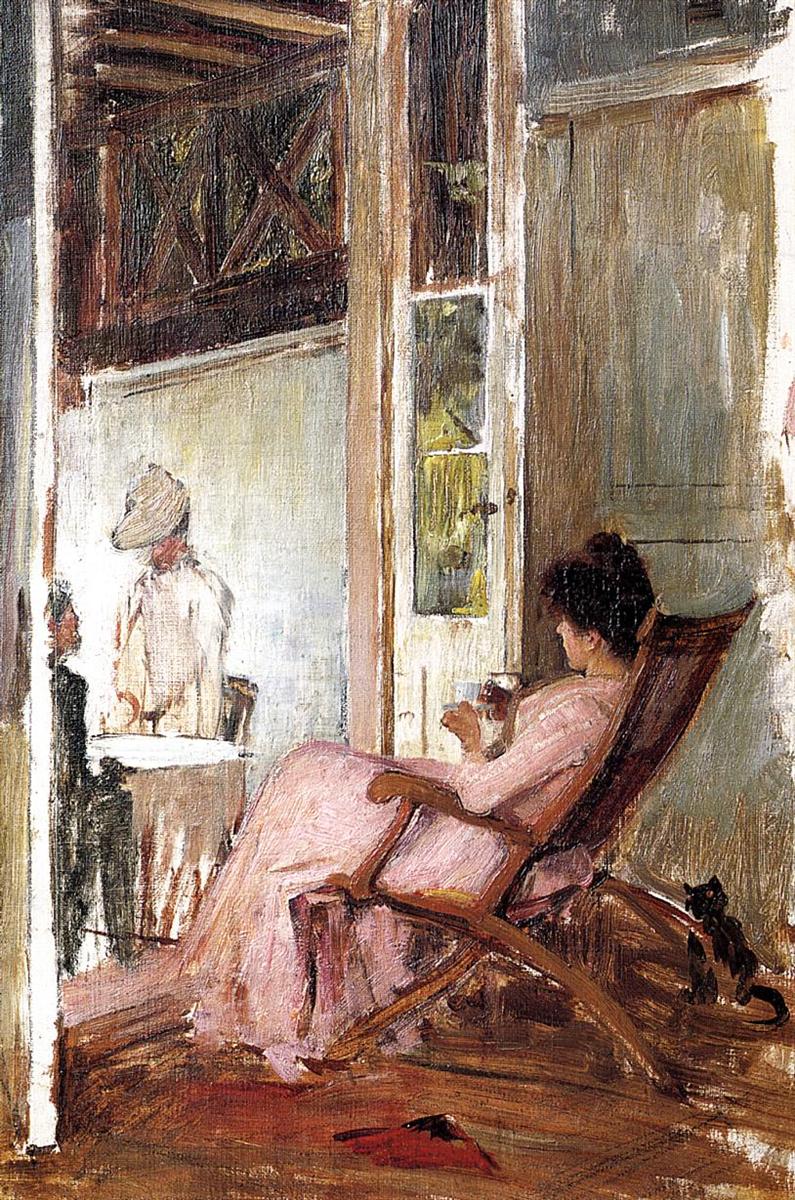
John William Waterhouse’s “The Loggia” (1893) is a quiet painting that feels like a pause taken in sunlight. The composition stages a small domestic moment at the threshold between inside and outside, where comfort, heat, and stillness become the real subject. A woman reclines in a wooden chaise, her pale pink dress pooling in soft folds. She is turned slightly away from us, absorbed in something held in her hands, while a second figure stands beyond the doorway, partially veiled by light and distance. The setting is neither fully interior nor fully exterior. That in-between architecture, the loggia itself, becomes a psychological space, a place where time slows and ordinary gestures gain weight.
The painting reads as intimate without being confessional. There is no dramatic incident, no obvious narrative punchline. Instead, Waterhouse builds meaning through posture, spacing, and atmosphere. The effect is that you do not “solve” the image so much as inhabit it. The calm is deliberate, but not empty. The stillness contains choices about privacy and exposure, and about what it means to rest while the world continues just beyond the frame.
The Loggia as a Threshold Space
A loggia is an architectural promise. It offers shelter while staying open to air, sound, and light. Waterhouse uses that promise to structure the entire picture. The doorway and its framing elements create a strong vertical axis, dividing the painting into zones: the shaded comfort of the seated woman and the brighter area where the standing figure appears. Even if you do not know the word “loggia,” you feel the idea immediately. This is a scene about boundaries.
That boundary is not harsh. It is porous, softened by light reflecting off pale walls and by the painterly handling of surfaces. But it is still a boundary with consequences. Inside, the air seems cooler, the color quieter, the mood slower. Outside, there is a sense of movement implied, even if we cannot see the full environment. Waterhouse does not need to show a garden or street clearly. He only needs the sensation of beyond, the suggestion that the seated woman has chosen to stay in the sheltered margin rather than step out into full exposure.
In this way, the architecture is not background decoration. It is the engine of meaning. The loggia frames a specific kind of modern privacy, one that can exist while still being adjacent to social space. The painting becomes a meditation on how people occupy thresholds, and how thresholds can protect, isolate, or gently separate lives.
Composition and the Psychology of Distance
The strongest relationship in the painting is not between two faces meeting each other. It is between two bodies separated by space and by roles. The seated woman is large in the frame and anchored by the chair’s diagonal lines. The standing figure, by contrast, is smaller, partially turned away, and positioned in a different light. This immediately establishes a hierarchy of presence. We are invited to spend more time with the reclining figure, to read her mood, and to feel the quiet pull of her attention inward.
Waterhouse increases that psychological inwardness by turning her away from us. We see her profile and the curve of her back rather than a frontal face. The pose is restful, but also self-contained. It suggests a person who does not need to perform for anyone. At the same time, the painting keeps her from becoming fully knowable. Because we do not get direct eye contact, we cannot easily label her emotion. Is she content, bored, dreamy, preoccupied, recovering from the heat? The ambiguity is productive. It allows the viewer’s mind to wander in the same slow rhythm as the scene.
The standing figure is placed so that we perceive them as part of the household’s working motion. Even without overt action, the stance and placement imply task and service. If the seated woman represents pause, the standing figure represents continuation. Waterhouse does not dramatize this contrast. He lets it sit quietly, as if it is simply the normal arrangement of things. That normality is precisely what makes it psychologically sharp. The painting asks you to notice how rest is often made possible by someone else’s movement.
Light, Heat, and the Feeling of an Afternoon
Waterhouse is especially attentive to the sensation of temperature. The light appears to fall in a way that suggests midday or afternoon brightness, yet the interior zone is calmer and more muted. The pale walls reflect light softly, creating a gentle haze that makes the scene feel warm rather than glaring. The seated woman’s pink dress picks up that warmth, its color sitting comfortably between blush and dusty rose, as if the fabric has absorbed the ambient heat.
The handling of light is also tied to time. The painting feels like it takes place in a moment when nothing urgent is required. That kind of time is not simply “free time.” It is a specific social luxury, an allowance. The way the chair is placed, the way the figure reclines, and the way the room is allowed to be quiet all suggest that this is a protected interval. Waterhouse paints the light not as a spotlight but as an atmosphere that permits languor.
There is also a subtle theatricality to the illumination. The doorway functions like a stage opening, with the standing figure positioned as if in a brighter wing. The contrast is not extreme, but it is enough to turn the architecture into a device for mood. The light helps separate two modes of being: one private and suspended, one practical and oriented toward duties beyond the resting space.
Color Harmony and the Emotional Palette
The painting’s color scheme is restrained, but it is not plain. Waterhouse builds harmony through a conversation of soft neutrals and warmer accents. Pale cream walls, light wood, and muted shadows create a gentle stage for the dress’s pink to become the emotional center. The pink is not flashy. It reads as human warmth rather than decorative color. It reinforces the idea of flesh, breath, and repose.
The wooden chair introduces a warm brown that stabilizes the composition. Its structure, with curved arms and angled supports, adds a sense of crafted solidity. The wood is both functional and elegant, a piece of domestic design that suggests a comfortable, curated environment. That environment matters. It tells us this is not a rough, improvised resting place. It is a home or a villa-like interior where leisure has been anticipated and furnished.
Accents of darker tones, including the small animal shape near the floor, provide punctuation. They keep the painting from dissolving into pastel softness. Those darker notes also help guide the eye downward and across the foreground, ensuring the composition remains grounded. The emotional palette, then, is not simply “soft and pretty.” It is soft with anchors, restful with structure.
Brushwork, Texture, and the Sense of the Real
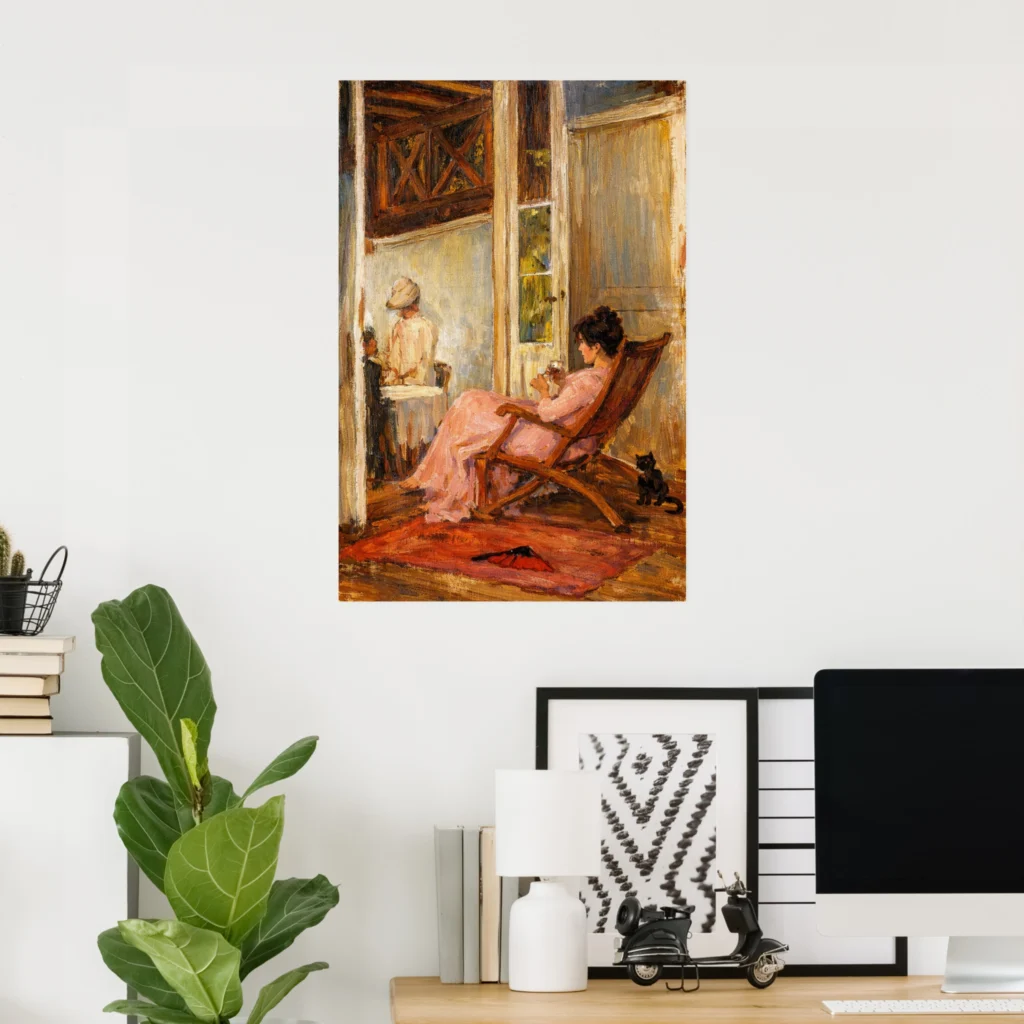
One of the painting’s pleasures is its tactility. Waterhouse suggests textures rather than over-describing them. The dress feels like light fabric, responsive to gravity and the shape of the body beneath it. The wooden surfaces feel worn enough to be lived with, not so polished that they become cold. The walls have a chalky, sun-touched quality that implies plaster catching light.
This approach to texture supports the painting’s atmosphere of ease. Overly crisp detail can make a domestic interior feel staged, like a showroom. Waterhouse instead uses painterly softness to evoke a place that has a pulse. The scene feels observed rather than assembled. That quality matters for the emotional credibility of the woman’s repose. We believe she is truly at rest because the world around her feels breathable.
The brushwork also creates a gentle vibration in the light areas, which helps convey heat and air. Rather than painting sunlight as a single, flat brightness, Waterhouse lets it shimmer slightly through variations in tone. This makes the space feel inhabited by light, not simply illuminated by it.
The Reclining Figure and the Language of Leisure
Reclining poses have a long history in Western art, often associated with myth, sensuality, or power. Waterhouse borrows the pose’s visual language but empties it of obvious spectacle. The woman’s recline here is not a performance for the viewer. It is a practical, comfortable position in a warm setting. That shift is important. It transforms the reclining body from an object of display into a sign of mood and condition.
Her attention is directed to her hands, where she appears to hold a small item, perhaps a letter, a card, or another personal object. Whatever it is, it functions as a quiet narrative device. It suggests thought without demanding drama. A letter can mean many things, but Waterhouse does not force a single reading. The object simply justifies her absorbed posture, giving the rest a purpose beyond idleness.
Her dress, with its soft volume, reinforces this. The clothing is elegant yet relaxed, implying a private or semi-private moment. It is not a public outfit meant for movement through crowds. It is the kind of garment that belongs to a space like a loggia, where one can be seen but not fully engaged. The figure becomes a portrait of selective participation in life, the choice to be near the world without entering it.
The Secondary Figure and the Quiet Social Structure
The standing figure, placed beyond the seated woman, shifts the scene from purely personal mood to social reality. This figure’s role reads as functional, someone delivering or preparing something. The details are intentionally understated, but the implication is clear: leisure is supported. The resting body in the foreground exists within a structure where someone else’s presence, even when gentle and unobtrusive, makes that rest possible.
Waterhouse does not make this a critique with sharp edges. He does not dramatize inequality or conflict. Instead, he presents the arrangement as calm, almost seamless. That calmness can be read in different ways. It can feel reassuring, a picture of a household running smoothly. It can also feel slightly uneasy, because the tranquility depends on invisible labor.
The physical distance between the two figures emphasizes this structure. They occupy the same architectural frame, yet they are not in intimate proximity. Their separation is visual and social. One inhabits the chair, the other the threshold. Waterhouse’s decision to keep their faces less communicative than their body language deepens the sense that this is not a conversation scene. It is a coexistence scene, a portrait of parallel lives within the same space.
Small Details That Expand the Narrative
The presence of a small pet near the bottom right, likely a cat, adds an understated warmth. Pets in domestic scenes often signal comfort, routine, and the ordinary pleasures of home. Here, the animal also serves compositional purpose, adding a dark, compact shape that balances the lighter mass of the dress. It gives the foreground a living punctuation, as if to say that this quiet moment includes other forms of attention and companionship.
The furniture and architectural elements also carry narrative weight. The chaise is angled so that it points toward the doorway, as if the seated woman’s rest is still oriented toward the outside. She has not turned fully away from the world. The open feeling of the entry suggests ventilation, openness, and the potential for movement, even if movement does not happen.
Even the floorboards, rendered with warm browns and subtle directionality, reinforce the sense of a lived interior. They lead the eye toward the chair and then toward the threshold, echoing the painting’s larger theme of near and far, inside and outside, pause and continuation.
Waterhouse’s Mood Painting and Late 19th-Century Sensibility
Waterhouse is often associated with literary and mythological subjects, especially those rooted in Pre-Raphaelite interests. Yet “The Loggia” shows another strength: the ability to build a painting around mood rather than plot. In the late 19th century, artists increasingly explored the everyday as a site for beauty, psychology, and modern feeling. Interiors, gardens, and transitional spaces became stages for subtle states of mind.
This painting participates in that shift. It suggests that emotional depth can be found in the arrangement of furniture, the angle of a body, the quality of light on a wall. The drama is not an event but a condition. What is being painted is the experience of time passing gently, shaped by social roles and personal attention.
Waterhouse’s approach here is quietly modern in its respect for ambiguity. He does not tell you what to think. He offers an atmosphere and lets meaning emerge through looking. The loggia becomes a metaphor for that process: you stand at the edge of the scene, neither fully inside the woman’s mind nor fully outside it, experiencing the painting as a threshold.
Interpretation and Lasting Appeal
“The Loggia” endures because it makes stillness feel specific. Many paintings depict leisure, but fewer make leisure feel like an actual texture of time, shaped by heat, architecture, and the soft pull of private thought. Waterhouse’s composition invites you to slow down, to read the space between figures, and to notice how a doorway can be a psychological boundary as much as a physical one.
The painting’s emotional complexity lies in its gentleness. It is soothing at first glance, but it contains quiet questions. What does it mean to rest? Who gets to rest, and under what conditions? How close can one be to the world without participating in it? By framing these questions within a calm domestic scene, Waterhouse makes them feel human rather than abstract.
Ultimately, the loggia is not just the location. It is the painting’s central idea. It is where comfort meets openness, where privacy meets visibility, where a person can recline and let the day move around them. Waterhouse turns that architectural in-between into a portrait of a mental in-between, and that is why the image lingers.