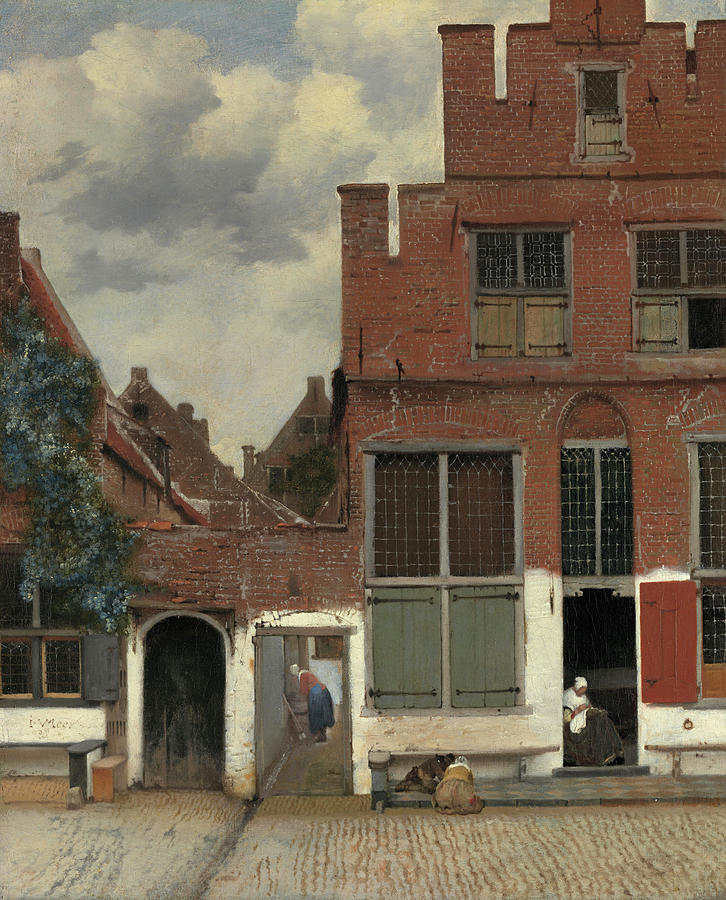
Image source: wikiart.org
Introduction
“The Little Street” (1660) is Johannes Vermeer’s greatest outdoor interior. It is not a sweeping cityscape or a ceremonial view; it is a quiet slice of Delft in which brick, mortar, laundry, and everyday gestures become a complete world. A stepped-gabled house dominates the scene; shutters are latched and unlatched; women go about modest tasks; children huddle at the threshold. The cobbles lead the eye toward an arched passage and a glimpse of back-alley space. Above, a Dutch sky bills with light and weather. Vermeer’s miracle is to give this commonplace corner the dignity of a portrait—measured, tender, and exact—while letting the life within it remain natural and unforced.
Historical Context and Vermeer’s Turn Outdoors
Around 1660, Vermeer was refining the domestic rooms that would make his name, yet he twice stepped outside to paint Delft: once in the grand civic panorama and once here, on a humble street. The choice to render an ordinary façade rather than a landmark speaks volumes about the painter’s temperament. He sought truth not in spectacle but in the order of daily spaces. Dutch art of the period celebrated the household as the foundation of civic virtue; “The Little Street” demonstrates how that ethic extends beyond interior walls to the seam where private life meets the public way. It shows a city that is both built and lived-in, a fabric woven from work and rest.
Composition and the Architecture of Everyday Life
Vermeer structures the painting around the stepped gable that rises like a brick altar at right, offset by a lower cluster of roofs to the left. The façade’s bands of windows and shutters create a rhythm of rectangles and diagonals; their varying states—one shutter propped, another closed, a window glazed with leaded panes—register the house’s life with the nuance of a face. A narrow alley opens between buildings, a measured breath in the brick mass that allows space to circulate. The cobbled street, painted with broken strokes and subtle tonal shifts, ushers the viewer inward. Nothing is central in a theatrical sense; everything is central in a structural sense. The composition is a balance of solids and voids, horizontals and verticals, a calm geometry animated by lived use.
Brick, Mortar, and the Poetry of Surfaces
Few paintings dignify brickwork with such loving attention. Vermeer renders the variations of color—from warm russet to cooling gray—the hairline cracks, the patches of repointing, the scars of weather. Mortar joints are neither mechanically even nor carelessly vague; they breathe with the irregularity of hand-laid masonry. The façade’s skin tells a history of repair and endurance, and the painter allows these marks to become expressive without turning them into ruin. Light glances across the bricks as though across flesh, and the house emerges as an organism: sheltering, aging, sustaining. In Vermeer’s hands, material becomes biography.
People as Notes in the Urban Chord
Human figures in “The Little Street” are scaled to their environment and to their tasks. At the right, a woman sits in the dim mouth of a doorway, absorbed in sewing or lacework; in the alley, another bends over a tub or broom; at the curb, two children crouch near a small sluice or gutter. They are not posed; they occupy their places with the ease of habit. Vermeer avoids anecdotal incident and instead composes a harmony of actions—work, care, rest—under one sky. The anonymity is purposeful. These are not portraits of individuals but embodiments of domestic labor and childhood play within a civic order that respects them.
Light and Atmosphere in a City Corner
The light is quiet, diffused by clouds, falling from left to right. It picks out the roughness of the plaster around the arched entry, grazes the wooden shutters with soft highlights, and drops into the doorway to cradle the woman at her craft. The sky carries a slow drama—clouds gathering and parting—that gives the street’s stillness a living roof. Vermeer is economical with shadow: there is no theatrical chiaroscuro, only the modulation of tones appropriate to a day when the weather changes by degrees. The atmosphere unifies everything, turning bricks, cloth, and skin into members of the same tonal family.
Doors, Windows, and the Threshold Between Worlds
Dutch life in the seventeenth century unfolded at thresholds where home met street. Vermeer stages those membranes with care. The raised step outside the door creates a perch that belongs neither fully inside nor out. Shutters mediate between light and privacy, proclaiming a domestic rhythm that opens to the world during labor and closes for rest. The small arched passage is a conduit for air and for the routines of cleaning and fetching water. These apertures are the civic anatomy of the painting; they articulate a neighborhood that breathes rather than a wall that blocks.
Color Harmony and the Emotional Temperature
Brick red and chalk white set the ground of the palette, countered by the matte greens of shutters and the cool blues lodged in the distant sky and the shaded alley. Earth colors rule: umbers, siennas, and lead whites tied together by atmospheric grays. Against this restrained harmony, small notes flare—a child’s light cap, the woman’s muted skirt, the faint blue blossoms of the vine at left. The result is a mood of sober warmth. Nothing is garish; color reveals structure and touch rather than calling attention to itself. The scene feels truthful because its chromatic temperature matches the weather of ordinary life.
Texture, Craft, and the Tactile Imagination
Vermeer’s brush speaks many dialects. The cobbles are stippled and dragged to suggest wear and grit; the wooden shutters are painted with firmer, longer strokes that indicate grain and edge; the plaster of the arch roughens to catch light, while the vine’s leaves are suggested with flecks that never become botanical fuss. The lacework woman is rendered with tiny, patient movements that echo her own. The fusion of these textures creates a tactile field that invites the hand as much as the eye, yet the painter never indulges in mere virtuosity. Technique is always subordinate to the sensation of a coherent place.
The Street as Domestic Sphere
The presence of children and the seated woman at the threshold expands the idea of home into the public zone. In the Dutch small city, the stoop and sidewalk functioned like a household porch; chores spilled outward, and neighbors shared a glance or word. “The Little Street” captures that permeability. We witness a society in which privacy and visibility are in balance, where the upkeep of domestic space is a civic virtue on display. The street is neither market nor parade ground; it is an extension of the room where work, care, and play reinforce community.
Silence, Sound, and the Experience of Time
Though a city scene, the painting is acoustically hushed. We can imagine faint sounds: the broom’s scratch, water poured in a pail, quiet voices carrying through a doorway, the soft chitter of children. These imagined noises arrive like undertones beneath the steady rhythm of light. Time in the picture is local and continuous; there is no climactic moment, only the flow of a day that will be repeated tomorrow. Vermeer’s strength is to dignify that recurrence, to suggest that a life is built from such days and that meaning accrues in the continuity of care.
The House as Character
The stepped gable is not just architecture; it is personality. Its silhouette cuts the sky with confidence; its windows reveal a policy of openness and reserve; its weathered face shows a history of endurance. Vermeer positions the house to take up more than half the canvas, granting it the right to be regarded as a protagonist. Yet the building’s grandeur is tempered by repair—patches of mortar, a slightly skew shutter, the chipped plaster of the arch. Like a beloved elder, it stands dignified because it has been used well.
The Vine, the Bench, and the Social Grammar of Place
Small elements calibrate the scene’s social temperature. A blooming vine softens the left edge and speaks of tending; a simple bench below offers a place to sit, to gossip, to mend nets or garments, to let a child climb. These are invites to linger. The city is not just traversed; it is inhabited. Vermeer includes them not as decoration but as instruments in a score where comfort and neighborliness are audible.
Order, Cleanliness, and Dutch Civic Ideals
Seventeenth-century Dutch culture prized cleanliness as both practical necessity and moral sign. “The Little Street” offers a visual essay in that virtue. The swept cobbles, the managed gutters, the tidy bench, the righted bucket all declare upkeep without fuss. The women’s tasks—sweeping, sewing—are public acts of order. The painting thus becomes a civic mirror: a self-image of a republic founded on households that keep themselves and, by extension, the city in good repair. Vermeer conveys this without motto or emblem; the truth is in the brick dust and the broom’s path.
Space, Depth, and the Measured Glimpse
Depth in the painting is modest but effective. We pass from street to stoop, from doorway to room and alley, from near gable to rooftops receding under the cloud deck. Vermeer keeps the perspective gentle; orthogonals guide rather than command. The small figure seen through the entry—a woman bent to her task—gives the eye a middle station and confirms the scale of all else. The view is not a surveyor’s; it is a neighbor’s, taken at human height and with human patience.
Technique, Layering, and the Unity of Tone
Vermeer builds the surface with underpainted tonal masses covered by layers that preserve the warmth beneath. Bricks are not drawn one by one so much as suggested by a rhythm of strokes that lets the wall breathe. Highlights on leaded glass are dropped with decisive touches; the laceworker’s cap is raised with pale impasto; clouds are scumbled to produce the softness of weather. Despite the variety of treatment, the picture reads as a single atmosphere. Tone binds everything: the reds are warmed by reflected light; the whites carry the dust of use; the greens sit back into the brick’s gravity. The unity is so complete that the viewer senses a lived hour rather than a compiled catalogue of things.
Comparisons Within Vermeer’s Oeuvre
“The Little Street” shares Vermeer’s fundamental concerns—light, attention, the dignity of ordinary acts—but relocates them from the room to the street. The seated woman echoes the absorbed figures of his interiors; the window gridding, though outdoors, continues the order provided by casements in his rooms; the careful textures of basket, brick, and cloth rhyme with carpets and jugs elsewhere. Yet the shift outside introduces new harmonies: moving air, the civic face of buildings, the presence of weather. If “View of Delft” is a public portrait, “The Little Street” is the city’s private smile.
Multiple Readings and the Open Story
As with many Dutch genre scenes, viewers can propose different stories: a household where women maintain virtue through work; a memory of the painter’s own neighborhood; an allegory of domestic order; a simple report from life. Vermeer sustains all of these without forcing any. He trusts that the clarity of things—brick touched by light, cloth pulled across a lap, a child crouched in play—will carry meaning more persuasively than captions. The painting is generous to interpretation because it is generous to reality.
Enduring Significance
“The Little Street” remains compelling because it perfects a way of seeing that is both affectionate and exact. It honors the city not for its monuments but for its households; it elevates tasks without romanticizing them; it finds poetry in cracks and comfort in thresholds. In a world that often measures importance by scale or spectacle, Vermeer’s small street insists that a culture is truly revealed in how people live alongside one another, how they sweep their stoops, mind their children, and sit at the doorway to sew under a passing cloud. The painting asks us to look at our own streets with similar attention—and to recognize that such attention is itself a form of care.