Image source: wikiart.org
Introduction
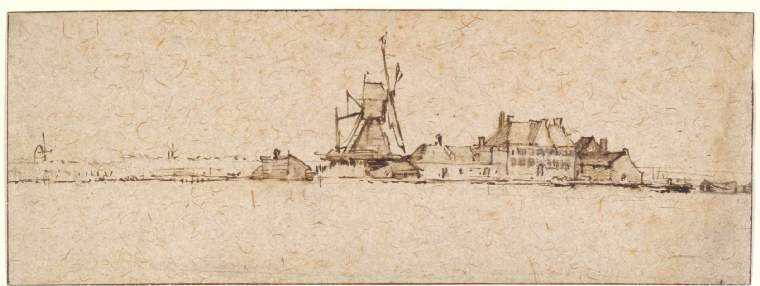
Rembrandt’s “The Little Mill” (1654) is a landscape of arresting modesty: a small, panoramic sheet where a windmill and a wafer-thin strip of buildings stand against a vast openness of air and water. Executed with spare brown ink, the drawing compresses an entire Dutch world into a few decisive marks—angular sails, rooflines stepping along a dike, and the faint suggestion of boats moored below the horizon. Nothing here strains for drama; instead the scene breathes with the plain inevitability of weather and work. The power of the drawing lies in that understatement. Rembrandt gives us not a picturesque view but a lived one, the kind a walker on the outskirts of Amsterdam might pause to note before moving on. In this shallow rectangle, as slender as a long windowpane, he distills the grammar of the Dutch landscape—wind, water, labor, and light—into a single line that divides the sheet between sky and earth.
A Panorama Made From Almost Nothing
The first astonishment of “The Little Mill” is the economy of means. The paper is largely untouched; the horizon sits low; the eye is guided to a knot of structures at center-right where the mill rises above barns and houses. A handful of strokes—some thin, some fattened by pressure—build the mill’s geometry: its scaffold-like stage, the long arm of the sail angled to catch the wind, the ladder of its machinery braced against the sky. Other lines hint at tiled roofs, chimneys, and walls, all kept to a minimum so that the spareness reads as air, not omission. The surrounding whiteness is not empty; it is weather, glare, and the bright slack water of a canal. Rembrandt’s refusal to thicken the page with detail is not haste; it is judgment. By leaving much undone, he lets the viewer’s own memory of fields, breezes, and open distances complete the scene.
The Horizontal Format and the Logic of the Dutch Landscape
The drawing’s extreme horizontality is inseparable from its subject. The Netherlands is a built horizon—polders, dikes, and meadows laid out under a sky that always seems larger than the ground. Rembrandt embraces that proportion. The band of architecture and mill occupies a small fraction of the sheet; the rest is sky whose whiteness suggests humidity and calm. This format has practical and poetic effects. Practically, it allows the eye to travel, discovering the mill, then the clustered roofs, then the faint break of a far-off settlement at the left edge. Poetically, it enacts the spaciousness that defines the Dutch sense of place. A long, low world requires long, low pictures.
Light, Air, and the Weather of Work
No clouds are drawn, yet the sheet is full of weather. We read the sky’s brightness in the untouched paper, the kind of high, diffuse light that flattens shadows and turns water into a pale mirror. The mill’s sails look idle; the day might be still, or the breeze too light to bother the ink with motion. That quiet meteorology suits the buildings below, which appear settled into routine. The drawing becomes a portrait of daily work enfolded by a sky that will not command attention. In this light, time stretches; a viewer feels the slow hours when a town earns its living without incident.
The Mill as Emblem and Machine
For a seventeenth-century Dutch audience, a windmill was more than a picturesque silhouette. It was infrastructure: a tool for grinding grain, sawing timber, or pumping water to keep reclaimed land dry. Rembrandt’s mill reads as a working structure, not a romantic emblem. The scaffolding around its body, the angular supports, and the stout sail arms are depicted with engineering clarity despite the economy of line. The “little” in the title speaks to scale on the page, not significance. The mill is the drawing’s pivot, the vertical accent in a world otherwise composed of horizontal forces—dike, canal, roof ridges, horizon. It is the nail that holds the panorama on the wall.
Architecture, Settlement, and the Rhythm of Rooflines
To the right of the mill a string of gabled houses steps along the dike, their roofs rising and falling like a musical phrase. Some are indicated by a single triangular stroke, others by a short ladder of hatching suggesting tiles. A chimney here and there tilts slightly, a human gesture in a world of straight lines. At the far right the cluster thickens into what could be a small industrial yard or barn complex, its bulk balancing the mill’s verticality. The left half of the sheet remains nearly vacant, a counterweight of emptiness that keeps the right-hand structures from feeling cramped. That negotiation between presence and absence is at the heart of Rembrandt’s landscape style.
The Line That Divides and Connects
In a drawing this spare, every line must work hard. The horizon is not drawn as a continuous stroke but as a sequence of marks—skips, dashes, and small horizontals that together articulate the lip of the water or the top of a dike. This brokenness does important things. It lets light leak through, preventing the horizon from becoming a hard barrier; it suggests the piecemeal construction of the Dutch countryside, an assembled world; and it mimics the way the eye reads distance not as a single edge but as a constellation of small confirmations. The line divides sky from land, yet its openness connects them.
Ink, Pressure, and the Music of the Brush
Rembrandt’s drawing instruments behave like musical voices. A thin, flexible pen lays down the fine scaffolding of the mill; a fuller, darker charge of ink articulates house silhouettes; a nearly dry brush scumbles bits of tone that read as shadows tucked under eaves. The pressure changes mid-stroke, thickening to emphasize a load-bearing post or thinning to let a roof recede. On this tiny sheet, such modulations become the score of a place: louder where structures stand, softer where the eye slips across water, silent where the sky opens. The technical control is invisible at first; only after lingering does one feel how deliberately the marks are varied.
Space Without Perspective Tricks
There is no bravura display of linear perspective here—no receding streets or carefully measured foreshortening. Instead Rembrandt uses scale and density to achieve depth. The mill and nearest buildings are the most articulated, their lines darker and more numerous. Farther left, forms shrink and fade, dissolving into a hint of village on the horizon. The river or canal below acts like a flat, luminous plank that sets the planes in order: nearest blank, middle built, farthest hinted. This strategy, common in his landscape drawings, relies on perception rather than geometry. It is the way the eye actually travels in a flat land: not by counting orthogonals, but by noting where the world gathers and where it thins.
Human Presence Without Figures
No figures are drawn, yet humans saturate the scene. The mill is a human invention tuned to the invisible wind; the houses are scaled to bodies; the long roofline is broken by chimneys that suggest kitchens below. Even the blank water implies traffic—a barge passing unseen, or a worker poling along the far bank. Rembrandt often trusted architecture and tools to stand in for people. Here the decision respects the mood. A strolling figure would pull attention, turning the sheet into anecdote. By letting the mill and dwellings speak for their inhabitants, he keeps the panorama collective and calm.
Sound, Smell, and the Implied Sensorium
Great drawings conjure more than sight. One can imagine the slow creak of timbers when the mill’s sails turn, the faint slap of water against pilings, the far-off call from a wharf, and the muffled thud of sacks hauled inside. The air would smell of wet wood, grain dust, and river silt. None of this is literally present, but the spareness invites projection. The untouched paper becomes light, which becomes air, which becomes the carrier of imagined sound and scent. Rembrandt’s restraint is the gateway to the senses.
Kinships With Other Landscapes of the 1650s
In the 1650s Rembrandt’s landscape drawings often compress a whole environment into one or two structural motifs—the bend of a river, a bridge, a windmill on a dike—set within generous air. “The Little Mill” belongs to that family, close in spirit to sheets where a single tree anchors a road or a solitary farmhouse holds a field in place. Compared with earlier, more detailed landscapes, these late drawings are bolder in omission and more candid about the act of looking. They are not maps; they are memories written down while the light still matches the sensation of being there.
The Poetics of the Ordinary
Seventeenth-century viewers did not necessarily expect landscape to carry moral lessons or pastoral fantasies. Dutch artists routinely celebrated the ordinary, and Rembrandt, though less prolific in pure landscapes than some contemporaries, embraced that ethic at its most austere. “The Little Mill” is not picturesque in the later Romantic sense. It refuses pathos. Yet the sheet is suffused with affection for a built land and the anonymous labor that sustains it. The mill and houses are not relics; they are the present tense of a country making itself every day against the sea.
The Discipline of Leaving Out
The bravery of the drawing is what it declines to include. No foreground weeds frame the view; no staffage figures gesture; no cloud studies crown the sky. This discipline keeps the image light on its feet, able to travel the long distance across the paper without stumbling. It also mirrors the visual truth of a flat horizon under bright light: there is often less to see than eyes hungry for spectacle desire. Rembrandt teaches a hard lesson—how to let a little suffice.
Scale, Pocketability, and the Artist’s Walk
The sheet’s small size and panoramic ratio suggest portability. One imagines Rembrandt standing at the edge of a canal with a small pad, noting the essentials before the wind shifted or the sun burst through. That quickness, however, does not read as haste. Instead it reads as the practiced shorthand of a walker who has recorded such views many times and knows which lines the world most wants. The drawing feels like a postcard to himself: a reminder of a morning’s light and the exact place where a mill met the skyline.
The Mill’s Shadow in Art History
From Bruegel onward, the windmill had served as both motif and emblem in northern art. Rembrandt inherited that iconography but humanized it, focusing on specific mills embedded in local economies rather than stylized silhouettes. Later artists—from Ruisdael to nineteenth-century printmakers—would mine the mill for picturesque effect. “The Little Mill” stands apart by refusing grandeur. It is content to be a record of seeing and a meditation on how few marks can balance a world. That restraint has proven influential to modern draughtsmen who seek poetry in reduction.
When Whiteness Becomes Meaning
The dominance of blank paper is not a failure to fill; it is the subject. Whiteness here means glare on water, breath in the lungs, the space wind requires to work a sail. It also means possibility: the room a landscape needs to stay open in the mind. Rembrandt’s choice to let so much whiteness stand is an argument about vision itself. We do not live amid continuous information; we live amid intervals. Between the marks lies the world we supply from memory and trust.
Conservation, Paper, and the Hand of Time
The light brown tone of the sheet and the faint fibers visible across its surface contribute to the drawing’s atmosphere. The paper’s texture catches the ink differently from stroke to stroke—sometimes soaking to a soft edge, sometimes resisting so the line sits sharp on top. Over centuries, the paper’s tone has likely warmed, deepening the sense of evening. These physical facts matter because Rembrandt worked with them, not against them. He allowed the sheet’s own character to become sky and water, building a landscape in dialogue with the material of its making.
A Modern Viewer at the Dike
To stand before “The Little Mill” today is to recognize a continuity of seeing. Modern viewers, used to speed and saturation, may first register the drawing as minimal. But patience draws out detail: a skiff suggested by two strokes; a low shed crouched at the mill’s base; a distant spire ghosting the far left horizon. The sheet rewards the same attentiveness a walker gives to a long embankment under quiet weather. In that way, the drawing is not only an image but an exercise—an invitation to slow the mind until it matches the tempo of the view.
Conclusion
“The Little Mill” is a triumph of smallness. With barely more than a horizon and a cluster of lines, Rembrandt composes a complete world: a windmill rooted in its work, houses stepping along a dike, water reflecting a pale sky, and all of it bathed in the large calm of Dutch air. The drawing embodies the artist’s late confidence in omission, his trust that the fewest true marks can summon the richest experience. It honors labor without anecdote, landscape without spectacle, and weather without clouds. To look at it is to feel a breeze you cannot see, to hear a creak that the page does not record, and to stand for a minute longer than you meant to at the edge of a canal, grateful that a “little” thing can hold so much.