Image source: wikiart.org
Introduction to The Little Fruit Seller by Bartolome Esteban Murillo
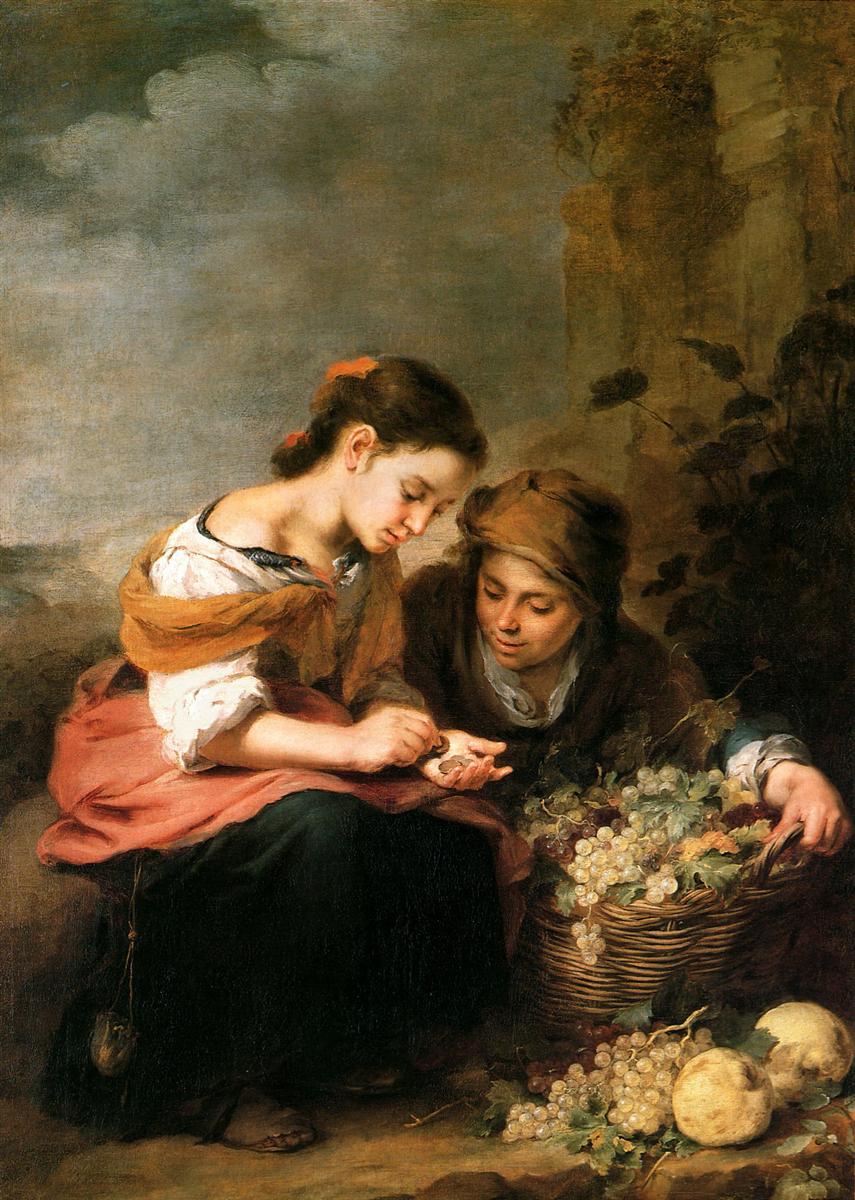
“The Little Fruit Seller,” painted in 1675 by Bartolome Esteban Murillo, is one of the most tender and evocative images in the artist’s celebrated series of street children. Instead of saints, nobles or mythological heroes, Murillo focuses on two young girls and a heavy basket of grapes and melons. The scene is intimate. One girl sits in profile, counting coins in the palm of her hand. The other leans in, watching closely with a mixture of curiosity and satisfaction. Their faces are softly lit, their clothes simple, their surroundings rustic and quiet.
The painting embodies much of what has made Murillo so beloved. His mastery of warm light, his sensitivity to human feeling and his ability to transform everyday life into poetic imagery all come together in this work. Beneath the charming subject lies a complex reflection on work, poverty, innocence and the small triumphs of survival in seventeenth century Seville.
Historical Context of The Little Fruit Seller by Bartolome Esteban Murillo
When Murillo created “The Little Fruit Seller” around 1675, Seville was a city marked by contrasts. It remained an important port of the Spanish empire, benefiting from trade with the Americas, yet it also suffered from economic decline, recurring plagues and widespread poverty. Crowded streets and markets were filled with vendors, beggars and children trying to earn a living.
Murillo was deeply embedded in this urban environment. Although he worked for religious institutions and wealthy patrons, he walked the same streets as the poor youths who appear in his genre paintings. His series of works depicting ragged boys and girls selling food, eating, playing or resting can be seen as a pictorial record of the human face of Seville’s hardship. Yet his approach is not purely documentary. He bathes these scenes in warmth and dignity, encouraging viewers to see beauty and grace in lives that might otherwise be overlooked.
“The Little Fruit Seller” fits perfectly into this context. The two girls could be daughters of peasants or urban poor who have brought fruit to market. They count their earnings with careful attention, suggesting the thin line between scarcity and sufficiency. Murillo offers his patrons an image that combines local color with moral reflection, inviting empathy and admiration for the industry of the young vendors.
Subject Matter and Narrative in The Little Fruit Seller
At first glance, the painting presents a simple narrative. Two girls have just completed a sale and are now counting the coins they have earned. A large basket overflowing with grapes sits beside them, and two melons rest on the ground. One girl holds the coins as the other watches, her hand resting on the rim of the basket. The moment is small yet full of meaning.
Murillo chooses a pause rather than a busy marketplace scene. There is no crowd, no buyers haggling, no movement of carts or animals. Instead, the narrative focuses on a quiet exchange between the two children. This choice allows the viewer to enter the scene emotionally, observing the concentration on their faces and imagining the satisfaction of having earned money through their own labor.
The story is open ended. Are they sisters, friends or partners in trade for the day. Are they about to divide the money, buy bread, or bring the coins home to their family. Murillo leaves these questions unanswered so that the viewer can project various possibilities. What matters most is the shared focus on the coins, which symbolically represent security, food and hope.
Composition and Focal Points
“The Little Fruit Seller” is carefully composed to draw attention to the girls and their modest wealth. Murillo places them slightly to the left of center, seated on the ground or on a low rock. Their bodies form a gentle diagonal that runs from the head of the left girl down to the right girl’s hand resting on the basket. This diagonal is echoed by the slant of the fruit basket itself, which leads the eye toward the cluster of grapes spilling out in luminous bunches.
The central focal point is the small cluster of coins in the left girl’s hand. Murillo ensures that the viewer notices this detail through subtle compositional cues. Both girls lean toward the coins. Their gazes converge there, and their arms create a circular rhythm that frames the money. The viewer’s eye naturally follows this loop, moving from faces to hands to fruit and back again.
The background remains relatively simple. A rocky wall and sparse foliage rise on the right, while on the left a broad expanse of sky fades into soft gray and blue tones. This simplicity keeps attention firmly on the figures and still life. The painting feels balanced and harmonious, with no superfluous elements to distract from the central human story.
Light, Color and Atmosphere
Murillo’s use of light in “The Little Fruit Seller” is one of the painting’s most striking features. Soft, warm light falls from the upper left, illuminating the girls’ faces, hands and the shimmering grapes. Their skin glows with delicate shades of peach and rose, creating a sense of youth and vitality. The folds of their clothing catch the light on edges and creases, giving depth and volume to the fabric.
The color palette is dominated by earthy tones. Browns, ochers and muted greens anchor the composition, while brighter accents bring life to key details. The girl on the left wears a salmon pink skirt and a warm ocher shawl draped across her shoulders. These colors contrast gently with the cooler greens and pale yellows of the grapes. The other girl’s clothing is darker and more subdued, focusing attention on her face and on the shared activity of counting money.
Clouds and sky in the background are rendered in soft gray-blue hues, which frame the figures without competing for attention. Overall, the atmosphere is tranquil and slightly hazy, suggesting late afternoon light. This gentle luminosity adds a contemplative mood to the painting, suggesting a pause after work rather than the bustle of midday.
The Two Girls as Characters
Murillo imbues the two girls with distinct personalities. The girl on the left, who holds the coins, sits with her body turned slightly toward the viewer but her head bent down in concentration. Her profile is delicate, with a straight nose, full lips and a gently rounded cheek. A ribbon ties back her hair, and a few strands escape around her face. Her posture suggests responsibility. She appears to be the one in charge, patiently counting and perhaps deciding how the money will be used.
The girl on the right leans closer, her face animated with curiosity and quiet excitement. Her features are slightly more rounded, her expression open and lively. She wears a simple headscarf that covers her hair, perhaps indicating a more modest or practical nature. Her eyes follow the movement of the coins with keen interest. She seems to trust the other girl, watching rather than interfering, yet clearly invested in the result.
The intimacy between them is evident in their proximity and relaxed gestures. There is no tension or rivalry in their expressions. Instead, Murillo captures a moment of cooperation and mutual reliance. The viewer senses the warmth of their companionship, which turns a commercial transaction into a shared achievement.
The Symbolism of Fruit, Coins and Basket
The still life elements in “The Little Fruit Seller” are not merely decorative. The overflowing basket of grapes and the melons resting on the ground carry symbolic weight within the painting.
Grapes have long held associations with abundance, harvest and the pleasure of eating. In Christian symbolism they can also refer to the Eucharist and the blood of Christ, signifying spiritual nourishment. In this secular context, the grapes likely represent the fruits of labor and the bounty of the earth. Their abundance contrasts with the poverty suggested by the girls’ clothing, emphasizing that even the poor can occasionally experience moments of plenty.
The melons, round and pale, add to this sense of harvest richness. Their hard rinds suggest durability, perhaps hinting that some of the food can be stored for later. Together with the grapes, they create a visual feast that appeals to the senses.
The coins introduce another layer of meaning. They are small but powerful symbols of exchange and survival. For these girls, the money is the reward for hours of work, perhaps under the hot sun or in a bustling market. The careful way they handle the coins underlines their importance. The painting implicitly asks viewers to consider the value of each coin in the life of a poor family. It also highlights the connection between natural abundance and economic reality, showing how the fruits of the earth are converted into the means of daily living.
Social Commentary and the Reality of Work
Murillo’s portrayal of poor children often carries a gentle but clear social message. In “The Little Fruit Seller,” he presents work as a dignified activity, even when undertaken by the very young. The girls are not depicted as beggars passively waiting for charity. They are active agents who harvest, transport and sell fruit to support themselves or their families.
Their clothing, though modest and slightly worn, is clean and carefully arranged. The shawl tied around the older girl’s shoulders and the headscarf on the younger girl suggest a sense of pride in appearance. Murillo refuses to portray them as pitiable outcasts. Instead, he emphasizes their industriousness and capacity for joy.
At the same time, the painting acknowledges the harsh reality that children must labor in order to eat. The very title, “The Little Fruit Seller,” reminds us that poverty has pushed these young people into the adult world of trade and calculation. The coins in their hands are both a reward and a reminder of economic necessity.
For wealthy patrons and viewers, such images may have functioned as a call to compassion. They reveal the humanity behind the anonymous masses of the poor. By inviting empathy with the girls’ hard work and satisfaction, Murillo encourages a charitable attitude toward those at the margins of society.
Murillo’s Technique and Approach to Genre Painting
“The Little Fruit Seller” showcases Murillo’s mastery of genre painting, a type of art that depicts scenes of everyday life. In seventeenth century Spain, such scenes were less common than religious works, yet they were highly valued by certain collectors, especially foreigners. Murillo approached this genre with the same seriousness and technical skill that he brought to altarpieces.
In this painting, his brushwork varies between detailed and sketchy. The girls’ faces and hands are rendered with smooth, precise strokes, building up subtle transitions of tone. The grapes and leaves in the basket, by contrast, are painted more loosely, with flicks of color that suggest texture without meticulous detailing. This contrast creates a natural hierarchy of attention, with the viewer drawn first to human emotion and then to the surrounding objects.
Murillo also demonstrates a sophisticated understanding of anatomy and drapery. The twist of the older girl’s torso, the bend of her arms, and the fall of her skirt are all convincingly depicted. Shadows under the folds and along the ground anchor the figures in space, while the softly modeled background suggests depth without distracting from the main group.
By elevating a simple scene of rural trade to the level of fine art, Murillo expands the boundaries of what was considered worthy of painting. His technique invites viewers to see the sacred potential in ordinary human interactions.
Relationship to Murillo’s Other Child and Fruit Scenes
“The Little Fruit Seller” is related to several other works by Murillo that feature children with fruit or food. A well known example is “Two Boys Eating Grapes and a Melon,” where ragged boys gleefully enjoy their harvest. Another is “Children Eating a Pie,” in which boys share a freshly baked treat while a dog waits hopefully nearby.
Compared to those more playful scenes, “The Little Fruit Seller” is quieter and more reflective. The emphasis shifts from the consumption of food to the economics behind it. Instead of boys who have paused to feast, we see girls concentrated on counting earnings. The mood is less boisterous and more contemplative, yet still touched by affection and warmth.
These related works together form a kind of visual cycle documenting the lives of poor children in Seville from different angles. Some images focus on rest and play, others on hunger or sickness, and this one on work and financial reckoning. Viewed as a whole, they reveal Murillo’s sustained interest in the dignity and complexity of childhood under difficult circumstances.
Emotional Resonance and Lasting Appeal
One of the reasons “The Little Fruit Seller” continues to attract admiration is its emotional complexity. On one level, it is a charming and beautiful image of two girls framed by fruit and soft light. On another level, it is a poignant reminder of how fragile their happiness is.
The scene captures a moment of success. The girls appear calm, even gently pleased, as they examine the coins they have earned. Yet the viewer knows that this success is modest and temporary. Tomorrow they must return to the orchards and markets, hoping once again for buyers. This combination of joy and vulnerability gives the painting a bittersweet tone that resonates with viewers across centuries.
Modern audiences may also find in the work a reminder of ongoing issues of child labor and economic inequality. While the setting is historical, the underlying story of young people who must work to support themselves remains relevant. Murillo’s sympathetic portrayal encourages viewers to consider their own responsibilities toward vulnerable children in contemporary society.
Conclusion
“The Little Fruit Seller” by Bartolome Esteban Murillo is a masterpiece of Baroque genre painting that unites technical mastery with deep human feeling. Through a simple scene of two girls counting coins beside a basket of fruit, Murillo explores themes of work, poverty, companionship and the small victories that sustain life. His warm light, harmonious composition and subtle characterization transform a humble subject into a poetic meditation on the dignity of everyday existence.
The painting invites viewers to draw near, to share in the girls’ quiet satisfaction, and to reflect on the social realities that shape their lives. At the same time, it celebrates the resilience and grace of youth, showing that even in hardship there can be beauty, tenderness and hope. More than three centuries after its creation, “The Little Fruit Seller” continues to speak with freshness and clarity, confirming Murillo’s reputation as one of the most humane and insightful painters of the Spanish Baroque.