Image source: wikiart.org
Introduction
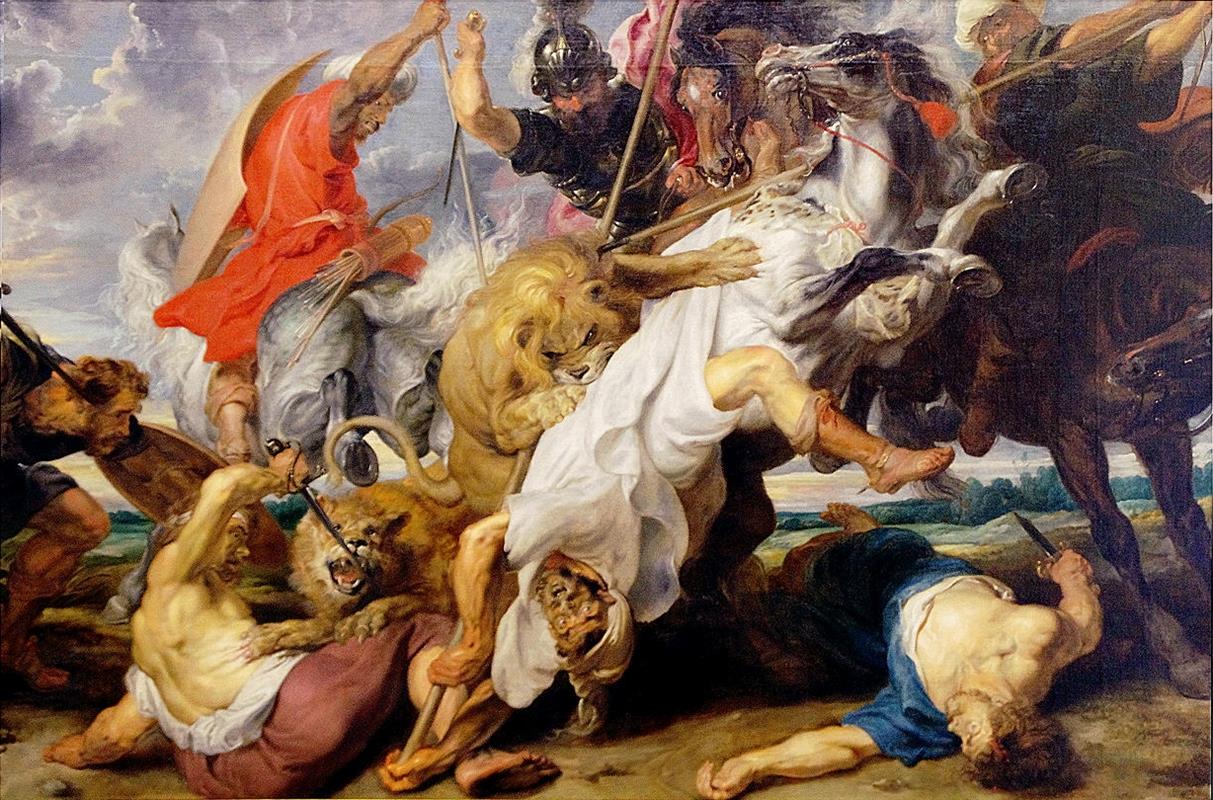
Peter Paul Rubens’s “The Lion Hunt” (1621) is a thunderclap of Baroque action. In a single panoramic sweep he unleashes men, horses, and lions into a spiraling collision where every limb, mane, and weapon cuts a directional line. The canvas does not merely depict danger; it manufactures velocity. Riders lean from their saddles with lances and scimitars; a rearing horse reveals the whites of its eyes; a lion clamps its jaw into a rider’s torso as another cat lunges with outspread claws. Rubens binds these shocks into a coherent rhythm so the eye races across the fray yet never loses its bearings. The picture is a manifesto for his art of controlled chaos, proving that grand history can be written in muscle and dust.
Courtly Spectacle and Historical Context
Hunt scenes were prized emblems of princely identity in the early seventeenth century. To subdue apex predators signaled courage, command, and the expensive infrastructure of dogs, horses, armor, and trained retainers. Rubens, already Europe’s pre-eminent court painter and diplomat, returned repeatedly to the subject of lion and boar hunts for patrons who wanted their walls to project sovereign vigor. Painted around 1621, “The Lion Hunt” participates in this politics of spectacle while reaching beyond it. The image is less a trophy than a living system of counterforces—fury against discipline, instinct against strategy—arranged with a theatricality learned in Italy and grounded in Flemish observation.
Composition as Whirling Engine
The composition is a rotating gyre anchored by the golden mass of the central lion. From that fulcrum bodies and weapons spin outward in interlocking diagonals: a horse rears to the right, a fallen rider tumbles headfirst, a soldier thrusts a spear down the central axis, and a stooping figure at left braces a shield against a second lion. These vectors cross like tightened cords. The ground plane tilts toward us, denying safe distance; clouds lift as if blown by the same wind that snaps banners and manes. Rubens organizes the melee into crescents and loops—the white swirl of a fallen robe, the curve of a horse’s belly, the S-bend of a flung leg—so the chaos reads as choreography.
Light, Color, and the Heat of the Moment
Light pours across the scene with a clear, late-afternoon intensity that heightens textures: sweat slicks horse flanks, metal flashes briefly along spearheads, and cat pelts glow in honeyed ochres. Rubens sets warm lions and tawny earth against cooler notes of steel, slate cloud, and the blue garments of a fallen hunter. Primary accents—vermilion in a rider’s mantle, the cream of a turban, the chalk of a white stallion—function like signal flags guiding the eye through overlapping bodies. The palette is not merely descriptive; it calibrates temperature. Where danger peaks, colors burn hottest; where bodies recede, tones cool to let the next impact flare.
The Lions as Protagonists
Rubens refuses to make the lions generic props. The central beast bites and braces at once, back legs digging for purchase, forepaws clamped into a victim’s torso. Its jaws compress flesh with believable pressure; teeth vanish into cloth and skin; the mane is a storm of brushstrokes that catch light in separate strands. Another lion snarls straight into a blade, gums pulled back in a grimace of pain and defiance. These cats are individuals, not symbols, and the dignity Rubens grants them dignifies the human courage arrayed against them. The contest reads as worthy, not one-sided slaughter.
The Horses as Co-Combatants
No less vivid are the horses, each given a psychology: one rears and wheels, mouth frothing and nostrils flared; another drives forward in a compact bundle of sinew; a third stumbles as a lion’s weight collapses its path. Rubens’s fluency with equine anatomy—tendons pulling like bowstrings, veins tracking under satin hide—turns the mounts into active agents, not platforms. Their fear and training create a secondary drama that mirrors the men’s. Saddles, bridles, and tasseled harnesses flicker in and out of visibility, evidence of the expensive pageantry that frames danger without taming it.
Human Anatomy, Gesture, and Baroque Velocity
Rubens models the hunters with the authority of a master who understands how joints carry force. Torsos twist, scapulae rise under skin, triceps tighten as grips fail or hold. One figure slides backward with spine arched like a drawn bow; another sits deep in the saddle, shoulder cocked for a drive that will arrive a beat later than the painting’s freeze. The painter edits nothing essential: wrinkles bunch where cloth resists, calloused feet splay, and beards bristle in the dust. Gestures are legible from afar and nuanced up close; they add up to a grammar of attack, recoil, and counter-thrust.
Weapons, Tactics, and the Ethics of Risk
Spears, scimitars, and daggers appear in disciplined arcs. The downward thrusts into the cats’ shoulders aim for arteries; crosswise slashes target the snarl where maw meets cheek. A shield at lower left receives the impact of a lion’s head; a bow at a rider’s hip reminds us that the hunt began at distance before collapsing into hand-to-paw struggle. Rubens’s accuracy acknowledges the expertise required to survive such encounters. The scene frames violence as rule-bound risk rather than random slaughter, a choreography in which training temporarily outpaces terror.
Sound, Scent, and the Sensory Storm
Although silent, the picture vibrates with implied noise: hooves pounding, iron ringing against fang, men shouting to rally or warn, cats roaring from low in the chest. One can almost smell horse sweat, crushed grass, and the rank heat of lion breath. Dust billows where bodies skid; a gust pushes a red mantle horizontal; a mane sprays flecks of foam. Rubens’s brushwork performs this meteorology—dry scumbles for dust, wet glazes for sweat, fat impasto for sunstruck highlights—so the air feels as worked as the figures.
The Horizon and the World Beyond the Fray
A streak of distant landscape—meadow green, pale road, a blue seam of far trees—cleaves the lower background. This calm horizontal is not an afterthought; it is the counter-chord that makes the foreground storm “sound.” The hunt happens in a real world with air and distance, not on a stage set. That sliver of quiet horizon implies continuation: the party has thundered out from somewhere and will, if they survive, thunder back with bodies and stories of near escape.
Italian Lessons and Flemish Truth
Rubens’s years in Italy taught him to engineer complex multi-figure action like Tintoretto and to model heroic flesh with Titian’s warmth. Yet the immediacy of clotted earth, the plain talk of a hand gripping a spear shaft, and the dogged observation of animal bodies belong to his Flemish temperament. “The Lion Hunt” synthesizes these lineages: Venetian color and bravura drawing meet northern tactility. The painting owes something to ancient Roman reliefs of venationes, yet it breathes with a speed and empathy that are unmistakably Rubensian.
Allegory and the Politics of Display
While the scene reads as literal hunt, it also shadows princely allegory. Lions can stand for enemies of the state, savage appetites, or the chaotic forces rulers claim to master. The riders’ turbans, armor, and varied costumes hint at a cosmopolitan retinue—an idealized army united under one will. Display mattered: such canvases hung in palaces and hunting lodges where guests were meant to feel the host’s capacity for command. Rubens satisfies this rhetoric without flattening the event into propaganda; he lets the lions’ ferocity and the hunters’ precariousness preserve real stakes.
Workshop Practice and Painterly Method
Rubens directed a bustling studio, yet the vital passages—the central lion, the rearing horses, the toppled figures—bear the speed and authority of his hand. He lays in large tonal masses quickly, then tightens forms with brisk anatomical accents: a white flick for tendon, a warm glaze for vascular bloom, a knife-edged stroke for steel. Edges choose their focus—hard where attention must lock (fangs, spear tips, eyes), soft where motion blurs (flying robes, manes, dust). The surface remains lively, with pentimenti where a leg or spear was shifted to sharpen the visual rhythm.
Comparisons Within the Hunt Series
Set beside Rubens’s other hunts—“Wolf and Fox Hunt,” “Boar Hunt,” and “Hippo and Crocodile Hunt”—this canvas sits at the fiery center of the cycle. The boar scene tangles in forest gloom; the hippo picture sprawls in aquatic horizontals; but “The Lion Hunt” is built as a bursting sun, its energies concentrated and radiating outward. Across the series Rubens experiments with how predators change human posture: lean and jab for boar, harry and encircle for wolf, vault and stab for lion. The variety proves the theme’s elasticity and the painter’s delight in solving new problems of motion and layout.
Moral Psychology and the Faces of Peril
Rubens gives even split-second faces moral weather. One hunter’s eyes widen with the sudden comprehension that he is falling; another’s mouth tightens into a line of practiced focus. A man on the ground grimaces in pain but still drives a dagger upward. The lions’ expressions range from raw hunger to wounded rage. None are caricatured; each records a human or animal mind at an exact threshold—before panic, during effort, at the edge of surrender. The picture reads as a study in character under pressure.
Time, Suspense, and the Frozen Beat
Rubens selects the instant just before the balance tips. Spears have not yet penetrated deeply; horses have not yet recovered their footing; the fallen have not yet been mauled beyond saving. This suspended beat makes viewers complicit. We finish the action mentally and feel risk in our own bodies. The painting is therefore not a stabilized trophy but a machine for generating suspense each time a viewer stands before it.
Legacy and Modern Appeal
“The Lion Hunt” remains magnetic because it merges narrative thrill with painterly intelligence. Modern cinema owes much to Rubens’s capacity to choreograph crowds while preserving individual stakes. The image also reads beyond its courtly origins as a parable of confronting the dangerous—whether political crisis, personal addiction, or ecological catastrophe—where success depends on trained courage rather than bluster. Its beauty does not anesthetize the violence; it clarifies it so we can perceive courage and cost together.
Conclusion
Rubens’s 1621 “The Lion Hunt” is a summit of Baroque dynamism. Every element—composition, light, color, anatomy, texture—serves the blast of impact without sacrificing clarity. Lions bite and resist, horses rear and obey, men risk and improvise. Out of these contests Rubens forges a single convulsive chord that rings long after the eye leaves the canvas. It is courtly bravado and human drama at once, a picture that proves order can be wrested from turmoil and that painting, in the right hands, can move as fast as fear.