Image source: wikiart.org
Claude Monet and the World of Honfleur
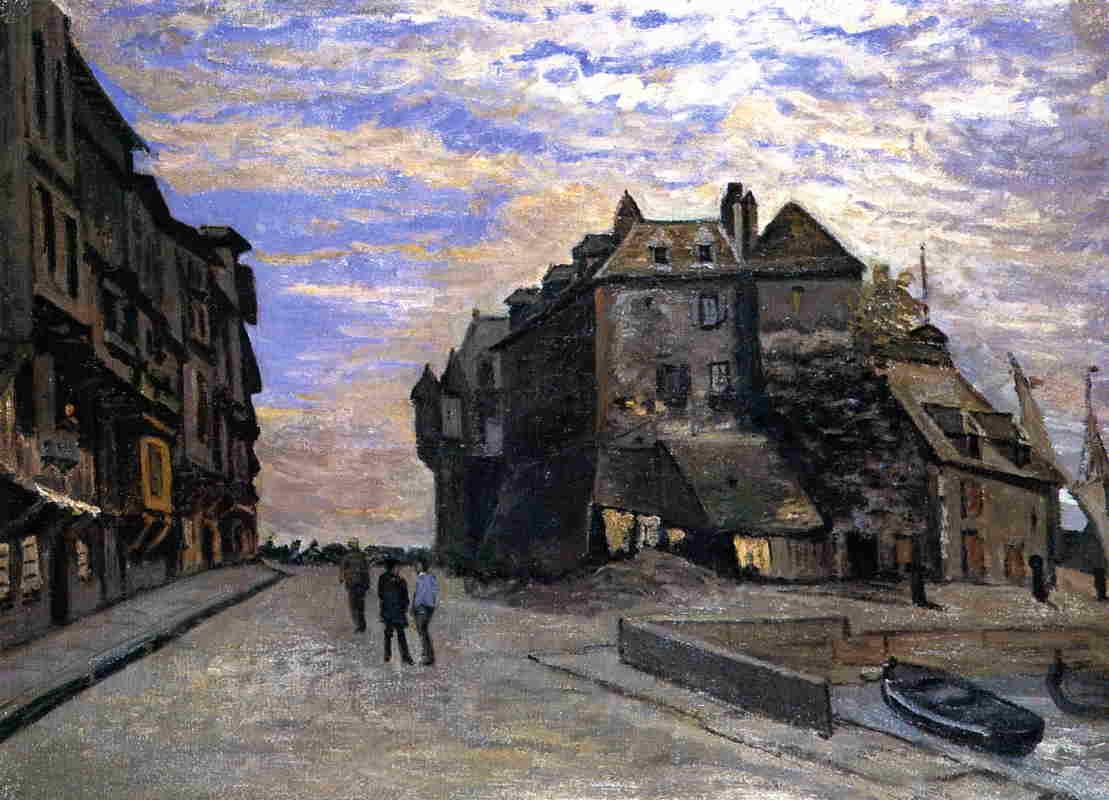
Claude Monet’s The Lieutenancy at Honfleur from 1864 belongs to a crucial moment in the artist’s development, when he was still shaping the visual language that would later transform modern painting. Even at this early stage, the work reveals a remarkable sensitivity to atmosphere, passing light, and the character of a real place. Rather than presenting Honfleur as a rigid architectural record or a picturesque postcard image, Monet gives it life through shifting color, softened form, and the emotional weight of a specific hour.
Honfleur was deeply important to Monet. The Norman port offered him an ever changing meeting point of land, water, weather, and human activity. It was also a place connected with artists who helped guide his eye toward direct observation, especially Eugène Boudin and Johan Barthold Jongkind. In that environment, Monet learned to pay close attention not only to objects themselves, but also to the conditions in which they were seen. A building was never just a building. A street was never just a street. Everything altered according to the sky, the hour, the season, and the moisture in the air.
That approach is already vivid in The Lieutenancy at Honfleur. The painting centers on one of the town’s most recognizable structures, the old Lieutenancy building near the harbor, yet the subject is not treated as a static monument. Instead, Monet transforms it into part of a living environment. The sky presses down with broad movement, the street opens into space, the figures drift quietly through the scene, and the boats at the edge of the water remind us that this is a place defined by commerce, travel, and coastal life. The result is both topographical and poetic.
What makes the painting especially compelling is the balance it achieves between solidity and transience. The architecture feels old, weighty, and historically rooted, but everything around it seems in motion. The clouds shift, the light dissolves edges, and the entire atmosphere appears to hover between day and evening. Monet is not simply documenting Honfleur. He is discovering how painting can register the sensation of standing there.
The Subject and the Sense of Place
The Lieutenancy itself dominates the right side of the composition. Its clustered rooftops, chimneys, and irregular walls form a dark mass that rises against the luminous sky. This old building carries visual and historical presence. It feels weathered, inhabited, and deeply tied to the port’s identity. Monet does not idealize it into clean symmetry. Instead, he embraces its uneven profile and slightly awkward complexity, which makes it feel genuinely observed.
On the left side of the painting, the row of buildings recedes down the street in shadow. These structures create a long visual corridor that leads toward the middle distance. Their darkness contrasts sharply with the brighter sky and pale roadway, giving the scene depth and direction. The street itself curves gently and draws the viewer inward, as though inviting a slow walk toward the harbor.
Near the center, a few small figures move through the open space. They are not individualized portraits. Monet keeps them slight and understated, but their presence is essential. They give scale to the architecture and animate the scene without overwhelming it. Their dark silhouettes echo the darker forms of the buildings, helping bind the composition together. They also reinforce the painting’s quiet, observational quality. This is not a dramatic public spectacle. It is an ordinary moment of urban life.
At the lower right, the water and moored boats introduce another layer of meaning. Honfleur was a port town, and even in a view focused on buildings and street space, the harbor remains part of the visual story. The boats are modest in size, almost tucked into the corner, yet they help define the location and mood. They remind the viewer that this is a threshold between solid ground and maritime movement, between the permanence of masonry and the uncertainty of tide and weather.
Monet’s choice of subject reflects a broader interest in modern life as it existed in real places rather than in idealized historical fantasies. Although the building itself is old, the painting’s outlook is modern in spirit. It values everyday perception. It finds beauty in a specific town, a specific hour, and a specific arrangement of light over familiar streets.
Composition and Spatial Design
One of the strongest features of the painting is its composition. Monet organizes the scene through large opposing shapes. The shadowed buildings on the left create a broad vertical barrier, while the Lieutenancy on the right forms an equally commanding counterweight. Between them, the open roadway and pale sky generate a wedge of breathing space. This tension between enclosure and openness gives the painting its structure.
The street functions as a visual path. Starting from the bottom left, it curves inward and gradually narrows as it approaches the center distance. This recession pulls the eye into the painting while also creating a sense of quiet motion. The viewer does not simply look at the scene from the outside. The composition encourages entry. We feel placed within the urban space, almost as though standing on the road ourselves.
The central openness is especially important because it prevents the architecture from becoming heavy or oppressive. Monet gives the scene air. Even though the buildings are dark and massive, they do not crush the composition because the middle ground and sky provide release. This balance between density and openness would become one of Monet’s great strengths in later years, especially in landscapes and waterside views where atmosphere plays a structuring role.
The Lieutenancy’s irregular roofline is another key compositional device. Rather than presenting a flat block, Monet lets the building break upward into varying peaks and angles. These forms are echoed by nearby rooftops and masts, creating a lively silhouette against the clouds. The architecture becomes part of a rhythmic design rather than a fixed geometric object.
The figures in the road are carefully placed as punctuation marks. They sit near the center of the painting, just where the open street and the building masses meet. Their small scale emphasizes the size of the architecture, but their dark forms also keep the eye from drifting too quickly into the distance. They anchor the human dimension of the scene.
Even the boats in the lower right corner contribute to the composition by extending the image toward the water and preventing the right edge from becoming visually abrupt. Monet understands how small elements can stabilize a large design. Nothing feels accidental. The painting appears spontaneous, but its structure is thoughtful and controlled.
Light, Atmosphere, and the Drama of the Sky
If the architecture gives the painting its body, the sky gives it its soul. The expansive cloud cover fills much of the upper half of the composition and establishes the emotional temperature of the scene. Monet paints the sky not as a smooth backdrop, but as a living field of movement. Patches of blue, violet, cream, and pale pink intermingle across the surface, suggesting a moment when light is changing rapidly.
This is one of the most striking aspects of the painting. The town below is dark and rooted, but the sky above is unstable and luminous. The effect suggests late afternoon or evening, when the day’s light begins to soften and cool, yet still catches the clouds with warm highlights. Monet is fascinated by this transitional state. He is not interested in a fixed local color sky. He wants the sky to feel seen in time.
The light does not fall evenly across the scene. Some windows glow faintly, some walls catch more illumination than others, and the roadway reflects the sky in subdued tones. This unevenness is essential to the painting’s realism. Real light is rarely uniform. It breaks across surfaces differently depending on angle, texture, and distance. Monet is already studying that complexity.
Atmosphere also softens the edges of things. The buildings do not appear sharply cut against the sky in a hard academic manner. Their outlines waver slightly, as though absorbed into the surrounding air. This creates a sense of humidity and coastal softness. Honfleur is not dry, crystalline, or still. It feels touched by sea air, weather, and moving cloud.
The emotional force of the painting depends heavily on this atmospheric handling. Without the sky, the scene might seem merely architectural. With it, the image becomes contemplative and slightly mysterious. There is a quiet drama here, but it is the drama of perception rather than narrative. Nothing spectacular is happening, yet the world feels charged because the light is so alive.
Monet’s later fame would rest largely on his ability to make light itself the subject of painting. In this early work, that interest is already unmistakable. He is not yet dissolving the world into near abstraction, but he is clearly moving away from description alone and toward sensation.
Color and Tonal Harmony
The color scheme of The Lieutenancy at Honfleur is restrained, yet it is far from dull. Monet builds the image through subtle harmonies of cool and warm tones. Blues and violets dominate the sky and shadows, while soft creams, muted pinks, ochres, and grays create flickers of warmth throughout the composition. This interplay gives the painting a refined tonal richness.
The roadway is especially interesting in this respect. It is not simply gray or brown. Monet allows it to absorb the atmosphere of the sky, so that it appears tinged with pale violet, silvery cream, and dusty blue. This creates visual unity across the composition. Ground and sky feel connected, as though the whole town is bathed in one shared envelope of light.
The darkest passages appear in the left hand buildings and in parts of the Lieutenancy. These deep browns, charcoals, and bluish blacks provide the necessary contrast that makes the sky glow. Monet understands that luminosity often depends on darkness nearby. By setting the clouds against strong shadowed forms, he heightens their radiance.
There are also moments of warm accent that keep the image from becoming cold. Tiny hints of yellowish light in windows and muted earth tones in the buildings suggest habitation and material warmth. These touches are small, but they matter. They humanize the scene and prevent the cool palette from becoming emotionally distant.
What stands out most is Monet’s refusal to rely on simplistic local color. He does not paint buildings in one fixed brown, the sky in one fixed blue, and the street in one fixed gray. Instead, every area is alive with variation. This sensitivity to relational color would become central to Impressionism, but here it is still held within a more compact and tonal framework.
The overall effect is one of harmony rather than contrast for its own sake. Even when the colors oppose one another, they do so gently. Nothing shouts. The painting whispers through carefully balanced tones, which makes its mood all the more persuasive.
Brushwork and the Early Monet Touch
Although this is an early work, Monet’s brushwork already shows his departure from polished academic finish. The surface is active. The clouds are built with broken touches and layered strokes that allow color to shimmer rather than flatten. The façades of buildings are suggested through varied handling rather than laborious detail. The street, figures, and water all bear evidence of a painter looking quickly but intelligently.
This handling is important because it reveals Monet’s priorities. He is less concerned with exact line than with visual effect. The brush is used to capture the impression of a form under specific conditions of light and atmosphere. That does not mean the painting is careless. On the contrary, it is highly observant. But observation here is translated into painterly language rather than into hard contour.
The sky offers the clearest example. Rather than smoothing the clouds into a finished academic gradient, Monet lets each patch of tone remain somewhat distinct. This broken texture gives the heavens movement and depth. The surface itself seems to breathe. We sense weather not because of literal detail, but because of the rhythmic variation of paint.
In the architectural passages, brushwork helps avoid stiffness. The old walls and roofs are not rendered like architectural blueprints. They feel worn, textured, and touched by light. Small shifts in stroke direction suggest different materials and planes without over describing them. Monet leaves room for the viewer’s eye to complete the image.
The figures are reduced to essentials, yet they remain convincing. A few dark strokes establish posture and movement. This economy is revealing. Monet knows where detail matters and where it would only burden the image. The painting’s power lies partly in that discipline.
Seen in the context of his career, this brushwork marks a transitional phase. Monet has not yet arrived at the fully luminous, high key color of his mature Impressionist canvases, but he is already pushing paint toward immediacy and visual truth. The painting thus records not only a place, but an artistic evolution in progress.
Mood, Silence, and Human Presence
One of the most memorable qualities of The Lieutenancy at Honfleur is its quiet mood. The scene is not busy. There is no crowd, no theatrical anecdote, no obvious drama. Instead, Monet offers stillness shaped by movement at a low register. A few walkers cross the road, a few boats rest by the water, and the buildings hold their place under a changeable sky. The atmosphere is calm, but not empty.
This calm has emotional depth. The shadows suggest evening or the close of day, which often brings reflection. The town seems to slow down. The open space in the road adds to that sensation. Rather than compressing the viewer into a crowded urban scene, Monet leaves room for silence. The place feels lived in, but not noisy.
The small scale of the human figures reinforces this mood. They are part of the town, not its masters. Monet does not elevate them into protagonists. Instead, they pass through the larger environment with modesty. This creates a moving sense of proportion. Human life is present and meaningful, yet it exists within a broader world of architecture, weather, and time.
There is also a subtle tension between intimacy and distance. We are close enough to the scene to notice its texture and spatial arrangement, but the fading light and generalized forms keep it slightly beyond full grasp. That distance gives the image poetry. We feel as though we are witnessing a place that is real yet already drifting into memory.
This emotional texture helps explain why the painting remains compelling. It does not depend on spectacle. It depends on recognition. Many viewers know the feeling of walking through an old town at day’s end, when the sky is unexpectedly beautiful and the buildings seem to absorb the whole history of the place. Monet captures that experience with unusual honesty.
The Painting’s Place in Monet’s Development
As a work from 1864, The Lieutenancy at Honfleur stands at an early but revealing point in Monet’s career. He was still years away from the first Impressionist exhibition and from the iconic series that would define his mature reputation. Yet this painting clearly shows the foundations of his later achievement.
First, it demonstrates his commitment to direct observation. Monet is not inventing an ideal harbor scene. He is responding to a specific site and to the fleeting conditions of seeing it. That devotion to the immediate visual world would become one of the defining principles of his art.
Second, the work shows his growing belief that atmosphere is as important as subject. The Lieutenancy itself gives the painting its title, but the experience of weather and light gives it meaning. This shift from object centered painting to perception centered painting is one of the most important developments in nineteenth century art, and Monet is already advancing it here.
Third, the painting reveals his comfort with ordinary modern subjects. While the building has historical associations, the scene itself is everyday. A street, a harbor edge, a few pedestrians, a cloudy sky. Monet finds significance in the commonplace. That modern sensibility would later allow him to paint train stations, bridges, suburban rivers, haystacks, and garden ponds with equal seriousness.
At the same time, the painting still retains some tonal density and structural firmness associated with earlier landscape traditions. This is what makes it so interesting. It is not fully mature Impressionism yet. It holds together the weight of tradition and the energy of innovation. We can see Monet learning how far he can simplify, how much he can trust broken color, and how completely he can let atmosphere reshape form.
For viewers today, that transitional quality is one of the painting’s greatest strengths. It lets us witness not only a finished image, but also the emergence of a new way of painting.
Why The Lieutenancy at Honfleur Still Matters
This painting continues to matter because it captures something larger than its immediate subject. It is about Honfleur, certainly, but it is also about how places are felt as well as seen. Monet transforms an old Norman harbor corner into an image of time, light, memory, and quiet human presence.
Its appeal also lies in its balance. The work is carefully composed, yet it does not feel rigid. It is atmospheric, yet still anchored in the visible world. It is poetic, yet grounded in observation. These qualities make it accessible to many kinds of viewers. Someone interested in architecture can admire the structure of the town. Someone drawn to landscape can respond to the sky and light. Someone interested in Monet’s career can recognize the seeds of later Impressionism.
The painting also reminds us that Monet’s greatness did not appear all at once in the most famous works of his later life. It was built through careful looking, through repeated engagement with real places, and through a growing confidence in the expressive power of paint itself. The Lieutenancy at Honfleur is one of those works in which the future can already be felt, even though it remains deeply rooted in the present moment it depicts.
Perhaps most importantly, the painting endures because it honors the beauty of an ordinary scene without exaggeration. It does not need grandeur to be moving. It finds depth in a harbor street, a heavy old building, a few passersby, and a sky full of shifting evening light. That ability to discover visual richness in the everyday is one of Monet’s most lasting gifts to art.
In this sense, The Lieutenancy at Honfleur is more than an early town view. It is a declaration of faith in perception itself. It suggests that the world, when closely observed, is never static or plain. It is full of nuance, transition, and atmosphere. Monet invites us to slow down and see that truth.
