Image source: wikiart.org
Introduction
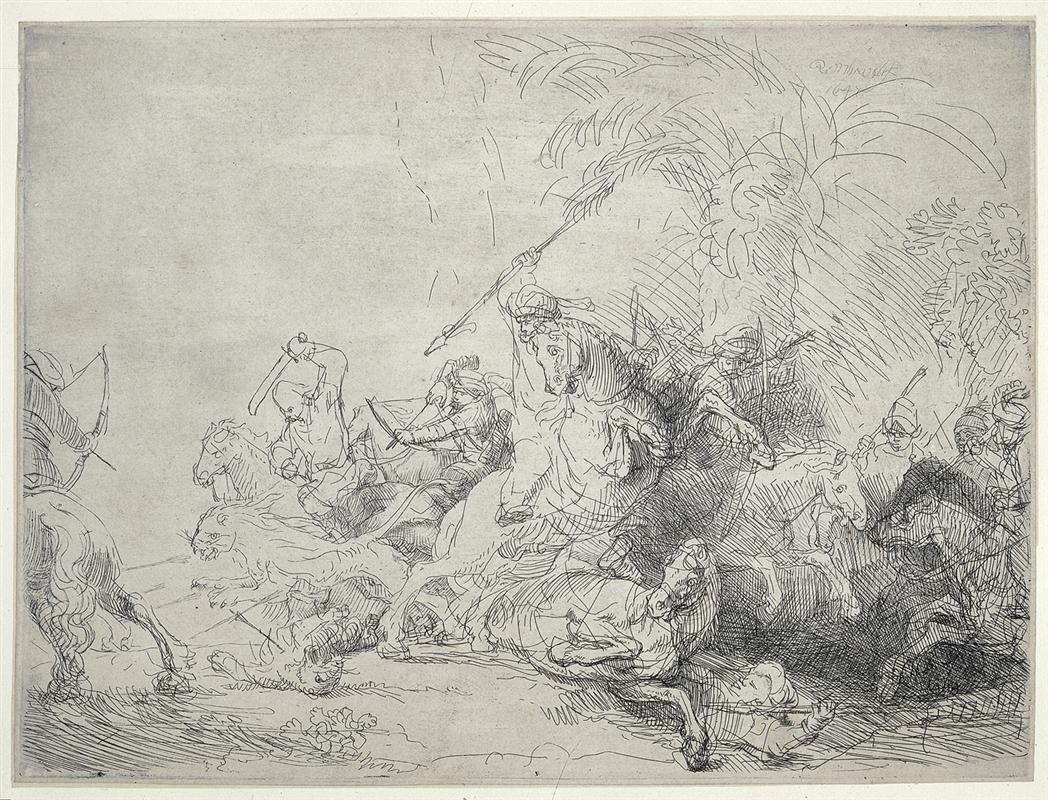
Rembrandt’s “The Large Lion Hunt” of 1641 is a whirlwind of bodies, hooves, blades, and manes compressed into a single sheet that feels as expansive as a battlefield. Rather than staging a ceremonious tableau, Rembrandt uses the medium of etching and drypoint to unleash raw velocity. Horses rear, riders twist, lions spring low and high, and the ground itself seems to tilt. The result is not just an image of combat; it is a study of how line can choreograph panic and courage at once. The print stands at the intersection of Dutch graphic subtlety and the grand baroque tradition of the hunt, and it reveals how Rembrandt could rival large oil paintings using only bitten copper and a fiercely intelligent sense of motion.
A Baroque Hunt Composed as a Storm Front
The composition drives from right to left like weather rolling across a plain. A dark wedge of crosshatching occupies the right margin where riders pour into the scene; from that pressure point, the entire mass explodes outward. At center, a horse pivots on its hind feet as its rider leans down with a curved saber, while beneath them a lion clutches a fallen man whose outflung arm rakes the ground. To the left, the charge continues in a lower key: an archer pulls his bow in counterpoint to the sabers, and a lion bounds forward with belly nearly grazing the earth. The eye never rests. Rembrandt’s diagonals—sabers, lances, legs, tails—crisscross to form a vibrating mesh that both ties the page together and keeps it on the brink of collapse. The hunt is less a narrative than a traveling storm of bodies.
Line as Kinetic Energy
Rembrandt’s etching line is elastic, various, and astonishingly purposeful. He switches from wiry outlines to feathery hatching and then to dense, almost woven passages that act like weights. The darkest area gathers under the foremost horse and the stricken figure, creating a gravitational sink that the other forms orbit. Everywhere else the lines stay open enough for paper to breathe through them, like air caught among limbs. Even cursory strokes—swift arabesques for palm fronds, shorthand loops for manes—carry directional force. The horses’ necks arc like drawn bows; the lions’ spines read as springs releasing stored energy. The print becomes a map of vectors.
Horses, Lions, and the Anatomy of Fear
Rembrandt was a relentless observer of animal and human movement, and here he treats the hunt as a physiological drama. The horses’ nostrils flare with minimal strokes; their forelegs splay in alarm, hooves skittering. Lions, in contrast, flow low and powerful, stomachs skimming the ground, tails acting as counterbalances. One lion takes down a horse at the right front; another lunges toward a tumbling rider; a third seems to spring from shadow. Human bodies mirror their mounts: a rider’s spine straightens into aggression, another curls defensively over his horse’s neck, a fallen man twists in an arc that repeats the curve of a lion’s tail. Fear and ferocity are not opposites here but two modes of the same kinetic grammar.
The Orchestration of Weapons
Sabers scythe through the air as the signature gesture of the composition. Their curved blades rhyme with the horses’ necks and the lions’ spines, binding predator and pursuer into a single calligraphic family. Spears appear only sparsely, while an archer at left extends a linear countertheme with his taut bowstring. The limited variety of weapons is deliberate: it keeps the page legible at speed. Each blade is also a directional arrow that steers the eye across the sheet, so the viewer rides the hunt rather than surveying it from above.
Space Without Horizon
There is almost no horizon line; landscape is reduced to a few nervous palm fronds and the vaguest notations of scrub. The absence of depth cues throws the fighters into a shallow arena where every body is close. This is a baroque stage without architecture, built to intensify impact. The palm fronds serve as a vertical screen against which motion reads clearly; their spare, repetitive marks also suggest wind, throwing the entire scene into a collective draft. What looks like emptiness at the top of the sheet is charged air, a void the charge is trying to fill and cannot.
Dialogue with the Tradition of Lion Hunts
The subject of the lion hunt had grand precedents in European art, not least the colossal canvases by Peter Paul Rubens. Rembrandt adopts that heroic genre but translates it into graphic immediacy. Where Rubens layers color, anatomy, and allegory, Rembrandt distills them into pure motion. He keeps the conceit of turbans and Near Eastern dress, acknowledging the period’s taste for “oriental” adventure, yet his interest is less exoticism than the universal physics of pursuit. The print does not preach triumph; it counts cost. Fallen figures are not incidental; they are compositional anchors. The heroism here is survival under pressure.
Light, Dark, and the Direction of Force
Even in monochrome, Rembrandt uses light and dark like a conductor uses dynamics. The right-hand mass of hatching functions as a forte, a loud entry of riders. As the eye travels leftward, the pressure softens into mezzo passages where individual actions are easier to read. Bright reserves of paper—especially beneath the central horse and along the lions’ flanks—become flashes of heat or dust. By shaping darks as directional wedges rather than clouds, Rembrandt creates the sensation of thrust, as though shadow itself were pushing bodies forward.
Drypoint Burr and the Texture of Violence
Rembrandt likely enlivened portions of the plate with drypoint, whose raised burr deposits velvety ink. Those velvet patches—seen in the darkest collisions at right and under the central fallen figures—give the violence a palpable nap. They read like friction. Smooth etched lines supply speed; burr supplies drag. The alternation mimics the tactile experience of battle: slashes through air interrupted by sudden resistance against muscle, hide, or ground.
The Viewer’s Entry and Ethical Distance
The archer at left, placed nearest the viewer and turned slightly away, serves as a proxy entrance. His pulled bow prepares a shot we are about to witness; we share his instant of aim. Yet Rembrandt also keeps us outside the circle of death. We are close enough to see the blade’s arc and the lion’s eye, not so close we must choose a side. That measured distance allows the sheet to function as a meditation on struggle rather than a trophy of conquest.
Rhythm, Repetition, and the Sense of Time
Repetition is the engine of the print’s rhythm. Curved blades recur, as do hooves lifted in pairs, as do heads turning in three-quarter profile. Each recurrence speeds reading. At the same time, difference prevents monotony: each horse’s curvature is individual, each rider’s grip shifts, each lion’s pounce varies. The result is cinematic. We sense frames before and after the one Rembrandt chose. The fallen at right must have been upright moments ago; the central horse will either recover its stance or go down in the next heartbeat. The etching locks a single tense second while allowing time’s current to roar through it.
Costume, Culture, and Amsterdam’s Global Eye
The turbaned riders and scimitars belong to a vocabulary of “Oriental” costume widely circulated in seventeenth-century Dutch art, informed by trade, travel accounts, and theater. Rembrandt uses these signs to place the hunt in an elsewhere, but he does so with a draftsman’s economy rather than a collector’s catalog. Costume is a rhythm of folds and edges that identifies status and motion; it does not dominate. The emphasis remains the anatomical inevitabilities of fear, attack, and weight.
The Ground as Instrument
Look closely at the ground: it is scarcely drawn, a few scalloped strokes where hooves dig in, a scatter of tufts, the suggestion of a bank. This restraint lets the ground act as a drumhead. Every step and fall seems to strike it, producing the visual equivalent of thuds and scrapes. Because the surface is minimally described, the viewer’s imagination supplies dust, stones, and skid. The print becomes sonorous in silence.
The Hunt as Allegory of Control and Chaos
Hunting scenes often symbolize dominion over nature. Rembrandt allows a more ambiguous reading. The hunters are numerous, well-armed, and mounted, yet chaos rules the foreground. For every poised saber there is a body tumbling; for every forward surge a stumble. The lions are not caricatured demons; they are astonishing athletes. In this balance of prowess and vulnerability, the print reads as an allegory of human attempts to impose order and the recurring truth that order is provisional. This is not a moral of despair, but of sobriety: force is never sovereign for long.
Comparison with Rembrandt’s Other Hunt Prints
Rembrandt returned to the theme in several formats, including smaller lion-hunt variations. “The Large Lion Hunt” stands out for its panoramic width and its orchestration of multiple episodes in a single sweep. The smaller prints often focus on one climactic grapple; here he composes an entire campaign compressed into seconds. It is as if he zoomed out just enough to include the logic of reinforcement and flank, yet kept close enough for viewers to feel warm breath and flying grit.
Lessons in Draftsmanship for Modern Eyes
For artists and designers, the sheet is a manual of how to draw motion without blur. Rembrandt does not smear contours; he stacks decisive lines that imply movement by implication rather than optical fuzz. He builds masses not by contour alone but by strong interior drawing—the saddles, bridles, and torsos are all animated from within, so when they twist, their insides twist with them. He manages a crowded field by graduating density: the darkest knit captures the point of crisis; surrounding zones stay airy. The effect is a legible maelstrom.
The Emotional Temperature
Despite the ferocity, the print’s temperature is more tragic than triumphant. The fallen do not scream with open mouths; they sprawl in shock. The victorious are too busy to exult. Even successful blows are drawn as work rather than spectacle. By refusing melodrama, Rembrandt raises the stakes. The viewer feels the cost of each action and senses how thin the line is between the mounted rider and the prone figure underfoot.
Why the Image Endures
The endurance of “The Large Lion Hunt” lies in the fusion of baroque excitement with ethical clarity. The sheet delivers speed without confusion, complexity without clutter, and grandeur without pomposity. It is thrilling because it is built from necessities—weight, line, direction, resistance—rather than ornament. And it is moving because it honors every actor in the conflict, human and animal alike, by drawing them with dignity and truth. The print does not ask us to celebrate a kill but to contemplate energy in its most heightened state, that instant where decision, chance, grace, and ruin cohabit a single breath.
Conclusion
In “The Large Lion Hunt,” Rembrandt proves that copper and ink can rival the most tumultuous painted epics. He composes a cavalcade as precise as it is explosive, harnessing line to describe impact, fear, valor, and the unstable pact between control and chaos. The sheet remains a masterclass in how to move an eye, stir a pulse, and leave a mind alert to the moral turbulence beneath bravura action. It is not merely a picture of hunters and lions; it is an essay on motion written in the alphabet of line.