Image source: wikiart.org
Claude Monet’s The Landing State and the Modern River Scene
Claude Monet’s The Landing State, painted in 1869, belongs to one of the most important moments in the artist’s early career. It shows a riverside leisure scene filled with boats, figures, reflections, foliage, and bright outdoor light. At first glance, the painting may look like a relaxed view of people enjoying a summer day near the water, but it is also a bold experiment in how modern life could be painted. Monet does not present the scene with polished academic finish. Instead, he builds it through fresh patches of color, broken brushwork, rapid contrasts, and a lively sense of atmosphere.
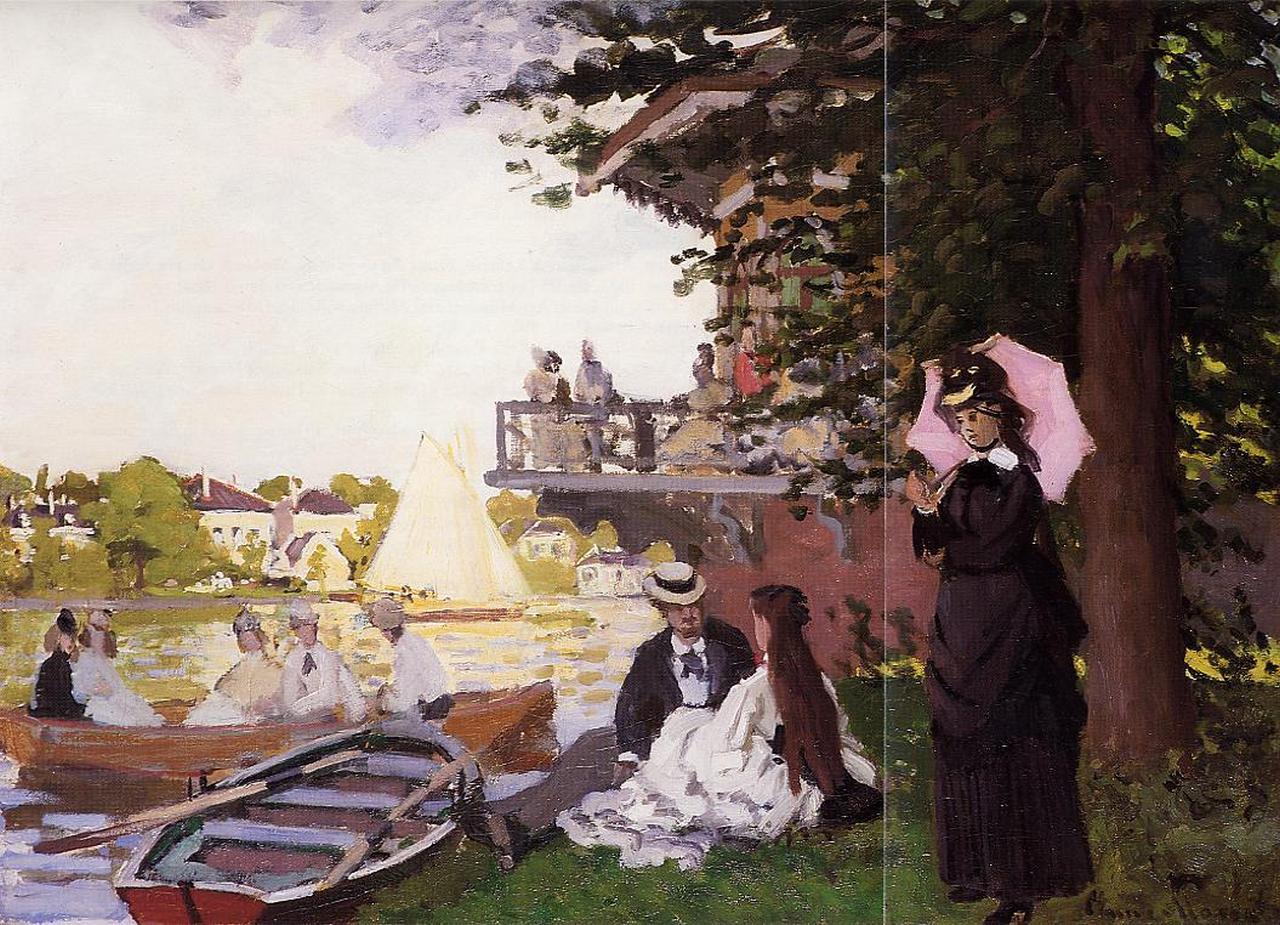
The painting captures a world of movement. Boats drift across the water, people gather on the bank, visitors sit and converse, and a woman holding a pink parasol stands near the shade of a large tree. The composition feels spontaneous, almost as though Monet had caught a passing moment before it dissolved. This quality is central to his development as an artist. In The Landing State, Monet is already moving toward the visual language that would later define Impressionism: attention to light, modern leisure, visible brushwork, and the fleeting effects of weather and reflection.
Painted in 1869, the work belongs to the same period as Monet’s famous scenes of La Grenouillère, the popular bathing and boating resort on the Seine. These subjects allowed Monet to explore the changing relationship between city life and nature. Parisian visitors could escape to riverside locations for rest, entertainment, and social display. Monet’s painting turns this modern leisure culture into a field of color and sensation, where people, boats, water, trees, and sunlight all become part of the same shimmering visual experience.
The Riverside Setting and the Culture of Leisure
The setting of The Landing State is essential to its meaning. Monet was deeply interested in places where modern life met the natural world. The riverbank, the small boats, the landing platform, and the social gathering all suggest a recreational space outside the crowded center of the city. This is not a remote wilderness. It is a cultivated leisure environment, shaped by travel, fashion, and middle class enjoyment.
The figures in the painting seem to belong to a world of relaxed sociability. Some sit in a boat, others gather on the bank, and more people appear on the elevated platform near the building. Their clothing signals urban refinement rather than rural labor. Men wear dark suits and hats. Women appear in light dresses, with one figure holding a striking pink parasol. These are not peasants, workers, or mythological characters. They are modern people enjoying a modern pastime.
This attention to ordinary leisure was one of Monet’s great innovations. Academic painting often favored historical, religious, or mythological subjects. Monet instead found beauty in contemporary experience. The simple act of arriving at a landing, resting beside the water, or watching boats pass became worthy of serious artistic treatment. The Landing State shows that modern life did not need dramatic storytelling to be visually compelling. Its appeal came from light, color, movement, and the quiet poetry of a passing afternoon.
The river also acts as a social stage. Boats bring people together, separate them into small groups, and create a sense of gentle motion across the image. The landing platform in the background suggests a place of arrival and departure, where visitors move between land and water. This creates a subtle rhythm of transition. The painting is not only about leisure, but about the pleasure of being between places, between city and countryside, between activity and rest.
Composition and the Balance of Light and Shade
The composition of The Landing State is carefully organized, even though it feels immediate and informal. Monet divides the scene between open brightness on the left and deep shade on the right. The left side of the painting opens toward the river, sky, distant houses, and the bright sailboat. The right side is darker, framed by a large tree, dense foliage, and the standing woman with the pink parasol. This contrast gives the painting much of its visual power.
The bright sail near the center-left acts as a glowing focal point. Its pale triangular shape catches the eye and reflects the sunlit atmosphere of the river. Around it, Monet places smaller notes of color: the distant houses, green trees, rippling water, and figures in the boat. These forms are not sharply outlined, but they are placed with enough clarity to create depth and balance.
The right side creates an opposing mood. The standing woman is almost absorbed into the shade, her dark dress blending with the tree and greenery behind her. Yet the pink parasol cuts through the darkness with a surprising burst of color. It is one of the most memorable details in the painting. Monet uses it not simply as an accessory, but as a compositional device. The parasol creates contrast, adds elegance, and links the shaded foreground to the brighter world of leisure beyond.
The foreground boats also help structure the image. The empty boat at the lower left pulls the viewer into the scene, while the boat filled with figures extends across the water. These curved wooden forms create a low horizontal rhythm that balances the vertical tree and standing woman on the right. The seated couple on the grass forms another intimate grouping, placed between the water and the shaded bank. Monet uses these overlapping zones to create a scene that feels full but not chaotic.
Monet’s Brushwork and the Impression of a Moment
One of the most striking features of The Landing State is the looseness of Monet’s brushwork. The painting does not try to hide the act of painting. Instead, brushstrokes remain visible, especially in the water, foliage, clothing, and sky. This gives the image a sense of speed and freshness. Monet seems less interested in exact detail than in the total impression produced by light and color.
The figures are suggested rather than fully described. Faces are simplified, bodies are built with broad strokes, and clothing is indicated through contrasts of dark and light. This approach may appear casual, but it is highly controlled. Monet gives just enough information for the viewer to understand the scene, then lets the eye complete the rest. This active role for the viewer would become one of the defining pleasures of Impressionist painting.
The water is especially important. Monet paints it with broken strokes of pale blue, lavender, green, yellow, and white. These colors do not simply describe the river’s surface. They capture reflected light, motion, and atmosphere. The water appears alive because it is not painted as a flat mirror. It flickers, shifts, and breaks apart under the influence of boats, sunlight, and reflected foliage.
The trees and foliage are handled with similar freedom. Instead of painting every leaf, Monet uses patches of dark green, brown, yellow, and black to create density and shade. In the upper right, the foliage becomes almost abstract, forming a textured mass that frames the scene. This contrast between dark vegetation and bright open air gives the painting its strong atmospheric depth.
The Pink Parasol as a Visual Accent
The woman with the pink parasol is one of the most important figures in the painting. She stands at the far right, partly hidden in the shade, yet her parasol immediately attracts attention. Its soft pink color contrasts with the surrounding dark greens and browns, making it appear luminous. Monet often used parasols in his outdoor scenes because they allowed him to explore color, fashion, and the effects of filtered light.
The parasol also introduces a note of modern elegance. It belongs to the world of fashionable leisure, where clothing and accessories were part of public display. The woman’s presence suggests that this riverside setting is not merely natural, but social. People come here to see and be seen, to stroll, converse, and enjoy the refined pleasures of the outdoors.
Her dark dress creates a strong vertical shape beside the tree. This gives the right edge of the composition a sense of stability. At the same time, the parasol opens outward like a flower, softening the darkness around it. The result is a beautiful tension between solidity and delicacy. The woman is both part of the shadow and separate from it.
This detail also shows Monet’s sensitivity to color relationships. The pink parasol is not isolated. Its tone echoes faint touches of warmth elsewhere in the painting, including the reddish wall, the brown boats, and small accents among the figures. These quiet repetitions help unify the image. The parasol may seem like a spontaneous touch, but it is deeply integrated into the painting’s color structure.
The Boats and the Language of Movement
Boats play a central role in The Landing State. They are not only objects in the scene, but symbols of leisure, mobility, and modern recreation. The river becomes a place where people can move freely, drifting away from the pressures of urban life. The boats also allow Monet to explore reflections, curves, and shifting perspectives.
The empty boat in the foreground is particularly effective. Its shape is cropped by the lower edge of the painting, making the viewer feel close to the riverbank. The boat is not presented as a carefully finished object. Its wooden structure is described through quick strokes of brown, black, blue, and reddish tones. This loose handling gives it immediacy, as though it has just been pulled up beside the viewer.
The occupied boat on the left adds narrative life. The people inside it appear relaxed and sociable. Their forms are lightly painted, with pale clothing catching the light. The boat creates a horizontal movement across the water, guiding the eye toward the glowing sail and distant bank. It also contrasts with the seated figures on land, suggesting different ways of enjoying the same riverside environment.
The sailboat in the distance adds another kind of movement. Its bright triangular sail rises in the middle of the painting, catching sunlight and creating a sense of openness. It pulls the scene beyond the immediate foreground, suggesting that the river continues outside the frame. This expansion of space is important. The painting feels like one glimpse of a larger, active world.
Light, Reflection, and Atmosphere
Light is the true subject of The Landing State. Although the painting contains figures, boats, buildings, and trees, everything is organized around the experience of outdoor illumination. Monet observes how sunlight transforms surfaces, how shade deepens color, and how reflections dissolve solid forms.
The left side of the painting is filled with pale light. The sky is broad and luminous, painted with soft whites and faint purples. The distant houses appear bright and simplified, their forms softened by atmosphere. The river catches this brightness and breaks it into shimmering strokes. The result is a feeling of warm, open air.
The right side, by contrast, is dense and shadowed. The tree trunk, foliage, and woman’s dress create a deep tonal mass. Yet Monet does not paint shadow as simply black. He fills it with greens, browns, violets, and muted reds. This was one of the lessons that would become central to Impressionism: shadows are full of color. They are affected by surrounding light, reflected surfaces, and the atmosphere itself.
The painting’s brilliance comes from the meeting of these zones. Bright water and dark foliage, pale dresses and black suits, pink parasol and green shade, white sail and brown boats all interact across the canvas. Monet is not merely arranging objects. He is arranging sensations. The viewer feels the day through color relationships.
The Human Figures and Social Observation
The figures in The Landing State are not individualized portraits. Monet does not invite us to study their personalities in detail. Instead, he presents them as part of a larger social and visual environment. Their gestures, clothing, and placement matter more than their facial expressions.
This approach reflects Monet’s modernity. In many earlier paintings, figures served as heroes, saints, allegorical characters, or moral examples. Here, they are ordinary visitors. Their importance lies in how they inhabit the scene. They sit, stand, row, converse, and look outward. Their leisure becomes the painting’s quiet subject.
The seated couple on the grass creates an intimate center in the lower right. The woman in white, seen from behind, is especially luminous against the darker ground. Her long reddish hair or dark auburn tones add warmth to the composition. The man beside her, dressed in black and white, creates a strong contrast. Together, they form a calm grouping that balances the busier boat and platform.
The people on the elevated landing appear as small, lively shapes. Monet does not describe them individually, but they add energy and depth. They suggest conversation, gathering, and the bustle of a popular riverside destination. Their presence also gives meaning to the title. The landing is not empty. It is a place of exchange, rest, arrival, and observation.
The Influence of Early Impressionism
The Landing State is important because it shows Monet on the edge of Impressionism before the movement had fully taken public shape. The first Impressionist exhibition would not occur until 1874, but many of the movement’s essential ideas are already visible here. Monet is painting modern life outdoors, using broken brushwork, bright color, and a focus on immediate perception.
The painting rejects the smooth finish expected by academic tradition. Instead of carefully blended surfaces, Monet offers visible marks. Instead of historical drama, he chooses everyday recreation. Instead of idealized nature, he paints a specific modern environment shaped by leisure and social life. These choices helped redefine what painting could be.
At the same time, the work still has a strong compositional structure. Monet was not simply painting randomly. The scene is balanced through light and dark, vertical and horizontal, open water and enclosed shade. This combination of spontaneity and design is one of the reasons Monet’s early outdoor scenes remain so compelling.
The painting also shows Monet’s growing interest in series thinking, even before his famous later series of haystacks, poplars, Rouen Cathedral, and water lilies. Around 1869, he was repeatedly exploring riverside subjects, boats, reflections, and leisure resorts. Each painting became a way to test how light changed the visible world. The Landing State belongs to this larger investigation.
Color Harmony and Visual Rhythm
The color harmony of The Landing State is subtle but powerful. Monet uses a range of greens, browns, whites, pinks, yellows, and pale blues to create a lively but unified scene. The painting’s surface feels varied because each area has its own color mood, yet the whole image remains balanced.
The greens of the trees and grass dominate the right and lower areas. These greens are not uniform. Some are deep and almost black, while others are touched with yellow light. The brown of the tree trunk and boats adds warmth and earthiness. The pale clothing of the figures and the white sail create flashes of brightness that keep the painting from becoming too heavy.
The pink parasol is the boldest color accent. It stands apart from the natural greens and browns, reminding the viewer of fashion, human presence, and modern taste. Yet it does not feel artificial in a negative way. Instead, it becomes part of the painting’s rhythm, like a bright note in music.
The water unifies many of these colors through reflection. It contains pale blues, whites, yellows, purples, and greens, bringing together sky, sail, trees, and sunlight. This reflective surface allows Monet to dissolve the boundaries between different parts of the scene. The world above and the world below seem to mingle in the river.
The Painting as a Scene of Modern Escape
One reason The Landing State remains appealing is that it captures the dream of escape without leaving modern life behind. The people in the painting are not isolated in untouched nature. They are enjoying a cultivated riverside space made accessible by modern transportation, leisure habits, and urban culture. This makes the painting both peaceful and socially modern.
The scene suggests a temporary retreat. Visitors have come to the river to relax, but their clothing and behavior still connect them to the city. The men’s suits, women’s dresses, parasols, and gathering places all show that leisure itself has become a social performance. Monet captures this without criticism. He observes the beauty of the moment, allowing the viewer to enjoy its elegance and freshness.
This quality gives the painting a gentle ambiguity. It is both natural and artificial, spontaneous and arranged, intimate and public. The riverbank offers rest, but it is also crowded with people. The shade offers privacy, but the figures remain visible. The boats suggest freedom, but they also belong to a fashionable recreational culture.
Monet’s genius lies in making these tensions feel effortless. He does not explain the scene. He lets it unfold through color and light. The viewer senses the warmth of the day, the murmur of conversation, the movement of water, and the pleasure of being outdoors.
Why The Landing State Matters in Monet’s Career
The Landing State matters because it shows Monet developing the artistic ideas that would define his mature work. The painting is not just an attractive riverside scene. It is a turning point in how he understood vision. Rather than treating the world as a collection of fixed objects, Monet treats it as a field of changing effects.
The painting anticipates his later dedication to atmosphere. In his mature works, Monet would return again and again to the same motifs under different light conditions. Here, he is already fascinated by the way light alters everything it touches. The sail is not just a sail, but a shape of brightness. The water is not just water, but a surface of reflections. The shade is not just darkness, but colored atmosphere.
The work also shows Monet’s confidence in unfinished looking surfaces. What might have seemed sketchy to traditional viewers now appears modern and alive. The looseness of the brushwork gives the scene its vitality. It allows the painting to breathe. The eye moves across the canvas quickly, just as it might move across a real outdoor scene.
For anyone studying Claude Monet’s early paintings, The Landing State offers a valuable example of his transition from Realist observation toward Impressionist sensation. It combines recognizable subject matter with a new freedom of handling. It shows a painter learning how to make the act of seeing itself the center of art.
Conclusion
Claude Monet’s The Landing State is a radiant example of his early modern vision. Painted in 1869, it captures a riverside world of boats, leisure, conversation, fashion, sunlight, and shade. The painting is filled with social detail, but its deepest subject is visual experience. Monet transforms an ordinary afternoon by the water into a study of color, atmosphere, and movement.
The composition balances open brightness with dense shadow, using the river, boats, figures, tree, and pink parasol to create a lively yet harmonious scene. Every part of the painting contributes to its sense of immediacy. The brushwork is loose, the reflections are broken, and the figures are suggested rather than fully defined. This gives the work its freshness and places it firmly within the early development of Impressionism.
What makes The Landing State so memorable is its ability to preserve a fleeting moment without freezing it. The painting feels alive because it accepts change. Water ripples, light shifts, people move, and color vibrates across the surface. Monet does not impose a heavy narrative. He allows the viewer to enter the scene through sensation.
As an early Monet painting, The Landing State reveals the artist’s growing commitment to modern life and outdoor perception. It shows how a simple riverside landing could become a complete world of visual poetry. In its glowing sail, shaded figures, lively boats, and unforgettable pink parasol, the painting offers a beautiful glimpse of Monet’s path toward the revolutionary language of Impressionism.