Image source: wikiart.org
A Night of Grief Made Visible
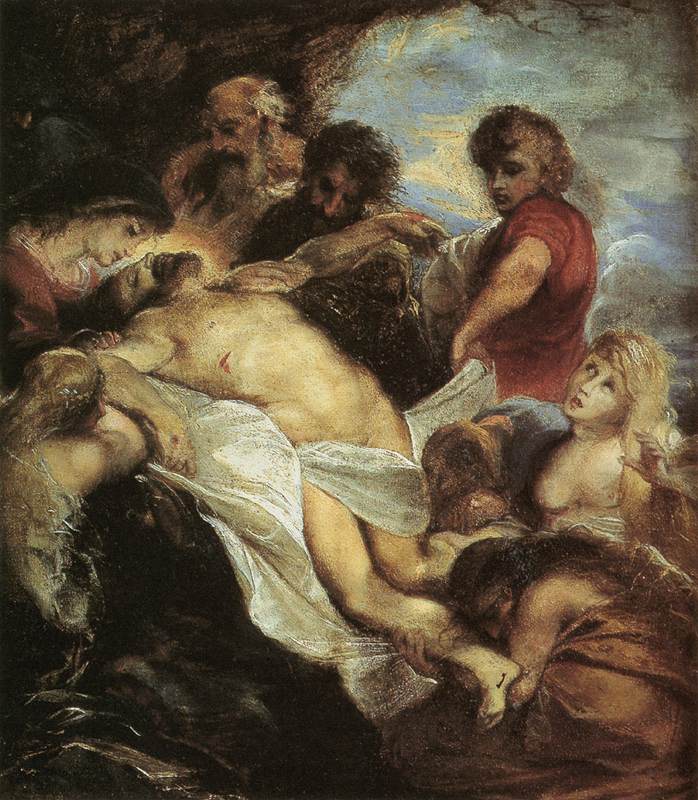
Peter Paul Rubens’s “The Lamentation” (1606) compresses the sorrow of the Passion into a single breathing tableau. The dead Christ lies diagonally across the foreground, his body half-wrapped in a white shroud that catches every shard of light; around him crowd mourners—Mary, the Magdalene, Saint John, and pious attendants—each registering grief with a different intensity. The scene is not theatrical; it feels immediate, as if the viewer has stepped into the cave of mourning while the last light of evening washes over bruised flesh and tear-streaked faces. Painted during Rubens’s Italian period, the picture fuses Venetian color with Roman gravity and a Northern candor about bodies and touch. It is a study in lamentation as both theology and human fact.
Historical Moment And Devotional Purpose
Dated to 1606, the work belongs to the years when Rubens lived between Mantua, Rome, and Genoa. He had studied the antique, absorbed the Carracci reform, and fallen in love with the Venetian way of letting color and atmosphere carry emotion. In this climate, a Lamentation was not only a subject; it was a devotional tool. Churches commissioned such scenes to gather collective sorrow and to teach believers how to stand near the mystery of death with disciplined feeling. Rubens paints a picture made for prayer—close, dark, and warm—designed to be read at altar distance and to reward nearness with tactile detail.
Composition That Draws The Body Toward The Heart
The composition pivots on the body of Christ set along a powerful diagonal from lower left to upper right. That slanted axis performs two tasks at once: it creates forward thrust that pulls the viewer into the scene, and it provides a stable armature upon which grief can hang. Figures flank the line—Mary at the head, the Magdalene at the feet, John and other mourners massed behind—forming a dark wreath around the pale center. Rubens pushes everyone close to the picture plane. No architecture or landscape dilutes the intensity. The cave-like darkness frames flesh and cloth so the eye can find the essential drama without distraction.
Light As Consolation And Verdict
Illumination is the painting’s theology. A soft, cool light comes from the right, feathers across the shroud, flashes on the wound in Christ’s side, grazes hair and cheek, then dissolves into the brown air of the grotto. It is not a supernatural beam tearing the sky; it is human-scaled light that might belong to late afternoon or a lamp set just out of view. This choice makes consolation believable. The same light that picks out sacred wounds also blesses hands and faces, suggesting that grace touches grief precisely at the level where we can feel it.
The Body Of Christ As The Center Of Meaning
Rubens paints the corpse with both dignity and painful truth. Shoulders relax into gravity; the right arm falls open; the ribcage rises and falls in cold whites and pearl grays; the abdomen softens; the knees turn outward in a posture of complete surrender. The wound in the side is small but decisive, a red punctuation mark in a sentence of pale tones. Muscles are modeled with wet-in-wet transitions that make the flesh read as still warm to the touch. The shroud’s cool fabric lies against the skin in sharp creases, confirming death without denying tenderness. This is not a rhetorical body. It is a son, a friend, a savior whose weight the living must carry.
Mary, Mother Of God, As The Gravity In The Room
The Virgin presses her face toward Christ’s head, eyes closed, mouth softened by immense fatigue. She is no actor. Rubens gives her the human truth of a woman emptied by loss yet still anchored by consent. Her hands, partly hidden, suggest that she has helped to hold and lower the body. The painter keeps her costume understated so that maternal presence, not Marian pageantry, leads. A faint glimmer of light along her veil turns it into a halo without gold—humility made luminous.
The Magdalene And The Language Of Touch
At the lower right, the Magdalene clutches Christ’s feet with a grief that is both personal and emblematic. In many Passion cycles, she weeps on the feet she once anointed; here that symbolism returns as raw need. Her hands press the heels with desperate care, fingers curling as if to warm them. Her gaze lifts, pleading and stunned. The reddish garment she wears echoes an inner fire that cannot find outlet except in touch. Rubens uses her figure to teach a lesson about piety: true devotion involves the body, and in grief the body knows what to do—hold, anoint, and not let go.
Saint John And The Weight Of Witness
Behind Christ’s chest stands John, identifiable by youthful features and the red garment thrown over his shoulder. He leans forward, one hand hovering as if to examine the wound or to help secure the shroud, the other perhaps bracing a companion. His attention is exact and practical. John is an emblem of faithful witness, and Rubens paints the mental work of witnessing—measuring, remembering, staying—with rare sympathy. In this press of sorrow, John keeps action moving: he will help carry the body; he will remember what he has seen.
The Supporting Cast And A Chorus Of Expressions
An older bearded figure, one of the holy men who aided the burial, bends close; another attendant’s face is half-lost in shadow; a young woman at far right turns outward with an imploring glance that invites the viewer in. Rubens avoids uniform emotion. Instead he orchestrates a spectrum—exhaustion, stunned silence, active compassion, incredulity. The variety produces credibility. Real grief is not symmetrical; it ricochets among companions, each absorbing a different share.
Color That Breathes Sorrow
The palette is anchored in earths: umbers, warm blacks, olive browns, and blood-warmed reds. Against this ground the shroud’s whites blaze, but not like cold marble; they glow with creamy warmth, complicating sorrow with tenderness. Flesh tones range from the cadaverous cool of Christ’s torso to the rosier flush of the living, an unspoken theology of life and death set side by side. Occasional notes of blue-gray in the upper right open a throat of air that hints at sky beyond the tomb. The color world is sober but not monochrome; it is chastened, as befits the subject.
Texture And The Tactility Of Faith
Rubens makes grief tactile through surface. The shroud is crisp and weighty; hair clumps damply; skin carries a humid bloom; the cave’s rock face is scrubbed, granular, and cold. These material differences are not decorative. They invite the viewer to imagine touch—how linen would rasp against a callused hand, how a forehead would meet cold skin, how rough stone would scrape a knee if one knelt fast. Baroque devotion involved the senses; Rubens supplies them with convincing objects.
Space Compressed For Intimacy
There is almost no “background.” The figures fill the rectangle so completely that the viewer stands within their circle. A patch of light at the upper right hints at an opening—perhaps the mouth of the cave—through which air and hope might pass. But the overall effect is nearness. You are not looking at a distant tableau; you are holding the other end of the cloth. That compression is pastoral: it makes contemplation participatory.
Brushwork That Feels Like Breathing
Seen up close, the painting moves. Rubens lays in shadows with broad, elastic strokes that ride the swell of a shoulder or the swell of drapery; he flicks small, sharp lights onto tears, knuckles, and fabric edges; he drags a dry brush across mid-tones to suggest the nap of hair or the roughness of stone. The energy of the hand keeps the death from feeling frozen. Even stillness vibrates with the living painterly act, a visual parallel to the heartbeat of those who grieve.
Influences, Sources, And Synthesis
The composition recalls Venetian lamentations—Titian’s smoky light and Veronese’s warm flesh—while the torsion of bodies nods to Roman and Florentine models, especially the muscular clarity of the Carracci. Rubens blends these into a Northern ethic of truthfulness about flesh and sorrow. He refuses the hammered polish that can make altarpieces remote. Instead he offers a sorrow one can share. The synthesis announces the language he would use in his monumental Antwerp works: Venetian warmth, Roman structure, Flemish touch.
Iconography And Theological Depth
The scene is not only documentary; it is symbolic. The white shroud prefigures the baptismal garment of the Church; the wound, small and centrally visible, becomes a font from which grace is imagined to flow; Mary’s proximity hints at the new Eve standing where the new Adam lies. The Magdalene’s embrace of the feet mirrors the faithful soul clinging to the foundation of the Church. Yet Rubens keeps symbols under the skin of realism. They enrich rather than interrupt.
The Viewer’s Path Through The Image
Rubens designs a prayer for the eye. You begin with the white shroud; your gaze slides to the wound, then to the tilted head at left where Mary kisses the brow; from there you climb the arms to John’s tense shoulders; you drop along the diagonal to the feet, where the Magdalene’s hands and hair entangle; finally you spiral outward along the ring of mourners and back to the pale center. Each circuit yields a new fragment—an elder’s furrow, a tear-brightened eyelid, a crease in linen—that keeps meditation fresh.
Emotion Without Manipulation
Baroque art can tilt toward spectacle. Here Rubens chooses restraint. The grief is intense but not operatic; gestures are compressed, not flung open; tears glisten but do not gush. That discipline makes the pathos durable. You are moved because you recognize human grief precisely portrayed, not because you are pushed by theatrical tricks. The painting trusts the viewer’s heart to respond to what is true.
Function In A Chapel Setting
Hung near an altar, this Lamentation would have accompanied the Eucharist with visual catechesis. The white cloth echoes the altar linen; the body presented for burial rhymes with the Host raised for communion; the circle of mourners corresponds to the gathered congregation. Rubens thus turns a wall into a mirror in which worshipers see their own gestures translated into sacred history: lifting, holding, grieving, hoping.
Legacy Within Rubens’s Oeuvre
This early experiment anticipates the majesty of later entombments and descents from the cross. The diagonal body; the ring of mourners; the illuminated linen against a dark ground; the humane psychology—these motifs recur in grander scale, but their emotional DNA is present here. “The Lamentation” reveals a young master already confident that sympathy, not spectacle alone, makes sacred narrative unforgettable.
Conclusion: When Paint Learns To Suffer With
“The Lamentation” is grief taught by paint. Rubens lets light, color, texture, and gesture carry what words fail to say: that love remains active when breath has gone; that the body, even cold, is worthy of tenderness; that community forms in the space sorrow opens. The scene persuades because it looks like us at our most faithful—helping, holding, and refusing to abandon the beloved. In the hush of this cave, the painter shows how lamentation becomes a kind of prayer that the eye can say.