Image source: wikiart.org
Entering the moment of temptation and rupture
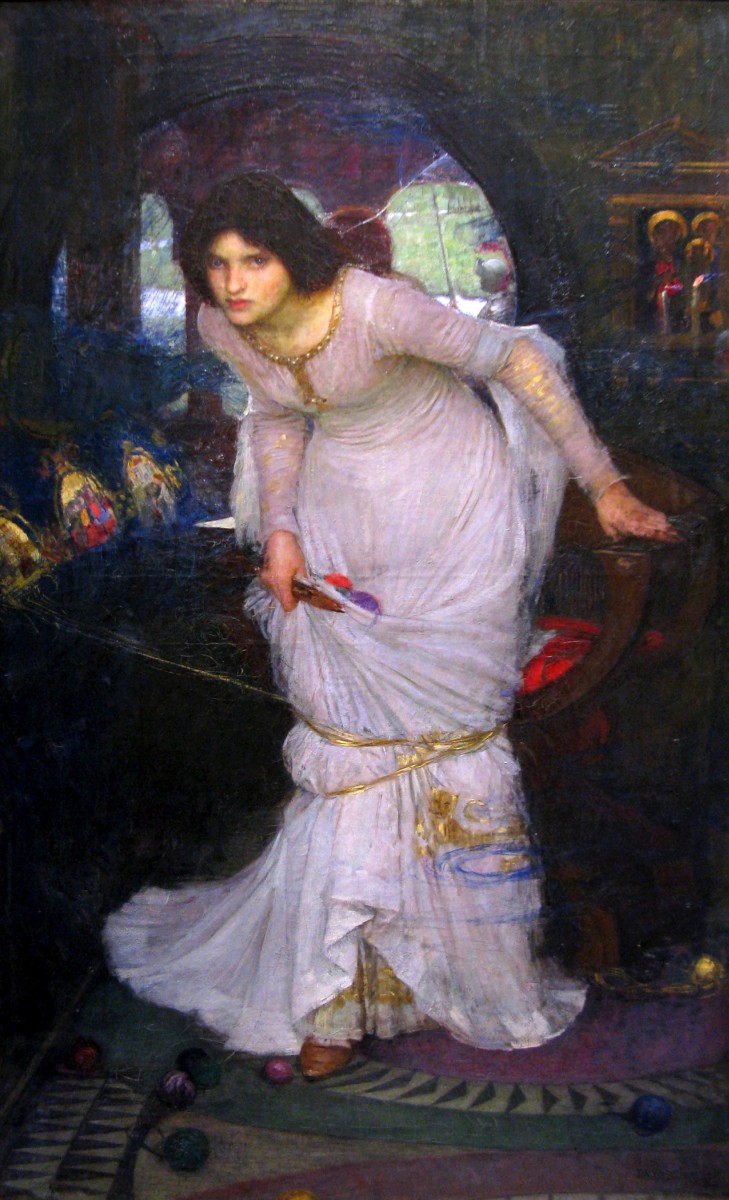
In The Lady of Shalott Looking at Lancelot (1894), John William Waterhouse chooses the single heartbeat in the legend when private devotion collides with public desire. The Lady is not yet drifting toward Camelot, not yet a tragic emblem on a river. She is still inside her confined world, caught mid movement, as if the painting has interrupted her at the exact instant she dares to look directly at what she has only been allowed to translate into art. Waterhouse builds the scene around that forbidden pivot. Everything in the room feels arranged for stillness and routine, yet her body and the tense diagonal lines of thread insist that the order has been broken.
The drama here is not loud. It is concentrated, internal, and physical. The Lady leans forward from a dark interior into a brighter circle of air and daylight, like someone stepping across a boundary that cannot be crossed safely. Waterhouse makes you feel how small the distance is between obedience and catastrophe. That is the painting’s core suspense: one glance, one shift of attention, and the whole carefully maintained system begins to unravel.
The Arthurian story behind the image
The subject comes from the Arthurian world popularized for Victorian audiences by Alfred, Lord Tennyson’s poem The Lady of Shalott. The Lady lives under a mysterious curse in a tower near Camelot. She cannot look directly at the world outside. Instead, she experiences life indirectly, through reflections, and spends her days weaving what she sees into a tapestry. The curse is both supernatural and symbolic: it enforces distance, mediation, and isolation. Her art becomes the only permitted way to engage with reality.
Then Sir Lancelot rides by, brilliant and immediate, and the Lady turns to see him for herself. The story’s punishment is instant. The woven work and the apparatus of her protected life are disrupted, and she is pushed toward the fatal journey that ends with her boat gliding into Camelot. Waterhouse paints the turning point rather than the conclusion, which makes this version feel psychologically sharp. Instead of elegy, we get the charged instant when longing overrides fear.
Composition and the architecture of confinement
Waterhouse stages the scene as a confrontation between enclosure and openness. The Lady is framed by darkness, with the room around her reading as heavy, shadowed, and almost cavernous. Then a circular opening behind her introduces a contrasting zone: cool daylight and hints of landscape. That circle functions like a visual magnet. Even if you did not know the story, you would sense that the outside world is calling her, and that the call is dangerous.
The composition is built from diagonals that imply sudden motion. Her torso angles forward, her arm braces against the loom, and the threads slice across the picture plane like taut wires. These lines do not merely describe weaving. They signal tension, as if the room itself has become a trap tightening around her. Waterhouse uses the loom’s curve and the arc of the opening behind her to create a sense of circular fate: a closed system that she has tried to live inside, and is now breaking.
The Lady as a figure of divided will
Waterhouse’s Lady is not idealized into calm tragedy. She looks alert, intense, and almost startled by her own choice. Her forward lean suggests urgency, but also hesitation, as if she is testing the limits of the curse before fully committing to the act of seeing. Her expression carries concentration and hunger at once. It is not dreamy romance. It is the face of someone who has been starved of direct experience and suddenly cannot resist.
The dress reinforces this psychology. Its pale fabric catches what little light exists in the room, making her body the brightest element in an otherwise dim space. She becomes a flare of presence inside a controlled interior. At the same time, the garment’s flowing length and softness make her look vulnerable, exposed, and unarmored. Against the mechanical purpose of the loom and the strictness of the curse, she appears human in the most fragile way: moved by attraction, curiosity, and the need to be part of life rather than merely record it.
The loom, the threads, and the symbolism of making
The loom dominates the narrative even when it recedes into shadow. It represents labor, routine, and the disciplined conversion of life into pattern. In the legend, the Lady’s weaving is both occupation and prison. It is the permitted channel for desire, because it turns longing into image rather than action. Waterhouse makes the weaving apparatus feel almost alive in its pressure. The threads stretch across the scene in multiple directions, and their visibility is crucial. They are not hidden craft. They are the very structure of her confinement.
Her hand holds a weaving tool with colored strands, a small detail that anchors the myth in tactile reality. The bright reds and purples near her hand become an accent of temptation. They also suggest that her artistic world, though limited, has contained intense color and emotion. Now that emotion has slipped its bounds. The scattered balls of yarn on the floor strengthen the sense of disruption. Craft materials that should be orderly are loose, rolling, displaced. The curse is not only a punishment from outside. It is mirrored by the visible breakdown of the system that has kept her safe.
Light, color, and the emotional temperature of the scene
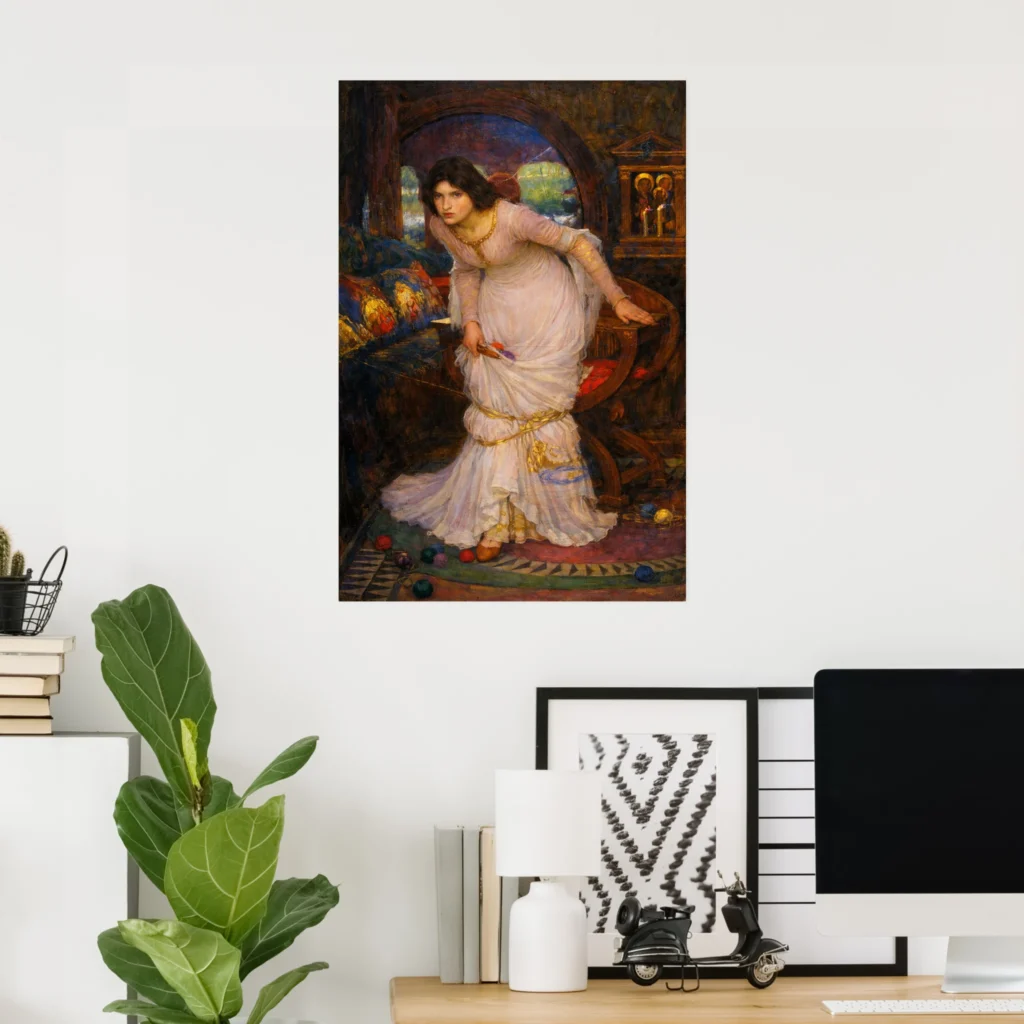
Waterhouse creates a restrained palette that makes each color decision feel meaningful. The room is built from deep blues, smoky blacks, and muted browns. These tones do not simply describe a shadowy interior. They set an emotional temperature: quiet, sealed, and heavy. Against that, the Lady’s pale dress reads like moonlight caught in fabric, and the daylight through the opening behind her introduces a cooler, fresher note that feels like freedom.
Small bursts of saturated color are placed like sparks. The reds near the loom and in the threads hint at passion and danger. The colored yarn balls scattered along the patterned floor act like dropped punctuation marks. They tell you the calm of ordinary weaving has been interrupted. Waterhouse also uses gold accents in her jewelry and garment details to suggest value and sacredness, as though her life has been precious and protected, even if that protection has become a cage.
Patterned surfaces and the Victorian love of detail
One of the pleasures of Waterhouse’s Arthurian paintings is the way decorative detail becomes narrative. Here, patterns are never merely ornamental. The floor’s geometric design suggests a planned world, a measured environment built around repetition and rule. This orderly ground contrasts with the loose yarn balls that disrupt it, like disorder intruding on a system that cannot adapt.
In the shadows, glimpses of imagery and objects suggest a layered interior life. The space feels inhabited by symbols, memories, and reverent pictures, implying that the Lady’s isolation has been filled with substitutes for real contact: art, devotion, story, and the disciplined beauty of making. This is a Victorian mood expressed through medieval costume and legend: the belief that a room can become a moral universe, and that objects can carry the weight of emotion and fate.
The gaze and the ethics of looking
This painting is fundamentally about the act of looking. In the legend, looking directly is forbidden, but the prohibition is also psychological. It sets up a division between representation and experience. The Lady can weave the world, but cannot live it. Waterhouse shows how unstable that arrangement is. The desire to see is not a minor curiosity. It is a claim to reality.
The Lady’s posture implies she is moving toward direct vision with full awareness of risk. Her gaze is focused outward, past the edge of the frame, toward the figure of Lancelot who is implied rather than fully presented. That choice matters. By withholding a clear view of Lancelot, Waterhouse keeps the emphasis on her transformation rather than his glamour. The true spectacle is the moment a constrained life chooses immediacy. The painting asks a quiet question: what is the cost of stepping out of mediation, and is the cost worth paying?
Fate, agency, and the tragedy built into the scene
Because Waterhouse paints the threshold moment, the scene holds two truths at once. The Lady is acting with agency. She chooses to look. Yet the story tells us that her choice triggers a chain she cannot stop. Waterhouse visualizes that paradox through physical tension. The threads are still attached, still stretched, but they feel as if they are already snapping in consequence. The room is still her shelter, yet it is already turning into the site of downfall.
That is why the painting reads as both romantic and unsettling. It honors the intensity of desire, but it also treats desire as a force that exposes the fragility of systems built on denial. The tragedy is not simply that she is punished. The tragedy is that her fullest human impulse, the need to see and be seen, is incompatible with the conditions of her existence. Waterhouse makes that incompatibility visible in every tugging line and every shadowed corner.
Waterhouse, the Pre-Raphaelite legacy, and 1890s mood
Although Waterhouse worked after the original Pre-Raphaelite movement, he absorbed its love of literary subjects, bright precision in key details, and fascination with women as carriers of myth and psychological intensity. In the 1890s, these themes took on a particular edge. Victorian culture was deeply interested in desire, restraint, and the consequences of transgression. The Lady of Shalott becomes a perfect vessel for that tension: a woman defined by rules and watched by fate, who nevertheless claims a moment of direct experience.
Waterhouse also brings a painterly softness that differs from the harder clarity of earlier Pre-Raphaelite technique. In this image, the atmosphere feels slightly veiled, as though the scene is suspended between reality and dream. That haze suits the legend, because the Lady’s life is already half removed from the real world. The moment she looks outward, she steps from a filtered existence into something sharper, brighter, and more dangerous.
Why this image still holds attention
This version of The Lady of Shalott continues to resonate because it dramatizes a conflict that feels modern: the difference between watching life and living it. The Lady’s weaving can be read as art, duty, or even a metaphor for mediated experience, a life of reflection rather than contact. Her glance toward Lancelot becomes the moment of rupture when a person refuses to remain an observer of their own desires.
Waterhouse does not treat her as a moral lesson or a simple victim. He paints her as intensely alive at the exact instant she becomes vulnerable. That blend of beauty and impending catastrophe is why viewers return to the painting. It captures the emotional realism of temptation: the way a single moment can feel both like liberation and like the beginning of irreversible loss.