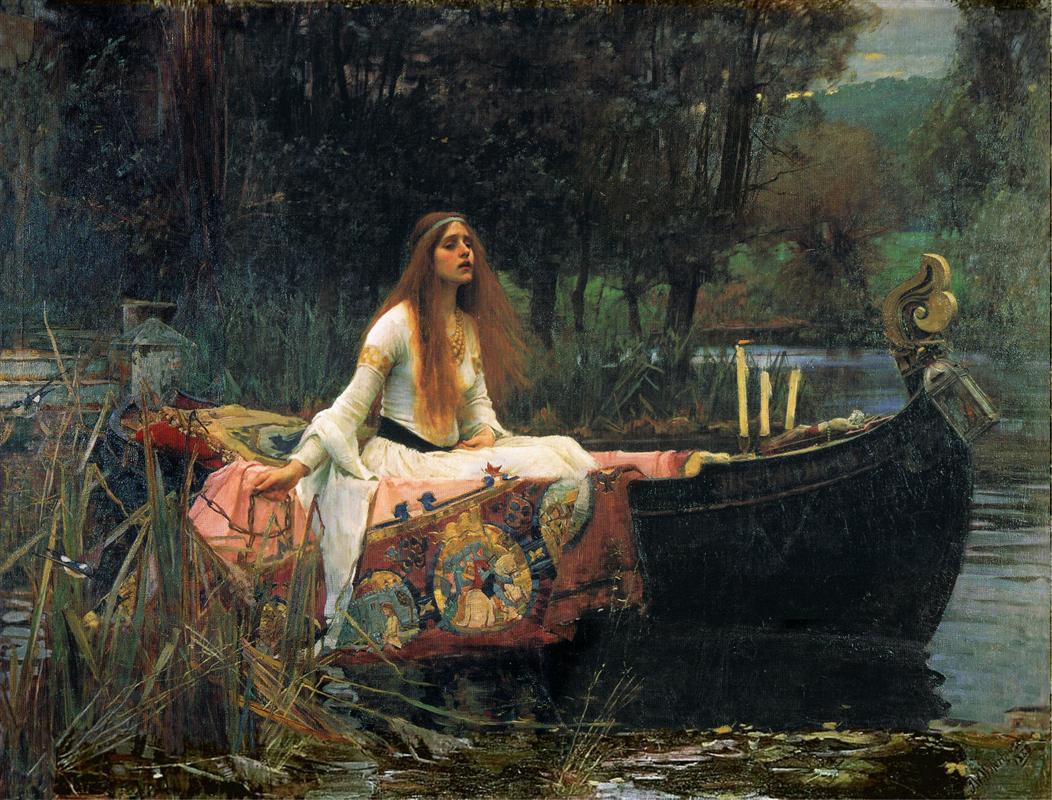
Image source: wikiart.org
Introduction: Waterhouse’s defining vision of a doomed heroine
John William Waterhouse’s The Lady of Shalott (1888) has become one of the most instantly recognizable images associated with late Victorian painting, not only because it is technically accomplished, but because it condenses a whole emotional universe into a single, suspenseful moment. The scene is quiet, yet it feels braced for catastrophe. A young woman sits in a boat at the edge of the riverbank, her face turned upward as if listening for something beyond the frame, beyond the trees, beyond ordinary time. Everything around her seems to participate in the same charged stillness: the dark water holding reflections like secrets, the reeds pressing in close, the dim woodland that reads as both shelter and prison.
Waterhouse was often grouped with the Pre-Raphaelite tradition, though he worked later and with a different emphasis. In this painting, he draws on that movement’s love of literary subjects and luminous detail, but he also intensifies the psychological atmosphere. The Lady is not simply an illustration of a famous poem. She is an emblem of longing and constraint, a figure poised between the safety of her enforced isolation and the peril of stepping into lived experience. The painting is compelling because it does not merely show tragedy, it makes you feel the instant when tragedy becomes irreversible.
The story behind the image: Tennyson’s poem and the curse of looking
The source is Alfred, Lord Tennyson’s narrative poem “The Lady of Shalott,” itself inspired by medieval legend and the Arthurian world. The Lady lives apart from society, secluded in a tower on the island of Shalott, near Camelot. She is under a mysterious curse: she must not look directly at the world outside her window. Instead, she sees life indirectly through a mirror and weaves what she sees into a tapestry. The arrangement is haunting because it turns perception into a secondhand experience. The Lady lives, but only as an observer, translating reality into art while barred from touch, participation, and choice.
The poem’s turning point arrives when she sees Sir Lancelot and cannot resist looking directly at him. In that instant, the mirror cracks, the weaving unravels, and the curse activates. She leaves the tower, finds a boat, and drifts toward Camelot, singing until she dies. The story has always carried a thick atmosphere of symbol and interpretation. It can be read as a meditation on desire and prohibition, on the cost of breaking rules that feel intolerable, and on the fragile boundary between artistic representation and lived experience. Waterhouse’s contribution is to select a moment that is neither the bright temptation of the glance nor the final discovery of her body in Camelot. He chooses the threshold moment, the launching, when choice becomes action and action becomes destiny.
The decisive moment: why the launch matters more than the ending
Waterhouse paints the Lady at the point of departure, when she has left her tower and is about to drift into a world that has been forbidden to her. This is crucial. Many tragic images focus on aftermath, but this one focuses on commitment. The boat is not already far downstream, it is still nestled near reeds and bank growth, close enough to suggest she could turn back if turning back were possible. That closeness makes the moment more painful. It implies that the tragic ending is not a distant fate but something already set in motion by a single human decision.
The Lady’s upward gaze is part of this. She does not look at the water or at the immediate obstacles. She looks beyond, as if toward the sound of Camelot’s life or toward a sky that might offer judgment. That gaze reads as both hope and resignation. It can be interpreted as prayer, as appeal, as disbelief, or as the stunned clarity that follows a life-changing break from routine. The painting’s drama is therefore interior. The landscape does not explode, the river does not rage, and yet the emotional pressure is immense because the viewer senses the cost of what has begun.
Composition and staging: a river scene built like a theatre
The composition is carefully structured to hold the Lady in a kind of suspended spotlight. The boat stretches horizontally across the foreground, a dark vessel cutting through water and marsh. Its prow curves upward with decorative carving that feels almost medieval, echoing the Arthurian source. The Lady, seated near the center-left, is the brightest element. Her white dress catches the available light and sets her apart from the surrounding greens, browns, and deep shadow.
Waterhouse frames the scene so that the background becomes a wall of trees, a darkened mass that encloses the space like a stage set. This does two things at once. It isolates her, reinforcing the theme of confinement, and it also pushes the viewer’s attention forward, toward the boat and the figure. The river’s surface provides a visual pause, an area of softened reflection that contrasts with the textured reeds and the heavy foliage. That contrast stabilizes the painting’s mood. We feel the tug between movement and stillness, between the river’s promise of travel and the bank’s suggestion of entanglement.
There is also a subtle directional logic. The boat points outward, angled toward the open water. The Lady’s body is oriented with the boat, but her head tilts upward, creating a tension between physical direction and emotional focus. It is as if her body has already accepted the journey while her mind is still grappling with its meaning.
The Lady’s presence: expression, posture, and the psychology of inevitability
Waterhouse gives the Lady a face that carries vulnerability without sentimentality. Her mouth is slightly parted, her expression strained but not theatrical. She looks as if she is in the middle of a breath, as if a song is beginning or ending, or as if words have failed her. This is important because the poem emphasizes her singing on the river, yet Waterhouse does not make performance the point. He makes it the sign of an inner state.
Her posture is upright but not rigid. She seems tired, perhaps from the physical act of leaving the tower, but also from the deeper exhaustion of having lived a life of constraint. Her hands rest in a way that suggests contact with the boat and the textiles around her, as if she is holding onto the last stable surfaces left to her. She is not posed like a confident voyager. She is posed like someone stepping into the unknown because the known has become unbearable.
Her long hair, flowing and warm in tone, acts almost like a visual echo of the river itself. It streams downward in a way that implies movement even when she sits still. Hair in Victorian painting often signaled femininity, sensuality, or emotional intensity. Here it also reads as unboundness, the opposite of the ordered, repetitive life of weaving. The looseness of her hair parallels the loosening of the woven world she has abandoned.
Symbolism in objects: the tapestry, the chain, and the candle-like light
Several objects intensify the narrative without turning it into a literal checklist. The tapestry draped along the side of the boat is perhaps the most direct reference to her life as a weaver. It is richly patterned and brightly colored compared with the surrounding environment. This makes it feel like a fragment of the tower brought into the world, a piece of mediated reality now exposed to actual wind, water, and decay. It also implies identity. She is carrying her art with her, yet she is also leaving behind the conditions that made that art possible.
The chain at the front of the boat is a striking symbol. It suggests that the boat has been tethered, restrained, held back from the river’s current. The act of departure becomes not only physical but moral and psychological. To leave is to unfasten oneself from the known, and the chain makes that visible. It is a reminder that the Lady’s confinement is not only a curse but also a system, something with weight and metal and consequence.
The candles, set near the prow, read as fragile light. Whether you interpret them literally or as emblematic, they contribute to the painting’s mood of precariousness. Candlelight is temporary and exposed, and on a river it feels especially vulnerable. They can suggest life itself, or the last remnants of sacred protection, or the idea that her journey is both a funeral rite and a pilgrimage.
Nature as emotional environment: reeds, water, and the enclosing forest
Waterhouse’s landscape is not merely a backdrop. It behaves like a psychological field. The reeds and grasses at the left edge are tangled, sharp, and crowded. They can be read as the threshold between land and water, but also as a metaphor for obstacles and entrapment. Even as she departs, the natural world seems to clutch at the boat, reluctant to let her go.
The water is calmer than the theme might suggest, but that calmness is precisely what creates dread. A storm would provide external drama, an obvious reason for disaster. Calm water forces the drama inward. The river becomes fate moving quietly, without rage. It carries without caring. That indifference fits tragedy, because tragedy often feels like a collision between human feeling and an unfeeling world.
The forested background is dark, heavy, and almost suffocating. Trees form a band of shadow that reduces the sky to a narrow, pale strip. This compresses the space, keeping the scene intimate and claustrophobic. The Lady’s white clothing and pale skin therefore feel even more vulnerable, like a flame in a room where the air is running out.
Color, light, and atmosphere: controlled gloom and selective radiance
The painting’s palette is a study in controlled restraint. Greens and browns dominate, but they are not fresh spring greens. They are deep, muted, and shadowed, suggesting late summer or early autumn, a seasonal metaphor for decline. The Lady’s dress is the most luminous surface, yet it is not a bright, celebratory white. It carries warmth and softness, giving it a human quality, like fabric that has absorbed lamplight and indoor life.
Waterhouse uses light sparingly. There is no blazing sun, only a subdued illumination that seems to come from an overcast sky or a late-day haze. This creates an atmosphere where everything feels slightly hushed, as if sound would be muffled by damp leaves and thick air. The effect is immersive. You do not merely see the scene, you feel its temperature.
The tapestry provides the strongest color accents, with reds, golds, and blues that stand out against the landscape. This contrast can be read as the contrast between art and life, between the crafted image world of weaving and the messy, desaturated reality of nature. Yet the tapestry is also physically present, meaning that art has entered life, and life will now weather it.
Waterhouse’s technique: detail, texture, and the balance of realism and romance
Waterhouse’s handling of paint here blends careful observation with lyrical emphasis. The textures of reeds, embroidered fabric, carved wood, and rippled water are rendered with attention that rewards close looking. This links him to the Pre-Raphaelite love of specificity. At the same time, the overall scene is not hyper-realistic in a documentary sense. It is curated for emotional effect. The forest’s darkness, the Lady’s radiance, and the boat’s ornate silhouette are arranged to produce a romantic intensity.
The brushwork is controlled, but not cold. There is softness in transitions, especially in the water and distant elements. That softness helps the atmosphere feel dreamlike, which suits a subject rooted in curse and legend. The realism grounds the figure, while the romantic staging elevates the moment into myth. This balance is one reason the painting has remained so popular. It feels believable enough to empathize with, yet symbolic enough to interpret endlessly.
Themes that keep the painting relevant: art, isolation, desire, and consequence
One of the richest ways to approach this painting is through the theme of mediation. The Lady’s original life is defined by indirect experience. She watches reflections and weaves representations. That condition resembles the experience of living at a distance from one’s own desires, or of consuming life through images rather than participation. Waterhouse’s painting dramatizes the moment when mediated existence becomes intolerable.
The painting also explores the cost of desire. The Lady’s choice is understandable, even inevitable. She has been denied direct life, so of course she reaches for it. Yet the story insists that this reaching has consequences. The tragedy can be read as moral warning, but it can also be read as critique of the system that made her choice lethal. In that sense, the curse is not only magic. It is a metaphor for social constraint, especially for women in Victorian cultural imagination, where longing and agency were often framed as dangerous.
There is also a theme of transition between roles. The Lady is a maker, a weaver, someone who turns perception into art. In leaving, she becomes a subject of narrative rather than a creator of images. She shifts from producing representation to being represented. That reversal is poignant. It suggests the fragility of artistic autonomy when one steps into public life, where one’s story can be claimed by others.
Why this 1888 version became iconic: emotional clarity and visual storytelling
Waterhouse painted multiple versions of The Lady of Shalott across his career, but the 1888 painting is often treated as definitive because it captures an emotionally clear moment while remaining visually rich. The composition is straightforward enough to read instantly, yet layered enough to revisit repeatedly. The Lady’s face and posture provide immediate empathy. The surrounding objects supply narrative anchors. The atmosphere supplies mood that feels almost musical.
The painting also satisfies a Victorian appetite for literary art while transcending mere illustration. Even viewers unfamiliar with Tennyson can sense the story’s shape. You can tell she is leaving something behind. You can tell the journey is risky. You can tell her beauty is not the point but part of the tragedy, because it makes the vulnerability more acute.
In a broader sense, the painting endures because it visualizes a universal human experience: the moment when you commit to a path that you know will change you, perhaps harm you, but also feels necessary for truth. That is not only a medieval legend. It is a recurring psychological reality.
The viewer’s role: standing on the bank, watching a fate unfold
Waterhouse positions the viewer like a silent witness. We are not in the boat with her, and we are not in Camelot awaiting her arrival. We are on the margin, close enough to see the details of her textiles and the tremor of expression, but powerless to intervene. This creates a particular kind of pathos. The painting asks for empathy, then denies rescue.
That denial is part of its power. It mirrors the curse’s structure. The Lady was forced to watch life from a distance, and now we watch her from a distance. The viewer becomes a participant in the theme of separation. We experience the ache of witness, the frustration of seeing a crucial moment without being able to alter it.
The boat’s darkness and the water’s depth also suggest the unknown beyond the frame. The river continues. The world continues. The painting ends here, but the story does not, and that gap between image and continuation is where imagination rushes in. We supply the downstream fate, and in doing so we become co-authors of the tragedy.
Conclusion: a luminous figure against a world that refuses to soften
The Lady of Shalott (1888) remains compelling because it is both intimate and mythic. It shows a single woman in a small boat, yet it feels like a painting about the scale of human longing. Waterhouse uses light, color, texture, and composition to build an atmosphere where beauty is inseparable from doom. The Lady’s whiteness against the dark riverbank is not merely visual contrast, it is a moral and emotional contrast: innocence or hope set against a world that is indifferent to innocence and hostile to hope.
The painting’s symbolism is rich without being obscure. The tapestry, the chain, the candles, and the enclosing forest all speak to the central tension between a life lived through art and a life lived directly. The tragedy is not only that the Lady dies. The tragedy is that she only gains direct experience at the moment when direct experience becomes fatal. Waterhouse captures that cruel irony with tenderness rather than sensationalism, creating an image that invites empathy across time.
In the end, the painting is a meditation on thresholds. Between isolation and society. Between representation and reality. Between safety and freedom. Between the beautiful stillness of a moment and the unstoppable movement of a river. That is why, long after Victorian literary culture has faded, Waterhouse’s Lady still feels present, still listening, still launching into the dark.