Image source: wikiart.org
Introduction to “The Judgment of Paris”
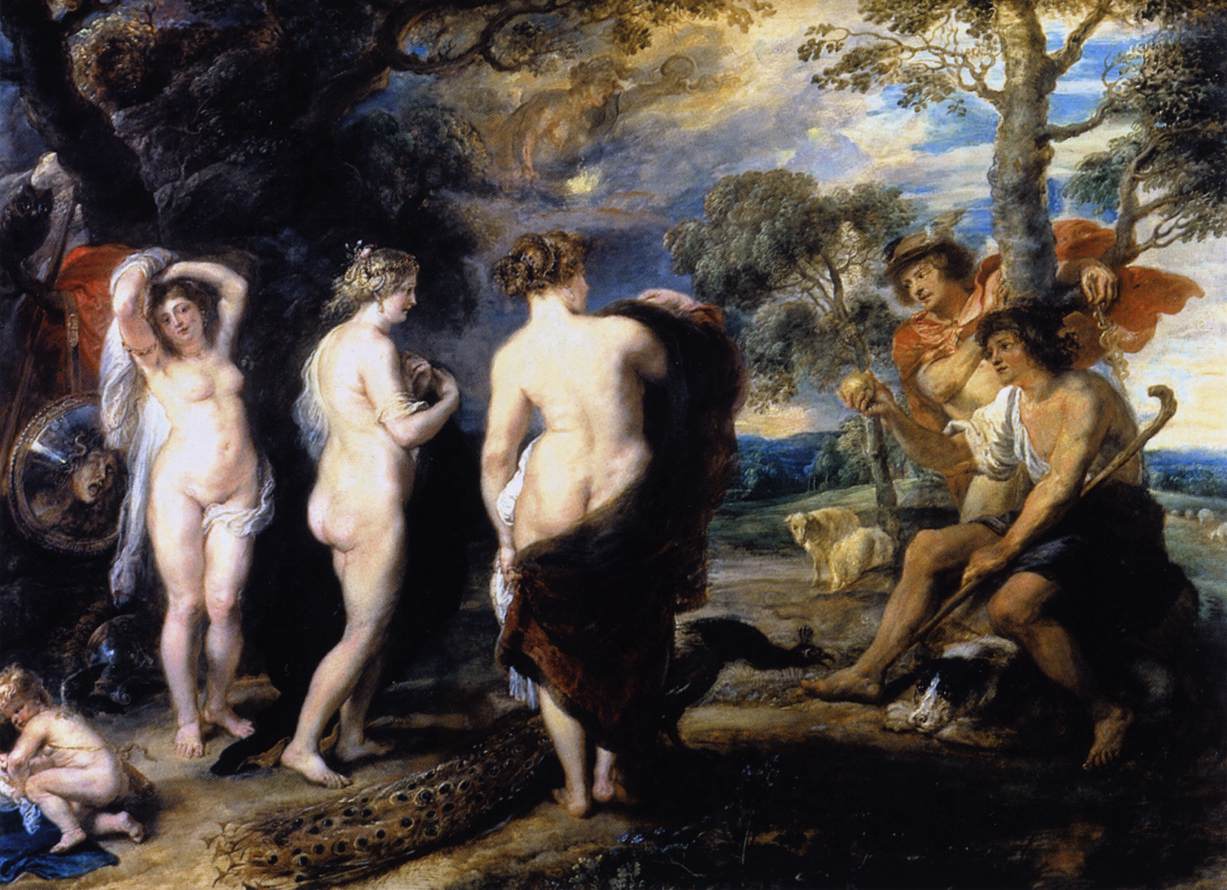
Peter Paul Rubens returned several times to the myth of “The Judgment of Paris,” and the 1636 version shown here is among his most lyrical and atmospheric interpretations. The painting presents the climactic moment when the Trojan shepherd Paris must decide which of three goddesses—Venus, Juno, or Minerva—deserves the golden apple inscribed “to the fairest.” Rubens sets the scene in a glowing pastoral landscape, balancing robust sensuality with narrative tension. While Paris sits at the right with the messenger god Mercury, the three nude goddesses stand at the left, their backs and profiles turned toward their judge. Above, faintly visible in the clouds, Jupiter and his eagle observe the proceedings, underlining the cosmic significance of this seemingly rustic encounter.
In this version, Rubens emphasizes not only the beauty of the goddesses but also the psychological drama of Paris’s choice. The composition is structured as a dialogue between two groups: the female triad on the left and the male pair on the right. The broad landscape opens behind them, suggesting the world that will soon be changed by the decision unfolding in the foreground.
The Mythological Story and Its Appeal
The myth, recounted by ancient authors such as Homer and Ovid, begins with a banquet of the gods from which Eris, goddess of discord, is excluded. In revenge she throws down a golden apple labeled “for the fairest,” which three goddesses claim. To avoid taking sides, Zeus appoints Paris, a Trojan prince living as a shepherd, to serve as judge. Each goddess attempts to bribe him: Juno promises power and wealth, Minerva offers wisdom and military success, and Venus pledges the love of the most beautiful woman in the world, Helen of Sparta. Paris ultimately awards the apple to Venus, a choice that leads to Helen’s abduction and the Trojan War.
For artists, the story offered a pretext to depict multiple female nudes within a classical framework, while also engaging with themes of beauty, judgment, and desire. Rubens, steeped in humanist culture and familiar with Italian Renaissance precedents, embraced these themes with particular enthusiasm. In the 1636 painting, he subtly alludes to the consequences of Paris’s choice yet dwells mainly on the enchantment of the moment, when everything is still undecided.
Composition and Spatial Dialogue
The canvas is divided into two main zones. On the left, under the shadow of a dark tree, stand the three goddesses, forming a compact, luminous group. On the right, seated at the base of another tree, Paris and Mercury appear more loosely arranged, accompanied by sheep and a dog that locate them in a pastoral setting. The central area of the painting is an open space of earth and sky across which glances and gestures travel, creating an invisible bridge between the two groups.
The goddesses are arranged in a gentle arc, each turned slightly differently. One lifts her arms to adjust her hair; another stands in profile, hands crossed modestly over her chest; the third turns her back to the viewer, drawing a dark cloak partially around her hips. The progression of poses—from frontal to three-quarter to back view—allows Rubens to display the female body from multiple angles, while also suggesting the unfolding of time, as if we are witnessing the goddesses gradually presenting themselves to Paris.
On the opposite side, Paris leans forward, holding the golden apple in his hand, his expression thoughtful and slightly hesitant. Mercury, distinguished by his winged hat, stands behind him and seems to prompt him toward a decision, his hand resting on Paris’s shoulder and his other hand pointing. This arrangement transforms the right-hand group into a kind of advisory council, discussing which candidate to favor.
The trees at either side frame the scene like wings of a stage, while the distant hills and sky recede softly into the background. The composition thus combines theatrical immediacy with spacious landscape, anchoring the myth in a believable natural world.
The Three Goddesses: Contrasting Ideals of Beauty
Rubens differentiates the three goddesses not only through pose and placement but also through subtle attributes and characterization. On the far left stands Minerva, identifiable by the shield with the Gorgon’s head and the helmet and armor resting nearby. Her pose, with arms raised behind her head, is confident and almost athletic, emphasizing strong shoulders and a firm stance. She embodies an active, martial beauty associated with courage and strategic intelligence.
Next to her, facing in profile, stands Juno, queen of the gods. She carries herself with dignified composure, her hands crossed demurely before her breast. While she is nude, a soft, pale cloth drapes near her hips, hinting at her usual regal robes. A peacock, her traditional attribute, struts at her feet, its iridescent tail feathers echoing the rich colors of the goddesses’ draperies. Juno’s beauty is stately and mature, more about authority and presence than playful allure.
The central figure with her back to the viewer is generally taken to be Venus. She holds a dark mantle that wraps partly around her hips, contrasting with her luminous flesh. Her twist toward Paris and the slight turn of her head invite his attention more directly than the poses of her companions. The curve of her spine and the soft modeling of her legs and hips express Rubens’s ideal of sensual, fertile womanhood. A small winged Cupid crouches at the lower left, playing with drapery; his presence confirms that the powers of love are at work in the scene.
Together, these three figures present Paris—and the viewer—with a spectrum of desirability: martial strength, regal power, and amorous pleasure. Rubens’s arrangement encourages us to compare them, just as Paris must, and to sense the difficulty of a choice in which each option represents a different life path.
Paris and Mercury: Human Judgment Under Divine Pressure
Paris, seated on a rock, appears as a youthful shepherd, bare-legged and holding a staff with his left hand. His right hand raises the apple toward the goddesses, but the gesture is tentative, not yet fully resolved. Rubens paints his face in three-quarter view, allowing us to see furrowed brows and parted lips that convey uncertainty. His posture leans forward, suggesting engagement and intrigue, yet his body remains grounded, as if weighed down by the responsibility of the choice.
Behind him, Mercury plays a dual role. As messenger, he has brought the goddesses to Paris; as advisor, he now urges him onward. His orange cloak and winged helmet give him a lively, almost worldly presence, contrasting with the rustic simplicity of Paris’s attire. The proximity of his hand to Paris’s shoulder suggests both guidance and possible pressure, hinting that divine politics may influence what appears to be a free judgment.
At Paris’s feet lies a dog, emblem of loyalty and watchfulness, and nearby graze sheep, reminders of his pastoral life. These humble creatures underscore the distance between Paris’s origins and the divine company he now keeps, heightening the sense that he has been thrust into a role far beyond his usual experience.
Landscape, Sky, and the Gods Above
The landscape forms an integral part of the painting’s emotional and symbolic structure. Behind the figures stretches a gently rolling countryside, bathed in cool, atmospheric light. Trees cluster near the horizon, and a river or path meanders into the distance. The calmness of this scene contrasts with the charged encounter in the foreground, suggesting the ordinary world that will feel the shockwaves of Paris’s choice.
Above, the sky is alive with light and movement. Warm oranges and cool blues mingle in swirling clouds that recall the dynamic heavens of Rubens’s altarpieces. If one looks closely, faint figures appear in the sky—Zeus (Jupiter) with his eagle, perhaps other gods as well—observing the scene below. This subtle inclusion reminds us that the judgment is not purely private or erotic; it carries cosmic implications. The gods themselves are invested in the outcome because it will tip the balance of power among them.
The merging of sky and landscape also mirrors the blending of divine and human realms. Paris, a mortal, is temporarily elevated to a level where his decision influences both worlds. Rubens expresses this vertiginous crossing of boundaries through the expansive, radiant sky that seems to spill down onto the figures with golden light.
Light, Color, and Sensual Atmosphere
Rubens’s mastery of color and light is on full display. The goddesses’ bodies are painted with creamy, warm flesh tones that stand out against the dark foliage behind them. Subtle pinks and pearly highlights describe the curves of their limbs, while cooler shadows lend depth. Draperies in red, white, and deep brown add rich accents, guiding the eye from one figure to another.
On the right side, the color range shifts slightly cooler: greens and blues predominate in the landscape, while the orange cloak of Mercury and the earth tones of Paris’s garments link the male group visually to the female triad. The peacock’s iridescent feathers introduce shimmering greens and blues that echo both sky and foliage, weaving the composition into a chromatic unity.
Light enters the scene from the upper left, washing over the goddesses and grazing Paris’s face. This directional light enhances the sense that the divine contest is under celestial scrutiny. At the same time, it bathes the naked bodies in a soft glow, heightening their sensual appeal. Rubens avoids harsh contrasts; instead, he uses graduated transitions that make the skin appear soft and living, almost palpable.
Baroque Movement and Emotional Tension
The painting’s Baroque character emerges in the dynamic interplay of curves and diagonals. The goddesses’ bodies form an undulating rhythm: Minerva’s raised arms, Juno’s sideways twist, Venus’s backward turn. These movements are echoed by the serpentine shapes of tree branches overhead and the arcs of clouds in the sky. On the right, Paris’s forward lean and Mercury’s pointing gesture continue this visual flow, drawing the viewer’s gaze back and forth across the scene.
Despite the lack of overt action—no one is yet receiving the apple—the painting is charged with tension. The goddesses wait, each confident yet curious; Paris hesitates; Mercury urges. Cupid plays nonchalantly at the edge, embodying the unpredictable force of desire. The viewer senses that this is the calm before a storm, the moment at which destiny is about to crystallize into a single gesture.
Rubens’s brushwork adds to this effect. Areas of foliage and sky are painted with loose, sweeping strokes that suggest wind and shifting light. The more carefully modeled figures stand out against this energetic backdrop, their solidity dramatized by the surrounding flux. This contrast between stable bodies and restless environment mirrors the psychological instability of the decision-making process.
Moral and Psychological Dimensions
While “The Judgment of Paris” is undeniably a celebration of physical beauty, it also invites reflection on moral and psychological themes. The myth has long been interpreted as a warning against superficial judgment and the allure of sensual rewards at the expense of higher values. Juno and Minerva represent, respectively, political power and wisdom—virtues associated with long-term stability and honor. Venus represents love and pleasure, powerful but potentially disruptive forces.
Rubens does not explicitly condemn or endorse any choice. However, his composition suggests where the gravitational pull lies. Venus, central and most directly oriented toward Paris, is visually privileged. The presence of Cupid and the soft modulation of her form emphasize her seductive appeal. The viewer, like Paris, may feel drawn toward her, even while aware of the tragic consequences foretold by the myth.
The painting also explores the vulnerability of human judgment under pressure from forces beyond control. Paris is not simply choosing between three equally accessible options; he is being courted and subtly coerced by divine offers, while larger cosmic powers watch from above. The work thus reflects on the complexity of decision-making, especially for those suddenly placed in positions of authority.
Rubens’s Artistic Sources and Innovations
Rubens’s interpretation engages with a long tradition of representations of the Judgment of Paris, from ancient sarcophagi to Renaissance and Mannerist paintings. He would have known works by Raphael, Titian, and others, yet he reshapes the theme according to his distinctive sensibility.
Unlike some earlier versions where the goddesses face directly toward the viewer in orderly symmetry, Rubens arranges them in a more naturalistic grouping, with overlapping poses and varied orientations. This choice breaks the static frontality of earlier models and generates a sense of conversational interaction. His landscape is also more expansive and atmospheric, integrating the figures into a living environment rather than placing them against a neutral backdrop.
Rubens’s robust, full-bodied female figures reflect his own ideal of beauty, distinct from the slender, elongated forms favored by Mannerist artists. His goddesses are substantial and tactile, emphasizing fertility and physical presence. In doing so, he aligns the classical myth with his broader celebration of corporeal life.
Legacy and Contemporary Response
For modern viewers, this 1636 “Judgment of Paris” remains compelling both as a tour de force of Baroque painting and as a complex meditation on desire and choice. The painting’s sensuality is undeniable, yet it is enriched by narrative depth and psychological nuance. Paris’s predicament—torn between competing ideals and immediate attraction—continues to resonate in a world where decisions often involve balancing pleasure, power, and responsibility.
The work also offers insight into seventeenth-century attitudes toward myth and the human body. Rubens treats classical stories not as distant, rigid tales but as living dramas played out by figures with flesh, emotion, and humor. His goddesses, Cupids, and shepherds occupy a world that, though idealized, feels accessible and human.
Ultimately, this “Judgment of Paris” stands as a testament to Rubens’s ability to weave together narrative, symbolism, landscape, and sensual form into a unified, richly layered painting. It invites prolonged looking and ongoing reinterpretation, much as the myth itself has inspired artists and thinkers across centuries.