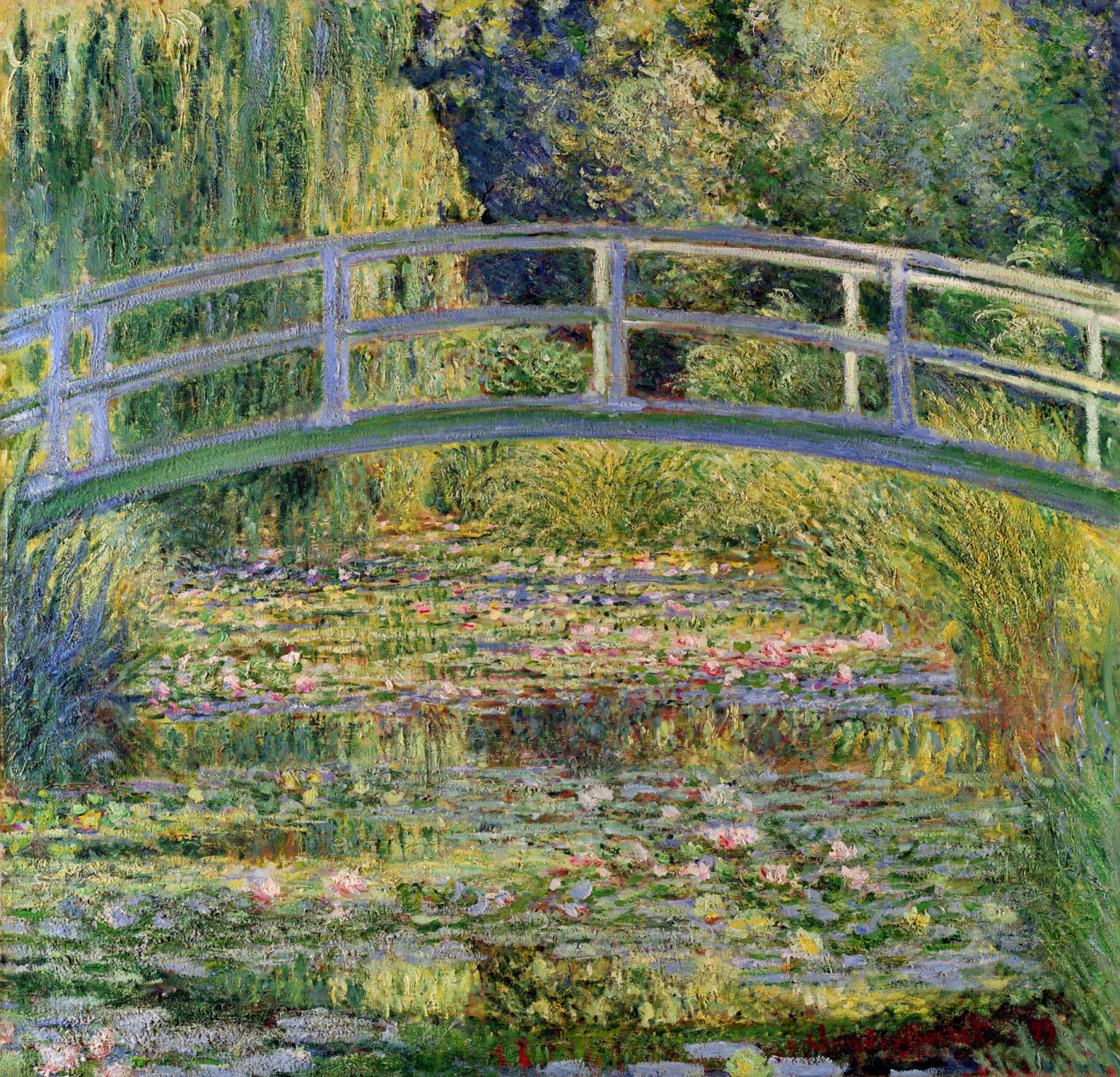
Image source: wikiart.org
Claude Monet and the World of Giverny
The Japanese Bridge (The Water-Lily Pond), painted by Claude Monet in 1899, belongs to one of the most celebrated phases of the artist’s career. By the end of the nineteenth century, Monet had moved far beyond the early Impressionist goal of capturing fleeting outdoor effects in a broad range of locations. At Giverny, the home and garden he carefully shaped over many years, he found a subject that allowed him to look deeper rather than farther. Instead of traveling constantly in search of new motifs, he turned his attention to a private, cultivated environment that could be studied again and again under changing conditions of light, season, weather, and mood.
This painting represents that shift with exceptional clarity. The Japanese bridge, arching over a lily pond rich with reflections and color, is not simply a picturesque garden feature. In Monet’s hands, it becomes a way of thinking about vision itself. The bridge offers structure, but the water below dissolves structure into shimmering fragments. The garden is real, yet it appears dreamlike. Nature is cultivated, but it still seems alive and unstable. In this tension between order and sensation, Monet found one of the great subjects of modern painting.
The Giverny water garden had deep importance for Monet. It was not just a place he observed but a place he designed. He imported plants, arranged paths, oversaw the pond, and introduced the Japanese style bridge that would become central to many works. This means the painting is not a neutral record of nature. It is a carefully staged encounter between human intention and natural transformation. Monet created the conditions for looking, then painted the endless variations that emerged from them.
The First Impression of the Painting
At first glance, The Japanese Bridge (The Water-Lily Pond) seems serene, inviting, and harmonious. The pale bridge sweeps across the upper half of the canvas in a gentle arc, while the pond below spreads outward in a dense field of water lilies, reflections, and floating color. Trees and bushes crowd the background, enclosing the space and making it feel intimate rather than expansive. The scene appears to be quiet, almost sheltered from the outside world.
Yet the longer one looks, the more complex the painting becomes. It is not a tidy garden picture built around precise edges and stable forms. Instead, Monet fills the image with broken, layered brushstrokes that make every surface vibrate. The bridge is visible and recognizable, but it is also softened by atmosphere and light. The water is reflective, but its reflections are unstable, interrupted by lilies, drifting color, and painterly texture. The vegetation is lush, though it often seems to merge with shadow, reflection, and air.
This is one of the key achievements of the painting. It gives a viewer enough recognizable form to enter the scene comfortably, then gradually reveals a much more ambitious exploration of perception. The subject is simple enough to be grasped instantly, but the experience of looking is never simple. The painting encourages slow attention, and that slowness uncovers its richness.
Composition and Spatial Design
The composition of The Japanese Bridge (The Water-Lily Pond) is both elegant and subtle. The bridge functions as the major organizing element. Its curved line stretches across the painting, creating a calm horizontal rhythm while also dividing the upper and lower zones of the image. This arc has a graceful lift that guides the eye naturally from left to right. It also introduces a note of architectural stability into a scene otherwise dominated by shifting organic forms.
The bridge does not sit in isolation. Its pale rails and posts are echoed in the reflections and tones around it, so that it belongs to the environment rather than standing apart from it. Monet avoids a stark contrast between built form and living nature. Instead, the bridge seems absorbed into the visual life of the garden. This soft integration helps create the painting’s sense of unity.
The space of the painting is unusually compressed. There is little sky, and there is no distant horizon opening toward a broad landscape. Instead, Monet draws the viewer inward, enclosing vision within the boundaries of the garden. The result is almost immersive. The painting feels less like a view onto a landscape and more like an entry into a self-contained world. The dense background foliage presses forward, the bridge spans the middle ground, and the pond fills the foreground with floating detail and reflection.
This compression of space is important because it shifts attention away from conventional depth and toward surface relationships. Rather than inviting the eye to travel deep into the distance, Monet asks it to move across the canvas, comparing colors, textures, and passages of light. The painting still has depth, but that depth is unstable and layered. Reflection complicates spatial logic. The water seems flat and deep at the same time. The bridge appears solid, yet the atmosphere around it softens its certainty. This ambiguity is central to the painting’s modernity.
Color, Light, and the Atmosphere of the Garden
Color is one of the painting’s most striking features. Monet builds the scene from an intricate orchestration of greens, blues, violets, yellows, and pinks. These colors are not simply descriptive. They do not exist only to tell us that leaves are green or flowers are pink. Instead, they create the atmosphere of the scene and convey the sensation of light moving across water, foliage, and painted wood.
The bridge itself is rendered in cool bluish and lavender tones, which gives it both delicacy and luminosity. It does not feel heavy or static. It seems touched by filtered daylight, partially dissolved by the moist air and reflected light around it. The surrounding greenery is equally varied. Monet avoids a single flat green, preferring a living range of mossy, olive, yellow-green, blue-green, and deeper shadowed tones. This variety makes the vegetation feel active and responsive to changing conditions.
The pond below is where Monet’s color reaches its richest complexity. Here, pink and white water lilies float among a dense web of green, blue, and reflected gold. Some areas shimmer with brightness, while others sink into cool shadow. The water is not a mirror in any literal sense. It transforms what it reflects, breaking forms apart and blending them into painterly patterns. The result is a surface that feels alive, unstable, and endlessly nuanced.
Light in this painting is diffuse rather than dramatic. There is no strong single beam or theatrical spotlight. Instead, illumination seems to spread softly across the garden, touching different areas in different ways. This gives the work a meditative mood. The scene is radiant, but not harsh. It feels suspended in a moment of calm attention, where light is experienced as atmosphere rather than event.
Brushwork and the Language of Impressionism
Monet’s brushwork is essential to the power of The Japanese Bridge (The Water-Lily Pond). The painting is not built through sharply drawn contours or smooth, hidden transitions. Instead, it is composed of countless visible strokes, touches, dabs, drags, and layered marks that remain active on the surface. These brushstrokes create form while also reminding us that the painting is a handmade object, a field of pigment arranged through perception and touch.
In the foliage, the brushwork can be dense and feathery, suggesting leaves, branches, and filtered light without fixing them into rigid detail. In the reflections, the strokes become more horizontal and broken, helping evoke the slight movement of water. In the lilies, Monet uses small touches of pink, white, and pale color that hover against the surrounding greens and blues. Each stroke matters individually, yet all of them contribute to a larger visual harmony.
This is one of Monet’s greatest strengths as a painter. He can allow brushstrokes to remain visibly separate while still making them cohere into a convincing and emotionally resonant whole. Up close, the painting may seem fragmented. From a modest distance, it gathers into an integrated scene. This dynamic between proximity and distance is central to the Impressionist project, and Monet handles it here with extraordinary assurance.
The surface energy of the painting also creates a sense of duration. The viewer feels that the image is not frozen but continuously unfolding. The eye moves from stroke to stroke, from color patch to reflection, from the bridge to the lilies and back again. In this way, Monet turns looking into an active experience. The painting does not merely present a scene. It stages the process of perception.
The Japanese Influence and the Meaning of the Bridge
The title itself draws attention to the bridge’s cultural association. The Japanese style bridge in Monet’s garden reflects the broader influence of Japanese art and design on many European artists in the late nineteenth century. Japanese prints, decorative objects, and garden elements introduced new ideas about composition, asymmetry, flattened space, and the poetic value of natural motifs. Monet was among the artists deeply attracted to this visual world.
In The Japanese Bridge (The Water-Lily Pond), the bridge serves as both a literal object and a symbolic threshold. It spans the pond, connecting one side of the garden to the other, yet it also suggests a crossing between different visual states. Above the bridge lies a more stable world of structure and foliage. Below it stretches the fluid realm of reflection, color, and floating vegetation. The bridge unites these zones while marking their difference.
There is also a deeper poetic resonance in the motif. Bridges often symbolize passage, transition, and contemplation. In Monet’s painting, this meaning is quiet rather than literary. The bridge does not carry a narrative event. No figures cross it. No story unfolds upon it. Its significance lies in its stillness. It invites the viewer to pause, to imagine standing there, looking down into the shifting world of the pond. It becomes a place of suspended attention.
Japanese influence also appears in the painting’s treatment of surface and framing. The compressed space, decorative richness, and emphasis on pattern all suggest an artist thinking beyond traditional Western landscape formulas. Monet is not abandoning nature, but he is transforming how nature can be organized on a canvas. The bridge and pond become an arrangement of rhythms, shapes, and tonal relations as much as a recognizable scene.
Water Lilies, Reflection, and the Dissolving of Form
The water lilies are crucial to the painting’s emotional and artistic effect. They float on the pond as delicate interruptions within the field of reflection. Their blossoms, touched with pink and white, create accents that draw the eye without overwhelming the composition. They are small but persistent points of beauty, scattered across the surface like notes in a piece of music.
The pond itself is perhaps the true subject of the painting. Water allows Monet to explore one of his deepest artistic concerns, the instability of appearances. Reflections change with light, angle, breeze, and movement. They offer visual richness while resisting fixed definition. This makes water an ideal medium for a painter interested in sensation, flux, and the limits of representation.
In this painting, reflection does not simply double the world above. It transforms it. Trees become elongated veils of color. Light becomes scattered shimmer. Solid vegetation dissolves into flickering, horizontal fragments. The world is both present and altered, recognizable and elusive. Monet uses this visual instability to create a space where material reality and painterly abstraction begin to meet.
This is one reason the water lily paintings became so influential. In works like The Japanese Bridge (The Water-Lily Pond), Monet approaches a kind of threshold between representation and abstraction. The scene remains legible, but parts of it are already moving toward a painting concerned above all with color, rhythm, and surface. Later artists would see in these works a powerful new direction for modern art.
The Emotional Tone of the Painting
Although Monet’s painting is grounded in observation, it also carries a strong emotional atmosphere. The mood of The Japanese Bridge (The Water-Lily Pond) is peaceful, contemplative, and slightly dreamlike. There is no human figure to direct the narrative or define the emotional response. Instead, feeling emerges through the harmony of the composition, the softness of the light, and the gentle movement implied by the brushwork.
The enclosed garden setting contributes to this sense of privacy and retreat. Unlike many landscapes that emphasize travel, weather, or grand natural spectacle, this painting feels inward. It suggests a place designed for quiet attention. The dense foliage around the bridge creates a sense of shelter, while the pond invites reflective looking in both the literal and emotional sense of the word.
At the same time, the painting is not static or overly polished. There is liveliness in its surface and subtle tension in its shifting forms. The viewer senses both calm and activity, repose and constant visual change. That balance is part of the painting’s enduring appeal. It offers rest for the eye without becoming dull, and complexity without becoming chaotic.
Many viewers respond to the painting almost instinctively because it feels both immediate and meditative. It captures the beauty of a garden scene, but it also evokes something more lasting, a state of concentrated attention in which the world seems at once tangible and fleeting. Monet transforms a familiar subject into an experience of quiet wonder.
The Place of This Work in Monet’s Career
By 1899, Claude Monet was no longer simply one of the founders of Impressionism. He was an artist pushing his own methods into new territory. The serial approach he had used for haystacks, poplars, and Rouen Cathedral had already shown his fascination with repeated motifs under changing conditions. At Giverny, this logic became even more intimate and more radical. The water garden gave him a subject that could be painted endlessly while still yielding new visual problems.
The Japanese Bridge (The Water-Lily Pond) stands at an important point in that development. It still includes a recognizable architectural feature that anchors the composition, making it accessible and structured. Yet it also reveals Monet’s growing interest in immersive surfaces and shifting optical effects. In later water lily paintings, the bridge often disappears and the image becomes almost entirely devoted to water, reflection, and floating vegetation. This 1899 work can be seen as a bridge in another sense, linking Monet’s earlier Impressionist landscapes to the increasingly daring paintings of his final decades.
The painting also demonstrates Monet’s confidence in returning to the same subject repeatedly without repetition becoming sameness. For him, the garden was never fixed. Light altered it, season altered it, weather altered it, and painting itself altered it. Each canvas became a new encounter. This capacity to rediscover a familiar place through sustained attention is one of the marks of his greatness.
Why The Japanese Bridge Continues to Captivate Viewers
One reason The Japanese Bridge (The Water-Lily Pond) continues to fascinate viewers is that it operates on multiple levels at once. It is immediately beautiful, with its lush greenery, soft bridge, and floating flowers. It is also formally sophisticated, using composition, color, and brushwork to challenge ordinary ways of seeing. It is rooted in a real place, yet it feels almost timeless, as though the garden exists outside ordinary chronology.
The painting also speaks to a modern desire for slowness and contemplation. In a world often dominated by speed and distraction, Monet’s garden offers another mode of attention. It asks the viewer to linger, to notice subtle tonal shifts, to move through the image gradually. The reward for that patience is not just visual pleasure but a deeper experience of presence.
Its appeal also lies in its balance between familiarity and mystery. A bridge over a pond is an easy subject to recognize, but Monet’s treatment prevents it from becoming merely descriptive. Reflection blurs certainty. Brushwork interrupts fixed edges. Color creates mood as much as information. The painting remains open, generous, and slightly elusive, which keeps it alive for repeated viewing.
In the end, The Japanese Bridge (The Water-Lily Pond) is one of Monet’s finest demonstrations of how painting can transform a simple motif into a profound visual meditation. It is a garden scene, but also a study of perception. It is a private corner of Giverny, but also a landmark in the history of modern art. Through this luminous bridge, floating lilies, and shimmering water, Monet invites us into a world where seeing becomes a form of reflection in itself.