Image source: wikiart.org
Introduction
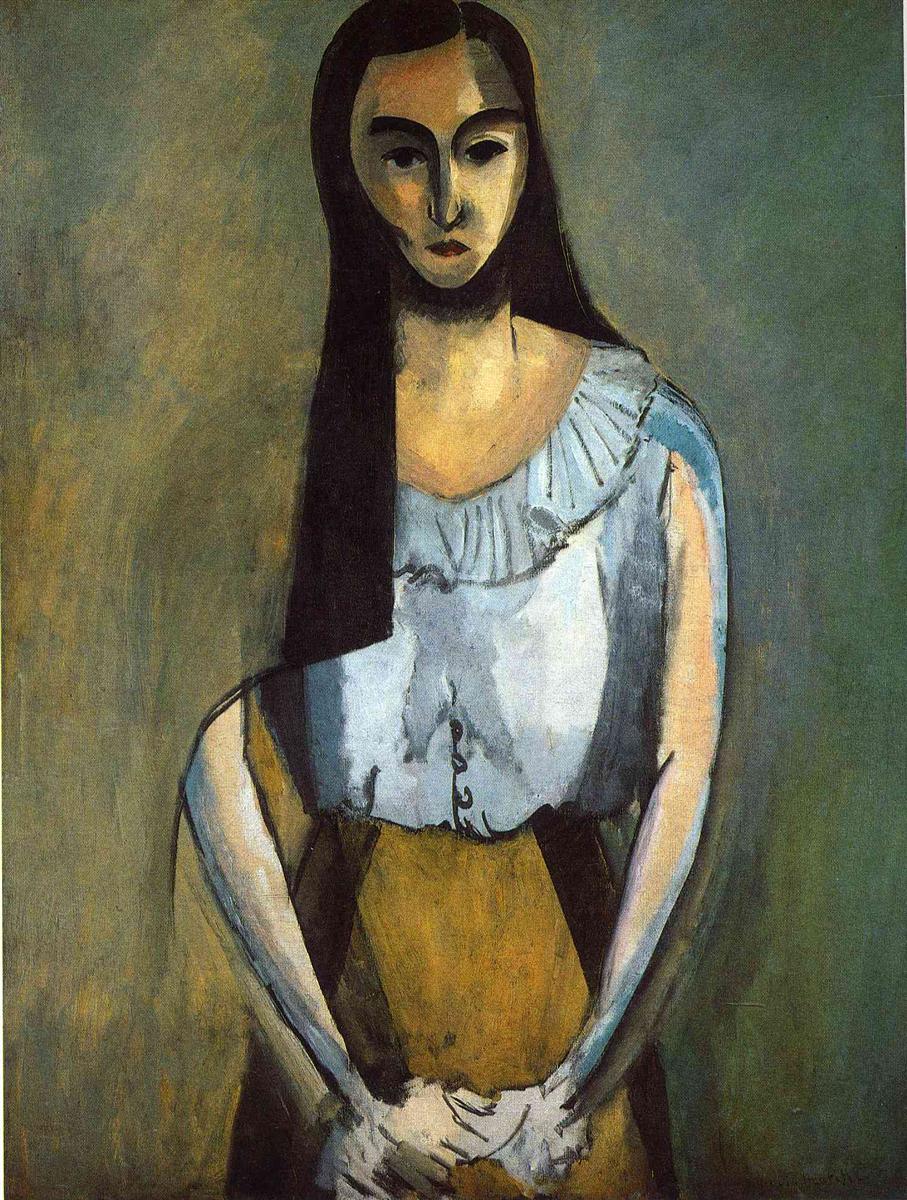
Henri Matisse’s “The Italian Woman” (1916) is a portrait that condenses a decade of experimentation into a single, lucid image. It presents a standing figure with long dark hair, a pale blouse gathered at the neckline, and hands folded at the waist. Everything about the painting—its pared-down palette, its monumental frontality, its emphatic contours—announces a new discipline. The exuberant chroma of Fauvism has been tempered; the Cubist fascination with structure has been absorbed without surrendering to fragmentation; the artist’s long love of ornament is present as rhythm rather than pattern. What remains is a portrait that reads like an icon of modern clarity, severe and tender at once.
Historical Context
By 1916 Europe had been at war for two years, and Matisse, working largely in Paris, had turned inward. The years 1914–1916 produced an extraordinary series of reductions—windows that were almost abstract, portraits in muted grisaille, still lifes built from a handful of planes. “The Italian Woman” belongs to this cycle. It succeeds several portraits from 1913–1915 in which the face is treated as an armature of geometric relations. Here Matisse pulls back from the most radical abstraction to regain the human presence, bringing the discipline of the earlier experiments to bear on a figure that addresses the viewer directly.
First Impressions
At a glance, the figure stands in a cool, atmospheric field of greens and grays. A triangular wedge of face drops from the forehead to a strong nose; heavy, simplified brows cast a permanent shadow of thought. The blouse, rendered in chalky whites and blue-gray shadows, glows against an ochre skirt. Long black hair descends like a vertical pillar, dividing the upper field. The hands, loosely described, meet at the abdomen, their whiteness echoing the blouse and creating a chain of light that runs from throat to waist. The painting’s calm is instant, its gravity undeniable.
Composition and Structure
The composition is a study in frontality and axial balance. The centerline runs from the hair part through the nose and breastbone to the clasped hands, creating a plumb line that steadies the image. Matisse builds the figure from broad, simple masses—head like a shield, torso a tall trapezoid, skirt a grounded, amber wedge—bounded by authoritative contours. Slight asymmetries keep the picture alive: the right shoulder sits fractionally higher; the left sleeve carries more blue shadow; the tilt of the mouth resists strict symmetry. These deviations, small and necessary, spare the portrait from stiffness and allow character to emerge.
Color and Light
The palette is narrowed to a few classes of color: cool greens and grays for the field, milk white and chalk blue for the blouse, deep walnut and black for hair and brows, soft ochre for the skirt, and a pinch of coral in the lips. By reducing chroma, Matisse allows temperature to do the expressive work. The green ground breathes with faint, mossy variations; the blouse’s whites are never flat, flickering between glacial blue and warm cream; the face settles in a honeyed half-tone that glows gently against the darker hair. Light isn’t modeled through theatrical shadow but through value steps across broad planes. The result is a steady, contemplative illumination—neither studio spotlight nor outdoor glare.
Drawing and the Authority of Contour
Contour carries meaning. The nose and brows are joined by a continuous, confident sweep, giving the mask-like face a sculptural firmness. The arms are drafted with swift lines that widen and thin as they travel, creating a living edge rather than a mechanical outline. Inside the forms, Matisse uses only the lines he needs: a short curl at the neckline, a spare inscription at the center of the blouse, a few angular indications in the hands. These lines act like ribs in a hull, unseen but indispensable to the volume’s integrity. Because the drawing is frank and economical, the figure retains gravity without detail.
Brushwork and Surface
The surface is open, breathable, and legible as paint. In the ground, wide passes move horizontally and vertically, allowing the weave of the canvas to flicker through and keeping the air around the sitter alive. In the blouse, heavier impasto catches light, turning the fabric into a field of shifting whites that feel crisp without fussy fold-drawing. The face is handled with a thinner skin of color, so that warmth seems to emanate from beneath. Here and there pentimenti remain—echoes of earlier placements along the shoulders and neck—evidence that final simplicity arrived through revision.
The Psychology of the Pose
The seated odalisques of Matisse’s later years offer languor; this standing figure offers reserve. Hands joined at the waist, elbows drawn slightly in, “The Italian Woman” occupies space with modesty and strength. The downturned corners of the mouth and the heavy arc of the brows give her a meditative gravity, while the directness of the pose prevents melancholy. She is present and composed, neither coy nor confrontational. Matisse avoids anecdote and costume drama so that psychology can arise from posture and proportion alone.
The Masklike Face and the Question of Identity
Matisse had long admired archaic and non-Western sculpture for its capacity to convey presence without descriptive fuss. In this portrait the eyebrows form a single dark wing, the nose is a column, and the eyes are almond slits set beneath a steady brow. Masklike simplification does not erase personality; it dignifies it. The viewer is invited to read character in the intervals between features, in the relationship of brow to eye, of mouth to chin, of hair’s weight to cheek’s light. The result is paradoxical and modern: abstraction deepens individuality.
Costume, Texture, and Ornament
The blouse’s gathered collar supplies the painting’s gentlest ornament. Matisse refuses lace or pattern; instead he allows short scallops of brushwork to state a ruffle and then withdraw. The ochre skirt anchors the figure with warmth and mass. The hair, painted as a nearly flat dark, becomes a structural counterweight to the glimmering blouse. Everything the sitter wears is treated as an instrument within the composition, not as a signal of social status. The decorative ideal—every part contributing to surface balance—survives austerity.
Space and Background
Background and figure exchange roles. The ground is not a void but a slow-breathing, mottled field that wraps the figure in air. There is no chair, no window, no studio paraphernalia, only a tonal architecture that keeps the body legible. The absence of descriptive setting prevents narrative from hijacking the painting. The viewer meets a presence, not a story.
Materiality and Evidence of Process
A modern portrait tells you how it was made. Scumbles, reserves, and overlaps remain visible; edges are adjusted rather than hidden. Along the right sleeve a pale halo shows where an earlier contour was pulled inward. In the hands the undercolor peeks through, preventing over-finish and reminding the eye that paint is the subject as much as person. This candor about process grants the portrait honesty; it is not polished veneer but the record of decisions.
Comparisons with Matisse’s Adjacent Works
Placed beside the cool grays of “Woman on a High Stool” (1914) and the masklike severity of “White and Pink Head” (1915), this painting reads as a reconciliation of structure with warmer human presence. It shares the economy of line and the reduced palette, yet invites more bodily empathy. Compared to the near-abstract window pictures of 1914, “The Italian Woman” returns to inhabited form, but it carries forward the same commitment to large, tuned planes. Relative to the luxuriant Nice period that would begin a few years later, this portrait is stripped and essential, a chapel before the palace.
Dialogue with Tradition
The long hair and central stance recall Renaissance Madonnas and Byzantine icons, but the devotional aura has been secularized into quiet poise. The blouse’s gathered neckline echoes classical drapery without indulging in illusionistic folds. One can sense Matisse measuring himself against tradition and preserving only what painting needs: frontality, proportion, and a tempered light capable of carrying dignity without rhetoric. He engages the past as a grammar, not as a costume shop.
Readings of Character and Meaning
Who is the “Italian woman”? The title signals an origin rather than a name, inviting the viewer to treat the painting as a meeting with type intensified into person. Her lowered mouth and concentrated eyes suggest patience and inwardness; the clasped hands testify to self-containment rather than passivity. The portrait can be read as a wartime image of steadiness, as a meditation on privacy, or as an assertion of the body’s quiet sovereignty within a world of noise. Its reserve is not absence; it is control.
How to Look
Approach the painting first as a large chord of color: green-gray air, white blouse, ochre skirt, black hair. Let the central axis settle. Next, dwell on the transitions, where the blouse’s blue cools into the shadow of the arm, where the hair meets the warm cheek, where the hands brighten against the skirt. Step closer until you see the brush’s path in the ground and the tiny adjustments along the sleeve. Step back again to feel how the figure’s weight is distributed evenly through feet you cannot see. The portrait yields its emotion in the oscillation between these distances.
Legacy and Influence
“The Italian Woman” has remained influential because it demonstrates a way through the competing demands of modern painting. It shows that one can accept structural discipline without losing empathy, adopt a restricted palette without drabness, and pursue flatness without canceling volume. Painters who seek a portrait language grounded in planes and intervals rather than detail often find this work exemplary. Designers, too, can learn from its calibrated temperatures and the way a few hues define an entire climate.
Conclusion
In “The Italian Woman,” Matisse transforms the human figure into a harmonized structure of light, color, and contour. The painting is both reticent and generous. It refuses anecdote and theatricality, yet it offers a deep sense of presence; it simplifies, yet the simplification releases warmth. A century later, the portrait still feels perfectly balanced—firm in structure, humane in feeling, and modern in its conviction that the essentials of painting are enough to carry a life.