Image source: wikiart.org
Introduction to Murillo’s Sacred Vision
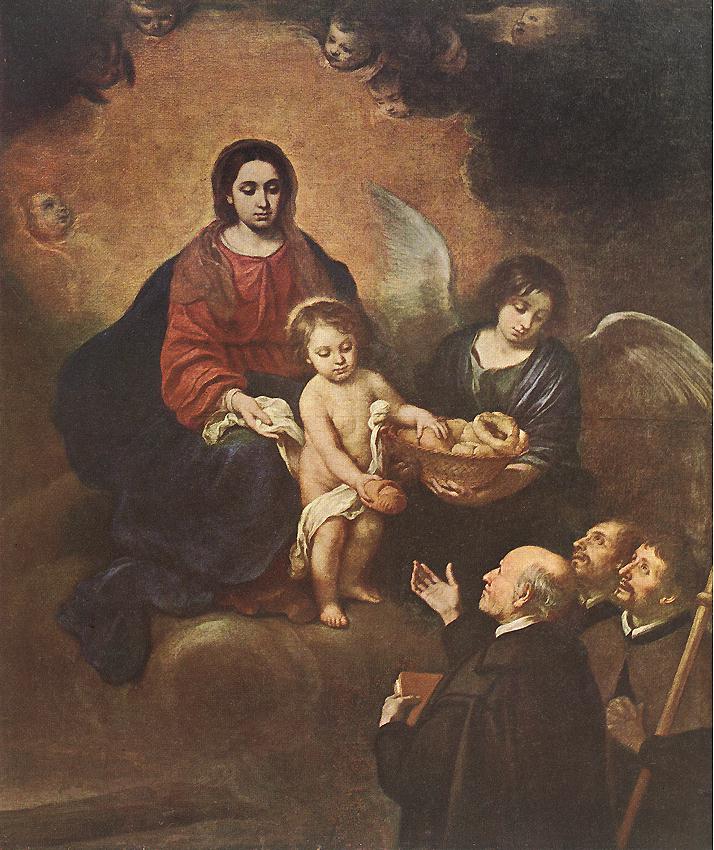
“The Infant Jesus Distributing Bread to Pilgrims” by Bartolomé Esteban Murillo presents a tender vision of charity that unites heaven and earth in a single, luminous scene. Painted in 1678, at the height of Murillo’s career, the canvas shows the Christ Child standing between the Virgin Mary and an angel, offering bread to kneeling pilgrims below. The work blends biblical symbolism, Eucharistic theology, and the social realities of seventeenth century Spain, particularly the pressing issue of poverty in Seville.
From the first glance, the painting feels gentle and approachable. Murillo does not stage a dramatic miracle filled with agitation; instead, he invites contemplation of quiet generosity. The figures are arranged in a stable, pyramidal composition that guides the eye from the kneeling men at the bottom toward the Child at the center, and then upward into the warm clouds populated by cherub heads. This vertical journey mirrors the spiritual ascent that the painting proposes: material hunger is answered by divine nourishment, and ordinary human need is taken up into the realm of grace.
The painting can be read both as a devotional image for private prayer and as a moral lesson for the Christian community. Murillo reminds viewers that charity is not only a social duty but also a direct participation in the compassion of Christ himself.
Historical Context of Seventeenth Century Seville
To understand the power of this image, it helps to recall the world in which Murillo worked. Seville in the mid and late seventeenth century was a city marked by both wealth and hardship. Once a thriving port for the riches of the New World, it had suffered from economic decline, plagues, and repeated waves of famine. Large populations of beggars, orphans, and itinerant pilgrims filled the streets. Religious confraternities and charitable institutions multiplied in response, attempting to relieve the suffering of the poor and to promote Catholic reform.
Murillo became the leading painter of this environment. He was deeply connected with charitable foundations, hospitals, and religious orders, many of which commissioned altarpieces and devotional works from him. This painting likely relates to that charitable world. The pilgrims kneeling at the bottom are not idealized heroes but familiar figures that contemporary viewers would have recognized: a bald elder clutching a book, younger men with rough faces and worn clothing, one holding a staff that signals the long journey of pilgrimage.
By depicting Christ himself distributing bread, Murillo visualizes a central ideal of the Counter Reformation Church in Spain: acts of mercy are extensions of Christ’s own love. The canvas therefore speaks to the spiritual responsibilities of the faithful and to the real needs of Seville’s urban poor, encouraging viewers to see Christ present in every hungry person.
Composition and Spatial Arrangement
Murillo’s composition is ingeniously structured to unite the celestial and the earthly realms. The Virgin and Child sit upon a cloud that hovers just above the heads of the pilgrims. There is no rigid architectural barrier, no strict separation between heaven and earth. Instead, a soft, glowing cloud bank forms a platform on which the sacred group appears, floating yet close enough to touch. The pilgrims reach upward, and Christ reaches downward, binding the two zones together through gesture.
The triangular arrangement of figures stabilizes the scene. At the apex is the Virgin Mary, whose calm presence anchors the composition. Below her, slightly to the right of center, stands the Infant Jesus. On the opposite side, an angel supports a large basket filled with round loaves. At the bottom of the triangle are the kneeling pilgrims, whose forms echo the edges of the cloud, creating a visual rhythm between solid ground and airy heaven.
Murillo also controls the depth of space with subtle gradations. The foreground is occupied by the pilgrims, rendered with stronger contrasts and sharper details. The sacred figures sit slightly back in space, enveloped in a soft haze of light. Above them, the cherub heads dissolve almost completely into the warm clouds. This progression from solid to vaporous reinforces the spiritual hierarchy. The painting feels deep but not distant; viewers are drawn into the scene as if they, too, were present among the pilgrims.
The Figures of Christ Child and the Virgin
At the heart of the image stands the Christ Child, small yet commanding. He is depicted with a naturalistic softness that betrays Murillo’s mastery of painting children. His limbs are rounded and tender, his expression serene and absorbed in the act of giving. A light cloth wraps around his hips and trails loosely, emphasizing his vulnerability and humanity. Yet he stands with quiet authority, one hand extended with a piece of bread, the other near the overflowing basket.
Murillo presents the Child not merely as an infant but as the eternal giver of sustenance. His gaze appears focused, perhaps on the pilgrim to whom he offers the bread, or perhaps beyond, toward the viewer. This ambiguity invites contemplation: the gift is offered to everyone who contemplates the painting.
Beside him sits the Virgin Mary, dressed in her traditional red gown and deep blue mantle. Her posture is gentle, almost modest; she does not dominate the scene, yet her presence is unmistakably maternal. She holds a cloth upon which additional loaves rest, and one of her hands seems ready to assist her son. Her downcast eyes and calm face convey both humility and quiet pride.
Mary functions as the bridge between the human and the divine. By sitting at the same level as her son and participating in his act of generosity, she embodies the Church itself, which receives grace from Christ and shares it with the world. Murillo’s tender portrayal suggests that divine mercy is intimate and familial, not distant or impersonal.
Angels, Pilgrims, and the Theme of Charity
On the right side of the holy group, an angel with large white wings holds the heavy basket of bread. The angel’s youthful face and flowing hair echo the softness of the Child, yet the figure also displays a certain strength in the arm supporting the basket. This angel is both helper and witness. The presence of angels confirms that the event belongs to a heavenly order, even as it addresses earthly hunger.
Below, the pilgrims complete the narrative. The central pilgrim, an elderly man with balding head and short beard, kneels in devotion while lifting a hand in gratitude. His other hand clutches a closed book, perhaps a sign of prayer or the Scriptures. He turns his face toward Christ with a mixture of awe and trust. Two younger pilgrims kneel behind him. Their faces show eagerness and humility as they gaze upward. One holds a staff, visual shorthand for the pilgrim’s path of hardship, fatigue, and faith.
These figures represent the human condition in need of divine help, but they also particularize that condition. Murillo gives each pilgrim distinctive features: rough noses, worn cheeks, furrowed brows. They appear as real men from the streets of Seville, not idealized marble statues. This realism strengthens the painting’s message about charity. Christ does not give in abstraction; he gives to people as they are, in their physical and social vulnerability.
Light, Color, and Atmosphere
Murillo’s handling of light is one of the most striking aspects of the painting. A warm, golden radiance permeates the entire scene, softening outlines and bathing the figures in a gentle glow. The light seems to originate from within the holy group, particularly from the Child, and spreads outward to touch the faces of the pilgrims. This effect underscores the idea that divine grace illuminates those who approach Christ.
The color palette reinforces this atmosphere. Deep blues, rich reds, and warm earth tones dominate the lower portion of the painting. The Virgin’s mantle, a deep blue, provides a strong visual anchor, while the red of her gown adds warmth and dignity. The angel wears softer shades that harmonize with the clouds and wings. The pilgrims are dressed in browns and dark greens, suggesting their humble status.
Above, the clouds are suffused with soft ochres and pinks that hint at the setting or rising sun without specifying a precise time of day. The cherub heads emerging from this luminous mist contribute to the sense that the entire heavens rejoice in this act of charity. Murillo’s subtle transitions between light and shadow prevent the composition from becoming harsh. Instead, it feels enveloping and contemplative, inviting viewers to linger.
Symbolism of Bread, Basket, and Gesture
Bread is the central symbol of the painting. On a literal level, bread represents basic nourishment, the answer to physical hunger. In Christian theology, however, bread also carries deep spiritual meaning, particularly in relation to the Eucharist. By presenting Christ as the one who directly hands bread to the pilgrims, Murillo connects this scene to the belief that Christ offers himself as the bread of life. The loaves in the basket thus symbolize both material charity and sacramental grace.
The arrangement of the bread emphasizes abundance. The basket is full, and additional loaves rest on Mary’s cloth. There is no sense of scarcity or reluctance. Christ’s hand extends freely, and the pilgrims’ hands are open to receive. This interplay of hands becomes a visual language of giving and receiving. The elderly pilgrim’s raised hand, halfway between supplication and thanksgiving, captures the moment of encounter.
Even smaller details contribute to the symbolic richness. The book in the pilgrim’s hand can be read as a sign of faith and prayer, reminding viewers that spiritual nourishment accompanies physical aid. The staff signifies the journey of life, with its hardships and uncertainties, that leads the pilgrim to this moment of divine generosity. The angel’s supportive gesture, steadying the basket, reflects the cooperation between heavenly assistance and human service. Together, these elements create a dense network of meanings that reward careful contemplation.
Emotional Tone and Devotional Experience
Although the painting deals with themes of poverty and need, its emotional tone is not grim. Murillo chooses to focus on consolation rather than despair. The pilgrims’ faces show longing and humility, yet they are already bathed in the light of the gift they receive. There is a quiet joy that permeates the scene, a sense that suffering has met its answer in divine compassion.
The expressions of the holy figures are equally gentle. Christ does not look stern or distant. He appears intent on the simple act of sharing bread. Mary’s slightly lowered eyes suggest meditation and compassion, while the angel’s calm gaze reveals attentive service. Even the cherub heads above, emerging from the clouds, contribute to an atmosphere of tender watchfulness.
For a seventeenth century viewer, this painting would have served as a powerful aid to prayer. By contemplating Christ giving bread, believers could meditate on their own need for mercy and their call to practice charity. The painting invites viewers to imagine themselves among the pilgrims, kneeling before the holy group. In this way, the artwork functions as a visual sermon, teaching through emotion as much as through symbolism.
Murillo’s Painterly Technique in this Work
Murillo’s technical skill is evident in every part of the canvas. His brushwork is supple and varied, shifting from delicate, precise strokes in the faces to looser handling in the drapery and clouds. The skin tones of the Child and the pilgrims are modeled with subtle transitions of color, giving them a lifelike presence. Murillo was renowned for his ability to paint children with softness and charm, and this talent is on full display in the figure of the Christ Child.
The fabrics showcase the artist’s command of texture. Mary’s blue mantle falls in heavy folds that catch the light along their ridges, while her red gown reveals a softer, heavier fabric. The angel’s clothing appears lighter, almost shimmering in places where the light strikes it. These variations not only create visual interest but also underscore the hierarchy of figures: the deep, saturated colors of Mary and the Child draw the eye first, while the more muted fabrics of the pilgrims keep them grounded in earthly reality.
Murillo’s background treatment is especially noteworthy. He avoids rigid architectural settings, opting instead for an atmospheric cloudscape that blends into the dark surroundings. This approach allows him to concentrate attention on the figures without distraction and to suggest a space that is both real and spiritual. The soft, almost blurred edges of the clouds contrast with the firmer contours of the central figures, enhancing the sense that the holy group emerges from a luminous, otherworldly realm.
Connections to Eucharistic Theology and Pilgrimage
The scene resonates strongly with Eucharistic themes that were central to Catholic spirituality in Murillo’s time. The bread that Christ distributes is not just an act of almsgiving; it also echoes the words of the Last Supper, where Christ offers bread as his body. By portraying the Child already performing this act, Murillo compresses time. The infancy of Jesus, his adult ministry, and the ongoing life of the Church converge in a single image of giving bread.
Pilgrimage, another important spiritual practice in the seventeenth century, also plays a key role. The staff, the travel worn clothing, and the kneeling posture identify the men as pilgrims who have journeyed to a sacred place in search of grace and healing. In many ways, they stand for all believers who travel through life toward ultimate union with God. The painting suggests that along this journey, Christ meets the pilgrim not only at the final destination but at every point of need.
In a more immediate sense, the painting would have spoken to the charitable institutions that cared for the poor and the sick. For hospitals, confraternities, or hospices that provided bread and shelter to travelers, this image affirmed that their work mirrored Christ’s own generosity. It offered spiritual encouragement and a visual identity, linking daily service to divine charity.
The Painting within Murillo’s Oeuvre
“The Infant Jesus Distributing Bread to Pilgrims” belongs to Murillo’s mature period, when his style had achieved a characteristic softness and warmth that distinguished him from many of his contemporaries. Earlier in his career, Murillo’s work contained stronger contrasts and more dramatic effects. By the late 1670s, his palette became more vaporous, his contours gentler, and his themes increasingly focused on tender moments of mercy and devotion.
The subject of charity recurs throughout Murillo’s oeuvre. He painted scenes of saints caring for the poor, images of the Holy Family with humble people, and numerous depictions of beggar children that combine realism with compassion. This painting fits into that broader concern but places Christ himself at the center of the charitable act.
Compared with grander altarpieces or large narrative cycles, this work feels intimate, even though the vision is glorious. The restrained number of figures and the absence of complex architectural settings create a focus on personal encounter. It encapsulates Murillo’s ability to fuse doctrinal depth, social awareness, and emotional immediacy. For viewers familiar with his other religious works, this painting stands as a particularly clear expression of his spiritual and artistic maturity.
Legacy and Contemporary Appreciation
Today, “The Infant Jesus Distributing Bread to Pilgrims” continues to captivate viewers who encounter it in museums, books, or digital reproductions. Modern audiences may not share the exact theological background of Murillo’s original patrons, yet the scene still speaks to fundamental human concerns. The contrast between hunger and nourishment, vulnerability and care, remains universal.
In a world that continues to struggle with poverty and displacement, the painting’s message feels surprisingly timely. Murillo’s pilgrims resemble any group of people in need, whether migrants, refugees, or the homeless in contemporary cities. The image suggests that genuine charity involves more than mere distribution of goods; it involves presence, attention, and a recognition of each person’s dignity.
Art historians also value the work as a prime example of Spanish Baroque painting that favors tenderness over theatricality. Murillo’s gentle approach offers an alternative to the more intense drama found in artists like Zurbarán or Ribera. Through this painting, viewers can appreciate how the Baroque spirit could express itself not only through dramatic lighting and violent emotion but also through quiet radiance and compassionate storytelling.
For collectors, scholars, and casual viewers alike, the painting remains a touchstone for discussions about the relationship between art, faith, and social responsibility. Its enduring appeal lies in the way it combines doctrinal richness with a deeply human scene of giving and receiving, encouraging every generation to reconsider what it means to share bread with those who hunger.