Image source: wikiart.org
Introduction
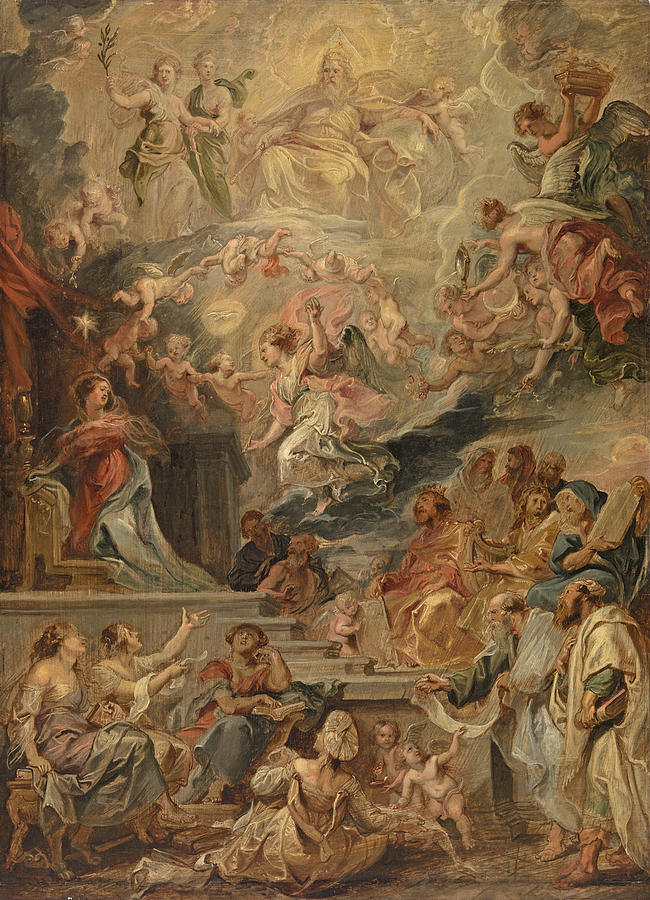
“The Incarnation as Fulfillment of All the Prophecies” by Peter Paul Rubens is a dazzling meditation on how the birth of Christ brings to completion the long history of divine promises. The painting is conceived like a grand celestial drama. Heaven and earth are both present, prophets and sibyls debate and listen, angels rush between realms, and the Virgin Mary becomes the vital hinge where all prophecies are realized. Rubens uses every tool of the Baroque language—sweeping diagonals, crowded yet legible groups, intense light, and sumptuous color—to transform complex theology into a living spectacle. The viewer is drawn into a visual sermon that moves from questions to revelation, from reading to seeing, from expectation to fulfillment.
Theological and Historical Context
Rubens worked in a Catholic Europe shaped by the Counter-Reformation, when painting was expected to teach, persuade, and move the faithful. The Council of Trent encouraged artists to present doctrine clearly yet emotionally, so that images could act almost like sermons. This painting responds directly to that expectation. The very title emphasizes doctrine: the Incarnation, the moment when the Word becomes flesh in the person of Christ, is shown as the event that makes sense of all earlier prophecies, both Hebrew and classical. Prophets from the Old Testament, along with sibyls from pagan antiquity, are gathered as witnesses who pointed forward to Christ even when they did not fully understand the meaning of their message.
Rubens was unusually well equipped for such a subject. Educated, fluent in several languages, and deeply interested in both classical literature and Christian theology, he often designed complex allegories for courts and churches. In this work, he fuses scholarly content with a theatrically accessible style, so that erudite viewers can identify specific figures and texts while ordinary worshippers respond to the emotional and spiritual movement of the scene.
A Multi-Level Composition
The composition is structured in tiers that function almost like a vertical narrative. At the top is the divine realm: God the Father enthroned in light, accompanied by personifications who embody aspects of his will. Below this, a swirling band of angels bridges heaven and earth. Further down sit prophets and sibyls on tiered steps, debating and deciphering written prophecies. At the left, slightly isolated yet central to the meaning of the work, stands the Virgin Mary, the human being through whom the Incarnation enters history.
The eye does not simply read these levels as separate zones; Rubens orchestrates them through powerful diagonals and arcs of movement. Figures gesture upward, angels fly in sweeping curves, rays of light descend. The compositional lines pull the viewer’s gaze from the questioning voices of the prophets up toward the radiant confirmation in heaven, and then back down to Mary, who receives the result of this divine counsel. In doing so, Rubens makes the viewer’s act of looking mirror the theological journey from prophecy to fulfillment.
The Heavenly Court and Divine Will
In the uppermost register, God the Father presides from within a glowing cloud. He is depicted as an elderly yet powerful patriarch, robed in golden light. Around him gather allegorical female figures, likely representing virtues or divine attributes such as Wisdom and Providence. Their presence suggests that the Incarnation is not a sudden improvisation but the unfolding of a long-intended plan rooted in divine wisdom.
The cloud upon which the heavenly figures sit is both solid and vaporous. Rubens uses creamy whites, soft yellows, and silvered grays, applied in loose, energetic brushstrokes, to give the feeling of a living, moving atmosphere. This nebulous throne extends outward to support small angels, who peek from behind the godhead or dance along its edges. The entire upper field radiates a diffused light that bathes both the divine court and the descending messengers, suggesting that the will of God is not distant but actively pouring into the rest of the composition.
Angels as Messengers of Fulfillment
Between heaven and earth, angelic figures form the dynamic heart of the painting. A sweeping chain of cherubs and winged youths crosses the middle of the canvas, uniting the divine throne with the human assembly below. Some carry laurel wreaths, emblems of victory; others hold tablets or scrolls, reminders of prophecy and law. Their bodies twist and dive in complex foreshortening, their draperies snapping in an unseen wind, giving the impression of an invisible spiritual force driving history forward.
A particularly striking figure is the angel in the center who descends directly toward the Virgin. This angel’s movement is both graceful and urgent, the body curved like a question mark that now finds its answer. The pose echoes the traditional iconography of the Annunciation, where an angel brings the message of Christ’s conception to Mary, but Rubens expands it to encompass not just a private moment but the entire history of prophecy. The angel is almost a living bridge; its downward motion channels the intention of God toward the earthly realm, while the upward tilt of its face keeps it in dialogue with heaven.
The Virgin Mary as Center of Fulfillment
On the left side of the composition, slightly lower than the angels but elevated above the prophets, stands the Virgin Mary. Clad in the familiar colors of blue and red, she is at once humble and majestic. Her right hand is placed upon her chest, a gesture of astonished acceptance; her left extends outward, opening herself to the message. Her figure is framed by architectural elements, including a column and a platform that suggest an interior space, perhaps meant to evoke the house of Nazareth where the Annunciation traditionally occurs.
Mary’s position is crucial. She does not sit among the debaters below, nor does she yet join the glory of heaven above. She occupies the threshold where divine promise enters human flesh. By placing her here, Rubens makes her the living hinge of salvation history. The prophets have announced, the angels carry the decree, God has willed it, but the Incarnation only unfolds because Mary consents. Her figure thus becomes the embodiment of faithful human response, the moment when receptivity allows fulfillment to take root.
Prophets and Sibyls in Learned Debate
The lower right portion of the painting is crowded with figures in animated conversation: bearded men in heavy robes, women in flowing gowns, and a few more youthful scholars. They hold scrolls and codices, the physical signs of prophecy and scripture. Several look upward in awe, others point toward Mary as if suddenly understanding that their texts find their meaning in her. Some continue to argue, their brows furrowed, their hands emphasizing particular passages.
Rubens likely intends these figures to represent Old Testament prophets such as Isaiah or Jeremiah, along with sibyls—pagan prophetesses whom Christian tradition believed had, in veiled ways, foretold the coming of Christ. By including both, Rubens dramatizes the idea that the Incarnation is anticipated not only within the history of Israel but also, in shadowed form, throughout the cultures of antiquity. The steps on which they sit rise toward Mary and the heavenly hosts, implying that the long climb of interpretation leads eventually to the recognition of Christ.
The treatment of these learned figures is particularly sensitive. Their robes are rendered in earthy tones of ochre, brown, and muted red, emphasizing their rootedness in history. Yet Rubens paints their faces with a lively variety of expressions—wonder, skepticism, joy, confusion—so that the group becomes a panorama of human reaction to revelation. This human diversity underscores the generous scope of fulfillment: the Incarnation addresses every kind of seeker and scholar, even those who struggle to understand.
Children and Everyday Humanity
Amid the intellectual intensity of the prophets, Rubens includes gentle touches of everyday humanity. Small children play or peer upward, one baby seated near the center of the lower group, another reaching toward an adult figure. One child in the foreground offers a small dish, echoing the theme of offering oneself to a larger purpose. These tiny presences allude to the fact that the Incarnation ultimately centers on a child—Christ himself—and that the promises of God reach ordinary families and future generations, not just learned elites.
These figures also demonstrate Rubens’ delight in painting the human body at different ages. Plump limbs, tousled hair, and playful postures give the painting warmth and tenderness. The theological drama, though grand, is never detached from bodily life. The divine plan concerns flesh and blood; children remind the viewer of that incarnational realism.
Light, Color, and Atmosphere
Light in this painting is not simply illumination; it is a narrative force. A warm, golden radiance emanates from the upper center, around God the Father, and streams downward through the angels toward Mary. This light gradually dissipates as it reaches the lower right corner, where the prophets sit in relative shadow. The effect is to create a gradient of understanding: heaven is pure clarity, Mary is bathed in a strong yet gentle glow, while the scholars dwell at the border where insight is dawning but not yet complete.
Rubens’ color palette reinforces this hierarchy. Heavenly figures are wrapped in pale, almost iridescent robes—creams, soft greens, and pastel pinks—that catch the light and contribute to the airy atmosphere. The Virgin’s garments, in contrast, are saturated and solid, with deep blue and rose red asserting her physical reality. The prophets wear heavy browns, oranges, and dull greens, their hues echoing stone and earth. The interplay of warm and cool tones, light and shadow, creates a visual rhythm that keeps the eye moving and reinforces the idea of revelation flowing through history.
The painter’s brushwork is equally expressive. In the clouds and angels, strokes are quick, feathery, and loosely blended, conveying motion and spiritual energy. In the prophets’ robes and the architectural elements, the handling is firmer, with folds articulated by decisive highlights and shadows. This contrast in texture helps distinguish between the ethereal and the earthly domains.
Movement, Gesture, and Baroque Dynamism
Rubens was a master of Baroque dynamism, and this painting is an exemplary demonstration. There is scarcely a figure that sits in calm repose. Bodies twist, lean, and reach; draperies swirl; clouds billow; angels soar. Yet the movement is not chaotic. It is organized around key diagonals and arcs that link the central themes of the piece.
One can trace a sweeping S-curve starting from the prophets at the lower right, rising through the central angel, and culminating in the throne of God at the upper center. A counter-movement runs from Mary at the left up through the band of cherubs and across to the right, where angels distribute symbols of the fulfilled prophecies. These interlocking flows of motion mirror the complex interplay of human inquiry and divine initiative. The world of the painting feels vibrantly alive, reinforcing the idea that history itself is being stirred and transformed by the Incarnation.
Gestures are especially eloquent. A prophet points directly toward Mary, as if finally connecting text and person. A sibyl clutches her scroll with new urgency. Mary’s hand to her heart signals both surprise and acceptance. Angels extend arms outward as though presenting divine decrees. For the viewer, these gestures act as guideposts, directing attention and revealing a chain of meaning without the need for written words.
The Incarnation as the Key to Interpretation
The painting’s title reminds us that the theme is not merely the Annunciation but the Incarnation understood as the fulfillment of all prophecies. Rubens visualizes this idea by showing how every part of the image converges toward Christ’s coming in the flesh. The prophets and sibyls below represent the partial, anticipatory knowledge of earlier ages. Their scrolls are full of signs and promises, but their meaning remains obscure until the moment God acts decisively in history. The heavenly court above represents divine intention and sovereignty, the source from which the plan of salvation originates. The angels embody the movement of that plan, carrying messages and instruments between realms.
Mary’s role is to receive and to embody. Through her consent, the Word becomes flesh, and the texts of prophecy are transformed into the living presence of the Savior. Rubens does not show the infant Christ directly; instead he focuses on the charged moment just before his conception and birth, when heaven and earth are aligned and all history leans forward. The absence of the child creates a powerful sense of anticipation; the viewer understands that everything in the image is poised on the brink of fulfillment.
In this way, the painting can be seen as a meditation on interpretation itself. The prophets read and speak; the sibyls foresee; scholars debate. But understanding remains partial until the Incarnation supplies the definitive context. The message is clear: the correct reading of history and scripture flows from the person of Christ. Rubens thus uses pictorial form to deliver a distinctly theological argument.
Devotional Impact and Viewer Experience
Beyond its intellectual sophistication, the work is designed to move the heart. A worshipper standing before the painting would experience a powerful sense of being caught up in a grand, upward-rising movement. The busy lower zone with its debates and doubts mirrors the viewer’s own world of questions. The radiant upper zone invites trust in a divine plan that transcends human reasoning. Mary’s quiet yet resolute acceptance offers a model of faith, while the angels’ joyous energy suggests that the fulfillment of God’s promises is a cause for celebration, not fear.
Rubens intensifies this devotional impact by involving the viewer visually. The steps in the foreground recede toward the center, as if inviting one to climb and join the assembly of seekers. Some figures face outward, their gestures extending into the viewer’s space, breaking the barrier between painting and observer. The theatricality characteristic of Baroque art here becomes a spiritual device: it draws the spectator into the drama of prophecy and fulfillment, encouraging a personal response.
Place within Rubens’ Oeuvre
“The Incarnation as Fulfillment of All the Prophecies” belongs to a broader group of Rubens works that explore complex theological themes through elaborate multi-figure compositions. Similar qualities can be found in his altarpieces devoted to the Eucharist, the Triumph of the Church, and the history of saints. In each case, Rubens embraces large casts of characters, intricate symbolism, and a dramatic interplay between earth and heaven.
What distinguishes this work is its emphasis on intellectual and spiritual continuity across time. By bringing together Hebrew prophets, classical sibyls, Christian scholars, angels, and the Virgin, Rubens offers a sweeping vision of universal history oriented toward Christ. The painting thus exemplifies the Baroque desire to integrate learning and piety, antiquity and Christianity, narrative and allegory. It demonstrates Rubens’ unique ability to translate ideas that might seem abstract or academic into vivid, emotionally compelling imagery.
Conclusion
“The Incarnation as Fulfillment of All the Prophecies” is a masterful synthesis of doctrine, artistry, and emotion. Through its tiered composition, its surging movement, its luminous color, and its expressive figures, the painting presents the Incarnation as the decisive key that unlocks the meaning of all earlier prophecy. Heaven and earth are shown in conversation; prophets and sibyls struggle to understand; angels rush between realms; and Mary stands at the center as the willing recipient of divine grace. Rubens merges learned symbolism with sensory richness, inviting viewers not only to admire his technical brilliance but to contemplate the mystery of a God who enters history and fulfills every promise. The result is an image that remains both visually breathtaking and spiritually resonant, a perpetual unfolding of meaning for anyone who stands before it and lets their gaze follow the painting’s upward-soaring path from question to fulfillment.