Image source: wikiart.org
Introduction to The Immaculate Conception with the Eternal Father
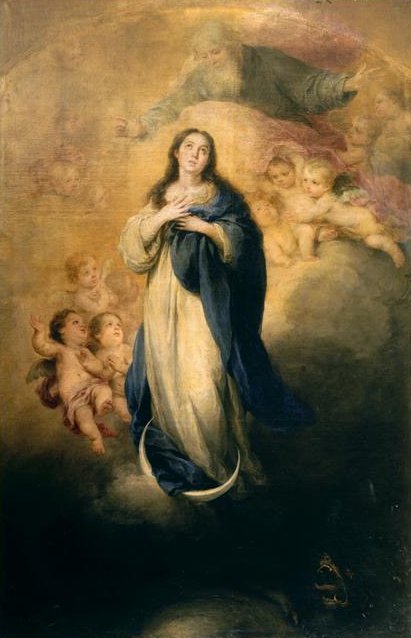
“The Immaculate Conception with the Eternal Father,” painted by Bartolomé Esteban Murillo in 1669, is among the most radiant and theologically rich works in his long engagement with Marian subjects. In this canvas Murillo brings together the figure of the Virgin Mary, the cherubic hosts of heaven, and the majestic presence of God the Father to express a core belief of Catholic doctrine, Mary preserved from original sin from the first instant of her existence.
The painting presents Mary rising before a field of golden light, wrapped in her familiar white dress and deep blue mantle. She stands on a crescent moon carried by clouds and cherubs, while above and behind her the Eternal Father leans forward, extending his arms in a gesture of blessing. The scene is at once intimate and cosmic, a marriage of soft Sevillian naturalism and grand Baroque theology.
The Immaculate Conception in Seventeenth Century Spain
To appreciate Murillo’s painting, it helps to recall how important the doctrine of the Immaculate Conception was in seventeenth century Spain. Long before it became an official dogma, Spanish theologians, confraternities, and artists championed the belief that Mary, chosen to be the Mother of Christ, was conceived without the stain of original sin. Seville, Murillo’s home city, was a center of this devotion.
Painters were commissioned to make the doctrine visible. Rather than depicting Mary as a child, artists usually showed her as a young woman already full of grace, lifted in glory above the world. Murillo became one of the greatest interpreters of this subject. In “The Immaculate Conception with the Eternal Father,” he adds a powerful element, the direct presence of God the Father, who affirms Mary’s unique grace from above. This inclusion reinforces the idea that the Immaculate Conception is not a vague compliment but a deliberate act of divine will.
Composition and Vertical Ascent
The composition of this painting leads the eye upward. Mary’s figure is centrally placed, rising like a slender column of light from the darker lower register toward the blazing golden cloud at the top. Her body is slightly turned, her head tilted gently upward, and her hands crossed on her breast in an attitude of humility and adoration.
Below, swirling clouds and cherubs create a base that seems to lift her. The crescent moon at her feet, pale and delicate, curves along the bottom of her dress, a traditional reference to the Woman of the Apocalypse described in the Book of Revelation. Above and behind Mary, the Eternal Father appears within a luminous cloud, leaning forward with open arms as if embracing her with his gaze and blessing. On either side of Mary, groups of cherubs populate the clouds, their plump bodies and delighted faces filling the space with movement and song.
This vertical arrangement creates a clear hierarchy, yet Murillo’s soft transitions between light and shadow make the ascent feel fluid. Mary does not look stiffly suspended, she seems to be gently drawn upward by grace itself.
The Figure of Mary as Ideal of Grace
Murillo’s Mary is youthful, serene, and deeply human. Her features are delicate but not unreal, suggesting a girl from Seville transformed by holiness. Her large eyes and slightly parted lips convey a mixture of awe and quiet trust. She does not appear overwhelmed by glory but absorbed in it.
Her hands are crossed over her chest, a gesture that combines modesty, acceptance, and love. The pose recalls the words of the Gospel where Mary consents to God’s will. In the context of the Immaculate Conception, this gesture suggests that the grace she received from the first moment of her existence is now embraced freely and consciously.
Murillo paints her garments with flowing softness. The white tunic symbolizes purity, while the deep blue mantle, edged with subtle folds, signals her role as Queen of Heaven. The fabric does not cling harshly to her body but billows gently, echoing the clouds and giving a sense of heavenly air. The subtle play of light across the cloth emphasizes her luminous presence without turning her into an abstract symbol.
The Eternal Father and the Heavenly Court
A distinctive feature of this version of the Immaculate Conception is the inclusion of the Eternal Father in the upper part of the canvas. He is depicted as an older, bearded figure emerging from a dense golden cloud. One arm extends outward, the other bends toward Mary, suggesting both command and affection. His body leans forward, as if he is presenting Mary to the world and at the same time drawing her closer to himself.
Murillo does not render the Father with the severe majesty seen in some earlier works. Instead, his expression is gentle, almost tender. This softens the potentially intimidating image of divine authority and aligns it with Murillo’s general emphasis on mercy and kindness. The Father’s presence makes clear that Mary’s Immaculate state is not self generated, it is an effect of God’s loving initiative.
Around Mary and the Father, clusters of cherubs and angelic heads fill the sky. Their rounded faces, playful gestures, and fluttering draperies are typical of Murillo. Some look toward Mary in adoration, others exchange looks among themselves, and a few seem to sing or shout. This chorus of innocence underscores the theme of purity that runs through the entire painting.
Light, Color, and the Glow of Grace
Light in “The Immaculate Conception with the Eternal Father” is not simply a physical phenomenon, it carries theological meaning. The painting is suffused with a warm golden radiance that emanates from the heavenly cloud surrounding the Father and Marian figure. This light spills downward, bathing Mary and the cherubs in soft illumination while leaving the outer edges comparatively darker.
The effect is similar to looking at a candle in a dim room, where the most intense brightness is at the center and gradually fades outward. In spiritual terms, Mary stands at the heart of divine favor, surrounded by the glow of grace that flows from God.
Murillo’s color palette is dominated by delicate creams, soft golds, and gentle blues. The interplay of the cool blue mantle and warm golden atmosphere creates harmony. The cherubs are painted in rosy flesh tones, adding a touch of earthly sweetness to the heavenly scene. There is very little harsh contrast, which contributes to the sense of calm beatitude.
Subtle touches of deeper color, such as the darker folds of the mantle or the shadowed edges of the clouds, give structure without disrupting the overall luminosity. This careful control of color and light is one of the reasons Murillo’s Immaculate Conceptions are so admired.
Symbolism of the Crescent Moon and Serpent
At Mary’s feet is a narrow crescent moon, luminous against the darker lower part of the painting. The moon is a key symbol for the Immaculate Conception. Drawing from the vision in Revelation of a woman “clothed with the sun, with the moon under her feet,” it signifies Mary’s victory over the changeable world and the realm of darkness. Murillo paints the moon as delicate and almost translucent, reinforcing the idea that it is a celestial support rather than a physical object.
Near the bottom right, partly lost in shadow, we can discern a serpent crushed or driven away. This small but important detail refers to the ancient promise in Genesis that the offspring of the woman would crush the serpent’s head. In the context of the Immaculate Conception, it emphasizes that Mary herself is untouched by the serpent’s venom, preserved from sin as a preparation for her role in salvation history.
Together, the moon and serpent situate Mary within a biblical continuum. She is both the humble girl of Nazareth and the triumphant woman of the apocalyptic vision, already sharing in the victory of her Son.
Murillo’s Devotional Style and Sevillian Context
Murillo developed his mature style in Seville, a city shaped by intense Catholic devotion, flourishing confraternities, and a strong tradition of religious art. His paintings were meant to serve not only as decoration but also as instruments of contemplation and prayer.
In this canvas, Murillo’s characteristic tenderness is evident. Unlike some stark Counter Reformation imagery that focuses on suffering, this work invites viewers to bask in joy and consolation. The expressions are gentle, the forms rounded, and the colors warm. Mary appears approachable, almost as if she invites the viewer into her gaze upward toward God.
At the same time, Murillo adheres to the iconographic guidelines set by theologians and artists for the Immaculate Conception. The youthful Virgin, the blue and white garments, the moon, the cherubs, and the golden light all follow established patterns. What makes his version distinctive is the way he softens and personalizes these elements, creating an image that feels less like a rigid formula and more like a living encounter.
Emotional and Spiritual Impact on the Viewer
“The Immaculate Conception with the Eternal Father” is designed to stir both the heart and the mind. The viewer is first drawn in by the beauty of Mary’s figure and the luminous atmosphere. The gentle expressions and tender gestures create an immediate sense of comfort. Then, gradually, the deeper theological meanings emerge.
Mary’s humble posture encourages an inner response of trust. The Father’s extended arms suggest that divine grace is active, generous, and personal. The cherubs, full of innocent joy, remind us of the purity to which believers are called.
Standing before this painting, a viewer might experience a sense of being lifted above daily worries into a more serene vision of reality, where sin is conquered and love reigns. Murillo’s brush translates doctrine into emotion, making a complex teaching about original sin and prevenient grace feel like a simple, powerful assurance of God’s care.
Place of This Work in Murillo’s Series of Immaculate Conceptions
Murillo painted many versions of the Immaculate Conception throughout his career, each with slight variations in pose, composition, and surrounding figures. This particular work, with the addition of the Eternal Father, occupies a special place in the series. It makes explicit the relationship between Mary’s unique grace and the will of God, while retaining the soft, contemplative character that defines Murillo’s Marian imagery.
Compared with some of his more monumental versions, this canvas feels slightly more intimate, even though the subject remains cosmic. The Father’s closeness, the tight cluster of cherubs, and the relatively narrow vertical format concentrate the viewer’s attention on a single axis of love that runs from God to Mary and, by implication, to all humanity.
In the larger story of Baroque art, this painting represents a high point in the visual articulation of the Immaculate Conception, a doctrine that had shaped Spanish piety for generations. Murillo gives that devotion a face and a luminous space where contemplation can unfold.
Conclusion
“The Immaculate Conception with the Eternal Father” by Bartolomé Esteban Murillo is a masterpiece of Baroque devotion and theological imagination. Through careful composition, radiant light, symbolic detail, and tender characterization, Murillo offers a vision of Mary as completely graced, lovingly chosen, and intimately united with God.
The presence of the Eternal Father above her transforms the familiar iconography of the Immaculate Conception into a dialogue between divine giver and human recipient of grace. Surrounding cherubs, the crescent moon, and the defeated serpent enrich the narrative with layers of biblical reference and symbolism.
For viewers then and now, the painting invites a response of admiration, trust, and quiet joy. It shows a world in which sin does not have the final word and where divine love can fill a human life so completely that it becomes luminous. Murillo’s canvas continues to glow as an image of hope, purity, and the gentle power of grace.