Image source: wikiart.org
Introduction to The Immaculate Conception with Saint Joachim and Saint Anne
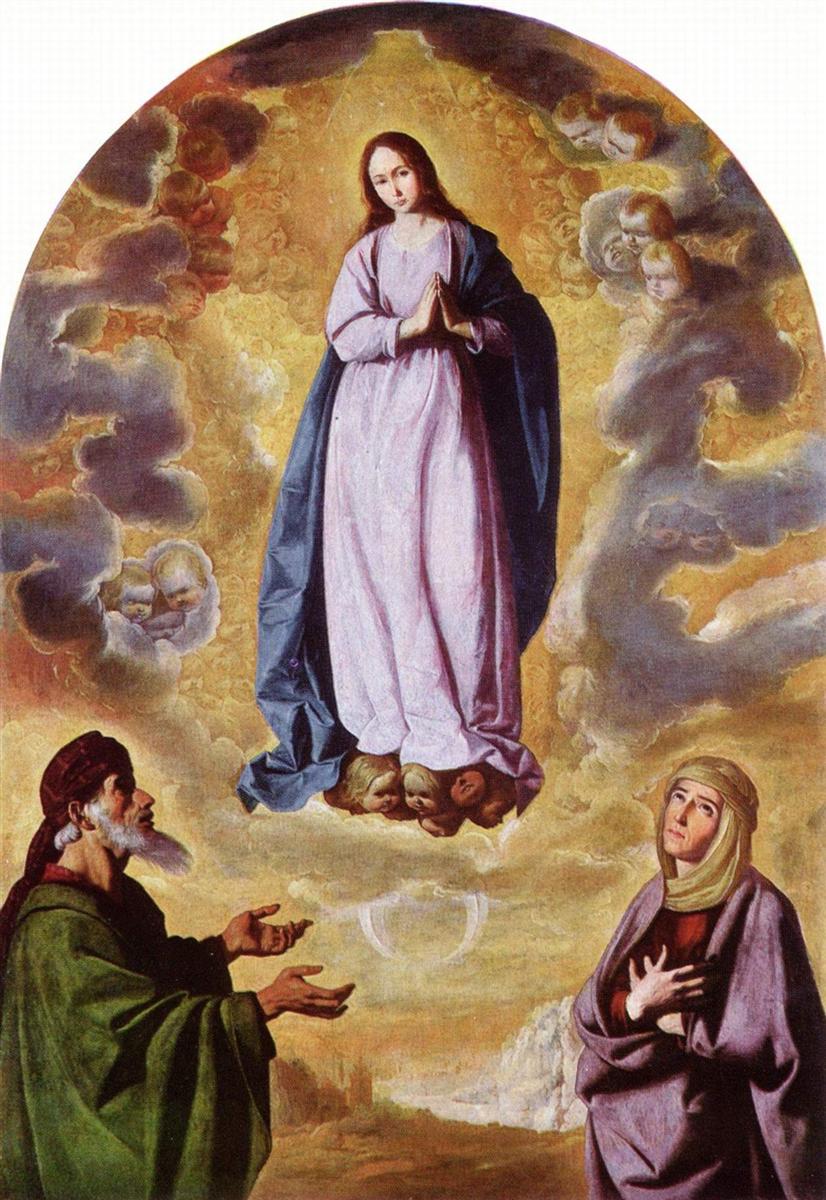
Francisco de Zurbaran’s “The Immaculate Conception with Saint Joachim and Saint Anne,” painted in 1640, is a luminous meditation on the mystery of Mary’s sinless conception and on the quiet faith of her parents. The painting presents the Virgin as a young girl, rising weightlessly in a glowing heaven of clouds and cherubs, while Joachim and Anne contemplate her from the earthly realm below. With its soft gold tones, delicate modeling and solemn stillness, the work captures both the theological richness of the doctrine and the intimate family story behind it.
In seventeenth century Spain the Immaculate Conception was not simply an abstract dogma. It was a passionately loved belief, defended by theologians, promoted by kings and venerated by ordinary people. Artists like Zurbaran were called on to give this devotion a visible form. In this canvas he does so with great clarity. The Virgin stands at the center of a celestial mandorla of light, hands joined in prayer, gently inclined head suggesting humility. Below, her parents look up with a mixture of wonder, gratitude and reverence. Heaven and earth meet in a composition that feels at once majestic and tender.
Historical and Theological Context
The doctrine of the Immaculate Conception affirms that Mary, from the first moment of her existence, was preserved by God from original sin in view of the merits of Christ. Long before it was officially defined, Spanish theologians and faithful vigorously promoted this belief. Seville, where Zurbaran worked, was one of the strongholds of the movement. Processions, confraternities and liturgical feasts celebrated Mary as conceived without stain. Artists were asked to translate complex theology into clear images that could teach and inspire.
The inclusion of Saint Joachim and Saint Anne in this painting widens the focus. According to tradition, these two elderly spouses longed for a child. After years of infertility, an angel announced that their prayer had been heard. Their daughter Mary would be uniquely blessed. By placing them at the bottom corners of the composition, Zurbaran reminds viewers that the mystery of the Immaculate Conception is rooted in the story of a real family. The divine privilege given to Mary emerges from the quiet fidelity of her parents.
At the same time, the canvas reflects a broader Counter Reformation emphasis on the intercession of saints and on Mary’s role as a pure, powerful advocate. Joachim and Anne do not compete with their daughter’s glory. They model how believers are to respond to God’s gifts with humble praise.
Composition and Spatial Structure
The painting has an arched top, which Zurbaran uses to reinforce the sense of a heavenly vision. The composition is strongly vertical. Mary’s figure occupies the central axis, rising upward from a cluster of cherub heads at her feet toward the apex of the arch. Her body forms a slender column of pale color framed by the deep blue of her mantle. Around her a swirling golden cloud filled with angelic faces creates a radiant backdrop.
The lower zone of the painting contains Joachim on the left and Anne on the right. They stand on what appears to be a low plateau or rocky plain. Between them stretches a pale landscape, with small architectural hints on the horizon. This earthly band is much narrower than the heavenly space above, which emphasizes how the mystery being contemplated belongs primarily to the realm of grace.
The two saints are angled slightly inward, their gazes converging on Mary. Joachim extends his hands with open palms, as if presenting or receiving the miracle that appears before him. Anne crosses her hands over her chest and looks upward with a gentle expression of awe. These gestures form a kind of visual echo of Mary’s own prayerful posture, creating harmony between the three figures and linking earth to heaven.
The Figure of the Virgin
Zurbaran’s Mary is youthful, almost adolescent, embodying innocence rather than royal majesty. She stands with hands joined at her chest, fingers slightly apart, a pose that suggests both prayer and acceptance. Her head tilts modestly to one side. The features are soft and regular, with a faint, contemplative melancholy in the eyes. There is no exaggerated ecstasy, only quiet recollection.
Her garments follow the traditional color scheme. She wears a long pale rose tunic, almost lavender in the soft light, and a deep blue mantle that falls in heavy folds from her shoulders. The colors are symbolic. Rose hints at love and human flesh, while blue traditionally evokes heaven and spiritual wisdom. In this painting the tones are subdued rather than saturated, which reinforces the atmosphere of purity.
Mary’s feet rest on a cloud supported by small cherub heads. Below this cloud, faintly visible, is a crescent moon, another classic symbol of the Immaculate Conception. It recalls the woman “clothed with the sun” and “with the moon under her feet” from the Book of Revelation. By placing Mary above the moon, Zurbaran signals her victory over changeable earthly weakness and over the darkness associated with sin.
What is striking is the balance between elevation and approachability. Mary is high above Joachim and Anne, surrounded by angelic hosts, yet she remains modest, almost simple. This double aspect reflects the Spanish devotion that saw Mary as both exalted Queen and tender Mother.
Saint Joachim and Saint Anne
In the lower left corner Joachim appears as an elderly man with white beard, wrapped in a green mantle and a red head covering. His profile is sharply drawn. He gazes upward with an expression that mixes astonishment, joy and a hint of pleading. His outstretched hands are empty, palms open. This gesture can be read as thanksgiving for the gift of his daughter, or as an act of offering, placing Mary entirely in God’s hands, acknowledging that her special holiness is a grace beyond his own merit.
On the opposite side Anne stands in a reddish tunic and ocher veil. Her body is turned slightly toward the center, but her face tilts upward. Her right hand touches her chest, near her heart, while her left supports it in a calmer echo of her husband’s more expansive gesture. She appears deeply moved, but her emotion is more interior. This contrast between the more active Joachim and the contemplative Anne brings variety and psychological nuance to the lower register.
Their garments pick up and transform the colors found in Mary’s clothing. Joachim’s green mantle suggests hope and life, reflecting the new hope that Mary’s conception brings to humanity. Anne’s reddish tones resonate with Mary’s rose tunic, emphasizing the maternal bond and the human lineage through which the Savior will enter history. At the same time, their mature faces and humble clothing remind viewers that holiness unfolds within ordinary married life and prolonged patience.
Clouds, Cherubs and the Heavenly Realm
The upper two thirds of the canvas are dominated by clouds and angelic faces. Zurbaran uses a warm golden palette for the central cloud that supports Mary, creating an effect of luminous glory. Around the edges cooler gray and violet clouds intrude, as if the darker skies of the world are being pushed back by the radiance of this mystery.
Within the golden area numerous cherub heads appear, some clearly defined, others barely emerging from the light. These angelic children surround Mary like a living border. Rather than forming a strict chorus, they float irregularly, giving the scene a gentle movement. Their presence emphasizes Mary’s privileged place in the order of grace. She is a human being, yet her purity makes her companion of the angels.
The cherubs at her feet are more prominent. Three or four small faces peer out from the cloud that lifts her up. They function almost like supporting pillars, reinforcing the impression that heaven itself bears her. At the same time, their youthful features connect the heavenly sphere with the theme of birth and childhood that underlies the Immaculate Conception.
Zurbaran’s handling of the clouds is painterly and expressive. Soft transitions of tone create depth. The golden light seems to emanate from behind Mary, framing her silhouette with a halo-like aura that replaces a conventional circular nimbus. This solution suits the vertical format and contributes to the sense that she is “clothed with the sun.”
Color, Light and Emotional Atmosphere
Light in this painting is not a single directional beam but an enveloping, diffuse glow. The golden sky functions almost as a source of illumination in itself, casting warm reflections on Mary’s garments and on the faces of Joachim and Anne. There are shadows, particularly in the folds of clothing and along the edges of the clouds, but they never become harsh. The overall effect is one of gentle luminosity.
The color scheme weaves together warmth and coolness. The gold of the clouds and the beige tones of the landscape create a warm foundation. Against this background the blues and soft pinks of Mary’s garments stand out without appearing aggressive. Joachim’s green and Anne’s muted red provide complementary tones that connect the lower and upper parts of the composition.
Emotionally, the painting radiates serenity. There is no violent movement, no stormy sky, no dramatic contrast of light and dark. Instead, the viewer encounters a still, contemplative vision. This calmness matches the theological subject. The Immaculate Conception is understood as a hidden, gentle act of grace at the very beginning of Mary’s existence, not a tumultuous crisis. Zurbaran’s light translates that hidden grace into a visible, softly glowing space.
Iconographic Details and Marian Symbolism
Zurbaran follows the established iconography of the Immaculate Conception, yet he also introduces small variations that reveal his personal approach. Key symbols include the crescent moon under Mary’s feet, the clouds, the crown of cherubs and the posture of prayer.
The moon alludes to her victory over sin and to her role as reflected light of the Sun of Justice, Christ. The fact that the moon is faint and almost transparent may hint at the hiddenness of the mystery. Viewers attentive to scripture would also recognize the connection to the apocalyptic woman from Revelation.
Mary’s hands joined in front of her heart recall the words of the angelic greeting, “Hail, full of grace,” and her response, “Behold the handmaid of the Lord.” Even though the painting refers to her conception rather than the Annunciation, Zurbaran uses this familiar gesture to express her constant attitude of receptivity to God.
The cherubim and the almost womb like golden cloud surrounding Mary can be read as visual metaphors for a “new creation.” She stands at the center of a renewed cosmos, a space of holiness prepared from all eternity. By including Joachim and Anne at the bottom, the painter underscores that this new creation is inserted into human history through a specific family.
Zurbaran’s Style and Comparison with Other Immaculate Conceptions
Zurbaran was not the only seventeenth century Spanish painter to tackle the theme of the Immaculate Conception. Artists like Murillo and Velazquez also produced celebrated versions. Compared to Murillo’s later Immaculate Conceptions, which often show Mary in swirling movement and ecstatic expression, Zurbaran’s 1640 canvas is more sober and restrained. His Virgin is still and upright, her gaze quiet rather than rapturous.
This difference reflects Zurbaran’s overall style. He tends to favor sculptural solidity and contemplative mood over fluid motion. Figures in his religious paintings often appear as statues come to life, enveloped in deep folds of cloth and lit with steady illumination. In this work the heavy blue mantle, the calm verticality and the carefully structured clouds all reveal that tendency.
Yet the painting is not static. The subtle rotations of the cherubs, the diagonals suggested by the clouds and the interplay of gestures between Mary and her parents keep the composition alive. Zurbaran achieves a delicate balance between monumentality and tenderness, making the scene suitable for prolonged devotional viewing.
Spiritual Interpretation and Devotional Impact
For believers in Zurbaran’s time, this painting would have served as more than an illustration of doctrine. It would have been a focus of prayer, especially during feasts of the Virgin. Joachim and Anne at the bottom act as guides for the viewer. Their gestures of awe and gratitude model the appropriate response to the mystery they behold. Standing before the canvas, one can almost join them in lifting one’s gaze upward.
The painting invites contemplation of several spiritual themes. First, the absolute gratuity of grace. Mary’s privilege is not something she earned. It is a gift from God, prefiguring the redemption that Christ will bring to all. Second, the importance of humble, persevering faith, represented by Joachim and Anne. Their long patience and obedience prepare the way for a new dawn in salvation history. Third, the harmony between heaven and earth. The painting suggests that God’s great works often unfold within ordinary family life and that the saints intercede for the world from within that fabric.
For contemporary viewers, even those outside the specific theological tradition, the painting can speak of innocence, hope and the beauty of human relationships touched by transcendence. The loving gazes between the figures, the enveloping light and the sense of calm uplift the spirit and encourage trust.
Conclusion
“The Immaculate Conception with Saint Joachim and Saint Anne,” painted by Francisco de Zurbaran in 1640, is a refined and deeply spiritual work that brings together theology, family devotion and Baroque artistry. Through a vertical composition centered on the youthful Virgin Mary, rising in a cloud of golden light, the painter translates the mystery of her sinless conception into a clear and moving image. The presence of her parents, gazing upward in awe, grounds the scene in human history and offers viewers a path into contemplation.
Zurbaran’s controlled use of light, his subtle color harmonies and his characteristic stillness create an atmosphere of serene glory. The painting remains a powerful witness to seventeenth century Spanish Marian devotion and to the enduring human longing for purity and grace.