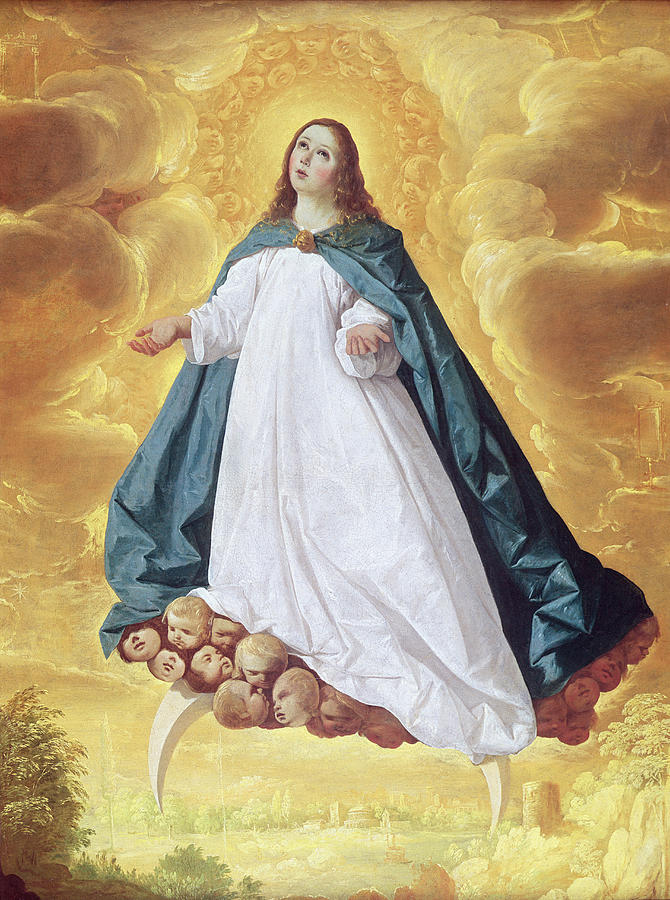
Image source: wikiart.org
Historical Context of The Immaculate Conception
Francisco de Zurbaran’s “The Immaculate Conception” belongs to a long and passionate chapter of Spanish religious history. In seventeenth century Spain the belief that Mary had been conceived without original sin was at the center of popular devotion, theological debate and artistic patronage. Although the doctrine was not officially defined until the nineteenth century, Spanish clergy, monarchs and ordinary believers already championed it as a distinctive mark of their faith. Confraternities organized processions, churches commissioned altarpieces, and artists such as Zurbaran, Murillo and Valdés Leal competed to give visual form to this mystery.
Zurbaran, renowned for his austere depictions of monks and martyrs, might seem an unlikely painter of such luminous Marian imagery. Yet his contemplative temperament and mastery of light made him uniquely suited to the subject. In this version of “The Immaculate Conception” he combines doctrinal clarity with poetic imagination, presenting Mary as a youthful figure who rises above the world on a cloud filled with cherubs, supported by a crescent moon and framed by radiant golden skies. The painting demonstrates how Spanish Baroque art could be both intellectually precise and deeply emotional, translating complex theology into a single unforgettable image.
Composition and Overall Structure
The composition is vertically oriented and strongly centralized. Mary occupies nearly the entire height of the canvas, her long white gown forming a simple yet powerful column of light that anchors the scene. She is slightly elevated above the lower edge of the image, floating on a dense cloud populated by the heads of cherubic angels. Under this cloud two elegant crescents, echoing the shape of the moon, curve downward toward the landscape below. The entire upper portion of the painting is filled with swirling golden clouds that open into a luminous halo around her head.
Zurbaran aligns Mary’s body almost frontally. Her feet are hidden by the cloud, but the fall of her robe and the positioning of her arms suggest a stable, almost monumental stance. Her head tilts gently upward, her eyes turned toward the unseen source of divine light above. This slight inclination prevents the composition from becoming rigid while maintaining a sense of calm symmetry. The expansive blue green mantle that wraps around her shoulders opens outward on both sides like a pair of wings, widening the form and balancing the vertical drive of the gown.
Below, barely visible through the golden atmosphere, stretches a serene landscape of fields, trees and distant buildings. This terrestrial zone is comparatively small, emphasizing the distance between earthly life and the heavenly realm Mary inhabits. Yet its presence reminds viewers that her purity has meaning for the world, not only for the heavens.
The Figure of Mary
Mary appears as a very young woman with soft features, fair skin and auburn hair. Her face is calm and slightly idealized, but not cold. Zurbaran avoids excessive sweetness by giving her a thoughtful, almost introspective expression. She looks upward with parted lips, as if she is quietly listening or responding to the voice of God. Her gaze does not fix on the viewer; instead, it passes beyond the picture plane, drawing us into the contemplative direction of her attention.
Her hands are held open at waist level, palms facing outward. This gesture evokes several meanings at once. It recalls the ancient orant posture of prayer, indicating her receptive attitude toward God. It suggests also a gesture of offering and blessing, as if she extends the grace she has received to those who contemplate the painting. The openness of the hands expresses her total availability, her willingness to be the servant of God.
The white robe that covers her from neck to feet speaks clearly of purity. Zurbaran models the fabric with gentle folds, avoiding the heavy, sculptural quality he sometimes uses in depictions of monks. Instead the cloth flows with soft, rounded creases that catch the light and create a sense of airy weightlessness. The absence of pattern or decoration on the gown further stresses the theme of immaculate simplicity. Mary is not adorned with worldly ornaments; her holiness is her adornment.
The Blue Green Mantle and Color Symbolism
Draped over Mary’s shoulders and extending down both sides of her figure is a deep blue green mantle. This color choice is significant. Traditional Marian iconography often uses blue to symbolize heavenly grace, fidelity and the sky itself. In this painting the hue leans toward green, adding freshness and a sense of living growth. The mantle thus becomes a visual symbol of Mary as a new creation, a sign of hope and renewal for the world.
Zurbaran paints the mantle with broad, confident folds that contrast with the smoother surface of the white gown. The inner portions fall in shadow, while the outer ridges catch highlights, creating a rhythmic play of dark and light. This not only gives the cloak volume and depth but also frames the central column of white, intensifying its brightness. The rich color of the mantle forms a dramatic counterpoint to the golden yellows of the surrounding clouds, resulting in a harmonious yet striking palette.
Color in the background is dominated by warm tones. Shades of gold, honey, pale orange and cream swirl together, suggesting sunlight dissolved into mist. These colors envelop the Virgin in an atmosphere of glory while at the same time bathing the entire scene in a unified glow. The lower landscape introduces cooler greens and blues, but these remain subdued, ensuring that the viewer’s eye always returns to the radiant figure in the center.
Cherubs, Crescent Moon and Apocalyptic Imagery
Beneath Mary’s feet lies one of the most distinctive features of the painting: a dense cluster of cherubic heads emerging from a darker cloud. Their small faces, each individualized, peek out from among the folds like living jewels. Some look upward toward Mary in adoration, others gaze outward. They function as both a pedestal and a choir. Their presence communicates that Mary is surrounded by angelic praise and that her elevation is not a solitary phenomenon, but one celebrated by the entire heavenly court.
Emerging from this cloud are two silver crescents that curve downward on either side. These crescents refer directly to the image of the woman in the Book of Revelation, described as clothed with the sun and standing on the moon. In Catholic interpretation this apocalyptic woman is often associated with Mary, particularly in the context of the Immaculate Conception. By placing her on the crescent moon, Zurbaran visually links Marian devotion with scriptural prophecy.
The crescents also play an important compositional role. Their pale color and sharp shape contrast with the soft forms of the clouds and the cherubs, giving a sense of delicacy and celestial structure. They frame the cloud like a cradle, reinforcing the idea that Mary is both supported by heaven and lifted above the instability of the earthly world.
The Heavenly Atmosphere
The sky surrounding Mary is not a realistic depiction of meteorological phenomena, but a carefully constructed symbolic space. Clouds billow in massive forms, swirling around the central figure in a pattern that creates depth and movement. They are arranged so that the densest, brightest gold concentrates behind her head, forming a natural halo that expands outward. Farther from the center the clouds become less saturated, gradually fading into softer tones.
This organization of the sky builds a sense of ascent. It is as if the viewer is witnessing the interior of a luminous vortex lifting Mary toward the invisible source of light above the frame. At the same time, the circular distribution of the clouds emphasizes her centrality. She seems to occupy the eye of a spiritual storm, perfectly calm while everything around her swirls.
The lower part of the sky, near the horizon, softens into lighter yellow and pale blue. Through this haze we glimpse a peaceful landscape with trees, hills and small buildings. The coexistence of detailed clouds and distant terrain creates a vertical itinerary for the eye: from earth, through the atmospheric layers, up to the radiant presence of the Virgin. This visual journey mirrors the spiritual movement of contemplative prayer, rising from mundane concerns to the contemplation of divine grace.
Theological Meaning of the Immaculate Conception
The doctrine of the Immaculate Conception affirms that Mary, from the first moment of her existence, was preserved from original sin by a singular grace of God in view of the merits of Jesus Christ. It emphasizes not only her role as mother of the Savior but also her perfectly pure response to God’s call. Spanish artists of the Baroque period sought to encode this doctrine in a symbolic vocabulary that the faithful could recognize instantly.
Zurbaran employs several standard iconographic elements while adding his own interpretation. The white robe, youthful features, crescent moon and crown of clouds are traditional signs of the Immaculate Conception. The cherubs and the golden sky underscore her closeness to heaven. What distinguishes this version is the restraint and clarity with which he combines these symbols. There are no complex arrangements of roses, mirrors or elaborate stars. Instead, the theology is distilled into a few powerful images: purity, elevation and light.
Mary’s posture communicates the spiritual meaning of the doctrine. Her upward gaze and open hands signify receptivity, not self exaltation. She does not rise through her own power but through the action of God. The painting thus counters any misunderstanding that the Immaculate Conception exalts Mary above the need for redemption. On the contrary, her unique privilege is presented as the fruit of divine mercy anticipating the redemptive work of her son.
Zurbaran’s Style and Artistic Choices
In many of his works Zurbaran is celebrated for dramatic chiaroscuro and austere monastic interiors. Yet in this painting he adopts a more luminous and airy style. The outlines are soft, the modeling delicate, and the palette dominated by light tones. This shift shows his flexibility and his sensitivity to subject matter. When painting a doctrine of pure light, he sets aside his darkest shadows and lets color and radiance carry the message.
Nevertheless, certain trademarks remain. The monumental solidity of Mary’s figure, the careful realism of the faces and the gravity of the drapery reveal the same hand that painted Carthusian monks and martyred saints. Even within this ethereal vision there is a tangible physicality. Mary’s gown has weight, the cherubs have distinct features, the crescent moon feels like a real object rather than a decorative curve. This grounded realism enhances the credibility of the vision, making it accessible to the faithful who would see in it not fantasy but a glimpse of heavenly truth.
Zurbaran also demonstrates mastery in the balance between stillness and movement. Mary herself is utterly still, like a statue of living light, yet the clouds and drapery seem to move gently around her. This contrast enhances the sense of her inner peace amid dynamic divine action.
Devotional Function and Viewer Experience
For seventeenth century viewers, “The Immaculate Conception” would have been more than an artwork; it would function as an object of prayer and teaching. Through processions, sermons and popular literature, believers were taught to see in such images a reflection of heavenly realities and a source of intercession. Kneeling before this painting, a devotee might recite litanies, ask for Mary’s protection or meditate on the mystery of God’s initiative in human lives.
The painting facilitates this devotional experience through its composition. Because Mary is depicted frontally, she faces the viewer as a personal presence. Her open hands suggest a welcome, as if she is ready to receive petitions and present them to God. At the same time, her gaze directed upward encourages viewers to look beyond her to the divine source from which her holiness flows. She acts as both a mirror and a path, reflecting God’s grace and guiding the eye and heart toward it.
The distance between Mary and the tiny landscape below has psychological impact. It reminds viewers that she now lives in a realm free from the limitations and anxieties of earthly life, yet from that elevated position she watches over the world. This sense of protective transcendence was particularly comforting in a time marked by plague, war and social upheaval. The painting becomes a visual assurance that grace is stronger than chaos.
Comparison with Other Immaculate Conceptions
Zurbaran painted several versions of the Immaculate Conception, and other Spanish artists treated the subject even more frequently. Compared with Murillo’s famous interpretations, which often show Mary in a swirling dance of drapery surrounded by a host of cherubs, Zurbaran’s version is more restrained and architectonic. The figure stands firmly rather than swirling, and the number of angels is limited. This austerity aligns with Zurbaran’s monastic sensibilities and perhaps with the taste of patrons who valued clarity over exuberance.
In some earlier works the Virgin is shown as slightly older, sometimes with more elaborate crowns or jewelry. Here she appears almost adolescent, emphasizing the idea of original innocence. The absence of heavy regal paraphernalia focuses attention on her spiritual dignity rather than external rank. This choice makes the painting especially effective for modern viewers, who may respond more readily to the simplicity and serenity of the image than to overly ornate iconography.
Legacy and Contemporary Resonance
Today, “The Immaculate Conception” by Francisco de Zurbaran continues to resonate with viewers of varied backgrounds. Art historians appreciate the way it encapsulates Spanish Baroque spirituality while showcasing the artist’s technical refinement. Devotional audiences find in it a source of inspiration and comfort. Even those who do not share the specific theological beliefs can be moved by its vision of purity, peace and hope.
The painting speaks to universal longings. The figure of Mary, rising above the clouds yet still youthful and human, can symbolize the desire for a life free from corruption, a world where innocence is not fragile but glorified. The warm golden sky suggests a realm of meaning beyond the turmoil of history. In an age often marked by cynicism and fragmentation, such an image quietly proposes that beauty and goodness have a transcendent source.
At the same time, the work encourages a humble understanding of greatness. Mary is exalted not because of worldly accomplishments but because she said yes to a call. Her openness to grace becomes a model for anyone seeking to live with integrity. In this sense, Zurbaran’s painting remains a powerful visual meditation on how light can enter the human story through the receptive heart of one person.
Conclusion
“The Immaculate Conception” by Francisco de Zurbaran is a luminous synthesis of theology, devotion and artistic mastery. Through the central figure of a youthful Mary in a white robe and blue green mantle, lifted on a cloud of cherubs above a crescent moon and golden sky, the artist communicates the Catholic belief that she was preserved from sin and filled with divine grace from the first moment of her existence. The painting’s vertical composition, delicate handling of light and color, and restrained yet powerful symbolism invite viewers into a contemplative encounter rather than a spectacle.
By balancing physical realism with spiritual radiance, Zurbaran creates an image that feels both otherworldly and intimately near. Mary’s upward gaze and open hands express the heart of the doctrine: a human being fully receptive to God’s love, whose purity becomes a blessing for the entire world. More than three centuries after its creation, the painting continues to draw eyes and hearts upward, offering a vision of beauty rooted in grace and a reminder that holiness, like light, can transform everything it touches.