Image source: wikiart.org
Introduction
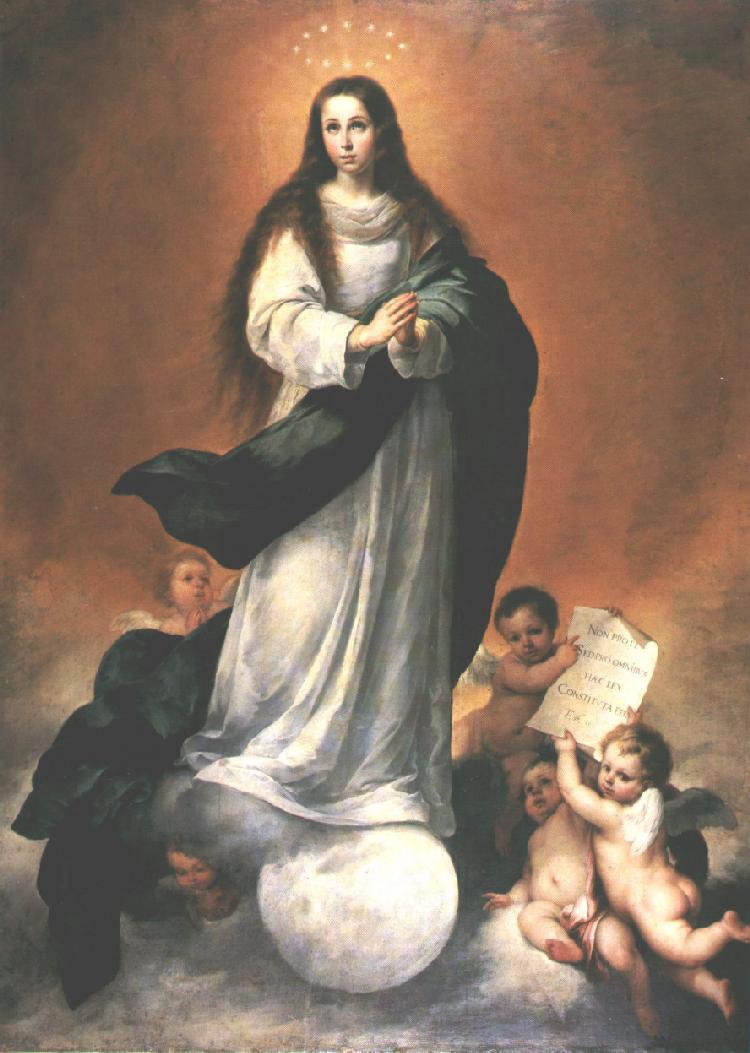
“The Immaculate Conception” by Bartolome Esteban Murillo, painted around 1670, is one of the most beloved images of the Virgin Mary in Spanish Baroque art. In this luminous canvas Murillo gives visual form to a theological idea that was central to Spanish Catholic devotion in the seventeenth century: the belief that Mary was conceived without original sin and preserved in perfect purity by divine grace. The painting is not a narrative scene. Instead, it is a visionary image, a kind of celestial portrait that invites prayer and contemplation. Murillo’s softly glowing style, his tender cherubs, and his youthful, introspective Virgin all work together to make doctrine feel intimate and emotionally accessible.
Historical and religious background
To understand the power of this painting, it helps to know how important the doctrine of the Immaculate Conception was in Murillo’s Spain. Although the dogma was only formally defined by the Catholic Church in the nineteenth century, Spain had championed the belief for centuries. Seville, where Murillo spent most of his life, was a fervent center of Marian devotion. Religious confraternities commissioned processions, sermons, and large altarpieces that celebrated Mary’s sinless conception.
Murillo created several versions of the Immaculate Conception for different patrons. The 1670 canvas reflects a mature formula that he refined over years of experimentation. He took inspiration from earlier artists but simplified the composition, removed distracting details, and focused entirely on the solitary figure of Mary surrounded by light and clouds. The result is both monumental and surprisingly gentle, shaped by Counter-Reformation ideals that encouraged clear, emotionally persuasive religious images.
Composition and overall design
At first glance the painting is strikingly vertical. Mary’s figure rises nearly the entire height of the canvas, giving the impression that she is ascending toward the viewer. She stands on a glowing orb and cloud that suggest both the earth and the heavens, while a cluster of cherubs gather at her feet and sides. The background is a warm, golden sky that gradually darkens toward the edges, creating a natural halo around her.
Murillo arranges the composition around a subtle diagonal. Mary’s body leans slightly to the left while her flowing dark blue mantle sweeps to the right in a broad arc. This opposing movement gives the painting a sense of gentle motion, as if a soft wind has just picked up in the heavens. Around her head a crown of tiny stars forms a delicate circle that the viewer may not notice immediately but that rewards closer looking.
The balance of masses is carefully calculated. Mary’s white robe creates a large, luminous shape at the center of the image. The darker, billowing mantle frames her figure and keeps it from melting into the background. The cherubs, clouds, and small objects at the bottom provide visual weight that anchors the composition and prevents Mary from appearing to float away entirely.
The figure of Mary
Murillo’s Virgin is notably young. She has the face of a Spanish adolescent, with soft features, a straight nose, and large, slightly downcast eyes. Rather than looking outward at the viewer, she gazes into the distance with a contemplative expression. This inward focus suggests an interior dialogue with God, a spiritual conversation that the viewer is allowed to witness but not interrupt.
Her hands are joined loosely at her chest. The gesture is not rigid or theatrical. It feels almost instinctive, as if she has just folded her hands in quiet acceptance. Murillo avoids excessive ornament in her clothing. The robe is plain white, cinched at the waist, and falls in long, simple folds. The mantle, a deep greenish blue, wraps diagonally around her figure and flutters out behind her, adding movement and drama without overwhelming her serene pose.
Her long brown hair falls freely down her back, which gives her an almost ordinary, human quality. Murillo does not crown her with a jeweled diadem or overload her with jewelry. The emphasis is on purity, humility, and youthful grace rather than royal pomp. This choice aligns with Spanish spiritual literature of the period, which often described Mary as the humble “handmaid of the Lord” exalted by divine favor.
Symbolism of purity and grace
Every element around Mary reinforces the theme of the Immaculate Conception. She stands on a crescent moon and a globe concealed in cloud, traditional Marian symbols rooted in the Book of Revelation. The crescent moon evokes the woman “clothed with the sun, with the moon under her feet, and on her head a crown of twelve stars.” Here Murillo adapts the imagery to emphasize Mary’s victory over sin and darkness. The moon and globe beneath her feet suggest that she is above the world’s corruption and cycles of change.
The circle of stars around her head articulates the same idea. The number of stars in this version is slightly more than twelve, forming a luminous halo rather than a strict crown. This detail shows Murillo’s sensitivity to visual effect. The halo of stars is both theological and decorative, turning the Virgin into a radiant center of celestial light.
The cherubs at her feet and sides represent innocence and heavenly joy. Some hold roses and lilies, flowers associated with purity and spiritual love. One cherub in the lower right corner holds a scroll with Latin text that refers to Mary’s sinless state. Even if viewers could not read Latin, the open booklike scroll signaled that this image expresses official Church teaching rather than a mere legend.
Light, color, and Murillo’s painterly language
Murillo’s handling of light is crucial to the painting’s impact. The whole scene is bathed in a warm, diffused glow that seems to emanate from Mary herself. There is no single, strong source of light. Instead the brightness gathers around the Virgin and fades into soft shadows at the edges of the canvas. This creates the impression that grace is something radiant that spreads outward from her presence.
The color palette is relatively restricted yet extremely effective. White and soft ivory dominate her robe and the clouds. The mantle is a deep cool green that nearly reads as blue, creating a complementary relationship with the warm golden sky. Subtle pink tones appear in her cheeks and lips, giving her a gentle, living warmth. The cherubs are painted with rosy flesh tones that echo the Virgin’s complexion and bind the whole color scheme together.
Murillo’s brushwork is more blended than that of many of his Baroque contemporaries. Edges are soft and transitions between light and shadow are gradual. This softness creates a sense of atmosphere and distance even in a close-up figure. Unlike Caravaggio’s dramatic, hard shadows, Murillo’s chiaroscuro envelops Mary in a luminous mist. The style is perfectly suited to a subject that speaks of spiritual mystery rather than physical drama.
Emotional tone and devotional function
Despite the grand subject, the emotional tone of “The Immaculate Conception” is quiet and intimate. There is no sense of fear, struggle, or ecstatic excess. Mary does not display overwhelming rapture. Instead she appears thoughtful, a little shy, and deeply recollected. This emotional restraint is one reason why Murillo’s Marian images have remained popular with ordinary worshippers.
For seventeenth-century viewers the painting would have functioned as a kind of visual prayer. The faithful could kneel before the canvas, recite the Rosary, and allow Mary’s calm gaze and gentle pose to guide their own meditation. The cherubs and clouds provide a heavenly context, but the main spiritual contact is between the viewer and the Virgin’s human face. By making Mary feel approachable, Murillo reinforces the belief that she intercedes personally for believers.
Today, even viewers who do not share the Catholic doctrine can feel the painting’s emotional appeal. Murillo’s Mary embodies an ideal of kindness, quiet strength, and moral beauty. The tender cherubs and glowing atmosphere invite a sense of comfort. The composition radiates a soft assurance that goodness is possible and that grace can transform the human condition.
Murillo’s style and influence
“The Immaculate Conception” sums up many of Murillo’s stylistic strengths. He was a master of soft modeling, delicate facial expressions, and harmonious color. In his religious works he aimed for clarity and sweetness rather than intellectual complexity. Critics who prefer more dramatic Baroque painters have sometimes dismissed Murillo as sentimental, but his best works show a high degree of subtlety and control.
In Seville his Immaculate Conceptions became a reference point for later artists. Numerous copies and variations were produced by workshop assistants, followers, and other painters who wanted to emulate his successful formula. Through prints his composition circulated widely beyond Spain, shaping how later centuries imagined the doctrine. Even modern devotional images and holy cards often echo Murillo’s arrangement of Mary standing on the moon, wrapped in a blue mantle, surrounded by cherubs.
From an art historical perspective, the painting illustrates how the Baroque style could be adapted to different moods. Where Roman and Flemish Baroque often revels in muscular energy and dramatic contrasts, Murillo’s Spanish Baroque tends toward tenderness and soft radiance. The swirling mantle and animated cherubs still provide movement, but the general rhythm is one of gentle ascent rather than explosive action.
Reading the background and supporting figures
It is easy to focus only on Mary and overlook the subtle storytelling in the lower part of the canvas. The cherubs do more than decorate; they help interpret the doctrine visually. One points upward, another holds a scroll, and others gaze admiringly at the Virgin. Their gestures direct the viewer’s attention and reinforce a sense of collective praise.
Some versions of Murillo’s Immaculate Conception include symbolic objects such as mirrors, towers, or enclosed gardens that refer to biblical metaphors for Mary. In this 1670 painting Murillo has simplified the symbolism, retaining only the most essential elements: the crescent, the stars, the flowers, and the cloud. This reduction makes the image easier to read at a distance and allows the Virgin’s presence to dominate.
The vague, cloudlike background also plays a role. Instead of a clearly defined architectural space, Murillo suggests an open sky that gently shifts from warm gold to cooler browns and grays. The lack of specific geography underscores the timeless, universal nature of the doctrine. Mary is not placed in Nazareth or Jerusalem; she inhabits a mystical space between heaven and earth.
Theological meaning in visual form
On a theological level the Immaculate Conception emphasizes Mary’s special role in salvation history. By preserving her from original sin, God prepared a pure vessel for the Incarnation of Christ. Murillo translates this abstract idea into visual language through purity of color, upward movement, and the absence of any sign of suffering on Mary’s body. Unlike Crucifixion scenes or images of martyr saints, there are no wounds, no heavy shadows, no instruments of torture. The mood is anticipatory rather than tragic.
Mary’s clasped hands and serene expression convey acceptance of her vocation. Christ is not depicted, but his future presence is implied by the cross that sometimes appears faintly in the sky in related versions, and by the cherub’s scroll quoting scriptural praise. The globe and clouds at her feet hint at the impact her Son will have on the world. Thus the painting bridges Old Testament prophecy, Marian theology, and New Testament fulfillment in a single iconic image.
For believers, contemplating this painting reinforces trust in Mary’s intercession and God’s providential plan. For art lovers, it offers a touchstone example of how Baroque art could express doctrine in a poetic, emotionally resonant way.
Conclusion
“The Immaculate Conception” by Bartolome Esteban Murillo is more than a beautiful Marian image. It is a carefully constructed work of Baroque art that blends theology, devotion, and painterly skill into a unified vision. The graceful pose of the Virgin, the delicate halo of stars, the cherubs that orbit her like living ornaments, and the golden atmospheric light all serve a single purpose: to make the invisible reality of divine grace visible and emotionally tangible.
Murillo’s painting continues to speak to modern viewers because it presents holiness not as something harsh or distant, but as radiant gentleness. Whether approached as a religious icon or as a masterpiece of seventeenth-century painting, “The Immaculate Conception” invites us to look upward, to notice the play of light on cloth and skin, and to sense in that softness a quiet but powerful hope.