Image source: wikiart.org
Introduction to The Immaculate Conception by Bartolomé Esteban Murillo
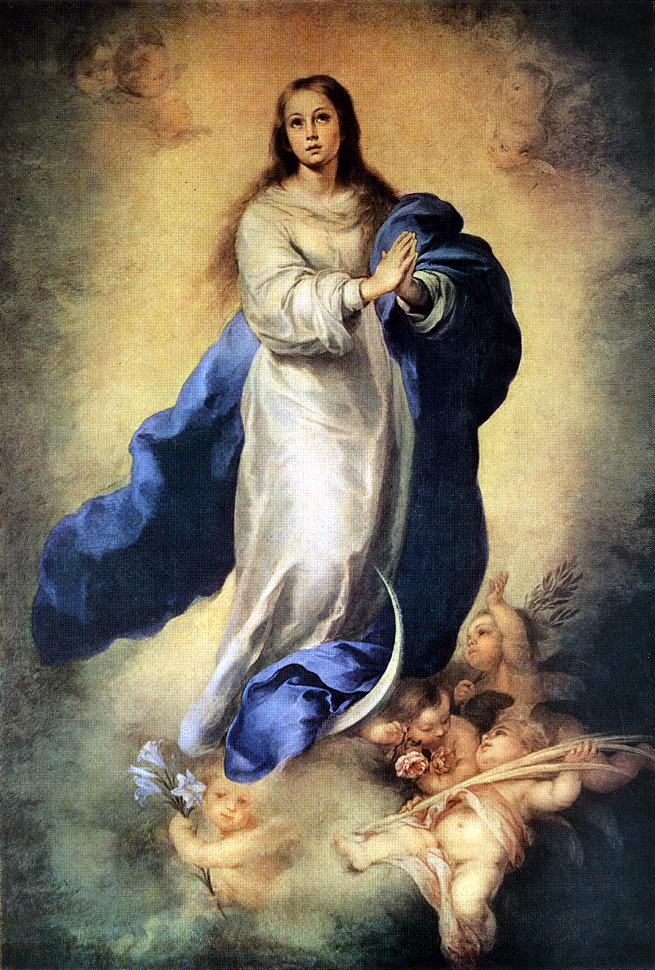
Bartolomé Esteban Murillo’s painting “The Immaculate Conception,” created around 1665, is one of the most famous visual interpretations of a doctrine that held special importance in Spain. The image presents the Virgin Mary as a young woman rising in glory on a cloud of light and angels. Wrapped in a deep blue mantle over a luminous white dress, she floats above a group of playful cherubs who carry lilies, roses, and other symbols of purity.
The composition is simple yet monumental. Mary stands almost frontally, hands joined near her heart, eyes lifted slightly upward. There is no narrative action around her. Instead, Murillo focuses on the mystery of her person, conceived without sin and chosen from all eternity to be the Mother of Christ. Through soft light, gentle colors, and a tender realism, the painter transforms complex theology into an accessible and emotionally resonant image.
Historical and Devotional Context
In seventeenth century Spain the belief that Mary was conceived free from original sin was passionately defended long before it became officially defined as dogma centuries later. Spanish kings, theologians, and ordinary believers alike felt a particular devotion to this privilege of the Virgin. Churches, confraternities, and universities commissioned images of the Immaculate Conception to express their faith and to decorate altars dedicated to the mystery.
Murillo, who worked in Seville, became the leading painter of this subject. Over the course of his career he produced several variations that refined and simplified the iconography. Earlier Immaculate Conception paintings often included long Latin inscriptions, complex symbolic devices, and elaborate settings. Murillo instead moved toward a more unified vision centered almost entirely on the figure of Mary.
This 1665 version shows the artist at a mature stage of that evolution. The Virgin is presented as a youthful, approachable girl, yet she is surrounded by the golden atmosphere of heaven. The painting would have encouraged viewers to contemplate both her unique holiness and her closeness to humanity. In a culture that valued Marian devotion so highly, such an image provided a focus for prayer and intercession.
Composition and Spatial Structure
Murillo organizes the painting around a strong vertical axis. Mary stands in the center of the canvas, slightly to the left of the axis, creating a gentle sense of movement as if she is drifting upward. Her figure forms an elongated oval shape that echoes the halo of light encircling her. The blue mantle expands outward like wings, balancing the composition and giving a sense of weightless volume.
Below her, a cluster of cherubs creates a horizontal base. They lie, sit, and float among soft clouds, anchoring the composition and creating a sense of depth. Some are fully visible, others emerge only partially from the mist. Their rounded bodies and lively gestures add warmth and informality to the otherwise solemn subject.
Above Mary’s head, the background fades into golden light. Faint faces of other angels or heavenly presences appear in the cloud, barely distinguished from the atmosphere. This choice emphasizes the idea that Mary is surrounded by the invisible world of grace. The edges of the painting are darker, so the eye is naturally drawn toward the central luminous figure.
Although there are several figures, the composition never feels crowded. Murillo uses overlapping forms and deliberate empty spaces to guide the gaze upward from the putti to Mary’s garments and then to her serene face. The overall effect is that of a gentle ascent from earth to heaven.
The Figure of the Virgin Mary
Mary herself is the heart of the painting. Murillo presents her as a very young woman, perhaps in her early teens, with delicate features and an almost childlike innocence. Her face is oval, with large dark eyes, a small mouth, and a straight nose. There is no strong emotion written on her features. Instead, her expression is calm, collected, and quietly awed, as if she has just heard a divine message.
Her hands are joined along her chest in a simple gesture of prayer. The gesture is modest rather than dramatic. It suggests humility, gratitude, and full openness to God’s will. Murillo avoids elaborate poses or detailed jewelry that might distract from her spiritual quality.
Mary’s garments follow the traditional colors associated with the Immaculate Conception. The white dress signifies purity and sinlessness. Its soft folds fall straight downward, almost like a column of light, giving her an air of unworldly grace. The blue mantle, associated with heavenly favor and queenship, wraps around her shoulders and billows outward, giving both elegance and a sense of movement. Highlights on the blue create shimmering transitions that suggest the richness of the fabric without making it heavy.
Murillo’s characteristic softness is evident in the way he models her skin and features. Subtle transitions of light and shadow create a gentle glow rather than sharp contrast. She appears illuminated from within, an effect that echoes the theological idea that God’s grace filled her from the first moment of her existence.
Light, Color, and Atmosphere
Light in this painting is not merely natural illumination. It is a symbolic presence. The entire background consists of a swirling cloud of golden light. There is no visible sun or open sky, no architectural setting, no landscape. The world of the painting is pure radiance.
The brightest area surrounds Mary’s upper body and face, creating a halo that merges with the atmosphere rather than forming a sharp circle. This diffuse light gives her a sense of being enveloped by divine favor. As the colors move toward the edges and bottom, they become cooler and darker, which increases the impression of upward motion and spiritual elevation.
Murillo’s color palette is restrained but full of nuance. The white of Mary’s dress is never stark. It contains touches of pale beige, blue, and gray so that it harmonizes with the surrounding light. The deep ultramarine of the mantle is applied broadly yet delicately, with lighter highlights suggesting folds. The cherubs below are painted in warm flesh tones that echo the golden atmosphere, uniting them visually with Mary while still distinguishing her by the purity of her white garment.
The use of soft edges and thin glazes helps create the impression that figures and clouds dissolve into one another. This technique is particularly effective around the cherubs and the faint angelic faces above. It suggests that in heaven, boundaries between beings are porous, all immersed in the same divine light.
Angels, Cherubs, and Symbolic Objects
The group of cherubs at the bottom of the painting plays an important iconographic role. They represent both the heavenly court that honors Mary and the spiritual fruitfulness of her immaculate state. Their varied actions and attributes add layers of meaning.
One cherub on the left holds a stem of white lilies. This flower has long symbolized purity and is often associated with the Virgin, especially in scenes of the Annunciation. Here it underscores the idea that Mary is entirely free from stain. Another cherub presents roses, which can signify love and joy as well as references to the mystical rose of Marian litanies.
A cherub at the lower right appears to carry a palm branch or another emblem of victory, indicating Mary’s triumph over sin from the very beginning of her life. Another child seems absorbed in playing with the clouds or watching Mary rise, reminding the viewer that this is also a moment of heavenly delight.
The mixture of deeply symbolic objects with playful cherubic behavior is typical of Murillo. He brings an affectionate, human touch to theological themes. The cherubs are not abstract symbols only. They are lively children who make the scene inviting and approachable. Their presence suggests that holiness is not cold or distant but filled with joy.
Theological Meaning and Iconography of the Immaculate Conception
The doctrine of the Immaculate Conception states that Mary, by a singular grace of God and in view of the merits of Christ, was preserved from original sin from the first moment of her existence. Artists developed a standardized imagery to convey this invisible reality. By Murillo’s time, this imagery often drew on a combination of biblical references, especially from the Book of Revelation and the Song of Songs.
In this painting, although the crescent moon familiar from other versions is not prominently visible, its symbolism is implied in the way Mary appears to stand on a cloud that hints at a silvery arc. The woman clothed with the sun and with the moon under her feet from Revelation is evoked through the enveloping golden light and the subtle suggestion of a lunar form below.
Her upward gaze and prayerful hands recall the “Tota Pulchra,” a litany celebrating her as entirely beautiful and pure. The absence of any earthly, historical setting emphasizes that the mystery of her conception reaches back into the hidden counsels of God before the visible events of her life.
Murillo simplifies the iconography so that viewers are not overwhelmed by symbols. Instead of surrounding Mary with multiple emblems from litanies and biblical allegories, he retains only the most essential: her colors, the cloud, the angels, and a few carefully chosen flowers. This clarity allows the theological message to emerge through contemplation of her person rather than an inventory of signs.
Murillo’s Artistic Language and Spanish Baroque Spirituality
Murillo is often associated with a gentle, luminous style that contrasts with the dramatic shadows and intense realism of other Baroque masters. In “The Immaculate Conception” this language perfectly suits the subject. The painting does not rely on violent contrasts or harsh gestures. Instead, it communicates through serenity, soft light, and delicate color transitions.
This approach reflects a particular strand of Spanish spirituality focused on tender affection for Mary and trust in her intercession. Rather than presenting her as a distant queen, Murillo shows her as a youthful, compassionate presence who intercedes for humanity. At the same time, the grandeur of the composition and the golden atmosphere affirm her exalted status in heaven.
Murillo’s technical mastery is evident in the way he balances realism and idealization. Mary’s face has individual features and lifelike flesh tones, yet it also embodies an ideal of beauty and purity. The cherubs are clearly based on observation of real children. Their hands, feet, and playful expressions are convincing, yet their context among clouds and light lifts them into a supernatural realm.
The painting serves as a visual prayer, embodying the Baroque desire to engage both intellect and emotion. It encourages viewers not only to understand a doctrine but to feel its consoling power.
Emotional Impact and Devotional Experience
Standing before this painting, viewers are likely to experience a sense of calm elevation. The upward movement of the composition, the gentle gaze of Mary, and the soft radiance all invite contemplation rather than agitation. The absence of harsh lines or complex architecture means that nothing distracts from the encounter with her presence.
For believers, this encounter naturally leads to prayer. Mary’s joined hands suggest that she prays for those who look upon her. Her youthful face and slight forward motion imply that she is attentive and responsive. The cherubs’ joy reinforces the idea that coming under her protection is a source of delight, not fear.
Even for those who approach the painting primarily as a work of art, its emotional effect is strong. One senses a harmony of forms and colors that creates a feeling of balance and hope. The image evokes the idea that purity and goodness are not naive fantasies but real powers that uplift human life.
Legacy and Influence of Murillo’s Immaculate Conception
Murillo’s versions of the Immaculate Conception became models for later artists in Spain and beyond. The combination of a blue mantle, white dress, youthful features, and surrounding cherubs shaped visual expectations of the subject for generations. Prints and copies circulated widely, reinforcing this iconographic type.
This particular 1665 painting is often cited as one of his finest achievements in the theme, due to its clarity and emotional resonance. It encapsulates the artistic goals of the Spanish Baroque, uniting doctrinal precision with accessible beauty. Many later images of the Immaculate Conception, whether in frescoes, altarpieces, or small devotional prints, can be traced back to Murillo’s model.
Today the painting continues to be reproduced in churches, prayer cards, and art books. Its enduring popularity lies in its successful translation of complex theology into a single, compelling vision of a young woman surrounded by light, whose holiness is both awe inspiring and gentle.
Conclusion
“The Immaculate Conception” of 1665 by Bartolomé Esteban Murillo stands as a masterpiece of Marian imagery and of Baroque painting. Through a carefully balanced composition, a harmonious palette of white, blue, and gold, and the tender realism of Mary and the cherubs, Murillo gives visual form to the mystery of a woman preserved from sin and filled with grace.
The painting speaks not through dramatic action but through quiet elevation. Mary’s serene gaze, her folded hands, and her floating figure surrounded by luminous clouds invite viewers into a contemplative space. The angels and symbolic flowers enrich the scene without overpowering it, reinforcing themes of purity, joy, and victory over sin.
In this work Murillo achieves a rare unity between theological depth and approachable beauty. “The Immaculate Conception” remains a powerful image of hope, purity, and divine favor, one that continues to inspire devotion and admiration centuries after its creation.