Image source: wikiart.org
Introduction to “The Immaculate Conception” by Bartolomé Esteban Murillo
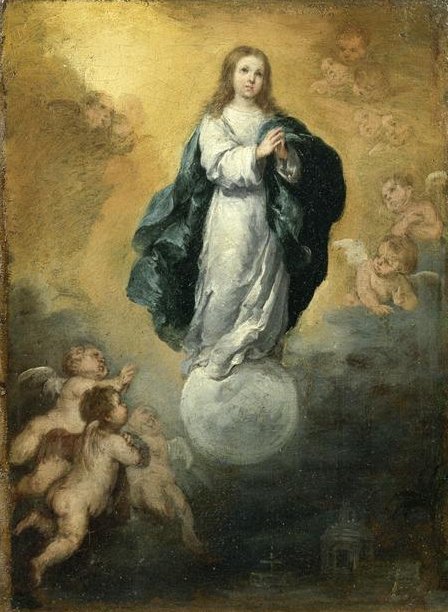
“The Immaculate Conception,” painted around 1655 by Bartolomé Esteban Murillo, is a luminous and intimate interpretation of one of the most cherished Marian themes in Spanish Catholicism. In this small yet visually rich work, Murillo presents the Virgin Mary as a young girl, clothed in white and wrapped in a deep blue mantle, rising above the earth on a glowing sphere. Around her swarm small angels and cherubs, while soft golden light fills the upper part of the composition.
The painting condenses theology, devotion, and poetic imagination into a single image. Rather than depicting a specific event from Mary’s life, Murillo visualizes a doctrine: that Mary was preserved from original sin from the first instant of her conception. To convey this invisible mystery, he calls upon symbols that would have been widely recognized by seventeenth century Spanish viewers and arranges them in a composition that suggests weightless ascent and spiritual purity.
Composition and Vertical Movement
Murillo builds the entire painting on a strong vertical axis. At the center stands the slender figure of Mary, her hands joined gently at her chest, her gaze turned slightly upward. She rises above a luminous sphere that represents the world or the moon, supported by playful cherubs who cluster around its base. From this glowing orb the composition moves upward through Mary’s body to the golden clouds that fill the top of the painting, where more angelic heads emerge from the mist.
The scene lacks any solid architectural framing or earthly landscape. The lower part hints at distant buildings or a small chapel, but these are barely indicated. The dominant spaces are the dark blue gray of the lower clouds and the warm, honey colored light that suffuses the upper background. This transition from darker tones below to brighter ones above reinforces the idea of elevation. Mary appears to be moving from the shadowed world toward a realm of pure light.
Murillo uses the flowing lines of Mary’s garments to strengthen this sense of upward motion. Her white tunic falls in long vertical folds, while the deep blue mantle billows behind and around her, forming a soft oval that frames her figure. This oval contour is echoed by the curve of the globe beneath her feet and the circular arrangement of cherubs, creating a rhythmic harmony that draws the viewer’s eye in a continuous upward sweep.
The Young Virgin and the Ideal of Purity
One of Murillo’s distinctive contributions to the iconography of the Immaculate Conception is his portrayal of Mary as an adolescent girl rather than a mature woman. In this painting she appears delicate and youthful, with smooth features, downcast eyes, and a slightly parted mouth that suggests both humility and quiet wonder. Her long, light brown hair falls loosely over her shoulders, unstressed by elaborate ornament.
This youthful appearance is not mere sentimentality. It expresses the idea of original innocence, as if Mary embodies humanity in its unfallen state. She is presented not as an unattainable queen remote from human experience, but as a young girl filled with grace, chosen and preserved by God. Her modest pose, with hands near her heart and her body slightly inclined, signals acceptance of this gift rather than pride.
Murillo softens the contours of her face and the transitions of light and shade, giving her an almost ethereal presence. The edges of her figure blend gently into the surrounding light, as if she is more spiritual than material. Yet he retains enough realism for viewers to feel her as a living person, capable of emotion and relationship. This balance between idealization and humanity is key to the emotional appeal of Murillo’s Marian images.
Iconography of the Immaculate Conception
Although the doctrine of the Immaculate Conception was not formally defined until the nineteenth century, it was passionately defended and celebrated in seventeenth century Spain. Artists developed a visual language to express it, and Murillo became one of its greatest interpreters. Many of the standard symbols appear in this painting, arranged with subtlety and grace.
Mary stands upon a sphere that can be read as both the world and the moon. The idea of the moon comes from the biblical phrase in the Book of Revelation that describes a woman clothed with the sun, with the moon under her feet. In the context of the Immaculate Conception, the moon often symbolizes mutability and the realm over which Mary has been given victory. Standing upon it indicates that she is untouched by the stain that affects the rest of creation.
Around her swarm cherubs and small angels. Those near the base seem to support the sphere, suggesting that heaven itself upholds the mystery of Mary’s preservation. Others in the upper part of the canvas look toward her with joyful fascination, as if contemplating the marvel that God has wrought. Their presence emphasizes that the Immaculate Conception is not only a theological idea but also a cause for cosmic celebration.
Traditional attributes like the lily, mirror, or enclosed garden are not explicitly depicted in this smaller composition, but the overall effect of whiteness, clarity, and enclosed light conveys their meanings. Murillo chooses to simplify the symbolic field in order to keep the viewer’s attention on the figure of Mary herself.
Color, Light, and Atmospheric Effects
Murillo’s color choices are both traditional and expressive. Mary’s white tunic represents purity and divine grace. It catches the strongest light, becoming almost radiant against the darker clouds and shadows. Over this he places a deep blue mantle, a color long associated with Mary as Queen of Heaven. In Spanish painting this blue often has a particular richness and depth, symbolizing not only heavenly dignity but also love and steadfastness.
The surrounding environment shifts from cool blues and grays in the lower clouds to warm golds and creams in the upper sky. This gradient creates a subtle movement from the temporal world to the timeless light of God. The golden light does not come from any single source. It seems to emanate from everywhere, bathing Mary and the cherubs in a soft, enveloping glow. This atmospheric lighting is a hallmark of Murillo’s mature style and contributes to the feeling of tender serenity in the scene.
The cherubs themselves are painted in warm flesh tones that echo the golden sky. Their forms are rounded and playful, suggesting energy and joy. Against them the cool white of Mary’s robe appears even more pristine. Murillo’s ability to modulate color and light in this way gives the painting a sense of inner luminosity, as if grace itself were radiating from the central figure.
The Role of the Cherubs
The small angels that cluster around the Virgin play more than a decorative role. They help articulate the theological meaning and emotional tone of the painting. At the lower left several cherubs appear to push or support the glowing sphere on which Mary stands. Their effort symbolizes heaven’s collaboration with God’s plan of salvation and suggests that Mary’s unique privilege is upheld by the entire celestial realm.
Other cherubs look up in adoration, their gestures echoing the viewer’s own gaze. By including them, Murillo creates a community of worship that extends from the angels in the picture to those who contemplate it. The cherubs at the top, whose heads emerge from the clouds, add to the sense that the whole of heaven rejoices in the Immaculate Conception.
Their childlike forms also soften and humanize the theological doctrine. Instead of an abstract explanation, the viewer encounters a cluster of lively, affectionate beings who delight in Mary’s purity. This contributes to the painting’s gentle, approachable character and reflects the popular aspect of Marian devotion in seventeenth century Spain.
Murillo’s Marian Style and Spanish Devotion
Murillo painted many versions of the Immaculate Conception throughout his career and became closely associated with this subject. He responded to a strong demand from religious orders, confraternities, and private patrons who wanted images that expressed Spain’s particular attachment to this doctrine. In 1655, when this painting was created, debates over the Immaculate Conception were intense, and Spain often presented itself as the champion of Mary’s privilege.
Murillo’s Marian style is distinguished by its sweetness, clarity, and gentle emotional tone. In contrast to more dramatic Baroque interpretations that emphasize strong diagonals and intense contrasts of light and shadow, Murillo prefers flowing lines and a harmonized palette. His Virgins rarely appear stern or distant. They are approachable, almost familiar, yet transfigured by grace.
In “The Immaculate Conception” this is especially evident. Mary’s face is not ecstatic or overwhelmed. She looks quietly amazed, as if contemplating God’s goodness with gratitude rather than fear. The painting thus supports a form of devotion centered on trust and love. For the faithful in Seville, such images would have been both doctrinal statements and objects of affectionate prayer.
Small Scale and Intimate Impact
Unlike some of Murillo’s large altarpieces on the same subject, this version of “The Immaculate Conception” is relatively small. Its scale suggests that it may have been intended for private devotion rather than a grand church setting. The smaller format invites close viewing. Standing in front of the painting, a viewer can feel almost as if holding a precious miniature window into the heavenly realm.
The intimate size influences the way Murillo handles detail. Faces, hands, and folds are painted with a soft economy of strokes, avoiding fussy precision. This looseness allows the image to vibrate with life when seen at the proper distance. It also allows the eye to merge forms in a way that enhances the sense of misty, supernatural light.
For a seventeenth century owner, this painting could have hung in a domestic or monastic cell, serving as a focus for daily prayer, especially the recitation of the Rosary or litanies honoring Mary. Its manageable dimensions make it feel like a personal companion rather than a distant monument.
Emotional and Spiritual Resonance
The emotional resonance of “The Immaculate Conception” lies in its combination of innocence, serenity, and joy. There is no hint of anguish or struggle here. Instead, the painting invites contemplation of grace given freely and received with humility. Mary’s gentle expression and modest body language suggest a soul that simply allows God to act within her.
For viewers, this can be both comforting and challenging. On the one hand, the image communicates that God’s grace can transform human nature, lifting it toward purity and light. On the other hand, it presents Mary as a model of receptivity and trust, encouraging believers to imitate her openness to God’s will in their own circumstances.
The cherubs’ joyful energy and the warm glow of the sky add to the sense of celebration. The painting feels like a visual hymn of praise, supporting liturgical feasts and personal thanksgiving alike. Even for those outside the Catholic tradition, the work can speak of beauty, innocence, and the possibility of goodness shining in a darkened world.
Conclusion
Bartolomé Esteban Murillo’s “The Immaculate Conception” from around 1655 is a compact masterpiece that distills an important theological doctrine into a tender and luminous vision. Through a carefully balanced composition, the upward movement from dark clouds to golden light, and the harmonious interplay of white, blue, and warm tones, Murillo presents the Virgin Mary as a youthful figure of spotless purity and gentle humility.
The supporting cherubs, the glowing sphere beneath her feet, and the enveloping atmosphere of light all contribute to the painting’s sense of heavenly celebration. At the same time, Mary’s human features and quiet demeanor keep the image accessible to the viewer’s affection and imagination.
Within the broader context of Spanish Baroque art and devotion, this painting exemplifies Murillo’s unique gift for integrating doctrine and emotion, grandeur and intimacy. It continues to offer a visual meditation on grace, innocence, and the enduring human desire to be lifted from darkness into light.