Image source: wikiart.org
Introduction
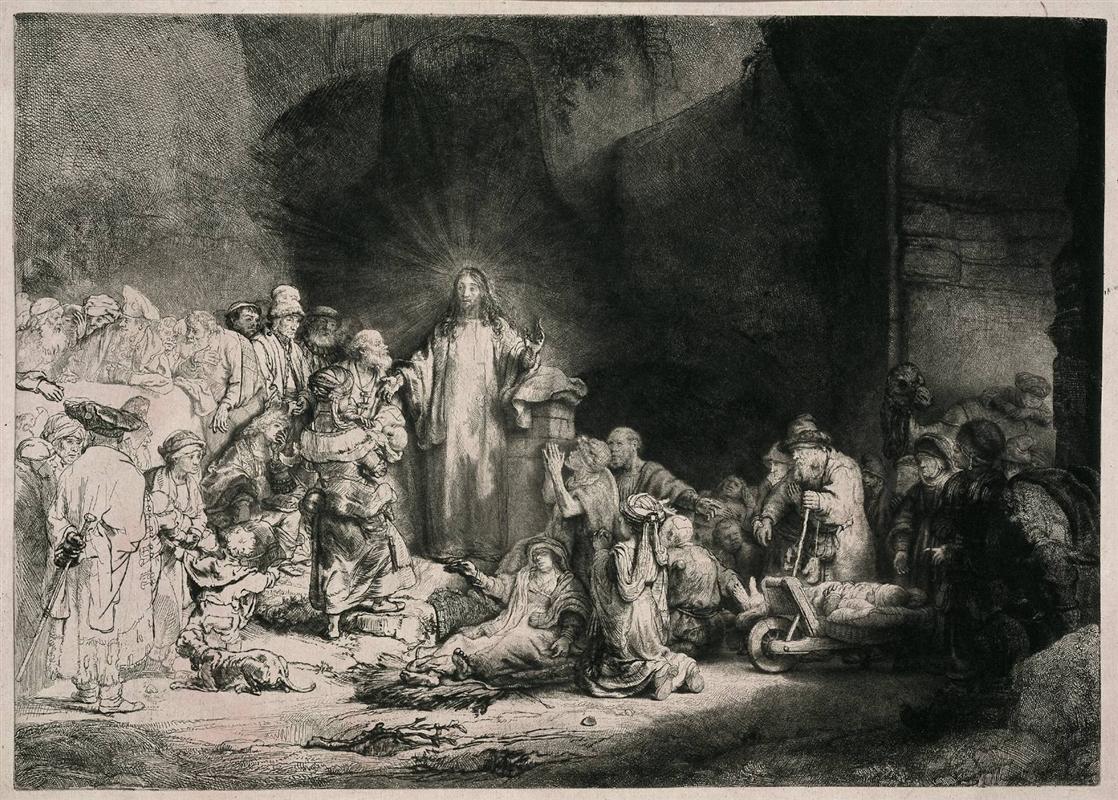
Rembrandt’s “The Hundred Guilder Print” is one of the most astonishing achievements in European printmaking. Also known as “Christ Healing the Sick,” this large etching gathers a multitude of figures into a single, breathing drama centered on the luminous presence of Christ. The work is a meditation on compassion, judgment, and the scales by which human value is weighed. With etching and drypoint alone, Rembrandt turns metal and ink into a deep theater of light, where the eye moves from shadowed crowds and private sorrows toward a radiance that is spiritual as much as optical.
Why It Is Called “The Hundred Guilder Print”
The popular title comes from the extraordinary price the print fetched in Rembrandt’s lifetime—around one hundred guilders, an extravagant sum for a single impression. The nickname recognizes not only its rarity and size but also the sheer ambition of the image. Rembrandt poured into this plate the full range of techniques he had refined over decades, demonstrating how a print could rival painting in narrative breadth, tonal depth, and psychological power.
Subject And Narrative Source
The scene compresses the Gospel of Matthew, chiefly chapter 19, into one coherent tableau. Christ stands near the center, haloed in rays of light, teaching and healing. Around him radiate episodes from the text: the Pharisees debating questions of law at the far left; mothers bringing their children for blessing just before him; the sick, the maimed, and the poor clustering at the lower right; and the “rich young man” recoiling in thought after being told to sell his possessions. Farther to the right, under a dark arch, a camel waits—an emblem of Christ’s teaching that it is easier for a camel to pass through the eye of a needle than for a rich man to enter heaven. Rembrandt binds these strands without literal captions. The unity arises from movement, gaze, and light.
Composition And The Choreography Of Crowds
The print is organized like a stage with three zones. At left, a compact group leans inward, their faces alert and disputatious. They are contained by a table and a cluster of hats—forms that create a low wall. At center, Christ stands upon a small step or plinth so that his gesture and face are legible above the press of bodies. At right, the most open space belongs to the needy: a kneeling woman with clasped hands, a man pushing a wheelbarrow bearing a sick figure, and others who crane to see or to plead. Rembrandt engineers the viewers’ path: we begin in the murmur of argument, cross the clearing of revelation, and arrive in the land of suffering where help is asked and offered.
Light As Theology
Rembrandt’s light is not just illumination; it is meaning. The background is vast and dark, carved with dense cross-hatching and drypoint burr so rich that it feels like velvet night. From this darkness Christ emerges as a source rather than a recipient of light. Fine radiating lines articulate a spiritual aura, but the glow also behaves naturally: it spills forward to strike the faces of those who look to him, it grazes the polished bald head of an old man, and it dies gently along the ground where the lame lie. The scene becomes a parable in chiaroscuro—grace entering shadowed life and revealing its textures without erasing them.
Gesture, Hands, And The Grammar Of Mercy
Christ’s hands are the print’s quiet center. One opens outward in a gesture of welcome; the other lifts slightly, teaching. Around him, hands echo and answer: a mother steadies a child; a skeptic strokes his beard; a beggar pleads with joined palms; a helper grips the handles of a wheelbarrow; a man at the far left counts or fiddles with coins. This choreography of hands tells the story as clearly as any inscription. Rembrandt knew that the smallest physical decisions hold moral weight.
The Children Before Christ
In the group nearest to Jesus, babies and toddlers nestle in arms while a few children stand on tiptoe. Their heads form a lively rhythm of ovals and curls. Christ’s light falls tenderly on these small faces, reaffirming the Gospel line, “Let the little children come to me.” Rembrandt’s art has always honored the humble and the ordinary; here he allows the children to calibrate the scene’s emotional truth. Their vulnerability measures the adults’ motives.
The Sick, The Suffering, And The Compassion Of Forms
The right foreground is a catalogue of human need. A woman kneels, her face buried in her hands. A figure lies supine at Christ’s feet, another turns a blind face toward the light, and farther right an old man brings the bedridden in a wheelbarrow. Rembrandt is exact about crutches, bandages, and frail bodies, but he refuses sensationalism. The poor are not foils for the pious; they are the very heart of the event. The light touching their skin is the picture’s most moving passage, not because it is technically dazzling (though it is), but because it visualizes hope.
The Rich Young Man And The Shadow Of Choice
To the immediate right of Christ, slightly behind the kneeling petitioner, the rich young man withdraws into shadow. His posture is thoughtful, inward. He isn’t caricatured as wicked; he is undecided. Rembrandt’s sympathy extends to the difficulty of giving up security. The shadow around him is not damnation; it is the psychology of hesitation. Beyond, the camel waits under the arch, turning Christ’s teaching into a small, pungent image. These choices—where to place a camel, how to angle a head—broadcast Rembrandt’s mastery at compressing doctrine into visual wit.
Architecture And Spatial Drama
The background masses of stone function like a natural amphitheater. The left wall cups the disputants, the high central shadow throws Christ forward, and the dark arch at right shelters the poor. This setting is not a specific ruin; it is a shaped darkness that heightens the human drama. Rembrandt uses the architecture as a giant reflector and absorber of light, guiding attention to where it matters most while keeping the whole scene coherent.
Technique: Etching, Drypoint, And Plate Tone
The print marries techniques with unusual freedom. Etched lines create the firm scaffolding of figures and space. Drypoint—where the needle raises a burr that holds extra ink—produces those velvety blacks that seem to breathe. Rembrandt likely experimented with inking and wiping the plate so that different impressions carry different atmospheres: sometimes the darks are heavier, sometimes the mid-tones more open. This variability transforms the print into a living work, unique in each pulling, and it showcases his belief that printmaking is not mere reproduction but a medium of invention.
Tactile Description And The Truth Of Details
Everywhere in the print, small details anchor the grand theme in lived experience: a dog that dozes at the lower left; the rough plank of the platform Christ stands on; the worn brim of a hat; a walking stick; the soft weight of a sleeping child. These specificities are not decoration. They insist that grace visits real, textured life. The dog sleeping amid revelation is particularly Rembrandtian—a note of ordinary continuity that refuses to flatter the viewer with pious overstatement.
Emotional Range And The Music Of Faces
Rembrandt’s crowd is a choir of states of mind. We read wonder, skepticism, fatigue, gratitude, and confusion. No two faces are the same; each has the creases of its own biography. The old man at Christ’s left looks up with a kind of seasoned urgency; a young mother near the center is focused on her child’s reaction more than on doctrine; a bystander toward the far right cranes for a better view, carried by curiosity rather than faith. This moral and emotional diversity is what makes the scene convincing. It is how crowds actually are.
Theological Reading: Grace Versus Law
The print stages a conversation between Law and Grace without forcing the issue. On the left, the learned men, with their books and arguments, represent order, tradition, and the human need to codify. On the right, the afflicted represent the messy urgencies of life. Christ stands between them, a channel rather than a judge, extending teaching and compassion together. The light that unifies the print is also a doctrinal statement: revelation does not humiliate; it reveals. In the best Protestant spirit, Rembrandt paints a world where inward transformation matters more than outward spectacle.
Sound, Time, And The Suspended Moment
Although the print is silent, it suggests a dense soundscape—murmurs of debate, small cries, a wheel creaking, the shuffle of feet. The moment Rembrandt chooses is not the climax of a single miracle but the sustained time of Christ’s ministry among the people. It feels like an hour condensed to an instant, busy yet spacious. This temporality is part of the print’s magic; we sense that if we looked away and back again, the crowd would have changed places and new bodies would have stepped forward.
Reception And Lasting Influence
From the seventeenth century onward, artists and collectors recognized the plate’s uniqueness. Its nickname, the prices it commanded, and the frequency with which it has been discussed all testify to its prestige. But the print’s true afterlife is in the way it taught later artists to think about light and crowds—how to use darkness as substance, how to make a central figure glow without artificiality, and how to choreograph masses without losing individuality. Painters and printmakers across Europe studied it not just as a religious image but as a masterclass in visual storytelling.
Relationship To Rembrandt’s Life
The print dates from a period of artistic mastery and personal strain. Without turning biography into interpretation, one can say that Rembrandt’s empathy for the needy and his skepticism about outward piety were sharpened by experience. His ability to see dignity in every face, and to visualize grace as an inclusive light, is consistent with a life attentive to hardship yet anchored in craft. The plate is large, complex, and technically demanding—an artist staking his claim for what the medium can do at the highest level.
Why The Print Still Feels Modern
Modernity in this work lies in its trust of ambiguity and its belief that technique can carry thought. The image refuses simple moral sorting; it keeps motives mixed, as real life does. Its darks are not merely black; they are atmospheres where interpretation happens. The print also embodies a democratic vision: the central figure is divine, but the surrounding people are painted with as much care. Each person is a world. That inclusive attention gives the work its inexhaustibility.
Close Reading Of Key Passages
Look at the kneeling woman directly in front of Christ, hands pressed together. Her gesture is traditional, but the tilt of her head and the slight angle of her shoulders make the plea specific, almost audible. Examine the man with the wheelbarrow: the handles dig into his palms, his posture leans forward with labor, and yet his face is hopeful. Return to the group of Pharisees at left: one points, another looks down skeptically, a third seems distracted by a child tugging at his garment. These micro-dramas ensure that wherever the eye lands, story unfolds.
Conclusion
“The Hundred Guilder Print” is not merely an illustration of scripture; it is a living threshold where art and compassion meet. Rembrandt uses the full expressive range of etching and drypoint to create an image that glows from within, choreographs crowds without losing their humanity, and stages theology as felt experience. The plate’s breadth, tonal gravity, and psychological tact make it an inexhaustible object of study. Every viewing realigns the balance of light and shadow, argument and mercy, law and grace. That is why the print earned its legendary price then, and why its value—artistic and human—remains immeasurable now.
