Image source: wikiart.org
Introduction to The House of Nazareth
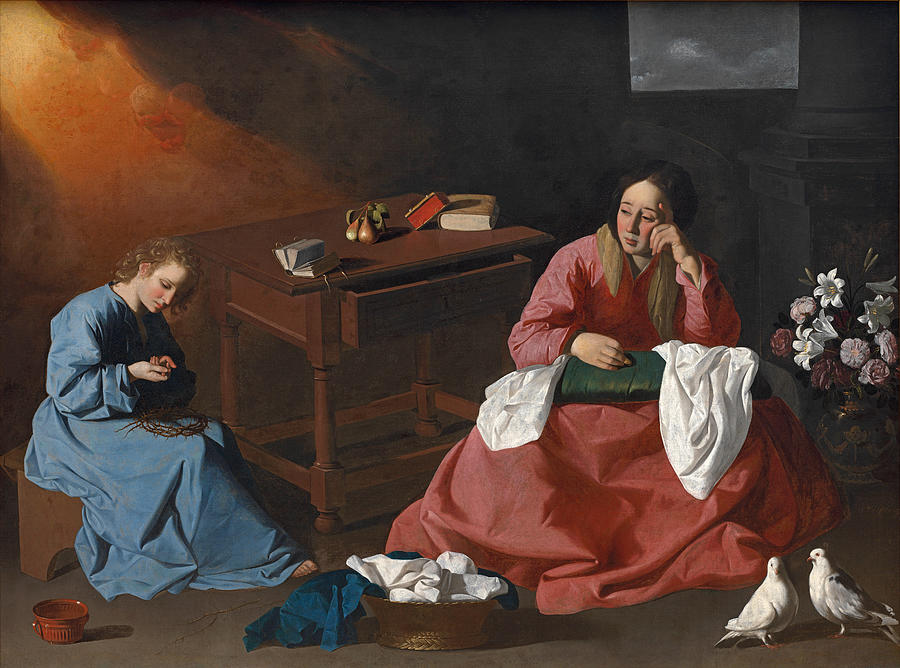
Francisco de Zurbaran’s “The House of Nazareth,” painted around 1640, is one of the most quietly moving works of the Spanish Baroque. At first glance it looks like an ordinary domestic interior. A young woman in a deep rose gown sits absorbed in her sewing. A boy in blue, seated on a low stool, twists a handful of thorns into a circle as if crafting a simple toy. A sturdy table, baskets of laundry, a few books, fruit and flowers complete the scene.
Yet almost immediately, the viewer senses that this is not an ordinary household. The woman is the Virgin Mary. The boy is the Christ Child. The room in Nazareth becomes the place where everyday work and future sacrifice are mysteriously intertwined. Zurbaran takes the most humble chores of family life and reveals within them the seeds of the Passion.
“The House of Nazareth” is sometimes titled “Christ and the Virgin in the House at Nazareth,” a reminder that we are witnessing an intimate moment in the hidden life of Jesus. Instead of focusing on miracles or public ministry, Zurbaran invites us to step quietly into the private world where salvation is prepared through ordinary tasks, silent prayer, and foreknowledge of suffering.
The Domestic Setting and Composition
The painting is organized around a simple yet powerful arrangement. The wooden table stretches across the center of the canvas, anchoring the composition and separating the two figures while still uniting them within one space. Mary sits to the right on a low platform, her full red dress spreading across the floor like a pool of color. Young Jesus sits on the left, slightly lower, draped in an enveloping blue robe.
The room is lit from above left by a warm beam of light that cuts diagonally across the space. This light pours in from an unseen window or heavenly source and touches the boy’s head, the corner of the table, and the folds of Mary’s garments. The rest of the room recedes into softer shadow.
The objects are positioned with deliberate care. On the table lie books, a sewing basket and a small still life of fruit. At Mary’s feet are a basket of laundry and folded cloths. On the far right, a vase of flowers blooms beside two white doves on the floor. Each object contributes to the symbolic language of the painting while also making the space feel convincingly real.
The overall impression is one of calm order. There is no clutter. The room is modest but tidy, reflecting the disciplined simplicity of the Holy Family. Zurbaran gives us a Nazareth that is both historically distant and immediately recognizable, a place that could be a seventeenth century Spanish interior as easily as an ancient Galilean home.
Mary as Silent Worker and Contemplative
Mary dominates the right half of the canvas, her figure both massive and graceful. She wears a rich red dress and a green apron. A golden scarf covers her dark hair and falls over her shoulder. Her body is slightly slumped, one hand supporting her head in a gesture of fatigue or inward reflection. With the other hand she guides a needle through white cloth resting on a cushion.
Zurbaran conveys several layers of meaning through this posture. On one level Mary is simply tired. She performs repetitive sewing for the household, perhaps making or mending garments. The baskets of linen at her feet show that this is not a symbolic prop but part of the daily routine.
At the same time, her tilted head and distant gaze suggest deep meditation. Mary is not lost in distraction but pondering something that weighs on her heart. Christian tradition often reflects on Mary as the one who “kept all these things and pondered them.” Zurbaran visualizes that interior work of memory and contemplation in her resting face and the slight droop of her shoulders.
Her sewing takes on a prophetic dimension. The white linens in her lap and basket can be read as the cloths that will one day swaddle the infant Christ, or later wrap his body in the tomb. By stitching these fabrics, Mary participates mysteriously in both his birth and his burial. The simple act of sewing becomes a thread that connects Christmas and Easter.
The Christ Child and the Crown of Thorns
On the left side of the painting, the boy Jesus is absorbed in weaving a small crown out of thorny twigs. He wears a loose blue robe that pools around his bare feet. His head bends forward with youthful concentration as his hands patiently twist the branches.
At first his action might be misread as childish play, a boy making a wreath from things found outdoors. Yet in the Christian imagination thorns immediately recall the crown placed on Christ’s head during the Passion. Zurbaran combines innocence and premonition. The child seems unaware of the full meaning of his handiwork, but the viewer knows that this simple circle will be echoed brutally on Golgotha.
The nest-like bundle on his lap and the thorns gathered at his feet emphasize his careful preparation. He is not forced to this task. He undertakes it freely and calmly. The beam of light from the upper left touches his hair and shoulders, setting him apart in gentle radiance and suggesting divine approval of his obedience.
The choice of blue for his garment is significant too. Blue is often associated with divinity and heavenly wisdom. Here it wraps the child who quietly anticipates his own suffering. The harmonious flow of the fabric and the relaxed curve of his body stress his humanity while hinting at a hidden majesty.
Light as Invisible Presence
Zurbaran uses light with extraordinary subtlety in “The House of Nazareth.” The warm ray entering from the upper left corner does more than illuminate objects. It introduces an unseen presence into the room. In the glow of that light, some viewers discern faint angelic forms, as if the heavens gently look in on this domestic scene.
This light reveals yet also conceals. It singles out the boy’s face, the tabletop still life, and the edge of Mary’s garments, while leaving the background and far right in soft shadow. The effect is to lead the eye to key elements without making the space overly theatrical. The hush of an ordinary afternoon remains intact, yet every highlighted object acquires a quiet significance.
The contrast between light and dark suggests the coexistence of the hidden and the revealed in the life of Nazareth. Most of Jesus’ childhood remains unknown, lived in silence. Yet within that obscurity, the light of divine purpose is already present, gradually shaping the path toward the Passion.
Symbolism of Objects and Still Life
Like many Spanish Baroque painters, Zurbaran uses still life elements richly charged with meaning. The table at the center bears a modest arrangement. There are books, probably representing the scriptures or devotional readings that nourish the Holy Family. A small sewing box hints again at Mary’s work. A simple cluster of fruit, perhaps pears and apples, evokes both the natural goodness of daily food and traditional symbolism. Fruit can recall the fall of Adam and Eve yet also the new fruitfulness of grace brought by Christ.
At Mary’s feet, the woven basket full of white cloth is more than laundry. White fabric often symbolizes purity and resurrection. These cloths can be read as the altar linens of the future Eucharist or as burial shrouds. Mary’s care for them mirrors the Church’s care for the mysteries of Christ’s body.
On the right, the bouquet of flowers brings color and fragrance into the otherwise austere room. Lilies and roses are common Marian symbols of purity and love. They bloom beside the hearth or architectural niche, like grace flowering in the hidden corners of everyday life.
Perhaps the most eloquent symbols are the two white doves on the floor near Mary. Doves traditionally signify peace, the Holy Spirit, and sacrificial offerings. They recall the pair of doves that Mary and Joseph presented in the Temple when Jesus was an infant. Their presence in the home suggests ongoing sacrifice and the gentle presence of the Spirit within this humble family.
Emotional Atmosphere and Human Psychology
One of the great strengths of “The House of Nazareth” lies in its emotional restraint. Nothing overtly dramatic happens, yet the painting carries a deep undercurrent of feeling. Mary’s weary posture, the boy’s solemn absorption, and the quiet light together create a mood of tender melancholy.
This is not sadness without hope. Rather, it is the thoughtful heaviness that comes when someone senses future suffering yet accepts it in love. The mother sewing garments and the child weaving thorns both participate in a destiny they partially understand. Zurbaran does not show them exchanging glances or speaking about it. Their silence speaks more powerfully.
The scene also captures the rhythms of domestic life. Anyone who has done household chores late into the day recognizes Mary’s slumped shoulders and resting head. Children everywhere have lost themselves in repetitive, absorbing tasks like the boy’s weaving. The universality of these gestures allows viewers to see their own families reflected in the Holy Family.
At the same time, the knowledge of who these figures are transforms the ordinary. The tired woman is the Mother of God. The preoccupied child is the Savior. The message is clear: holiness can be found in very simple human experiences, especially when they are lived with love and openness to God’s will.
Nazareth as Workshop of Salvation
Traditional Christian spirituality often speaks of Nazareth as the “school” or “workshop” where Jesus learned obedience and labor. Zurbaran’s painting visualizes this idea. The plain table, scourged floor, baskets and cloths turn the room into a workshop where the materials of salvation are quietly prepared.
The crown of thorns on the child’s lap, the linens in Mary’s hands, the doves of sacrifice, the fruit of new life, all point forward to Holy Week. Yet they are embedded in daily work rather than isolated as icons. In this way Zurbaran reminds viewers that the great drama of redemption emerges gradually out of hidden years of faithfulness.
For a seventeenth century Spanish audience, particularly for monastic viewers, this emphasis on hidden labor would have carried strong resonance. Monks and nuns spent most of their lives in repetitive duties that outwardly seemed unremarkable. “The House of Nazareth” assured them that such steady, unglamorous work could be profoundly united with Christ’s own hidden years.
Zurbaran’s Artistic Style in The House of Nazareth
This painting also showcases Zurbaran’s mature style. His figures are monumental yet simple, carved out of light and shadow with a sculptor’s sense of volume. The folds of Mary’s dress fall in broad, weighty planes that give her a grounded presence. Young Jesus’ robe flows smoothly, emphasizing his gentle youthfulness.
The artist’s use of color is both restrained and striking. The rich red of Mary’s gown and the cool blue of Jesus’ robe form a harmonious contrast that echoes traditional color associations for these two figures. Surrounding objects are painted in earthy browns, soft whites and muted greens, allowing the figures to stand out without clashing.
Zurbaran’s training as a painter of monastic devotions is evident in the stillness and clarity of the scene. He refuses unnecessary ornament. Every object, every fold, every highlight serves the overall spiritual message. The realism is precise, but it is directed toward contemplation rather than storytelling spectacle.
Relevance for Contemporary Viewers
Although painted in the seventeenth century, “The House of Nazareth” speaks strongly to modern viewers. Its focus on ordinary domestic life resonates with anyone who spends their days caring for a home or family. The painting dignifies such work by placing it at the center of a sacred narrative.
In a culture that often values visible achievements and public recognition, Zurbaran’s vision of a hidden, faithful life can be deeply consoling. The Holy Family in Nazareth is not surrounded by crowds. They live quietly, work with their hands, and allow the future to unfold in God’s time.
The painting also invites reflection on how small habits prepare us for larger choices. The child weaving thorns is a powerful image of how seemingly playful or simple acts can foreshadow the path we will one day walk. For believers, there is encouragement here to live daily tasks with intention, trusting that nothing is wasted in God’s plan.
Beyond explicitly religious themes, the work offers a gentle meditation on family bonds. The unspoken connection between mother and child, their shared space and parallel tasks, evoke the intimacy and complexity of familial love. Even viewers who approach the painting purely as art can feel the quiet affection and mutual dependence that hold this small household together.
Conclusion The Quiet Drama of Nazareth
“The House of Nazareth” by Francisco de Zurbaran is a masterpiece of contemplative storytelling. Without dramatic gestures or crowded compositions, it reveals the profound sacredness of everyday life. In a modest room lit by a single beam of light, a tired mother sews and a child patiently weaves a crown of thorns. Around them, baskets of linen, simple fruit, flowers and doves whisper of the mysteries to come.
Zurbaran fuses realism and symbolism so seamlessly that viewers may not immediately notice how deeply theological the painting is. Yet the longer one looks, the more it becomes clear that this domestic interior is the threshold of the Passion. Nazareth is the place where future suffering and redemption are woven quietly into the fabric of ordinary chores.
For centuries, people have returned to this image for comfort and insight. It reminds them that holiness often grows in silence, in simple work, and in the acceptance of a path that is only partially understood. In the quiet presence of Mary and the young Christ, “The House of Nazareth” continues to invite contemplation of the mystery of a God who becomes small, lives in a family, and prepares for the salvation of the world in the most humble of homes.