Image source: wikiart.org
Introduction
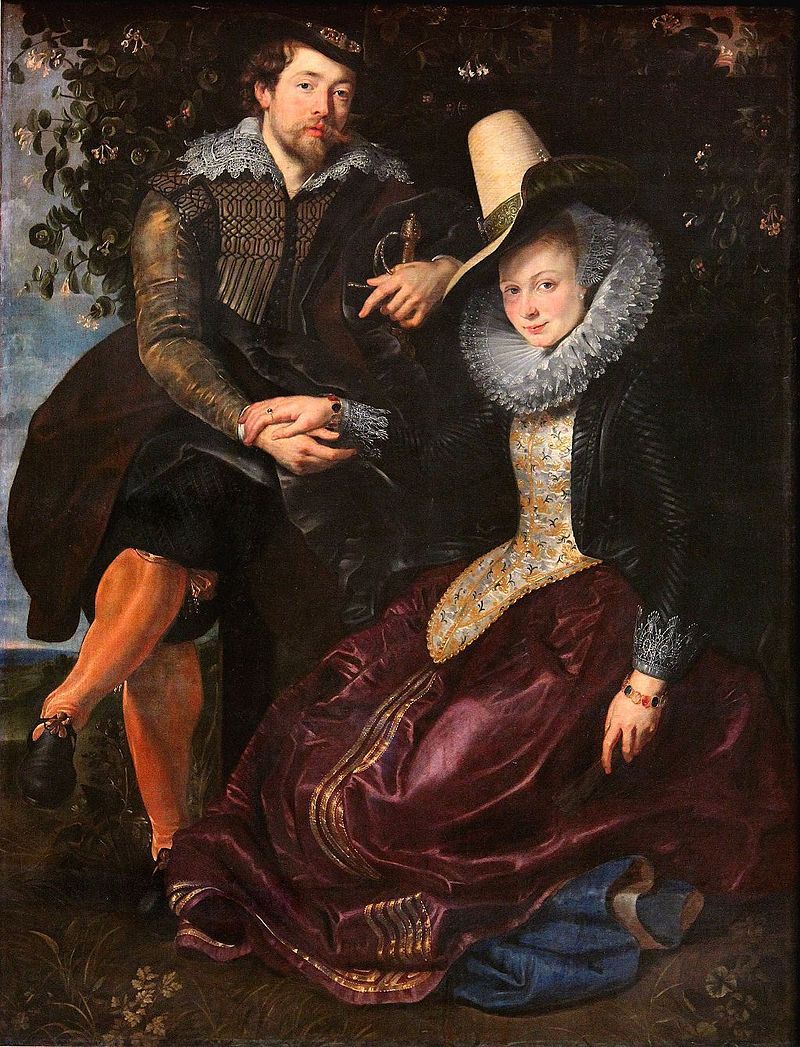
Peter Paul Rubens’s “The Honeysuckle Bower” (1609) is among the most tender double portraits of the seventeenth century. Painted soon after the artist’s return to Antwerp from Italy and shortly after his marriage to Isabella Brant, it presents the newlyweds seated together beneath an arbor of blossoming honeysuckle. The scene is intimate without being private, public without being pompous. In it Rubens invents a new kind of self-portrait: not the solitary genius in his studio, and not the courtier alone in silk and lace, but the artist as husband, joined to his wife by a garden, a gesture, and a network of symbols that announce concord and lifelong fidelity. The picture’s seduction arises from its balance of sumptuous detail—embroidered satin, crystalline lace, glimmering jewelry—with a soft, leafy setting in which flowers, light, and shadow seem to breathe around the couple. It is at once a love picture and a statement of social identity, a manifesto for the young painter’s future as a gentleman, a court artist, and a man whose life would be tethered to affection as much as ambition.
The Historical Moment and a Marriage Announced
The year 1609 marks the beginning of the Twelve Years’ Truce and a brief restoration of peace and prosperity in the Southern Netherlands. Rubens returned from an Italian sojourn rich with lessons from Titian, Veronese, and the antiquities of Rome, and at once established himself as Antwerp’s prodigal master. In that same year he married Isabella Brant, daughter of a respected humanist magistrate. “The Honeysuckle Bower” commemorates this union. Far from being a straightforward likeness, it is a carefully staged declaration that folds together private happiness and public aspiration. Rubens presents himself not in workman’s dress but as a man of polite society—a sword at his side, a plume on his small cap, a hand adorned with rings—seated with a wife whose intelligence and grace equal his own. The painting situates marriage at the center of civic and artistic life at the moment a battered city was eager for images of stability and hope.
Iconography of the Garden and the Language of Love
The honeysuckle that crowns the arbor is not botanical filler. In early modern emblem books the plant signifies constancy, fidelity, and the sweetness of mutual love. It grows as a binding vine, and its perfume was thought to linger the longest at dusk, a poetic cue that the fragrance of love endures. By placing the couple beneath this living canopy, Rubens transforms a fashionable garden into a moral emblem. The clasping of right hands—dextrarum iunctio—was the classical sign of matrimonial oath. Their joined hands, placed prominently at the center of the composition, translate that oath into flesh. Additional emblems amplify the message: the sword hilt near Rubens’s waist proclaims honor and the status of gentleman; the gloves, lightly held and never worn, are tokens of courtesy and refined behavior; Isabella’s rings, bracelet, and fan are not merely ornaments but signs of a lawful, well-endowed union. Even the bench and the cushioned seat suggest settled comfort rather than fleeting dalliance. The entire image is an allegory in plain sight: love under the sign of honeysuckle, sealed by hands, dignified by civility.
Composition, Gesture, and the Dialogue of Poses
Compositionally, Rubens engineers a duet. The pair form a gentle pyramid whose apex is the invisible point above their heads where vine and leaf meet, and whose base spreads outward along the lines of their dark garments and the sweep of Isabella’s claret-colored skirt. Rubens sits slightly higher, his left leg crossed over his right, shoulder turned protectively toward Isabella. She kneels or sits low on a blue cushion, her torso angled toward him while her head tilts to address the viewer with a poised, confidential smile. The central knot is the pair of hands: Rubens’s right hand loops lightly beneath her left, while her right touches his with a soft, assured pressure. Nothing in the pose is stiff. Elbows bend, the wrist droops, fingers interlace and then relax. The gestural conversation says as much as their faces do: he offers steadiness and public declaration; she supplies wit, warmth, and agency. Their bodies are linked like clauses in a single sentence.
Light, Shadow, and the Enclosed World of the Bower
Light filters through the bower as if through a scrim of leaves. It strikes the ruffs and cuffs first, igniting their frosted lace with a glitter that rivals the glint on sword and gems. It then warms the flesh of faces and hands before running in broad, buttery strokes across the satin of Isabella’s skirt. The background remains a tender dusk of greens and browns, a private atmosphere where speech feels hushed. Rubens’s light does not proclaim miracle; it caresses matter. The effect is to enclose the pair in a cocoon of air that feels fragrant and cool. Outside the arbor the world is unsettled—wars have only just paused—but inside it the couple inhabit a climate conditioned by affection and protected by foliage that seems to shelter as much as it decorates.
Clothing as Character and Social Horizon
Costume carries a large share of meaning. Rubens wears a dark, gleaming doublet with patterned bodice, leather sleeves, and a cloak that sweeps in soft folds over the bench. The small hat with its feather sits informally, both courtly and a hint mischievous. His hose are warm orange; the black shoes are tied with fashionable rosettes. Isabella’s dress orchestrates a virtuoso passage of textures: the crystalline “cartwheel” ruff; black satin bodice with fine slashing; a delicate stomacher embroidered with sprigs; and the great skirt of mulberry satin trimmed with gold braid that swells like a tide toward the picture plane. On her head perches an elegant high-crowned straw hat lined with green, tilted at an angle that dramatizes the light on her face. Such riches are not simply ostentation. In Antwerp a thriving textile industry and the culture of polite commerce made splendid clothes a language of civic pride. Rubens uses that language to proclaim that the painter is not merely a craftsman hired by nobles; he has become, by talent and marriage, a gentleman among them.
The Faces and the Psychology of Concord
Rubens paints himself with an open, direct gaze, cheeks touched by the soft flush of youth, beard and mustache trimmed but not overly combed. He looks outward with a calm that absorbs the viewer without asking for flattery. Isabella’s face is the poem within the painting. Light rests on her forehead, turns on the delicate bridge of her nose, and comes to rest upon a composed smile whose reserve never hardens into stiffness. Her eyes do not plead or preen; they invite. Many double portraits of the period organize the psychology of marriage by making the woman’s gaze deferential and the man’s gaze proprietary. Rubens refuses that hierarchy. The glances interweave: his hand presents hers; her eyes meet ours as if to say that what we behold is a partnership founded in agreement. The psychology of concord is written in these small exchanges of look and touch.
The Brush and the Pleasures of Surface
Rubens’s technique here is sensuous but controlled. Lace is summoned with calligraphic strokes and tiny touches of impasto that catch actual light. Satin is built with sweeping, unctuous passages of paint that change color with the turn of a fold. The honeysuckle leaves are quickly notated—dark grounds punched with lighter greens—so that the foliage hums without demanding attention. Skin is constructed through warm, translucent glazes; across knuckles and cheekbones thin, cool half tones settle like breath. Rubens orchestrates these varied touches so that every material announces itself: crispness for lace, depth for velvet, snap for satin, a living warmth for flesh. The surface pleasures invite prolonged looking and, by extension, prolonged contemplation of the married life the surface represents. The painting is not merely a document of an occasion; it is a dwelling the viewer can inhabit with the eye.
The Garden Portrait and a Northern Tradition Renewed
Northern European art had long cultivated the “locus amoenus,” the pleasant place where couples and saints alike meet among trees and flowers. From late medieval garden Madonnas to Bruegel’s peasant weddings, the outdoor setting often signifies moral order or pastoral joy. “The Honeysuckle Bower” renews that lineage with Italian lessons in color and form. The idyllic garden is not a backdrop stuck on to sweeten a portrait; it is a participant in the drama of marriage. The leaves curve to arch over the couple; branches echo the arabesques of lace; the patterned stomacher and patterned foliage reply to each other as if dress and garden were woven on the same loom. Rubens thus proposes that nature and culture collaborate to frame love. The garden is both literal and allegorical: a shelter planted by families and a symbol of the well-kept life.
The Artist’s Self-Fashioning and the Ethics of Gentility
This double portrait is also a strategic act of self-fashioning. Rubens, back from Italy and on the edge of a brilliant career, presents himself already in possession of the social virtues associated with the courtier—ease, polish, measure. The sword suggests that the body that paints is also trained in the exercises of nobility; the glove implies the gift of the hand not only to art but to public ceremony; the rings signal patrimony and success. Yet there is nothing of the poseur here. A quiet humor rides in the relaxed leg, the friendly tilt of his cap, and the frankness of his gaze. Gentility is recast not as haughtiness but as an ethics of measure and respect. The artist’s status does not float above marital love; it grows from it.
Color Harmony and the Poise of Warmth and Cool
The color architecture is a model of equilibrium. Cool blacks and silvery grays of their garments align with the green of the foliage, forming a sober frame. Against this framework Rubens sets controlled warmth: the glowing mulberry of Isabella’s skirt, the creamy note of her stomacher, the amber stockings of the artist, and the flesh tones that carry a subtle Venetian pink. Small reds sparkle in jewels and lips; a green ribbon under the brim of the straw hat rhymes with leaves; gold braids echo the sword’s metal. The palette breathes like a chord: it has depth, brightness, and a sustained middle tone that feels civilized. The color world is not flashy; it is cultivated, aligned with the values the portrait celebrates.
Intimacy Made Public and the Viewer’s Place
The painting invites the viewer to stand at conversational distance, as if arriving at the edge of the arbor during a garden promenade. The couple acknowledges our presence but does not perform for us. We are witnesses to a vow more than spectators to a spectacle. This creates an unusual modernity: love is not confined to an interior or to private symbolism; it is lived outdoors, in shared civic air. The space allows the viewer to imagine stepping closer, to see how lace is stitched and how fingers rest in rings, yet the decorum of the scene keeps one from intruding. The balance of intimacy and publicity mirrors the balance of marriage itself in a city culture where unions were both family pacts and personal ties.
Echoes, Influences, and Anticipations
In Italy Rubens learned from Titian how paint can simulate flesh and how portraits can exhale the atmosphere of privilege without losing tenderness. He also studied antique reliefs that choreograph joined hands as emblems of concord. “The Honeysuckle Bower” translates those lessons into Flemish terms—crisper textures, closer observation of fabric, a fresher green world. The picture also looks forward. Van Dyck would later refine the language of aristocratic portraiture across Europe, but the template of easy grandeur married to psychological delicacy is here already. The union of artist and spouse becomes the model for many later images of couples who stage their affection among trees and terraces.
Time, Memory, and the Quiet Melancholy of Happiness
Despite its joy, the painting carries a quiet undertow of time. The honeysuckle blossoms, but blossoms wither; satin shines, but fashions change; vows endure precisely because time will test them. Rubens, who would later suffer grievous losses, paints happiness with the knowledge that it is precious. The softness of the bower’s dusk, the way shadows touch the edges of the couple’s garments, the tenderness with which the hands are painted—all communicate a gratitude that is not naïve. The portrait is a keepsake for the future, a document intended to recall this exact feeling of sheltered abundance when the world grows harsher.
Conclusion
“The Honeysuckle Bower” is more than a celebration of newlyweds or a display of early Baroque finish. It is a compact vision of a life that binds work to love, public identity to private tenderness, and emblem to lived feeling. Beneath the flowering vine, Rubens and Isabella Brant present themselves as partners in a common enterprise of affection and civility. The joined hands fix the vow at the heart of the picture; the garden shelters it; light carves it into memory. The painter’s return to Antwerp, the city’s return to a semblance of peace, and the household’s beginning all meet here in a single, radiant image. Few works match its combination of surface delight and moral clarity. It remains a touchstone for how art can make joy visible without sentimentality and can present love as something at once fragrant, formal, and free.