Image source: wikiart.org
Introduction to The Holy Family with the Little Bird
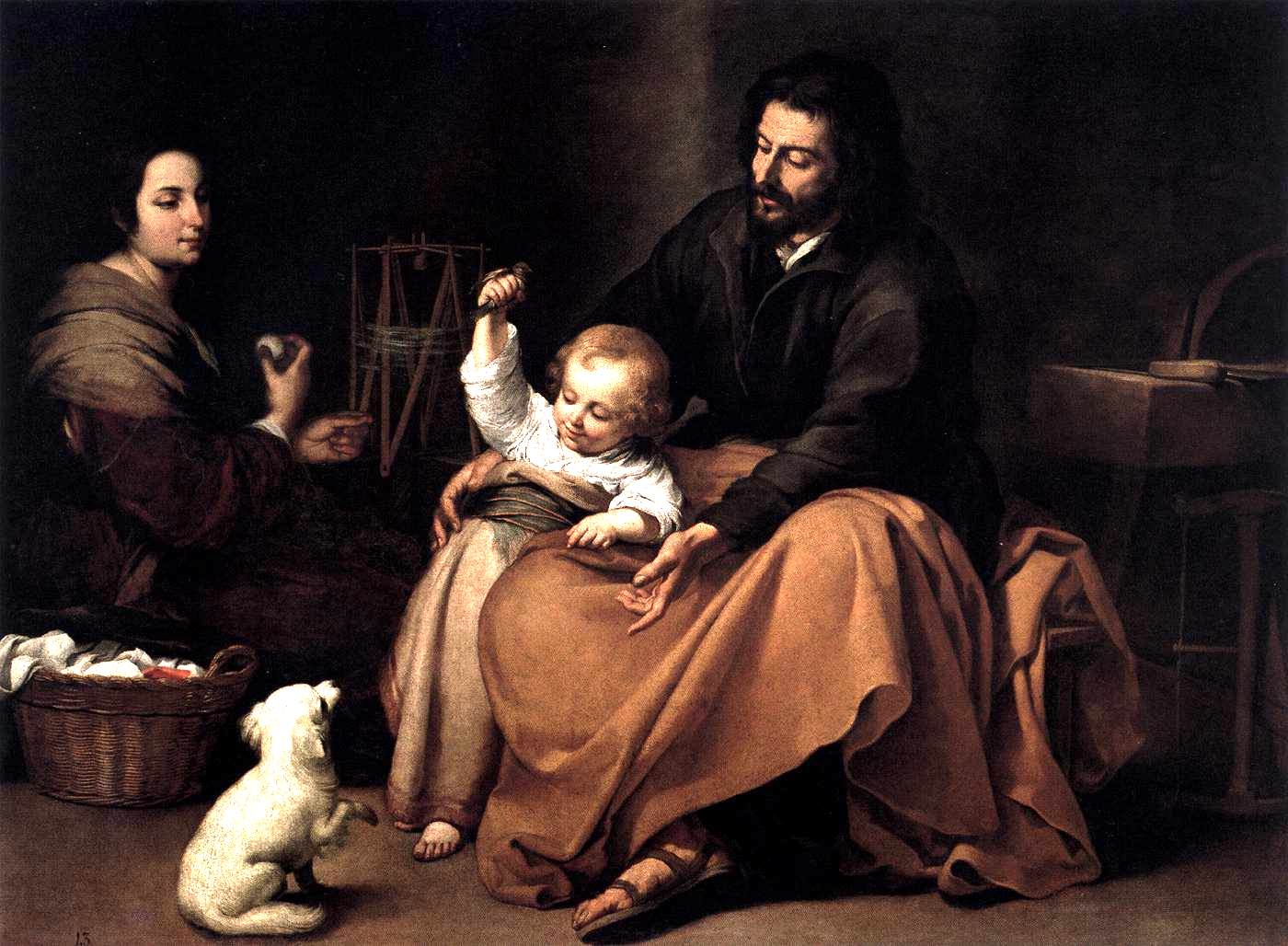
“The Holy Family with the Little Bird,” painted by Bartolome Esteban Murillo around 1650, is one of the most tender domestic scenes in Spanish Baroque art. Instead of a grand throne or a dramatic miracle, Murillo places the Holy Family inside a humble workshop. Joseph sits at the center, the Christ Child on his lap, while Mary works quietly in the background. At their feet a small dog stands on its hind legs, alert and eager, watching the child tease it with a tiny bird.
This painting turns the sacred story of the Holy Family into a moment of everyday intimacy. Murillo presents Jesus not as a distant icon, but as a lively toddler who plays, laughs and tugs at his father’s hands. The scene is filled with gentle gestures and domestic details that would have resonated with seventeenth century viewers in Seville and still feel movingly familiar today.
Murillo and the Domestic Holy Family
Murillo became famous for his images of the Virgin, the Christ Child and scenes from the life of Jesus that emphasize warmth and human emotion. In Catholic Spain, art played an important role in nurturing devotion. Painters like Murillo were encouraged to show sacred figures in ways that ordinary people could recognize as close to their own lives.
In “The Holy Family with the Little Bird,” Murillo does exactly that. Joseph is not a distant patriarch. He appears as a hardworking artisan, seated in his workshop with tools and a workbench visible behind him. Mary, calmly spinning thread, looks like a Sevillian housewife who combines work with watchful affection for her family. By portraying the Holy Family in such recognizable terms, Murillo invites viewers to see their own family life as a place where holiness can flourish.
This focus on domestic intimacy was characteristic of Murillo’s style. Many of his religious paintings soften the dramatic intensity typical of Baroque art, replacing it with a gentle luminosity and a sense of quiet narrative. The Holy Family becomes a model not only of piety but of everyday love.
Composition and the Triangle of Affection
The composition of the painting is carefully constructed to highlight the relationships between the three main figures. Joseph occupies the right side of the canvas, seated on a low bench. His brown cloak and ocher robe form a large mass of warm color that anchors the scene. On his knees sits the Christ Child, turned slightly toward the viewer yet still nestled in his father’s arms. To the left, Mary sits slightly in shadow, forming the third point of a triangle that frames the child at its center.
This triangular arrangement is a classic device in Renaissance and Baroque art, used to suggest stability and harmony. Here it creates a sense of unity between Joseph, Mary and Jesus. Although Mary is physically further from the child than Joseph, her gaze and her relaxed posture show that she is fully present in the moment. Her hand, which holds a ball of thread, extends subtly toward the center, visually joining her to her husband and son.
The lower part of the scene is enlivened by the dog and the basket of linen. These elements, while secondary, echo the triangular composition. The dog, placed near Mary’s feet and turned toward the child, reinforces the sense that all eyes are drawn to Jesus. The basket on the left balances the workbench on the right, framing the family within their modest home.
Light and Atmosphere
Murillo uses light to guide the viewer’s attention and to create a warm, contemplative mood. The background is mostly dark, with only enough detail to suggest the corner of a workshop. Against this dark backdrop, the figures emerge in soft illumination. The brightest areas are the Christ Child’s face and white shirt, Joseph’s hands, and the glossy fur of the small dog.
This play of light and shadow, characteristic of Baroque painting, has both aesthetic and symbolic meaning. The child, bathed in light, is literally and metaphorically the center of the scene. Joseph’s face is also well lit, showing his contemplative expression as he watches his son. Mary remains in gentler half shadow, which adds to the intimate atmosphere and hints at her quiet, interior contemplation.
The overall tone is warm rather than harsh. Instead of strong contrasts, Murillo favors gentle transitions between light and dark. This creates a sense of calm, as though time has slowed so that viewers can savor this single moment in the Holy Family’s day.
The Christ Child at Play
At the heart of the painting is the delightful figure of the Christ Child. Unlike the solemn infant in many earlier religious works, Murillo’s Jesus behaves exactly like a lively toddler. He sits sideways on Joseph’s lap, one bare foot hanging down, the other tucked against his father’s robe. His chubby hands grasp a small bird tied to a string. With his arm raised in excitement, he teases the little dog in front of him, whose attention is totally captured by the fluttering creature.
The child’s expression is joyful and absorbed. He looks down at the bird with a smile, oblivious to the symbolic weight that later viewers might attach to the scene. This natural behavior emphasizes his true humanity. Murillo invites us to imagine Jesus not only as Savior but as a child who experienced the ordinary pleasures and games of childhood.
At the same time, the little bird carries symbolic meaning. In Christian art, the goldfinch and similar small birds often allude to the Passion of Christ, because they were thought to eat thistles and thorns. Here, the bird held playfully by the child hints at his future suffering. The game with the dog foreshadows the drama of salvation history, yet Murillo presents it so gently that the painting remains joyful rather than tragic.
Joseph as Tender Father
One of the most striking aspects of “The Holy Family with the Little Bird” is Murillo’s portrayal of Joseph. In earlier centuries Joseph was often depicted as an elderly, somewhat marginal figure. By Murillo’s time, there was a renewed interest in presenting him as an active, loving father.
Murillo shows Joseph as a relatively young man with dark hair and beard, dressed in simple but sturdy clothes. He sits in a relaxed pose, his body forming a protective cradle around the child. One arm encircles Jesus’s waist, ensuring that the energetic toddler does not slip from his lap. The other hand opens gently toward the dog, as if to moderate the child’s play or to invite the animal closer.
His face expresses a calm, reflective affection. He watches his son with a slight smile and a softness in his eyes that conveys both pride and humility. This Joseph is not merely a guardian but a true father whose work, rest and leisure revolve around the child entrusted to him. In a culture where paternal tenderness was often idealized but not always visible, such an image would have been both edifying and emotionally compelling.
Mary at Work and at Peace
To the left, Mary provides a quieter but essential presence. She sits near a basket overflowing with linen and a spinning device in the background. She holds a ball of thread in her left hand while her right seems poised to continue her work. The inclusion of textile tools emphasizes Mary’s role as industrious mother, caring for the household through her labor.
Murillo dresses her in warm earth tones with a mantle that recalls traditional colors of the Virgin while blending with the palette of the room. Her head is turned toward the child and Joseph, and a subtle smile touches her lips. Although she works, her mind and heart are clearly focused on her family.
Her placement in partial shadow suggests interiority, a contemplative dimension that complements Joseph’s more visible interaction with the child. In many of Murillo’s Marian images, Mary embodies gentle spiritual depth, and here that same quality is present within the domestic setting. She meditates silently on the mystery of Christ while participating fully in the simple routine of spinning and childcare.
The Little Dog and Domestic Symbolism
The small white dog at the bottom left is impossible to miss. Sitting on its haunches, front paws slightly raised, it stares intently at the bird in the child’s hand. Its pose is both comic and endearing, capturing the eager attention that pets often give to children’s games.
In seventeenth century symbolism, dogs were associated with loyalty and faithfulness. Here the dog’s focus on the child may represent the devotion that believers owe to Christ. At the same time, the animal simply enriches the painting’s realism. Many households in Seville would have kept small dogs, and viewers would have recognized the familiar behavior of a pet begging for scraps or wanting to join a game.
Other domestic objects contribute to this atmosphere. The woven basket filled with linen or clothing hints at Mary’s daily tasks. The workbench and carpenter’s tools in the background remind us of Joseph’s profession. Together, these elements root the Holy Family firmly in the ordinary world of labor and home life.
Theological Meaning in Everyday Gestures
Despite its domestic charm, “The Holy Family with the Little Bird” communicates profound theological ideas. The central theme is the sanctification of ordinary family life. By showing Jesus growing up in a simple home, surrounded by the work, play and affection of his parents, Murillo illustrates the Christian belief that God entered fully into human experience.
The bird and dog, the tools and textiles, all participate in this sanctification. Nothing is too small or mundane to become a place where divine love is revealed. At the same time, the symbolic weight of the bird hints that this peaceful scene is part of a larger story. The child who plays so innocently will one day take up the burden of suffering and redemption.
The harmonious triangle formed by Jesus, Mary and Joseph also reflects the ideal of Christian family life. Their mutual attentiveness shows a balance of roles. Joseph supports and guides the child, Mary sustains the household and contemplates the mystery, and Jesus, though small, is the center around which their lives revolve.
Murillo’s Style and the Appeal of Tender Realism
This painting exemplifies Murillo’s distinctive combination of realism and gentle idealization. The figures are modeled with convincing physical presence. Fabric folds, skin tones and textures are rendered with care, especially in the large expanse of Joseph’s robe and the gleaming coat of the dog. Yet there is a softness in the contours and a warmth in the colors that go beyond strict naturalism.
Murillo’s brushwork is smooth and controlled, avoiding the rough textures found in some of his contemporaries. His color palette favors warm browns, soft whites and muted reds, creating an atmosphere of comfort and intimacy. This visual warmth mirrors the emotional warmth of the scene.
The appeal of “The Holy Family with the Little Bird” lies in how accessible it feels. Viewers can imagine stepping into this room, hearing the rustle of fabric, the creak of Joseph’s chair, the excited yelp of the dog. At the same time, they are invited to recognize that this ordinary room shelters the most extraordinary child in history.
Lasting Legacy and Devotional Power
Over the centuries, Murillo’s vision of the Holy Family has remained influential. Reproductions of this painting have adorned churches, convents and homes, especially in Spain and Latin America. Its blend of familiar domesticity and spiritual depth makes it an enduring image for meditation.
For parents, it offers a comforting model of family tenderness, where play and prayer coexist. For believers, it is a reminder that God’s presence can be found in the simplest corners of daily life. For art lovers, it showcases Murillo’s mastery of composition, light and narrative.
“The Holy Family with the Little Bird” encapsulates what makes Murillo such an important figure in Baroque art. He had the rare ability to take lofty theological themes and translate them into scenes that feel close, gentle and full of human warmth. In this painting, the sacred story of salvation becomes a quiet evening at home, where a child plays with a bird and a dog while his parents watch with love.