Image source: wikiart.org
Introduction to The Holy Family with the Infant St. John the Baptist
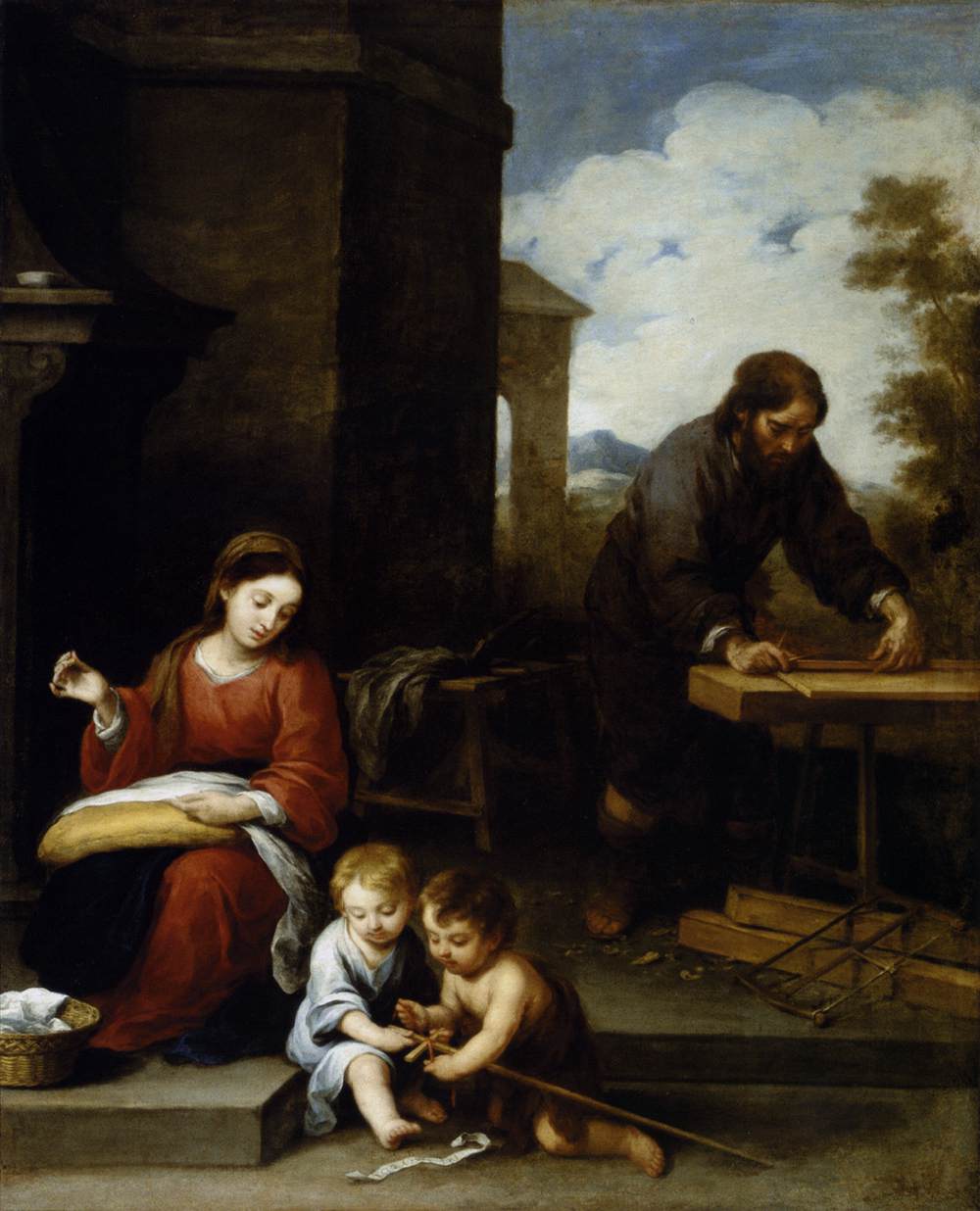
Bartolome Esteban Murillo’s painting The Holy Family with the Infant St. John the Baptist, completed around 1670, is a tender domestic vision of the sacred family life of Jesus, Mary, Joseph and the young John the Baptist. Rather than portraying a solemn religious scene in a distant, idealized setting, Murillo brings the viewer into a warm, intimate courtyard where work, play and prayer quietly intermingle. The canvas captures the moment when two children, Christ and his cousin John, interact in a way that foreshadows their future roles, yet remains grounded in the everyday rhythms of family life.
At first glance the painting reads as a genre scene of a working family in Seville. Only gradually does the viewer recognize the divine identity of the figures and the layers of symbolism hidden in simple gestures and tools. This union of realism and spirituality is characteristic of Murillo’s mature style and explains why his religious images were cherished by both ecclesiastical patrons and ordinary believers. In The Holy Family with the Infant St. John the Baptist, Murillo builds a bridge between sacred history and the familiar world of his contemporaries, inviting viewers to encounter holiness in the midst of daily labor and childhood play.
Composition and Spatial Arrangement
The composition is carefully structured to guide the viewer’s eye from work to contemplation, from the earthly to the divine. The scene unfolds on a shallow terrace in front of a carpenter’s workshop. Mary sits on the left side of the foreground, slightly turned toward the two children who occupy the center. She is placed near the viewer, her seated figure forming a stable triangle with the children at her feet. Joseph stands in the right middle ground at his workbench, his body bent as he planes a plank of wood. Behind him the architecture recedes into shadow, while an open sky with soft clouds opens above, relieving the weight of the dark workshop wall.
The children form the emotional and compositional focus of the painting. Jesus, in a light blue tunic, sits on the step with one leg extended. Opposite him kneels the infant St. John, dressed in a brown garment reminiscent of the camel hair robe he will wear as an adult prophet. The boys are absorbed in their play with cross shaped pieces of wood and a slender reed. Their small gestures and the careful arrangement of their bodies create a circular movement that draws the viewer inward.
Lines of sight reinforce these compositional relationships. Mary’s gentle gaze falls directly on Jesus and John, while Joseph glances downward toward his carpentry but remains connected to the family group through the diagonal of his arms and tools. The structural verticals of the pillar and workshop wall anchor the composition, yet the numerous diagonals of limbs, tools and garments prevent it from becoming static. Murillo thus achieves a dynamic equilibrium between contemplation and activity, stillness and motion.
Light and Atmosphere
Light is central to Murillo’s storytelling. A soft, cool natural light descends from the right and upper portions of the canvas, illuminating the children and Mary while leaving the background in deeper shadow. The effect is not theatrical or harsh but gentle and diffused, as if the family were working in the late afternoon. This interplay of light and shadow highlights the psychological focus of the scene and conveys a sense of calm domestic holiness.
Mary’s face and hands are bathed in a warm glow that separates her from the darker wall behind her. The two children share this luminous zone, their pale skin and light garments catching the light more strongly than the objects around them. Joseph, although in relative shadow, has light falling on his hands and tools. These illuminated areas place emphasis on labor as an expression of love and duty.
The sky in the upper right is filled with soft, bluish clouds that suggest quiet serenity rather than drama. Through the open sky Murillo allows a subtle connection to the divine realm without inserting explicit heavenly visions. The atmosphere throughout the painting is calm and tender, filled with a muted radiance that seems to emanate from the presence of Christ himself.
Color, Fabric and Texture
Murillo’s color palette combines warm earth tones with glowing highlights of red, blue and ocher. Mary wears a deep red dress with a dark blue mantle that drapes over her lap and spills down the steps. These traditional Marian colors connect her to centuries of iconographic tradition, yet Murillo paints the fabrics with a softness that feels entirely human and tactile. Her garments suggest both dignity and simplicity.
The clothing of the children is lighter and more delicate. Jesus’s blue tunic and bare legs catch the light, making him visually prominent against the darker stone step. John’s small brown garment merges with the warm earth tones around him, hinting at his future life in the wilderness. Joseph’s darker brown clothing and work apron emphasize his role as a laborer and help him recede into the background, reinforcing the idea that his service is quiet and humble.
Texture is handled with remarkable sensitivity. The rough wood of Joseph’s bench, the smooth surface of the planks, the woven basket at Mary’s feet and the stone steps beneath the children are rendered with a realism that grounds the sacred figures in a tangible world. Murillo’s brushwork varies from soft blending in the faces and fabrics to slightly more visible strokes in the background architecture and sky, creating an appealing balance between clarity and painterly richness.
Iconography and Symbolism
Although the painting appears at first to be a simple domestic tableau, it is filled with symbols that reveal Murillo’s theological intention. The tools of Joseph’s trade scattered across the foreground, including squared planks and a wooden frame, quietly allude to the cross on which Jesus will die. The children’s play with rods and strips of paper foreshadows the instruments of the Passion and Christ’s future role as redeemer.
The young John the Baptist is recognizable by his rustic garment and the reed he holds, both traditional attributes of his adult iconography. As he interacts with Jesus, their play becomes a prophetic sign of John’s mission to point toward Christ as the Lamb of God. Even the faint inscription on the strip of paper may allude to John’s proclamation or the words that will later be inscribed on the cross.
Mary’s presence symbolizes contemplation and acceptance of God’s will. She holds a piece of sewing on her lap, perhaps a garment she is making for her child. Her domestic task is not separate from prayer. Instead, Murillo suggests that her quiet work is itself a form of devotion. Her posture and slightly bowed head express meditative watchfulness as she observes the boys, aware that their innocent game contains a deeper meaning.
Joseph’s role as carpenter is central to the symbolism. His labor provides for the family and is therefore sanctified. In the context of Counter Reformation spirituality, Joseph was often presented as a model of humble obedience and industriousness. Murillo’s depiction of Joseph emphasizes these virtues while also hinting at the material reality of Christ’s future crucifixion through the wood he works.
Human Emotion and Spiritual Meaning
One of the most striking aspects of The Holy Family with the Infant St. John the Baptist is the way Murillo fuses genuine human feeling with spiritual depth. Mary’s expression is tender yet tinged with seriousness, as if she senses the destiny awaiting her son. There is no dramatic grief or overt ecstasy. Instead, the mood is contemplative and inward. Her love for Jesus and concern for his future coexist in her quiet gaze.
The children radiate warmth and spontaneity. Their interaction is believable as natural play between two small boys, yet their focused interest in the objects before them and their closeness to Mary’s feet suggest trust and security. Murillo captures the psychological reality of children at play, preoccupied with their own world even as they remain supported by adult figures.
Joseph’s concentration on his carpentry adds another emotional layer. His slightly furrowed brow and downward gaze imply responsibility and care. He is not detached from the family but supports them through his work. The overall emotional tone is one of affectionate intimacy, in which each family member fulfills a distinct role within a harmonious whole.
At a spiritual level, the painting expresses the idea that holiness can reside in ordinary tasks and relationships. Childlike play, domestic chores and manual labor become avenues for the unfolding of divine salvation. Murillo offers viewers a vision of sanctity embedded in the everyday, encouraging them to see their own lives as potential spaces of grace.
Murillo’s Style and the Spanish Baroque Context
Murillo was a leading painter in seventeenth century Seville, a city marked by both intense religiosity and widespread poverty. His work reflects the emotional fervor of the Spanish Baroque but tempers its drama with sweetness and compassion. In contrast to the stark tenebrism and harsh realism of some of his contemporaries, Murillo favored soft light, warm color harmonies and an emphasis on tender emotion.
In The Holy Family with the Infant St. John the Baptist, these characteristics are clearly visible. The transitions between light and shadow are gentle rather than abrupt. Figures are idealized to a degree, with smooth faces and calm expressions, yet they retain enough realism to remain believable. Murillo’s training in Seville and his exposure to Italian and Flemish art contribute to this balanced style, which merges naturalism with graceful design.
The subject of the Holy Family was especially popular in Spain during this period, as religious reformers sought to promote models of family virtue and devotion. Murillo’s interpretation fits within this framework while adding his distinctive tenderness. The painting would have served both a didactic and devotional purpose, inviting viewers to meditate on the virtues of Mary, Joseph and Christ while also seeing them as a loving, approachable family.
The Holy Family as Everyday Devotion
The setting of the painting is neither sumptuous nor explicitly biblical. Instead, it resembles a simple Sevillian courtyard with plain architecture and a distant landscape. This choice reflects Murillo’s commitment to making sacred stories accessible to the everyday faithful. By presenting the Holy Family in surroundings that resembled those of his viewers, he encouraged them to identify with the scene and bring its virtues into their own homes.
Mary’s sewing and Joseph’s carpentry emphasize the dignity of work. The children’s play emphasizes innocence and the importance of gentle guidance. Together, these elements form a visual meditation on family life as a path to holiness. For seventeenth century viewers, particularly those in religious communities or households seeking moral instruction, such an image would have been both comforting and challenging.
The painting can also be understood as a reflection on the education of children. Jesus and John are depicted learning through play and through the quiet supervision of adults. Their interaction with symbolic objects demonstrates how children absorb deeper truths gradually, through daily experiences rather than formal instruction alone. Murillo suggests that spiritual formation happens in the midst of life’s ordinary routines.
Legacy and Contemporary Appreciation
Over time, The Holy Family with the Infant St. John the Baptist has become one of Murillo’s quintessential images of gentle devotion. Modern viewers continue to be drawn to its combination of domestic realism and spiritual resonance. The painting exemplifies the compassionate, accessible side of the Baroque, a style often associated with dramatic contrasts and intense emotion.
Today the work can be appreciated on multiple levels. Art historians value it for its masterful handling of light, color and composition. Students of theology see in it a visual representation of incarnational spirituality, in which the divine enters into everyday human experience. Families and individual viewers often respond to the warmth and tenderness of the relationships portrayed.
The painting also offers an important counterpoint to more heroic or triumphal religious images. Instead of emphasizing miraculous feats or grand revelations, Murillo focuses on the hidden years of Christ’s childhood, when the greatest miracles were love, work and patient waiting. In this sense, The Holy Family with the Infant St. John the Baptist remains a powerful invitation to find meaning in the quiet, repetitive tasks that make up much of human life.
Conclusion
Bartolome Esteban Murillo’s The Holy Family with the Infant St. John the Baptist is a richly layered work that speaks to the heart as much as to the intellect. Through a carefully balanced composition, gentle light and thoughtfully chosen colors, Murillo presents a scene where divine destiny and everyday life meet. The children’s play with symbolic objects, Mary’s meditative sewing and Joseph’s concentrated labor all contribute to a narrative of love, responsibility and spiritual purpose.
The painting reflects the values of seventeenth century Spanish Catholicism while transcending its historical moment through its universal portrayal of family love and childhood innocence. It invites viewers to contemplate not only the future sacrifice of Christ and the prophetic mission of John but also the sanctity of ordinary domestic routines. In this intimate and luminous vision, Murillo demonstrates his unique ability to translate complex theological ideas into images of simple human tenderness.